

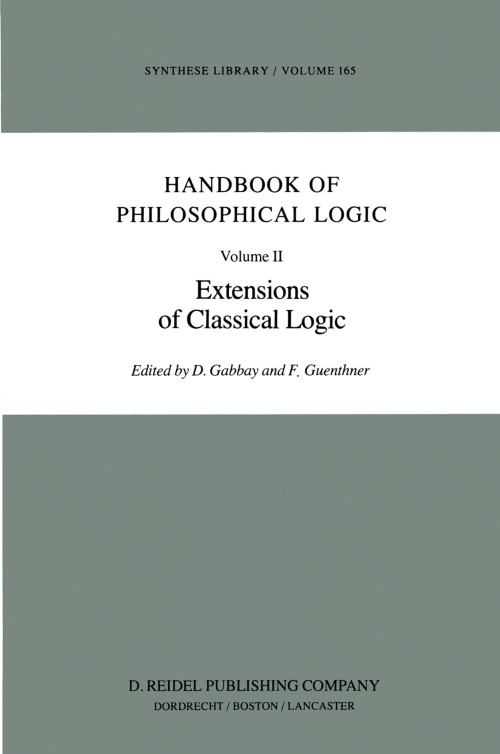
Handbook of Philosophical Logic [electronic resource] : Volume II: Extensions of Classical Logic / edited by Dov M. Gabbay, Franz Guenthner.
Erişim Adresi
ISBN
9789400962590
Dil Kodu
İngilizce
Yer Numarası
DK/7010
Basım Bildirimi
1st ed. 1984.
Yayın Bilgisi
Dordrecht : Springer Netherlands : Imprint: Springer, 1984.
Fiziksel Niteleme
788 p. online resource.
Dizi
Synthese Library, Studies in Epistemology, Logic, Methodology, and Philosophy of Science, 2542-8292 ; 165
İçindekiler Notu
to Volume II -- II.1. Basic Modal Logic -- II.2.Basic Tense Logic -- II.3. Combinations of Tense and Modality -- II.4. Correspondence Theory -- II.5. Quantification in Modal Logic -- II.6. Philosophical Perspectives on Quantification in Tense and Modal Logic -- II.7. C. General Intensional Logic -- II.8.Conditional Logic -- II.9.Modal Logic and Self-reference -- II.10. Dynamic Logic -- II.11. Deontic Logic -- II.12. The Logic of Questions -- Name Index.
Özet, vb.
The chapters in the present volume go beyond 'classical' extensional logic with respect to one important factor: they all include among the semantic constituents representations of so-called 'possible worlds'. The inclusion of such 'indices' has turned out to be the semantic mainstay in dealing with a number of issues having to do with intensional features of natural and artificial languages. It is, of course, an open question whether 'possible world' semantics is in the final analysis the proper solution to the many problems and puzzles intensional constructions raise for the logical analysis of the many varieties of discourse. At present, there seem to be about as many opponents as proponents with regard to the usefulness of having the semantics of intensional languages based on possible world constructs. Some attempts to come to grips with intensional phenomena which are not couched in the possible world framework are discussed in Volume IV of the Handbook. Chapter 1 is an extensive survey of the main systems of (propositional) modal logic including the most important meta-mathematical results and the techniques used in establishing these. It introduces the basic terminology and semantic machinery applied in one way or another in many of the subsequent chapters. Chapter 2 discusses the most significant developments in (propositional) tense logic which can of course be regarded as a special kind of modal logic, where the possible world indices are simply (ordered) moments of time.
Konu
Logic.
Mathematical logic.
Logic.
Mathematical Logic and Foundations.
Mathematical logic.
Logic.
Mathematical Logic and Foundations.
Diğer Yazarlar
Kurum Adı
Eseri Alıntıla
Referansları kullanmadan önce gözden geçirmeniz ve varsa gerekli düzeltmeleri yapmanız önerilir.
Dijital Kaynak
MARC Görünümü
LEADER 04718nam a22005655i 4500
001 805695
003 TR_AnAIT
005 20260127000628
007 cr nn 008mamaa
008 121227s1984 ne | s |||| 0|eng d
020 |a9789400962590|9978-94-009-6259-0
024 7 |a10.1007/978-94-009-6259-0|2doi
041 |aeng
049 |aTürk Tarih Kurumu Kütüphanesi
050 4|aBC1-199
072 7|aHPL|2bicssc
072 7|aPHI011000|2bisacsh
072 7|aQDTL|2thema
082 04|a160|223
090 |aDK/7010
245 10|aHandbook of Philosophical Logic|h[electronic resource] :|bVolume II: Extensions of Classical Logic /|cedited by Dov M. Gabbay, Franz Guenthner.
250 |a1st ed. 1984.
264 1|aDordrecht :|bSpringer Netherlands :|bImprint: Springer,|c1984.
300 |a788 p.|bonline resource.
336 |atext|btxt|2rdacontent
337 |acomputer|bc|2rdamedia
338 |aonline resource|bcr|2rdacarrier
347 |atext file|bPDF|2rda
490 1 |aSynthese Library, Studies in Epistemology, Logic, Methodology, and Philosophy of Science,|x2542-8292 ;|v165
505 0 |ato Volume II -- II.1. Basic Modal Logic -- II.2.Basic Tense Logic -- II.3. Combinations of Tense and Modality -- II.4. Correspondence Theory -- II.5. Quantification in Modal Logic -- II.6. Philosophical Perspectives on Quantification in Tense and Modal Logic -- II.7. C. General Intensional Logic -- II.8.Conditional Logic -- II.9.Modal Logic and Self-reference -- II.10. Dynamic Logic -- II.11. Deontic Logic -- II.12. The Logic of Questions -- Name Index.
520 |aThe chapters in the present volume go beyond 'classical' extensional logic with respect to one important factor: they all include among the semantic constituents representations of so-called 'possible worlds'. The inclusion of such 'indices' has turned out to be the semantic mainstay in dealing with a number of issues having to do with intensional features of natural and artificial languages. It is, of course, an open question whether 'possible world' semantics is in the final analysis the proper solution to the many problems and puzzles intensional constructions raise for the logical analysis of the many varieties of discourse. At present, there seem to be about as many opponents as proponents with regard to the usefulness of having the semantics of intensional languages based on possible world constructs. Some attempts to come to grips with intensional phenomena which are not couched in the possible world framework are discussed in Volume IV of the Handbook. Chapter 1 is an extensive survey of the main systems of (propositional) modal logic including the most important meta-mathematical results and the techniques used in establishing these. It introduces the basic terminology and semantic machinery applied in one way or another in many of the subsequent chapters. Chapter 2 discusses the most significant developments in (propositional) tense logic which can of course be regarded as a special kind of modal logic, where the possible world indices are simply (ordered) moments of time.
532 8 |aAccessibility summary: This PDF is not accessible. It is based on scanned pages and does not support features such as screen reader compatibility or described non-text content (images, graphs etc). However, it likely supports searchable and selectable text based on OCR (Optical Character Recognition). Users with accessibility needs may not be able to use this content effectively. Please contact us at accessibilitysupport@springernature.com if you require assistance or an alternative format.
532 8 |aInaccessible, or known limited accessibility
532 8 |aNo reading system accessibility options actively disabled
532 8 |aPublisher contact for further accessibility information: accessibilitysupport@springernature.com
650 0|aLogic.
650 0|aMathematical logic.
650 14|aLogic.
650 24|aMathematical Logic and Foundations.
700 1 |aGabbay, Dov M.|eeditor.|4edt|4http://id.loc.gov/vocabulary/relators/edt
700 1 |aGuenthner, Franz.|eeditor.|4edt|4http://id.loc.gov/vocabulary/relators/edt
710 2 |aSpringerLink (Online service)
773 0 |tSpringer Nature eBook
776 08|iPrinted edition:|z9789027716040
776 08|iPrinted edition:|z9789400962606
776 08|iPrinted edition:|z9789400962613
830 0|aSynthese Library, Studies in Epistemology, Logic, Methodology, and Philosophy of Science,|x2542-8292 ;|v165
856 40|uhttps://doi.org/10.1007/978-94-009-6259-0
912 |aZDB-2-SHU
912 |aZDB-2-SXPR
912 |aZDB-2-BAE
950 |aHumanities, Social Sciences and Law (SpringerNature-11648)
950 |aPhilosophy and Religion (R0) (SpringerNature-43725)
001 805695
003 TR_AnAIT
005 20260127000628
007 cr nn 008mamaa
008 121227s1984 ne | s |||| 0|eng d
020 |a9789400962590|9978-94-009-6259-0
024 7 |a10.1007/978-94-009-6259-0|2doi
041 |aeng
049 |aTürk Tarih Kurumu Kütüphanesi
050 4|aBC1-199
072 7|aHPL|2bicssc
072 7|aPHI011000|2bisacsh
072 7|aQDTL|2thema
082 04|a160|223
090 |aDK/7010
245 10|aHandbook of Philosophical Logic|h[electronic resource] :|bVolume II: Extensions of Classical Logic /|cedited by Dov M. Gabbay, Franz Guenthner.
250 |a1st ed. 1984.
264 1|aDordrecht :|bSpringer Netherlands :|bImprint: Springer,|c1984.
300 |a788 p.|bonline resource.
336 |atext|btxt|2rdacontent
337 |acomputer|bc|2rdamedia
338 |aonline resource|bcr|2rdacarrier
347 |atext file|bPDF|2rda
490 1 |aSynthese Library, Studies in Epistemology, Logic, Methodology, and Philosophy of Science,|x2542-8292 ;|v165
505 0 |ato Volume II -- II.1. Basic Modal Logic -- II.2.Basic Tense Logic -- II.3. Combinations of Tense and Modality -- II.4. Correspondence Theory -- II.5. Quantification in Modal Logic -- II.6. Philosophical Perspectives on Quantification in Tense and Modal Logic -- II.7. C. General Intensional Logic -- II.8.Conditional Logic -- II.9.Modal Logic and Self-reference -- II.10. Dynamic Logic -- II.11. Deontic Logic -- II.12. The Logic of Questions -- Name Index.
520 |aThe chapters in the present volume go beyond 'classical' extensional logic with respect to one important factor: they all include among the semantic constituents representations of so-called 'possible worlds'. The inclusion of such 'indices' has turned out to be the semantic mainstay in dealing with a number of issues having to do with intensional features of natural and artificial languages. It is, of course, an open question whether 'possible world' semantics is in the final analysis the proper solution to the many problems and puzzles intensional constructions raise for the logical analysis of the many varieties of discourse. At present, there seem to be about as many opponents as proponents with regard to the usefulness of having the semantics of intensional languages based on possible world constructs. Some attempts to come to grips with intensional phenomena which are not couched in the possible world framework are discussed in Volume IV of the Handbook. Chapter 1 is an extensive survey of the main systems of (propositional) modal logic including the most important meta-mathematical results and the techniques used in establishing these. It introduces the basic terminology and semantic machinery applied in one way or another in many of the subsequent chapters. Chapter 2 discusses the most significant developments in (propositional) tense logic which can of course be regarded as a special kind of modal logic, where the possible world indices are simply (ordered) moments of time.
532 8 |aAccessibility summary: This PDF is not accessible. It is based on scanned pages and does not support features such as screen reader compatibility or described non-text content (images, graphs etc). However, it likely supports searchable and selectable text based on OCR (Optical Character Recognition). Users with accessibility needs may not be able to use this content effectively. Please contact us at accessibilitysupport@springernature.com if you require assistance or an alternative format.
532 8 |aInaccessible, or known limited accessibility
532 8 |aNo reading system accessibility options actively disabled
532 8 |aPublisher contact for further accessibility information: accessibilitysupport@springernature.com
650 0|aLogic.
650 0|aMathematical logic.
650 14|aLogic.
650 24|aMathematical Logic and Foundations.
700 1 |aGabbay, Dov M.|eeditor.|4edt|4http://id.loc.gov/vocabulary/relators/edt
700 1 |aGuenthner, Franz.|eeditor.|4edt|4http://id.loc.gov/vocabulary/relators/edt
710 2 |aSpringerLink (Online service)
773 0 |tSpringer Nature eBook
776 08|iPrinted edition:|z9789027716040
776 08|iPrinted edition:|z9789400962606
776 08|iPrinted edition:|z9789400962613
830 0|aSynthese Library, Studies in Epistemology, Logic, Methodology, and Philosophy of Science,|x2542-8292 ;|v165
856 40|uhttps://doi.org/10.1007/978-94-009-6259-0
912 |aZDB-2-SHU
912 |aZDB-2-SXPR
912 |aZDB-2-BAE
950 |aHumanities, Social Sciences and Law (SpringerNature-11648)
950 |aPhilosophy and Religion (R0) (SpringerNature-43725)
Materyaller
Depodan talep edilen materyal sadece kütüphane içerisinde kullanılmaktadır.
Materyal dışarıya ödünç verilmemektedir.
Materyal dışarıya ödünç verilmemektedir.
