

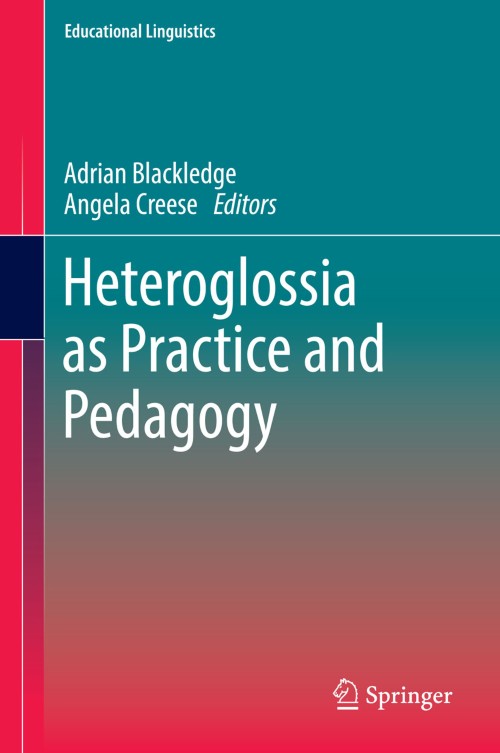
Heteroglossia as Practice and Pedagogy [electronic resource] / edited by Adrian Blackledge, Angela Creese.
Erişim Adresi
ISBN
9789400778566
Dil Kodu
İngilizce
Yer Numarası
DK/7027
Basım Bildirimi
1st ed. 2014.
Yayın Bilgisi
Dordrecht : Springer Netherlands : Imprint: Springer, 2014.
Fiziksel Niteleme
XII, 327 p. 22 illus., 7 illus. in color. online resource.
Dizi
Educational Linguistics, 2215-1656 ; 20
İçindekiler Notu
Foreword -- 1. Heteroglossia as Practice and Pedagogy -- 2. Building on Heteroglossia and Heterogeneity: The Experience of a Multilingual Classroom -- 3. Heteroglossia, Voicing and Social Categorisation -- 4. Heteroglossia in Action: Sámi Children, Textbooks and rap -- 5. ‘The Lord is my shock absorber’: A socio-historical integrationist approach to mid-20th century literacy practices in Ghana -- 6. Translanguaging in the Multilingual Montreal Hip Hop Community: Everyday Poetics as Counter to the Myths of the Monolingual Classroom -- 7. Hip Hop Heteroglossia as Practice, Pleasure, and Pedagogy: Translanguaging in the Lyrical Poetics of “24 Herbs” in Hong Kong -- 8. Learning a Supervernacular: Textspeak in a South African Township -- 9. The Ambiguous World of Heteroglossic Computer-Mediated Language Learning -- 10. Heteroglossic Practices in the Online Publishing Process: Complexities in Digital and Geographical Borderlands -- 11. Theorizing and Enacting Translanguaging for Social Justice -- 12. Rethinking Bilingual Pedagogy in Alsace: Translingual Writers and Translanguaging -- 13. Focus on Multilingualism as an Approach in Educational Contexts -- 14. Faux Spanish in the New Latino Diaspora -- 15. Dissecting Heteroglossia: Interaction Ritual or Performance in Crossing and Stylisation? -- 16. Marking Communicative Repertoire throughMetacommentary.
Özet, vb.
This volume presents evidence about how we understand communication in changing times, and proposes that such understandings may contribute to the development of pedagogy for teaching and learning. It expands current debates on multilingualism, asking which signs are in use and in action, and what are their social, political, and historical implications. The volume’s starting-point is Bakhtin’s ‘heteroglossia’, a key concept in understanding the tensions, conflicts, and multiple voices within, among, and between those signs. The chapters provide illuminating accounts of language practices as they bring into play, both in practice and in pedagogy, voices which index students’ localities, social histories, circumstances, and identities. The book documents the performance of linguistic repertoires in an era of profound social change caused by the shifting nature of nation-states, increased movement of people across territories, and growing digital communication. "Our thinking on language and multilingualism is expanding rapidly. Up until recently we have tended to regard languages as bounded entities, and multilingualism has been understood as knowing more than one language. Working with the concept of heteroglossia, researchers are developing alternative perspectives that treat languages as sets of resources for expressing meaning that can be drawn on by speakers in communicatively productive ways in different contexts. These perspectives raise fundamental questions about the myriad of ways of knowing and using language(s). This collection brings together the contributions of many of the key researchers in the field. It will provide an authoritative reference point for contemporary interpretations of ‘heteroglossia’ and valuable accounts of how ‘translanguaging’ can be explored and exploited in the fields of education and cultural studies." Professor Constant Leung, King’s College London, UK.
Konu
Language and languages __ Study and teaching.
Applied linguistics.
Learning, Psychology of.
Sociolinguistics.
Language Education.
Applied Linguistics.
Instructional Psychology.
Sociolinguistics.
Applied linguistics.
Learning, Psychology of.
Sociolinguistics.
Language Education.
Applied Linguistics.
Instructional Psychology.
Sociolinguistics.
Diğer Yazarlar
Kurum Adı
Eseri Alıntıla
Referansları kullanmadan önce gözden geçirmeniz ve varsa gerekli düzeltmeleri yapmanız önerilir.
Dijital Kaynak
MARC Görünümü
LEADER 05351nam a22005535i 4500
001 805712
003 TR_AnAIT
005 20260127000647
007 cr nn 008mamaa
008 131217s2014 ne | s |||| 0|eng d
020 |a9789400778566|9978-94-007-7856-6
024 7 |a10.1007/978-94-007-7856-6|2doi
041 |aeng
049 |aTürk Tarih Kurumu Kütüphanesi
050 4|aP51-59.4
072 7|aCJ|2bicssc
072 7|aEDU029080|2bisacsh
072 7|aCJ|2thema
082 04|a418.0071|223
090 |aDK/7027
245 10|aHeteroglossia as Practice and Pedagogy|h[electronic resource] /|cedited by Adrian Blackledge, Angela Creese.
250 |a1st ed. 2014.
264 1|aDordrecht :|bSpringer Netherlands :|bImprint: Springer,|c2014.
300 |aXII, 327 p. 22 illus., 7 illus. in color.|bonline resource.
336 |atext|btxt|2rdacontent
337 |acomputer|bc|2rdamedia
338 |aonline resource|bcr|2rdacarrier
347 |atext file|bPDF|2rda
490 1 |aEducational Linguistics,|x2215-1656 ;|v20
505 0 |aForeword -- 1. Heteroglossia as Practice and Pedagogy -- 2. Building on Heteroglossia and Heterogeneity: The Experience of a Multilingual Classroom -- 3. Heteroglossia, Voicing and Social Categorisation -- 4. Heteroglossia in Action: Sámi Children, Textbooks and rap -- 5. ‘The Lord is my shock absorber’: A socio-historical integrationist approach to mid-20th century literacy practices in Ghana -- 6. Translanguaging in the Multilingual Montreal Hip Hop Community: Everyday Poetics as Counter to the Myths of the Monolingual Classroom -- 7. Hip Hop Heteroglossia as Practice, Pleasure, and Pedagogy: Translanguaging in the Lyrical Poetics of “24 Herbs” in Hong Kong -- 8. Learning a Supervernacular: Textspeak in a South African Township -- 9. The Ambiguous World of Heteroglossic Computer-Mediated Language Learning -- 10. Heteroglossic Practices in the Online Publishing Process: Complexities in Digital and Geographical Borderlands -- 11. Theorizing and Enacting Translanguaging for Social Justice -- 12. Rethinking Bilingual Pedagogy in Alsace: Translingual Writers and Translanguaging -- 13. Focus on Multilingualism as an Approach in Educational Contexts -- 14. Faux Spanish in the New Latino Diaspora -- 15. Dissecting Heteroglossia: Interaction Ritual or Performance in Crossing and Stylisation? -- 16. Marking Communicative Repertoire throughMetacommentary.
520 |aThis volume presents evidence about how we understand communication in changing times, and proposes that such understandings may contribute to the development of pedagogy for teaching and learning. It expands current debates on multilingualism, asking which signs are in use and in action, and what are their social, political, and historical implications. The volume’s starting-point is Bakhtin’s ‘heteroglossia’, a key concept in understanding the tensions, conflicts, and multiple voices within, among, and between those signs. The chapters provide illuminating accounts of language practices as they bring into play, both in practice and in pedagogy, voices which index students’ localities, social histories, circumstances, and identities. The book documents the performance of linguistic repertoires in an era of profound social change caused by the shifting nature of nation-states, increased movement of people across territories, and growing digital communication. "Our thinking on language and multilingualism is expanding rapidly. Up until recently we have tended to regard languages as bounded entities, and multilingualism has been understood as knowing more than one language. Working with the concept of heteroglossia, researchers are developing alternative perspectives that treat languages as sets of resources for expressing meaning that can be drawn on by speakers in communicatively productive ways in different contexts. These perspectives raise fundamental questions about the myriad of ways of knowing and using language(s). This collection brings together the contributions of many of the key researchers in the field. It will provide an authoritative reference point for contemporary interpretations of ‘heteroglossia’ and valuable accounts of how ‘translanguaging’ can be explored and exploited in the fields of education and cultural studies." Professor Constant Leung, King’s College London, UK.
650 0|aLanguage and languages|xStudy and teaching.
650 0|aApplied linguistics.
650 0|aLearning, Psychology of.
650 0|aSociolinguistics.
650 14|aLanguage Education.
650 24|aApplied Linguistics.
650 24|aInstructional Psychology.
650 24|aSociolinguistics.
700 1 |aBlackledge, Adrian.|eeditor.|4edt|4http://id.loc.gov/vocabulary/relators/edt
700 1 |aCreese, Angela.|eeditor.|4edt|4http://id.loc.gov/vocabulary/relators/edt
710 2 |aSpringerLink (Online service)
773 0 |tSpringer Nature eBook
776 08|iPrinted edition:|z9789400778559
776 08|iPrinted edition:|z9789400778573
776 08|iPrinted edition:|z9789402406085
830 0|aEducational Linguistics,|x2215-1656 ;|v20
856 40|uhttps://doi.org/10.1007/978-94-007-7856-6
912 |aZDB-2-SHU
912 |aZDB-2-SXED
950 |aHumanities, Social Sciences and Law (SpringerNature-11648)
950 |aEducation (R0) (SpringerNature-43721)
001 805712
003 TR_AnAIT
005 20260127000647
007 cr nn 008mamaa
008 131217s2014 ne | s |||| 0|eng d
020 |a9789400778566|9978-94-007-7856-6
024 7 |a10.1007/978-94-007-7856-6|2doi
041 |aeng
049 |aTürk Tarih Kurumu Kütüphanesi
050 4|aP51-59.4
072 7|aCJ|2bicssc
072 7|aEDU029080|2bisacsh
072 7|aCJ|2thema
082 04|a418.0071|223
090 |aDK/7027
245 10|aHeteroglossia as Practice and Pedagogy|h[electronic resource] /|cedited by Adrian Blackledge, Angela Creese.
250 |a1st ed. 2014.
264 1|aDordrecht :|bSpringer Netherlands :|bImprint: Springer,|c2014.
300 |aXII, 327 p. 22 illus., 7 illus. in color.|bonline resource.
336 |atext|btxt|2rdacontent
337 |acomputer|bc|2rdamedia
338 |aonline resource|bcr|2rdacarrier
347 |atext file|bPDF|2rda
490 1 |aEducational Linguistics,|x2215-1656 ;|v20
505 0 |aForeword -- 1. Heteroglossia as Practice and Pedagogy -- 2. Building on Heteroglossia and Heterogeneity: The Experience of a Multilingual Classroom -- 3. Heteroglossia, Voicing and Social Categorisation -- 4. Heteroglossia in Action: Sámi Children, Textbooks and rap -- 5. ‘The Lord is my shock absorber’: A socio-historical integrationist approach to mid-20th century literacy practices in Ghana -- 6. Translanguaging in the Multilingual Montreal Hip Hop Community: Everyday Poetics as Counter to the Myths of the Monolingual Classroom -- 7. Hip Hop Heteroglossia as Practice, Pleasure, and Pedagogy: Translanguaging in the Lyrical Poetics of “24 Herbs” in Hong Kong -- 8. Learning a Supervernacular: Textspeak in a South African Township -- 9. The Ambiguous World of Heteroglossic Computer-Mediated Language Learning -- 10. Heteroglossic Practices in the Online Publishing Process: Complexities in Digital and Geographical Borderlands -- 11. Theorizing and Enacting Translanguaging for Social Justice -- 12. Rethinking Bilingual Pedagogy in Alsace: Translingual Writers and Translanguaging -- 13. Focus on Multilingualism as an Approach in Educational Contexts -- 14. Faux Spanish in the New Latino Diaspora -- 15. Dissecting Heteroglossia: Interaction Ritual or Performance in Crossing and Stylisation? -- 16. Marking Communicative Repertoire throughMetacommentary.
520 |aThis volume presents evidence about how we understand communication in changing times, and proposes that such understandings may contribute to the development of pedagogy for teaching and learning. It expands current debates on multilingualism, asking which signs are in use and in action, and what are their social, political, and historical implications. The volume’s starting-point is Bakhtin’s ‘heteroglossia’, a key concept in understanding the tensions, conflicts, and multiple voices within, among, and between those signs. The chapters provide illuminating accounts of language practices as they bring into play, both in practice and in pedagogy, voices which index students’ localities, social histories, circumstances, and identities. The book documents the performance of linguistic repertoires in an era of profound social change caused by the shifting nature of nation-states, increased movement of people across territories, and growing digital communication. "Our thinking on language and multilingualism is expanding rapidly. Up until recently we have tended to regard languages as bounded entities, and multilingualism has been understood as knowing more than one language. Working with the concept of heteroglossia, researchers are developing alternative perspectives that treat languages as sets of resources for expressing meaning that can be drawn on by speakers in communicatively productive ways in different contexts. These perspectives raise fundamental questions about the myriad of ways of knowing and using language(s). This collection brings together the contributions of many of the key researchers in the field. It will provide an authoritative reference point for contemporary interpretations of ‘heteroglossia’ and valuable accounts of how ‘translanguaging’ can be explored and exploited in the fields of education and cultural studies." Professor Constant Leung, King’s College London, UK.
650 0|aLanguage and languages|xStudy and teaching.
650 0|aApplied linguistics.
650 0|aLearning, Psychology of.
650 0|aSociolinguistics.
650 14|aLanguage Education.
650 24|aApplied Linguistics.
650 24|aInstructional Psychology.
650 24|aSociolinguistics.
700 1 |aBlackledge, Adrian.|eeditor.|4edt|4http://id.loc.gov/vocabulary/relators/edt
700 1 |aCreese, Angela.|eeditor.|4edt|4http://id.loc.gov/vocabulary/relators/edt
710 2 |aSpringerLink (Online service)
773 0 |tSpringer Nature eBook
776 08|iPrinted edition:|z9789400778559
776 08|iPrinted edition:|z9789400778573
776 08|iPrinted edition:|z9789402406085
830 0|aEducational Linguistics,|x2215-1656 ;|v20
856 40|uhttps://doi.org/10.1007/978-94-007-7856-6
912 |aZDB-2-SHU
912 |aZDB-2-SXED
950 |aHumanities, Social Sciences and Law (SpringerNature-11648)
950 |aEducation (R0) (SpringerNature-43721)
Materyaller
Depodan talep edilen materyal sadece kütüphane içerisinde kullanılmaktadır.
Materyal dışarıya ödünç verilmemektedir.
Materyal dışarıya ödünç verilmemektedir.
