

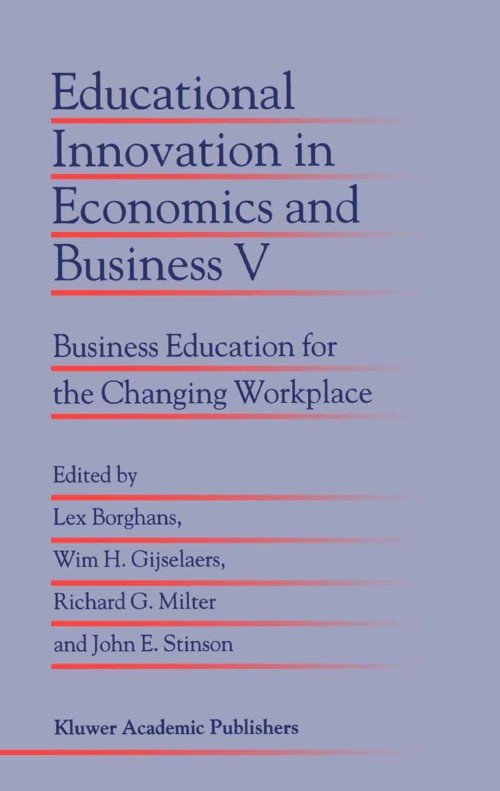
Educational Innovation in Economics and Business V [electronic resource] : Business Education for the Changing Workplace / edited by Lex Borghans, Wim H. Gijselaers, Richard G. Milter, John E. Stinson.
Erişim Adresi
ISBN
9780306475504
Dil Kodu
İngilizce
Yer Numarası
DK/7080
Basım Bildirimi
1st ed. 2000.
Yayın Bilgisi
Dordrecht : Springer Netherlands : Imprint: Springer, 2000.
Fiziksel Niteleme
XXII, 462 p. online resource.
Dizi
Educational Innovation in Economics and Business ; 5
İçindekiler Notu
Learning in a Changing Workplace -- Developing Added Value Skills Within an Academic Program Through Work Based Learning -- Leadership Education in a Changing Workplace -- New Training Methods: A Giant Leap of Faith? -- The Economics of the Learning Organization and the Role of Economics in the Organization of Learning -- Technology and Innovation -- The IS Department Defines the Future of the College of Business -- Informatics Engineering and Business Informatics in the Ict Society: Substitutes Or Complements? -- An Innovative Approach to Teaching Investments Using Information Technology -- People, Knowledge, and the Internet: Redefining Categories, Concepts, and Models -- Integration of Groupware Into a MIS Curriculum -- Innovative Learning Methods -- Innovative Business Education:‘Problem-oriented Learning’ - Some Results -- Competitions and Problem-based Learning: The Effect of an Externally Set Competition on a Cross-curricular Project in Marketing and Design -- A Problem-based Learning Approach to Business Software Skills -- Some Evidence on the Use of Writing Intensive Methods in the Principles of Macroeconomics Courses -- Designing Assignments and Classroom Discussions to Foster Critical Thinking at Different Levels in the Curriculum -- Curriculum Issues -- Distance Learning: Paradigm Shift or Pedagogical Drift? -- The Integration Of Service Management Principles In A Business School Curriculum -- Promoting the Human Element in Resource Based Learning for Undergraduate Business Education Programs -- Non-prescriptive Guidelines For More Effective Learning About High Quality Leadership, In Management Education And Development -- Cross-cultural Learning Practices for Business Education -- Lessons Learned: The Implementation of an Innovative Core Curriculum in Business -- NewAssessment Procedures -- Who Am I, What Do I Want, What Can I Do? An Assessment Centre as Part of the HBO Curriculum -- The Assessment Center: Global Issues and Local Responses -- Assessment & Development Centers in a Problem-based Learning Environment -- Cognition and Learning -- What Should We Expect to be Different about How Expert Business Economists Solve Problems? -- Tracking Down the Knowledge Structure of Students.
Özet, vb.
The workplace is changing drastically these days. As a consequence of the Information and Communication Technology (ICT) revolution, new economic activities emerge, the production process changes, people use different communication tools, and organizational structures are adjusted. All these changes relate to the heart of business and economics, and there is no doubt that they will also influence education in these areas. Of course ICT provides new technologies to facilitate learning, but a changing workplace also requires a renewed focus within the curriculum of economics and business education. If ICT is leading to profound change in the workplace, is innovation then only a matter of introducing more technology in education? Unfortunately, this is not necessarily true. The translation of changes in the workplace into an improved curriculum requires serious analysis of the essence of the changes at the work place, and the way technology may enable student learning. For example, relevant knowledge is changing faster and faster. Does this mean that we have to adopt the curriculum faster and faster? Perhaps not, as students will have a labor market career of 30 or 40 years. Focusing on today’s knowledge – even if it is very up-to-date – loses more and more value if the life cycle of knowledge becomes shorter. Increased speed of change also implies a decrease in the value of knowing all these things.
Konu
Education.
Learning, Psychology of.
Education.
Instructional Psychology.
Learning, Psychology of.
Education.
Instructional Psychology.
Kurum Adı
Eseri Alıntıla
Referansları kullanmadan önce gözden geçirmeniz ve varsa gerekli düzeltmeleri yapmanız önerilir.
Dijital Kaynak
MARC Görünümü
LEADER 05779nam a22005415i 4500
001 805766
003 TR_AnAIT
005 20260127000751
007 cr nn 008mamaa
008 100301s2000 ne | s |||| 0|eng d
020 |a9780306475504|9978-0-306-47550-4
024 7 |a10.1007/0-306-47550-2|2doi
041 |aeng
049 |aTürk Tarih Kurumu Kütüphanesi
050 4|aL1-991
072 7|aJN|2bicssc
072 7|aEDU000000|2bisacsh
072 7|aJN|2thema
082 04|a370|223
090 |aDK/7080
245 10|aEducational Innovation in Economics and Business V|h[electronic resource] :|bBusiness Education for the Changing Workplace /|cedited by Lex Borghans, Wim H. Gijselaers, Richard G. Milter, John E. Stinson.
250 |a1st ed. 2000.
264 1|aDordrecht :|bSpringer Netherlands :|bImprint: Springer,|c2000.
300 |aXXII, 462 p.|bonline resource.
336 |atext|btxt|2rdacontent
337 |acomputer|bc|2rdamedia
338 |aonline resource|bcr|2rdacarrier
347 |atext file|bPDF|2rda
490 1 |aEducational Innovation in Economics and Business ;|v5
505 0 |aLearning in a Changing Workplace -- Developing Added Value Skills Within an Academic Program Through Work Based Learning -- Leadership Education in a Changing Workplace -- New Training Methods: A Giant Leap of Faith? -- The Economics of the Learning Organization and the Role of Economics in the Organization of Learning -- Technology and Innovation -- The IS Department Defines the Future of the College of Business -- Informatics Engineering and Business Informatics in the Ict Society: Substitutes Or Complements? -- An Innovative Approach to Teaching Investments Using Information Technology -- People, Knowledge, and the Internet: Redefining Categories, Concepts, and Models -- Integration of Groupware Into a MIS Curriculum -- Innovative Learning Methods -- Innovative Business Education:‘Problem-oriented Learning’ - Some Results -- Competitions and Problem-based Learning: The Effect of an Externally Set Competition on a Cross-curricular Project in Marketing and Design -- A Problem-based Learning Approach to Business Software Skills -- Some Evidence on the Use of Writing Intensive Methods in the Principles of Macroeconomics Courses -- Designing Assignments and Classroom Discussions to Foster Critical Thinking at Different Levels in the Curriculum -- Curriculum Issues -- Distance Learning: Paradigm Shift or Pedagogical Drift? -- The Integration Of Service Management Principles In A Business School Curriculum -- Promoting the Human Element in Resource Based Learning for Undergraduate Business Education Programs -- Non-prescriptive Guidelines For More Effective Learning About High Quality Leadership, In Management Education And Development -- Cross-cultural Learning Practices for Business Education -- Lessons Learned: The Implementation of an Innovative Core Curriculum in Business -- NewAssessment Procedures -- Who Am I, What Do I Want, What Can I Do? An Assessment Centre as Part of the HBO Curriculum -- The Assessment Center: Global Issues and Local Responses -- Assessment & Development Centers in a Problem-based Learning Environment -- Cognition and Learning -- What Should We Expect to be Different about How Expert Business Economists Solve Problems? -- Tracking Down the Knowledge Structure of Students.
520 |aThe workplace is changing drastically these days. As a consequence of the Information and Communication Technology (ICT) revolution, new economic activities emerge, the production process changes, people use different communication tools, and organizational structures are adjusted. All these changes relate to the heart of business and economics, and there is no doubt that they will also influence education in these areas. Of course ICT provides new technologies to facilitate learning, but a changing workplace also requires a renewed focus within the curriculum of economics and business education. If ICT is leading to profound change in the workplace, is innovation then only a matter of introducing more technology in education? Unfortunately, this is not necessarily true. The translation of changes in the workplace into an improved curriculum requires serious analysis of the essence of the changes at the work place, and the way technology may enable student learning. For example, relevant knowledge is changing faster and faster. Does this mean that we have to adopt the curriculum faster and faster? Perhaps not, as students will have a labor market career of 30 or 40 years. Focusing on today’s knowledge – even if it is very up-to-date – loses more and more value if the life cycle of knowledge becomes shorter. Increased speed of change also implies a decrease in the value of knowing all these things.
650 0|aEducation.
650 0|aLearning, Psychology of.
650 14|aEducation.
650 24|aInstructional Psychology.
700 1 |aBorghans, Lex.|eeditor.|4edt|4http://id.loc.gov/vocabulary/relators/edt
700 1 |aGijselaers, Wim H.|eeditor.|4edt|4http://id.loc.gov/vocabulary/relators/edt
700 1 |aMilter, Richard G.|eeditor.|4edt|4http://id.loc.gov/vocabulary/relators/edt
700 1 |aStinson, John E.|eeditor.|4edt|4http://id.loc.gov/vocabulary/relators/edt
710 2 |aSpringerLink (Online service)
773 0 |tSpringer Nature eBook
776 08|iPrinted edition:|z9780792365501
776 08|iPrinted edition:|z9789048155583
776 08|iPrinted edition:|z9789401738545
830 0|aEducational Innovation in Economics and Business ;|v5
856 40|uhttps://doi.org/10.1007/0-306-47550-2
912 |aZDB-2-SHU
912 |aZDB-2-SXED
912 |aZDB-2-BAE
950 |aHumanities, Social Sciences and Law (SpringerNature-11648)
950 |aEducation (R0) (SpringerNature-43721)
001 805766
003 TR_AnAIT
005 20260127000751
007 cr nn 008mamaa
008 100301s2000 ne | s |||| 0|eng d
020 |a9780306475504|9978-0-306-47550-4
024 7 |a10.1007/0-306-47550-2|2doi
041 |aeng
049 |aTürk Tarih Kurumu Kütüphanesi
050 4|aL1-991
072 7|aJN|2bicssc
072 7|aEDU000000|2bisacsh
072 7|aJN|2thema
082 04|a370|223
090 |aDK/7080
245 10|aEducational Innovation in Economics and Business V|h[electronic resource] :|bBusiness Education for the Changing Workplace /|cedited by Lex Borghans, Wim H. Gijselaers, Richard G. Milter, John E. Stinson.
250 |a1st ed. 2000.
264 1|aDordrecht :|bSpringer Netherlands :|bImprint: Springer,|c2000.
300 |aXXII, 462 p.|bonline resource.
336 |atext|btxt|2rdacontent
337 |acomputer|bc|2rdamedia
338 |aonline resource|bcr|2rdacarrier
347 |atext file|bPDF|2rda
490 1 |aEducational Innovation in Economics and Business ;|v5
505 0 |aLearning in a Changing Workplace -- Developing Added Value Skills Within an Academic Program Through Work Based Learning -- Leadership Education in a Changing Workplace -- New Training Methods: A Giant Leap of Faith? -- The Economics of the Learning Organization and the Role of Economics in the Organization of Learning -- Technology and Innovation -- The IS Department Defines the Future of the College of Business -- Informatics Engineering and Business Informatics in the Ict Society: Substitutes Or Complements? -- An Innovative Approach to Teaching Investments Using Information Technology -- People, Knowledge, and the Internet: Redefining Categories, Concepts, and Models -- Integration of Groupware Into a MIS Curriculum -- Innovative Learning Methods -- Innovative Business Education:‘Problem-oriented Learning’ - Some Results -- Competitions and Problem-based Learning: The Effect of an Externally Set Competition on a Cross-curricular Project in Marketing and Design -- A Problem-based Learning Approach to Business Software Skills -- Some Evidence on the Use of Writing Intensive Methods in the Principles of Macroeconomics Courses -- Designing Assignments and Classroom Discussions to Foster Critical Thinking at Different Levels in the Curriculum -- Curriculum Issues -- Distance Learning: Paradigm Shift or Pedagogical Drift? -- The Integration Of Service Management Principles In A Business School Curriculum -- Promoting the Human Element in Resource Based Learning for Undergraduate Business Education Programs -- Non-prescriptive Guidelines For More Effective Learning About High Quality Leadership, In Management Education And Development -- Cross-cultural Learning Practices for Business Education -- Lessons Learned: The Implementation of an Innovative Core Curriculum in Business -- NewAssessment Procedures -- Who Am I, What Do I Want, What Can I Do? An Assessment Centre as Part of the HBO Curriculum -- The Assessment Center: Global Issues and Local Responses -- Assessment & Development Centers in a Problem-based Learning Environment -- Cognition and Learning -- What Should We Expect to be Different about How Expert Business Economists Solve Problems? -- Tracking Down the Knowledge Structure of Students.
520 |aThe workplace is changing drastically these days. As a consequence of the Information and Communication Technology (ICT) revolution, new economic activities emerge, the production process changes, people use different communication tools, and organizational structures are adjusted. All these changes relate to the heart of business and economics, and there is no doubt that they will also influence education in these areas. Of course ICT provides new technologies to facilitate learning, but a changing workplace also requires a renewed focus within the curriculum of economics and business education. If ICT is leading to profound change in the workplace, is innovation then only a matter of introducing more technology in education? Unfortunately, this is not necessarily true. The translation of changes in the workplace into an improved curriculum requires serious analysis of the essence of the changes at the work place, and the way technology may enable student learning. For example, relevant knowledge is changing faster and faster. Does this mean that we have to adopt the curriculum faster and faster? Perhaps not, as students will have a labor market career of 30 or 40 years. Focusing on today’s knowledge – even if it is very up-to-date – loses more and more value if the life cycle of knowledge becomes shorter. Increased speed of change also implies a decrease in the value of knowing all these things.
650 0|aEducation.
650 0|aLearning, Psychology of.
650 14|aEducation.
650 24|aInstructional Psychology.
700 1 |aBorghans, Lex.|eeditor.|4edt|4http://id.loc.gov/vocabulary/relators/edt
700 1 |aGijselaers, Wim H.|eeditor.|4edt|4http://id.loc.gov/vocabulary/relators/edt
700 1 |aMilter, Richard G.|eeditor.|4edt|4http://id.loc.gov/vocabulary/relators/edt
700 1 |aStinson, John E.|eeditor.|4edt|4http://id.loc.gov/vocabulary/relators/edt
710 2 |aSpringerLink (Online service)
773 0 |tSpringer Nature eBook
776 08|iPrinted edition:|z9780792365501
776 08|iPrinted edition:|z9789048155583
776 08|iPrinted edition:|z9789401738545
830 0|aEducational Innovation in Economics and Business ;|v5
856 40|uhttps://doi.org/10.1007/0-306-47550-2
912 |aZDB-2-SHU
912 |aZDB-2-SXED
912 |aZDB-2-BAE
950 |aHumanities, Social Sciences and Law (SpringerNature-11648)
950 |aEducation (R0) (SpringerNature-43721)
Materyaller
Depodan talep edilen materyal sadece kütüphane içerisinde kullanılmaktadır.
Materyal dışarıya ödünç verilmemektedir.
Materyal dışarıya ödünç verilmemektedir.
