

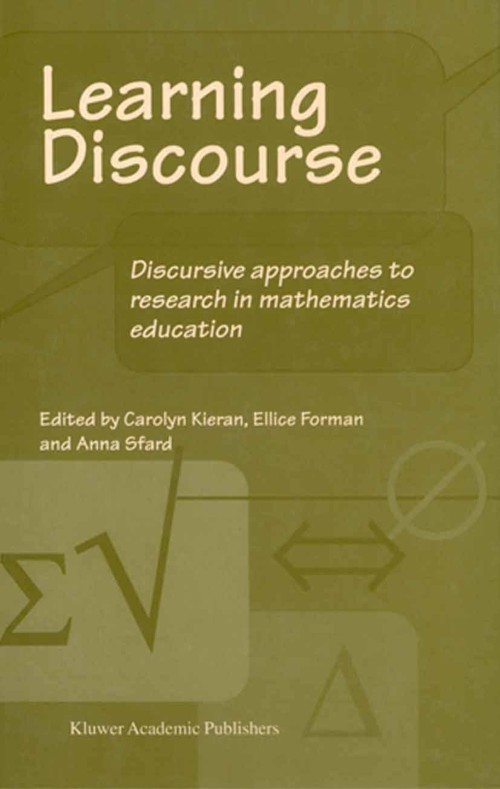
Learning Discourse [electronic resource] : Discursive approaches to research in mathematics education / edited by C. Kieran, Ellice Ann Forman, Anna Sfard.
Erişim Adresi
ISBN
9780306480850
Dil Kodu
İngilizce
Yer Numarası
DK/7082
Basım Bildirimi
1st ed. 2002.
Yayın Bilgisi
Dordrecht : Springer Netherlands : Imprint: Springer, 2002.
Fiziksel Niteleme
IV, 302 p. online resource.
İçindekiler Notu
There is More to Discourse than Meets the Ears: Looking at Thinking as Communicating to Learn More About Mathematical Learning -- Educational Forms of Initiation in Mathematical Culture -- Cultural, Discursive Psychology: A Sociocultural Approach to Studying the Teaching and Learning of Mathematics -- The Multiple Voices of a Mathematics Classroom Community -- “Can any Fraction be Turned into a Decimal?” A Case Study of a Mathematical Group Discussion -- The Mathematical Discourse of 13-Year-Old Partnered Problem Solving and Its Relation to the Mathematics That Emerges -- Making Mathematical Meaning Through Dialogue: “Once You Think of It, the Z Minus Three Seems Pretty Weird” -- From Describing to Designing Mathematical Activity: The Next Step in Developing a Social Approach to Research in Mathematics Education? -- Research on Discourse in the Mathematics Classroom: A Commentary.
Özet, vb.
The authors of this volume claim that mathematics can be usefully re-conceptualized as a special form of communication. As a result, the familiar discussion of mental schemes, misconceptions, and cognitive conflict is transformed into a consideration of activity, patterns of interaction, and communication failure. By equating thinking with communicating, the discursive approach also deconstructs the problematic dichotomy between "individual" and "social" research perspectives. Although each author applies his or her own analyses to the discourse generated by students and teachers grappling with mathematical problems, their joint aim is to put discursive research into the limelight and to spur thinking about its nature and its possible advantages and pitfalls. This volume is therefore addressed both to those interested in specific questions regarding classroom communication, and to those who are looking for a general conceptual lens with which to tackle the complexity of mathematical teaching and learning.
Konu
Mathematics __ Study and teaching .
Learning, Psychology of.
Mathematics Education.
Instructional Psychology.
Learning, Psychology of.
Mathematics Education.
Instructional Psychology.
Diğer Yazarlar
Kurum Adı
