LEADER 04151nam a22005415i 4500
001 805771
003 TR_AnAIT
005 20260127000757
007 cr nn 008mamaa
008 121227s1992 ne | s |||| 0|eng d
020 |a9789401131209|9978-94-011-3120-9
024 7 |a10.1007/978-94-011-3120-9|2doi
041 |aeng
049 |aTürk Tarih Kurumu Kütüphanesi
050 4|aH1-99
050 4|aAZ19.2-999
072 7|aGT|2bicssc
072 7|aNON000000|2bisacsh
072 7|aGT|2thema
082 04|a300|223
082 04|a001.3|223
090 |aDK/7085
100 1 |aRoberts, Ellis A.|eauthor.|4aut|4http://id.loc.gov/vocabulary/relators/aut
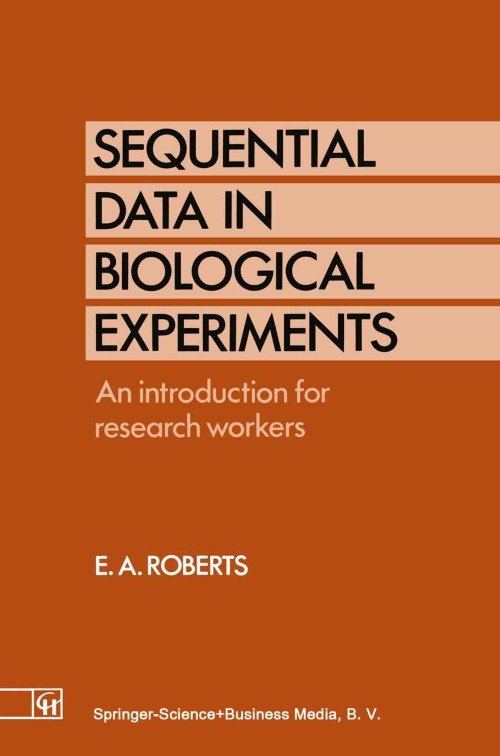
245 10|aSequential Data in Biological Experiments|h[electronic resource] :|bAn introduction for research workers /|cby Ellis A. Roberts.
250 |a1st ed. 1992.
264 1|aDordrecht :|bSpringer Netherlands :|bImprint: Springer,|c1992.
300 |aXII, 240 p.|bonline resource.
336 |atext|btxt|2rdacontent
337 |acomputer|bc|2rdamedia
338 |aonline resource|bcr|2rdacarrier
347 |atext file|bPDF|2rda
505 0 |a1 Introduction -- 2 A simple factorial grazing experiment measured on 27 occasions -- 3 A 3 × 3 factorial with quantitative levels -- 4 Definable within-individual comparisons -- 5 Covariance -- 6 Pre-treatment observations in the design of experiments -- 7 Weighted regression, goodness-of-fit and related topics -- 8 Environmental variables -- 9 Correlation between series of random variables -- 10 Response (reaction) times -- Bibliographical note.
520 |aThere are many excellent books on general statistical methods in agricul tural and biological research. These books cover a broad range of methods without going into detail on specialized topics. A number of topics including regression analysis, design of experiments, biological assay and categorical analysis have received in-depth treatment in specialized texts. Little appears in standard textbooks on experiments in which observations form sequences. The live weights of animals during a long-term experiment provide a familiar example of data forming a sequence, but many others occur: for example, moisture content of segments of soil cores, successive counts of insects in an orchard and hormone levels in blood over a period. Correla tions are likely to be found among the observations in all these examples. The book by Goldstein (1979) provided the first systematic coverage of the principles involved in longitudinal studies, but is mainly concerned with observational studies on humans. The main aims of this book are to provide research workers with methods of analysing data from comparative experiments with sequential obser vations and to demonstrate special features of the design of such experi ments. These aims are achieved by working through sets of data.
532 8 |aAccessibility summary: This PDF is not accessible. It is based on scanned pages and does not support features such as screen reader compatibility or described non-text content (images, graphs etc). However, it likely supports searchable and selectable text based on OCR (Optical Character Recognition). Users with accessibility needs may not be able to use this content effectively. Please contact us at accessibilitysupport@springernature.com if you require assistance or an alternative format.
532 8 |aInaccessible, or known limited accessibility
532 8 |aNo reading system accessibility options actively disabled
532 8 |aPublisher contact for further accessibility information: accessibilitysupport@springernature.com
650 0|aSocial sciences.
650 0|aHumanities.
650 14|aHumanities and Social Sciences.
710 2 |aSpringerLink (Online service)
773 0 |tSpringer Nature eBook
776 08|iPrinted edition:|z9780412414107
776 08|iPrinted edition:|z9789401131216
776 08|iPrinted edition:|z9789401053815
856 40|uhttps://doi.org/10.1007/978-94-011-3120-9
912 |aZDB-2-SHU
912 |aZDB-2-SXH
912 |aZDB-2-BAE
950 |aHumanities, Social Sciences and Law (SpringerNature-11648)
950 |aHistory (R0) (SpringerNature-43722)