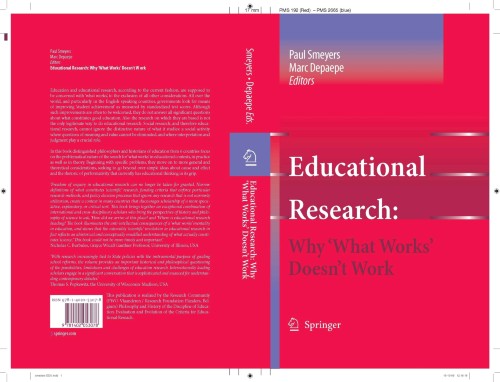
Educational Research: Why 'What Works' Doesn't Work [electronic resource] / edited by Paul Smeyers, Marc Depaepe.
Erişim Adresi
ISBN
9781402053085
Dil Kodu
İngilizce
Yer Numarası
DK/7090
Basım Bildirimi
1st ed. 2006.
Yayın Bilgisi
Dordrecht : Springer Netherlands : Imprint: Springer, 2006.
Fiziksel Niteleme
VI, 196 p. online resource.
Dizi
Educational Research, 2543-0653 ; 1
İçindekiler Notu
The ‘Good Practices’ of Jozef Emiel Verheyen – Schoolman and Professor of Education at the Ghent University -- Ovide Decroly, A Hero of Education -- Why Generalizability is not Generalizable -- The New Languages and Old Institutions: Problems of Implementing New School Governance -- Problematization or Methodology -- The Relevance of Irrelevant Research; The Irrelevance of Relevant Research -- Expectations of What Scientific Research could (not) Do -- Kuhnian Science and Education Research: Analytics of Practice and Training -- The International and the Excellent in Educational Research -- Technical Difficulties: The Workings of Practical Judgement -- The Science of Education – Disciplinary Knowledge on Non-Knowledge/Ignorance?.
Özet, vb.
Education and educational research, according to the current fashion, are supposed to be concerned with ‘what works’, to the exclusion of all other considerations. All over the world, and particularly in the English-speaking countries, governments look for means of improving ‘student achievement’ as measured by standardized test scores. Although such improvements are often to be welcomed, they do not answer all significant questions about what constitutes good education. Also the research on which they are based is not the only legitimate way to do educational research. Social research, and therefore educational research, cannot ignore the distinctive nature of what it studies: a social activity where questions of meaning and value cannot be eliminated, and where interpretation and judgment play a crucial role. In this book distinguished philosophers and historians of education from 6 countries focus on the problematical nature of the search for ‘what works’ in educational contexts, in practice as well as in theory. Beginning with specific problems, they move on to more general and theoretical considerations, seeking to go beyond over-simple ideas about cause and effect and the rhetoric of performativity that currently has educational thinking in its grip. ‘Freedom of inquiry in educational research can no longer be taken for granted. Narrow definitions of what constitutes ‘scientific’ research, funding criteria that enforce particular research methods, and policy decision processes that ignore any research that is not narrowly utilitarian, create a context in many countries that discourages scholarship of a more speculative, exploratory, or critical sort. This book brings together an exceptional combination of international and cross-disciplinary scholars who bring the perspectives of history and philosophy of science to ask, ‘How did we arrive at this place? and ‘Where is educational research heading? Thebook illuminates the anti-intellectual consequences of a ‘what works’ mentality in education, and shows that the ostensibly ‘scientific’ revolution in educational research in fact reflects an ahistorical and conceptually muddled understanding of what actually constitutes ‘science.’ This book could not be more timely and important.’ Nicholas C. Burbules, Grayce Wicall Gauthier Professor, University of Illinois ‘With research increasingly tied to State policies with the instrumental purpose of guiding school reforms, the volume provides an important historical and philosophical questioning of the possibilities, limitations and challenges of education research. Internationally leading scholars engage in a significant conversation that is sophisticated and nuanced for understanding contemporary debates.’ Thomas S. Popkewitz, the University of Wisconsin-Madison, USA This publication is realized by the Research Community (FWO-Vlaanderen / Research Foundation Flanders, Belgium) Philosophy and History of the Discipline of Education. Evaluation and Evolution of the Criteria for Educational Reseach. .
Konu
Education, Higher.
Education __ Philosophy.
Educational sociology.
Education and state.
Education.
Higher Education.
Philosophy of Education.
Sociology of Education.
Educational Policy and Politics.
Education.
Education __ Philosophy.
Educational sociology.
Education and state.
Education.
Higher Education.
Philosophy of Education.
Sociology of Education.
Educational Policy and Politics.
Education.
Diğer Yazarlar
Kurum Adı

Eseri Alıntıla
Referansları kullanmadan önce gözden geçirmeniz ve varsa gerekli düzeltmeleri yapmanız önerilir.
Dijital Kaynak
MARC Görünümü
LEADER 05860nam a22005775i 4500
001 805776
003 TR_AnAIT
005 20260127000803
007 cr nn 008mamaa
008 100301s2006 ne | s |||| 0|eng d
020 |a9781402053085|9978-1-4020-5308-5
024 7 |a10.1007/978-1-4020-5308-5|2doi
041 |aeng
049 |aTürk Tarih Kurumu Kütüphanesi
050 4|aLB2300-2799.3
072 7|aJNM|2bicssc
072 7|aEDU015000|2bisacsh
072 7|aJNM|2thema
082 04|a378|223
090 |aDK/7090
245 10|aEducational Research: Why 'What Works' Doesn't Work|h[electronic resource] /|cedited by Paul Smeyers, Marc Depaepe.
250 |a1st ed. 2006.
264 1|aDordrecht :|bSpringer Netherlands :|bImprint: Springer,|c2006.
300 |aVI, 196 p.|bonline resource.
336 |atext|btxt|2rdacontent
337 |acomputer|bc|2rdamedia
338 |aonline resource|bcr|2rdacarrier
347 |atext file|bPDF|2rda
490 1 |aEducational Research,|x2543-0653 ;|v1
505 0 |aThe ‘Good Practices’ of Jozef Emiel Verheyen – Schoolman and Professor of Education at the Ghent University -- Ovide Decroly, A Hero of Education -- Why Generalizability is not Generalizable -- The New Languages and Old Institutions: Problems of Implementing New School Governance -- Problematization or Methodology -- The Relevance of Irrelevant Research; The Irrelevance of Relevant Research -- Expectations of What Scientific Research could (not) Do -- Kuhnian Science and Education Research: Analytics of Practice and Training -- The International and the Excellent in Educational Research -- Technical Difficulties: The Workings of Practical Judgement -- The Science of Education – Disciplinary Knowledge on Non-Knowledge/Ignorance?.
520 |aEducation and educational research, according to the current fashion, are supposed to be concerned with ‘what works’, to the exclusion of all other considerations. All over the world, and particularly in the English-speaking countries, governments look for means of improving ‘student achievement’ as measured by standardized test scores. Although such improvements are often to be welcomed, they do not answer all significant questions about what constitutes good education. Also the research on which they are based is not the only legitimate way to do educational research. Social research, and therefore educational research, cannot ignore the distinctive nature of what it studies: a social activity where questions of meaning and value cannot be eliminated, and where interpretation and judgment play a crucial role. In this book distinguished philosophers and historians of education from 6 countries focus on the problematical nature of the search for ‘what works’ in educational contexts, in practice as well as in theory. Beginning with specific problems, they move on to more general and theoretical considerations, seeking to go beyond over-simple ideas about cause and effect and the rhetoric of performativity that currently has educational thinking in its grip. ‘Freedom of inquiry in educational research can no longer be taken for granted. Narrow definitions of what constitutes ‘scientific’ research, funding criteria that enforce particular research methods, and policy decision processes that ignore any research that is not narrowly utilitarian, create a context in many countries that discourages scholarship of a more speculative, exploratory, or critical sort. This book brings together an exceptional combination of international and cross-disciplinary scholars who bring the perspectives of history and philosophy of science to ask, ‘How did we arrive at this place? and ‘Where is educational research heading? Thebook illuminates the anti-intellectual consequences of a ‘what works’ mentality in education, and shows that the ostensibly ‘scientific’ revolution in educational research in fact reflects an ahistorical and conceptually muddled understanding of what actually constitutes ‘science.’ This book could not be more timely and important.’ Nicholas C. Burbules, Grayce Wicall Gauthier Professor, University of Illinois ‘With research increasingly tied to State policies with the instrumental purpose of guiding school reforms, the volume provides an important historical and philosophical questioning of the possibilities, limitations and challenges of education research. Internationally leading scholars engage in a significant conversation that is sophisticated and nuanced for understanding contemporary debates.’ Thomas S. Popkewitz, the University of Wisconsin-Madison, USA This publication is realized by the Research Community (FWO-Vlaanderen / Research Foundation Flanders, Belgium) Philosophy and History of the Discipline of Education. Evaluation and Evolution of the Criteria for Educational Reseach. .
650 0|aEducation, Higher.
650 0|aEducation|xPhilosophy.
650 0|aEducational sociology.
650 0|aEducation and state.
650 0|aEducation.
650 14|aHigher Education.
650 24|aPhilosophy of Education.
650 24|aSociology of Education.
650 24|aEducational Policy and Politics.
650 24|aEducation.
700 1 |aSmeyers, Paul.|eeditor.|4edt|4http://id.loc.gov/vocabulary/relators/edt
700 1 |aDepaepe, Marc.|eeditor.|4edt|4http://id.loc.gov/vocabulary/relators/edt
710 2 |aSpringerLink (Online service)
773 0 |tSpringer Nature eBook
776 08|iPrinted edition:|z9781402053078
776 08|iPrinted edition:|z9789048110650
776 08|iPrinted edition:|z9789048173341
830 0|aEducational Research,|x2543-0653 ;|v1
856 40|uhttps://doi.org/10.1007/978-1-4020-5308-5
912 |aZDB-2-SHU
912 |aZDB-2-SXED
950 |aHumanities, Social Sciences and Law (SpringerNature-11648)
950 |aEducation (R0) (SpringerNature-43721)
001 805776
003 TR_AnAIT
005 20260127000803
007 cr nn 008mamaa
008 100301s2006 ne | s |||| 0|eng d
020 |a9781402053085|9978-1-4020-5308-5
024 7 |a10.1007/978-1-4020-5308-5|2doi
041 |aeng
049 |aTürk Tarih Kurumu Kütüphanesi
050 4|aLB2300-2799.3
072 7|aJNM|2bicssc
072 7|aEDU015000|2bisacsh
072 7|aJNM|2thema
082 04|a378|223
090 |aDK/7090
245 10|aEducational Research: Why 'What Works' Doesn't Work|h[electronic resource] /|cedited by Paul Smeyers, Marc Depaepe.
250 |a1st ed. 2006.
264 1|aDordrecht :|bSpringer Netherlands :|bImprint: Springer,|c2006.
300 |aVI, 196 p.|bonline resource.
336 |atext|btxt|2rdacontent
337 |acomputer|bc|2rdamedia
338 |aonline resource|bcr|2rdacarrier
347 |atext file|bPDF|2rda
490 1 |aEducational Research,|x2543-0653 ;|v1
505 0 |aThe ‘Good Practices’ of Jozef Emiel Verheyen – Schoolman and Professor of Education at the Ghent University -- Ovide Decroly, A Hero of Education -- Why Generalizability is not Generalizable -- The New Languages and Old Institutions: Problems of Implementing New School Governance -- Problematization or Methodology -- The Relevance of Irrelevant Research; The Irrelevance of Relevant Research -- Expectations of What Scientific Research could (not) Do -- Kuhnian Science and Education Research: Analytics of Practice and Training -- The International and the Excellent in Educational Research -- Technical Difficulties: The Workings of Practical Judgement -- The Science of Education – Disciplinary Knowledge on Non-Knowledge/Ignorance?.
520 |aEducation and educational research, according to the current fashion, are supposed to be concerned with ‘what works’, to the exclusion of all other considerations. All over the world, and particularly in the English-speaking countries, governments look for means of improving ‘student achievement’ as measured by standardized test scores. Although such improvements are often to be welcomed, they do not answer all significant questions about what constitutes good education. Also the research on which they are based is not the only legitimate way to do educational research. Social research, and therefore educational research, cannot ignore the distinctive nature of what it studies: a social activity where questions of meaning and value cannot be eliminated, and where interpretation and judgment play a crucial role. In this book distinguished philosophers and historians of education from 6 countries focus on the problematical nature of the search for ‘what works’ in educational contexts, in practice as well as in theory. Beginning with specific problems, they move on to more general and theoretical considerations, seeking to go beyond over-simple ideas about cause and effect and the rhetoric of performativity that currently has educational thinking in its grip. ‘Freedom of inquiry in educational research can no longer be taken for granted. Narrow definitions of what constitutes ‘scientific’ research, funding criteria that enforce particular research methods, and policy decision processes that ignore any research that is not narrowly utilitarian, create a context in many countries that discourages scholarship of a more speculative, exploratory, or critical sort. This book brings together an exceptional combination of international and cross-disciplinary scholars who bring the perspectives of history and philosophy of science to ask, ‘How did we arrive at this place? and ‘Where is educational research heading? Thebook illuminates the anti-intellectual consequences of a ‘what works’ mentality in education, and shows that the ostensibly ‘scientific’ revolution in educational research in fact reflects an ahistorical and conceptually muddled understanding of what actually constitutes ‘science.’ This book could not be more timely and important.’ Nicholas C. Burbules, Grayce Wicall Gauthier Professor, University of Illinois ‘With research increasingly tied to State policies with the instrumental purpose of guiding school reforms, the volume provides an important historical and philosophical questioning of the possibilities, limitations and challenges of education research. Internationally leading scholars engage in a significant conversation that is sophisticated and nuanced for understanding contemporary debates.’ Thomas S. Popkewitz, the University of Wisconsin-Madison, USA This publication is realized by the Research Community (FWO-Vlaanderen / Research Foundation Flanders, Belgium) Philosophy and History of the Discipline of Education. Evaluation and Evolution of the Criteria for Educational Reseach. .
650 0|aEducation, Higher.
650 0|aEducation|xPhilosophy.
650 0|aEducational sociology.
650 0|aEducation and state.
650 0|aEducation.
650 14|aHigher Education.
650 24|aPhilosophy of Education.
650 24|aSociology of Education.
650 24|aEducational Policy and Politics.
650 24|aEducation.
700 1 |aSmeyers, Paul.|eeditor.|4edt|4http://id.loc.gov/vocabulary/relators/edt
700 1 |aDepaepe, Marc.|eeditor.|4edt|4http://id.loc.gov/vocabulary/relators/edt
710 2 |aSpringerLink (Online service)
773 0 |tSpringer Nature eBook
776 08|iPrinted edition:|z9781402053078
776 08|iPrinted edition:|z9789048110650
776 08|iPrinted edition:|z9789048173341
830 0|aEducational Research,|x2543-0653 ;|v1
856 40|uhttps://doi.org/10.1007/978-1-4020-5308-5
912 |aZDB-2-SHU
912 |aZDB-2-SXED
950 |aHumanities, Social Sciences and Law (SpringerNature-11648)
950 |aEducation (R0) (SpringerNature-43721)
Materyaller
Depodan talep edilen materyal sadece kütüphane içerisinde kullanılmaktadır.
Materyal dışarıya ödünç verilmemektedir.
