

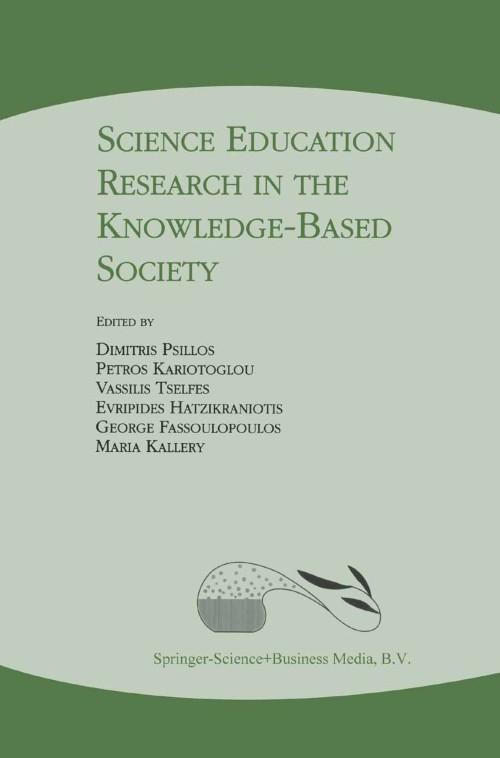
Science Education Research in the Knowledge-Based Society [electronic resource] / edited by Dimitris Psillos, Petros Kariotoglou, Vassilis Tselfes, Euripides Hatzikraniotis, George Fassoulopoulos, Maria Kallery.
Erişim Adresi
ISBN
9789401701655
Dil Kodu
İngilizce
Yer Numarası
DK/7107
Basım Bildirimi
1st ed. 2003.
Yayın Bilgisi
Dordrecht : Springer Netherlands : Imprint: Springer, 2003.
Fiziksel Niteleme
XI, 481 p. online resource.
İçindekiler Notu
1: Theoretical and Methodological Approaches to Science Education Research -- Presidential Address: What can we reasonably expect of research in science education? -- Constructivism in science education: The need for a clear line of demarcation -- Overviews of the Research Presented at ESERA 2001 -- On the methodology of ‘phenomenography’ as a science education research tool -- Conversation Theory and self-learning -- Analysis of video data of secondary school science students -- Longitudinal studies — providing insight into individual themes in science learning and students’ views of their own learning -- Changing referential perspective in science classroom discourse -- 2:Learning and Understanding Science -- Students’ positions in physics education. A gendered perspective -- Situated conceptions and obstacles. The example of digestion/excretion -- About some of the difficulties in learning Thermodynamics at the University Level -- Metacognitive Experiences in the Domain of Physics: Developmental and Educational Aspects -- How children reason from data to conclusions in practical science investigations -- Mechanistic reasoning on the concept of wave surface, and on the Huygens principle -- Atomic Physics in Upper Secondary School: Layers of Conceptions in Individual Cognitive Structure -- The electric current on its way to our house and the parallel connection of the electric appliances: primary students’ (11–12) representations -- Detailed Investigation of Professional Physicists Solving Physics Tasks -- Learning from writing in secondary science: A case study of students’ composing strategies -- Seventh-grade pupils’ epistemic views in the context of model-based instruction -- Nonlinear Analysis of the Effect of Working-Memory Capacity on Student Performance in ProblemSolving -- The Nature Of Growth In Children’s Science Understandings: Insights From A Longitudinal Study -- HOCS Problem solving Vs. LOCS exercise solving: What do college science students prefer? -- 3 :Teaching and Communicating Science -- Science and Technology Education: A high priority political concern in Europe -- A mesoscopic model of liquids for teaching fluids statics -- The importance of weightlessness and tides in teaching gravitation -- Making decisions about biological conservation issues in peer group discussion -- Discourse in the laboratory: quality in argumentative and epistemic operations -- Modelling the evolution of teaching -learning sequences: From discovery to constructivism -- Nonlinear Physics in Upper Physics Classes: Educational Reconstruction as a Frame for Development and Research in a Study of Teaching and Learning Basic Ideas of Nonlinearity -- Promoting Understanding through Representational Redescription: an exploration referring to young pupils’ ideas about gravity -- Different types of classroom debates on biotechnology. Are these simply an exercise in rhetoric or do they encourage a well-founded critical attitude? -- 4: Science Education and Information and Communication Technologies -- WISE Research — Promoting International Collaboration -- Research about the use of information technology in science education -- Physics Learning and Microcomputer Based Laboratory (MBL) — Learning effects of using MBL as a technological and as a cognitive tool -- Phenomenographical Approach to Design for a Hypertext Teacher’s Guide to MBL -- Application of a framework appropriate for a multilevel assessment of educational multimedia software in science (FEVES) -- Brain Research in Science Education Research -- Computer modelling and simulation in sciencelessons: using research into teachers’ transformations to inform training -- 5: Science Teachers: Knowledge and Practices -- Exploring science teachers’ pedagogical content knowledge -- Relating research in didactics and actual teaching practice: impact and virtues of critical details -- Transforming the Standard Instrument for Assessing Science Teacher’s Self-Efficacy Beliefs (STEBI) For Use in Denmark -- Teachers’ confidence in primary science and teacher-student interactions -- Teachers’ views and attitudes towards the communication code and the rhetoric used in press science articles -- Science teachers’ perceptions of the current situation of planetary emergency -- 6: International Research and Development Projects -- A European Research Project for New Challenges in Science Teacher Training -- Quality Development Projects in Science Education -- Video-Based Studies on Investigating Deficiencies of School Science Teaching -- Authors Index.
Özet, vb.
We are pleased to present the ESERA 2001 Conference book, which is based on contributions submitted and presented to the Third International Conference "Science Education Research in the Knowledge Based Society" that was organised by the Department of Primary Education of the Aristotle University of Thessaloniki and held in Thessaloniki from August 21 to August 26, 2001. The focus of the Conference was to discuss the scope, methods, outcomes and perspectives of research in science education in the context of the rapidly developing knowledge-based society. Some 450 researchers, teachers, and postgraduate students attended the conference. They came mainly from European countries, with a substantial proportion - some 20- from countries outside Europe. While ESERA conferences reflect research carried out in Europe, they are increasingly becoming international events attracting researchers from all over the world. A total of 220 works were presented in guest lectures, symposia, poster workshops, individual papers and poster sessions that took place during the conference along with alternative activities and informal meetings. All these of the Conference (edited by works are already published in the Proceedings D. Psillos, P. Kariotoglou, V.Tselfes, G.Bisdikian, G.Fassoulopoulos, E. Hatzikraniotis, M.Kallery).
Konu
Science __ Study and teaching.
Learning, Psychology of.
Educational technology.
Teachers __ Training of.
Science Education.
Instructional Psychology.
Digital Education and Educational Technology.
Teaching and Teacher Education.
Learning, Psychology of.
Educational technology.
Teachers __ Training of.
Science Education.
Instructional Psychology.
Digital Education and Educational Technology.
Teaching and Teacher Education.
Diğer Yazarlar
Kurum Adı
Eseri Alıntıla
Referansları kullanmadan önce gözden geçirmeniz ve varsa gerekli düzeltmeleri yapmanız önerilir.
Dijital Kaynak
MARC Görünümü
LEADER 09156nam a22006615i 4500
001 805793
003 TR_AnAIT
005 20260127000825
007 cr nn 008mamaa
008 130220s2003 ne | s |||| 0|eng d
020 |a9789401701655|9978-94-017-0165-5
024 7 |a10.1007/978-94-017-0165-5|2doi
041 |aeng
049 |aTürk Tarih Kurumu Kütüphanesi
050 4|aQ181-183.4
072 7|aJNU|2bicssc
072 7|aPD|2bicssc
072 7|aSCI063000|2bisacsh
072 7|aJNU|2thema
072 7|aPD|2thema
082 04|a507.1|223
090 |aDK/7107
245 10|aScience Education Research in the Knowledge-Based Society|h[electronic resource] /|cedited by Dimitris Psillos, Petros Kariotoglou, Vassilis Tselfes, Euripides Hatzikraniotis, George Fassoulopoulos, Maria Kallery.
250 |a1st ed. 2003.
264 1|aDordrecht :|bSpringer Netherlands :|bImprint: Springer,|c2003.
300 |aXI, 481 p.|bonline resource.
336 |atext|btxt|2rdacontent
337 |acomputer|bc|2rdamedia
338 |aonline resource|bcr|2rdacarrier
347 |atext file|bPDF|2rda
505 0 |a1: Theoretical and Methodological Approaches to Science Education Research -- Presidential Address: What can we reasonably expect of research in science education? -- Constructivism in science education: The need for a clear line of demarcation -- Overviews of the Research Presented at ESERA 2001 -- On the methodology of ‘phenomenography’ as a science education research tool -- Conversation Theory and self-learning -- Analysis of video data of secondary school science students -- Longitudinal studies — providing insight into individual themes in science learning and students’ views of their own learning -- Changing referential perspective in science classroom discourse -- 2:Learning and Understanding Science -- Students’ positions in physics education. A gendered perspective -- Situated conceptions and obstacles. The example of digestion/excretion -- About some of the difficulties in learning Thermodynamics at the University Level -- Metacognitive Experiences in the Domain of Physics: Developmental and Educational Aspects -- How children reason from data to conclusions in practical science investigations -- Mechanistic reasoning on the concept of wave surface, and on the Huygens principle -- Atomic Physics in Upper Secondary School: Layers of Conceptions in Individual Cognitive Structure -- The electric current on its way to our house and the parallel connection of the electric appliances: primary students’ (11–12) representations -- Detailed Investigation of Professional Physicists Solving Physics Tasks -- Learning from writing in secondary science: A case study of students’ composing strategies -- Seventh-grade pupils’ epistemic views in the context of model-based instruction -- Nonlinear Analysis of the Effect of Working-Memory Capacity on Student Performance in ProblemSolving -- The Nature Of Growth In Children’s Science Understandings: Insights From A Longitudinal Study -- HOCS Problem solving Vs. LOCS exercise solving: What do college science students prefer? -- 3 :Teaching and Communicating Science -- Science and Technology Education: A high priority political concern in Europe -- A mesoscopic model of liquids for teaching fluids statics -- The importance of weightlessness and tides in teaching gravitation -- Making decisions about biological conservation issues in peer group discussion -- Discourse in the laboratory: quality in argumentative and epistemic operations -- Modelling the evolution of teaching -learning sequences: From discovery to constructivism -- Nonlinear Physics in Upper Physics Classes: Educational Reconstruction as a Frame for Development and Research in a Study of Teaching and Learning Basic Ideas of Nonlinearity -- Promoting Understanding through Representational Redescription: an exploration referring to young pupils’ ideas about gravity -- Different types of classroom debates on biotechnology. Are these simply an exercise in rhetoric or do they encourage a well-founded critical attitude? -- 4: Science Education and Information and Communication Technologies -- WISE Research — Promoting International Collaboration -- Research about the use of information technology in science education -- Physics Learning and Microcomputer Based Laboratory (MBL) — Learning effects of using MBL as a technological and as a cognitive tool -- Phenomenographical Approach to Design for a Hypertext Teacher’s Guide to MBL -- Application of a framework appropriate for a multilevel assessment of educational multimedia software in science (FEVES) -- Brain Research in Science Education Research -- Computer modelling and simulation in sciencelessons: using research into teachers’ transformations to inform training -- 5: Science Teachers: Knowledge and Practices -- Exploring science teachers’ pedagogical content knowledge -- Relating research in didactics and actual teaching practice: impact and virtues of critical details -- Transforming the Standard Instrument for Assessing Science Teacher’s Self-Efficacy Beliefs (STEBI) For Use in Denmark -- Teachers’ confidence in primary science and teacher-student interactions -- Teachers’ views and attitudes towards the communication code and the rhetoric used in press science articles -- Science teachers’ perceptions of the current situation of planetary emergency -- 6: International Research and Development Projects -- A European Research Project for New Challenges in Science Teacher Training -- Quality Development Projects in Science Education -- Video-Based Studies on Investigating Deficiencies of School Science Teaching -- Authors Index.
520 |aWe are pleased to present the ESERA 2001 Conference book, which is based on contributions submitted and presented to the Third International Conference "Science Education Research in the Knowledge Based Society" that was organised by the Department of Primary Education of the Aristotle University of Thessaloniki and held in Thessaloniki from August 21 to August 26, 2001. The focus of the Conference was to discuss the scope, methods, outcomes and perspectives of research in science education in the context of the rapidly developing knowledge-based society. Some 450 researchers, teachers, and postgraduate students attended the conference. They came mainly from European countries, with a substantial proportion - some 20- from countries outside Europe. While ESERA conferences reflect research carried out in Europe, they are increasingly becoming international events attracting researchers from all over the world. A total of 220 works were presented in guest lectures, symposia, poster workshops, individual papers and poster sessions that took place during the conference along with alternative activities and informal meetings. All these of the Conference (edited by works are already published in the Proceedings D. Psillos, P. Kariotoglou, V.Tselfes, G.Bisdikian, G.Fassoulopoulos, E. Hatzikraniotis, M.Kallery).
532 8 |aAccessibility summary: This PDF is not accessible. It is based on scanned pages and does not support features such as screen reader compatibility or described non-text content (images, graphs etc). However, it likely supports searchable and selectable text based on OCR (Optical Character Recognition). Users with accessibility needs may not be able to use this content effectively. Please contact us at accessibilitysupport@springernature.com if you require assistance or an alternative format.
532 8 |aInaccessible, or known limited accessibility
532 8 |aNo reading system accessibility options actively disabled
532 8 |aPublisher contact for further accessibility information: accessibilitysupport@springernature.com
650 0|aScience|xStudy and teaching.
650 0|aLearning, Psychology of.
650 0|aEducational technology.
650 0|aTeachers|xTraining of.
650 14|aScience Education.
650 24|aInstructional Psychology.
650 24|aDigital Education and Educational Technology.
650 24|aTeaching and Teacher Education.
700 1 |aPsillos, Dimitris.|eeditor.|4edt|4http://id.loc.gov/vocabulary/relators/edt
700 1 |aKariotoglou, Petros.|eeditor.|4edt|4http://id.loc.gov/vocabulary/relators/edt
700 1 |aTselfes, Vassilis.|eeditor.|4edt|4http://id.loc.gov/vocabulary/relators/edt
700 1 |aHatzikraniotis, Euripides.|eeditor.|4edt|4http://id.loc.gov/vocabulary/relators/edt
700 1 |aFassoulopoulos, George.|eeditor.|4edt|4http://id.loc.gov/vocabulary/relators/edt
700 1 |aKallery, Maria.|eeditor.|4edt|4http://id.loc.gov/vocabulary/relators/edt
710 2 |aSpringerLink (Online service)
773 0 |tSpringer Nature eBook
776 08|iPrinted edition:|z9781402014123
776 08|iPrinted edition:|z9789048163373
776 08|iPrinted edition:|z9789401701662
856 40|uhttps://doi.org/10.1007/978-94-017-0165-5
912 |aZDB-2-SHU
912 |aZDB-2-SXED
912 |aZDB-2-BAE
950 |aHumanities, Social Sciences and Law (SpringerNature-11648)
950 |aEducation (R0) (SpringerNature-43721)
001 805793
003 TR_AnAIT
005 20260127000825
007 cr nn 008mamaa
008 130220s2003 ne | s |||| 0|eng d
020 |a9789401701655|9978-94-017-0165-5
024 7 |a10.1007/978-94-017-0165-5|2doi
041 |aeng
049 |aTürk Tarih Kurumu Kütüphanesi
050 4|aQ181-183.4
072 7|aJNU|2bicssc
072 7|aPD|2bicssc
072 7|aSCI063000|2bisacsh
072 7|aJNU|2thema
072 7|aPD|2thema
082 04|a507.1|223
090 |aDK/7107
245 10|aScience Education Research in the Knowledge-Based Society|h[electronic resource] /|cedited by Dimitris Psillos, Petros Kariotoglou, Vassilis Tselfes, Euripides Hatzikraniotis, George Fassoulopoulos, Maria Kallery.
250 |a1st ed. 2003.
264 1|aDordrecht :|bSpringer Netherlands :|bImprint: Springer,|c2003.
300 |aXI, 481 p.|bonline resource.
336 |atext|btxt|2rdacontent
337 |acomputer|bc|2rdamedia
338 |aonline resource|bcr|2rdacarrier
347 |atext file|bPDF|2rda
505 0 |a1: Theoretical and Methodological Approaches to Science Education Research -- Presidential Address: What can we reasonably expect of research in science education? -- Constructivism in science education: The need for a clear line of demarcation -- Overviews of the Research Presented at ESERA 2001 -- On the methodology of ‘phenomenography’ as a science education research tool -- Conversation Theory and self-learning -- Analysis of video data of secondary school science students -- Longitudinal studies — providing insight into individual themes in science learning and students’ views of their own learning -- Changing referential perspective in science classroom discourse -- 2:Learning and Understanding Science -- Students’ positions in physics education. A gendered perspective -- Situated conceptions and obstacles. The example of digestion/excretion -- About some of the difficulties in learning Thermodynamics at the University Level -- Metacognitive Experiences in the Domain of Physics: Developmental and Educational Aspects -- How children reason from data to conclusions in practical science investigations -- Mechanistic reasoning on the concept of wave surface, and on the Huygens principle -- Atomic Physics in Upper Secondary School: Layers of Conceptions in Individual Cognitive Structure -- The electric current on its way to our house and the parallel connection of the electric appliances: primary students’ (11–12) representations -- Detailed Investigation of Professional Physicists Solving Physics Tasks -- Learning from writing in secondary science: A case study of students’ composing strategies -- Seventh-grade pupils’ epistemic views in the context of model-based instruction -- Nonlinear Analysis of the Effect of Working-Memory Capacity on Student Performance in ProblemSolving -- The Nature Of Growth In Children’s Science Understandings: Insights From A Longitudinal Study -- HOCS Problem solving Vs. LOCS exercise solving: What do college science students prefer? -- 3 :Teaching and Communicating Science -- Science and Technology Education: A high priority political concern in Europe -- A mesoscopic model of liquids for teaching fluids statics -- The importance of weightlessness and tides in teaching gravitation -- Making decisions about biological conservation issues in peer group discussion -- Discourse in the laboratory: quality in argumentative and epistemic operations -- Modelling the evolution of teaching -learning sequences: From discovery to constructivism -- Nonlinear Physics in Upper Physics Classes: Educational Reconstruction as a Frame for Development and Research in a Study of Teaching and Learning Basic Ideas of Nonlinearity -- Promoting Understanding through Representational Redescription: an exploration referring to young pupils’ ideas about gravity -- Different types of classroom debates on biotechnology. Are these simply an exercise in rhetoric or do they encourage a well-founded critical attitude? -- 4: Science Education and Information and Communication Technologies -- WISE Research — Promoting International Collaboration -- Research about the use of information technology in science education -- Physics Learning and Microcomputer Based Laboratory (MBL) — Learning effects of using MBL as a technological and as a cognitive tool -- Phenomenographical Approach to Design for a Hypertext Teacher’s Guide to MBL -- Application of a framework appropriate for a multilevel assessment of educational multimedia software in science (FEVES) -- Brain Research in Science Education Research -- Computer modelling and simulation in sciencelessons: using research into teachers’ transformations to inform training -- 5: Science Teachers: Knowledge and Practices -- Exploring science teachers’ pedagogical content knowledge -- Relating research in didactics and actual teaching practice: impact and virtues of critical details -- Transforming the Standard Instrument for Assessing Science Teacher’s Self-Efficacy Beliefs (STEBI) For Use in Denmark -- Teachers’ confidence in primary science and teacher-student interactions -- Teachers’ views and attitudes towards the communication code and the rhetoric used in press science articles -- Science teachers’ perceptions of the current situation of planetary emergency -- 6: International Research and Development Projects -- A European Research Project for New Challenges in Science Teacher Training -- Quality Development Projects in Science Education -- Video-Based Studies on Investigating Deficiencies of School Science Teaching -- Authors Index.
520 |aWe are pleased to present the ESERA 2001 Conference book, which is based on contributions submitted and presented to the Third International Conference "Science Education Research in the Knowledge Based Society" that was organised by the Department of Primary Education of the Aristotle University of Thessaloniki and held in Thessaloniki from August 21 to August 26, 2001. The focus of the Conference was to discuss the scope, methods, outcomes and perspectives of research in science education in the context of the rapidly developing knowledge-based society. Some 450 researchers, teachers, and postgraduate students attended the conference. They came mainly from European countries, with a substantial proportion - some 20- from countries outside Europe. While ESERA conferences reflect research carried out in Europe, they are increasingly becoming international events attracting researchers from all over the world. A total of 220 works were presented in guest lectures, symposia, poster workshops, individual papers and poster sessions that took place during the conference along with alternative activities and informal meetings. All these of the Conference (edited by works are already published in the Proceedings D. Psillos, P. Kariotoglou, V.Tselfes, G.Bisdikian, G.Fassoulopoulos, E. Hatzikraniotis, M.Kallery).
532 8 |aAccessibility summary: This PDF is not accessible. It is based on scanned pages and does not support features such as screen reader compatibility or described non-text content (images, graphs etc). However, it likely supports searchable and selectable text based on OCR (Optical Character Recognition). Users with accessibility needs may not be able to use this content effectively. Please contact us at accessibilitysupport@springernature.com if you require assistance or an alternative format.
532 8 |aInaccessible, or known limited accessibility
532 8 |aNo reading system accessibility options actively disabled
532 8 |aPublisher contact for further accessibility information: accessibilitysupport@springernature.com
650 0|aScience|xStudy and teaching.
650 0|aLearning, Psychology of.
650 0|aEducational technology.
650 0|aTeachers|xTraining of.
650 14|aScience Education.
650 24|aInstructional Psychology.
650 24|aDigital Education and Educational Technology.
650 24|aTeaching and Teacher Education.
700 1 |aPsillos, Dimitris.|eeditor.|4edt|4http://id.loc.gov/vocabulary/relators/edt
700 1 |aKariotoglou, Petros.|eeditor.|4edt|4http://id.loc.gov/vocabulary/relators/edt
700 1 |aTselfes, Vassilis.|eeditor.|4edt|4http://id.loc.gov/vocabulary/relators/edt
700 1 |aHatzikraniotis, Euripides.|eeditor.|4edt|4http://id.loc.gov/vocabulary/relators/edt
700 1 |aFassoulopoulos, George.|eeditor.|4edt|4http://id.loc.gov/vocabulary/relators/edt
700 1 |aKallery, Maria.|eeditor.|4edt|4http://id.loc.gov/vocabulary/relators/edt
710 2 |aSpringerLink (Online service)
773 0 |tSpringer Nature eBook
776 08|iPrinted edition:|z9781402014123
776 08|iPrinted edition:|z9789048163373
776 08|iPrinted edition:|z9789401701662
856 40|uhttps://doi.org/10.1007/978-94-017-0165-5
912 |aZDB-2-SHU
912 |aZDB-2-SXED
912 |aZDB-2-BAE
950 |aHumanities, Social Sciences and Law (SpringerNature-11648)
950 |aEducation (R0) (SpringerNature-43721)
Materyaller
Depodan talep edilen materyal sadece kütüphane içerisinde kullanılmaktadır.
Materyal dışarıya ödünç verilmemektedir.
Materyal dışarıya ödünç verilmemektedir.
