

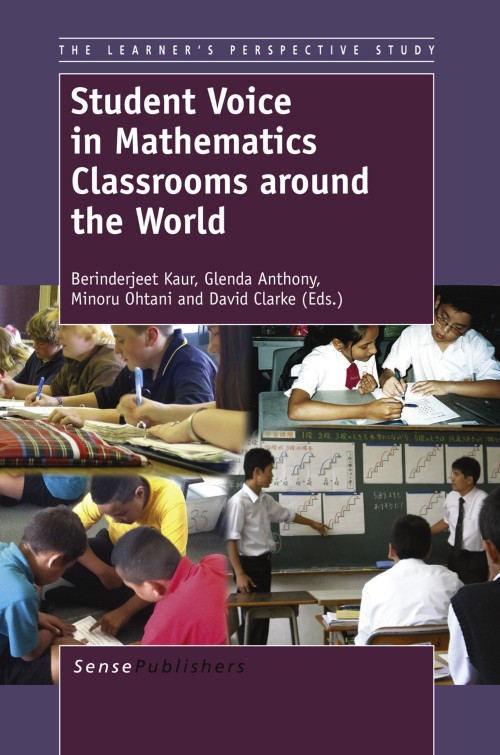
Student Voice in Mathematics Classrooms around the World [electronic resource] / edited by Berinderjeet Kaur, Glenda Anthony, Minoru Ohtani, David Clarke.
Erişim Adresi
ISBN
9789462093508
Dil Kodu
İngilizce
Yer Numarası
DK/7108
Basım Bildirimi
1st ed. 2013.
Yayın Bilgisi
Rotterdam : SensePublishers : Imprint: SensePublishers, 2013.
Fiziksel Niteleme
VIII, 317 p. online resource.
Dizi
Learner’s Perspective Study
Özet, vb.
The Learner's Perspective Study ascribes to the premise that the investigation of social practice within the mathematics classrooms must attend to the learners’ practice with at least the same priority as that accorded to the teachers’ practice. In focusing on student voice within this partnership, as enacted in many different guises across different cultures and socio-political learning environments, we hope that we will be better informed to understand the relationship between pedagogy and learning mathematics, and between pedagogy and the empowerment of diverse learners. Research findings from the Learner's Perspective Study reported in this book and its companion volumes affirm just how culturally-situated are the practices of classrooms around the world and the extent to which students are collaborators with the teacher, complicit in the development and enactment of patterns of participation that reflect individual, societal and cultural priorities and associated value systems. In this book, we attend closely to this collaboration with our focus on the voice of the student. Collectively, the authors consider how the deliberate inclusion of student voice can be used to enhance our understandings of mathematics classrooms, of mathematics learning, and of mathematics outcomes for students in classrooms around the world. The Learner’s Perspective Study aims to juxtapose the observable practices of the classroom and the meanings attributed to those practices by classroom participants. The LPS research design documents sequences of at least ten lessons, using three video cameras, supplemented by the reconstructive accounts of classroom participants obtained in post-lesson video-stimulated interviews, and by test and questionnaire data, and copies of student written material. In each participating country, data generation focuses on the classrooms of three teachers, identified by the local mathematics education community as competent, and situated indemographically different school communities within the one major city. The large body of complex data supports both the characterization of practice in the classrooms of competent teachers and the development of theory.
Konu
Education.
Education.
Education.
Kurum Adı
Eseri Alıntıla
Referansları kullanmadan önce gözden geçirmeniz ve varsa gerekli düzeltmeleri yapmanız önerilir.
Dijital Kaynak
MARC Görünümü
LEADER 04713nam a22004815i 4500
001 805794
003 TR_AnAIT
005 20260127000827
007 cr nn 008mamaa
008 130906s2013 ne | s |||| 0|eng d
020 |a9789462093508|9978-94-6209-350-8
024 7 |a10.1007/978-94-6209-350-8|2doi
041 |aeng
049 |aTürk Tarih Kurumu Kütüphanesi
050 4|aL1-991
072 7|aJN|2bicssc
072 7|aEDU000000|2bisacsh
072 7|aJN|2thema
082 04|a370|223
090 |aDK/7108
245 10|aStudent Voice in Mathematics Classrooms around the World|h[electronic resource] /|cedited by Berinderjeet Kaur, Glenda Anthony, Minoru Ohtani, David Clarke.
250 |a1st ed. 2013.
264 1|aRotterdam :|bSensePublishers :|bImprint: SensePublishers,|c2013.
300 |aVIII, 317 p.|bonline resource.
336 |atext|btxt|2rdacontent
337 |acomputer|bc|2rdamedia
338 |aonline resource|bcr|2rdacarrier
347 |atext file|bPDF|2rda
490 1 |aLearner’s Perspective Study
520 |aThe Learner's Perspective Study ascribes to the premise that the investigation of social practice within the mathematics classrooms must attend to the learners’ practice with at least the same priority as that accorded to the teachers’ practice. In focusing on student voice within this partnership, as enacted in many different guises across different cultures and socio-political learning environments, we hope that we will be better informed to understand the relationship between pedagogy and learning mathematics, and between pedagogy and the empowerment of diverse learners. Research findings from the Learner's Perspective Study reported in this book and its companion volumes affirm just how culturally-situated are the practices of classrooms around the world and the extent to which students are collaborators with the teacher, complicit in the development and enactment of patterns of participation that reflect individual, societal and cultural priorities and associated value systems. In this book, we attend closely to this collaboration with our focus on the voice of the student. Collectively, the authors consider how the deliberate inclusion of student voice can be used to enhance our understandings of mathematics classrooms, of mathematics learning, and of mathematics outcomes for students in classrooms around the world. The Learner’s Perspective Study aims to juxtapose the observable practices of the classroom and the meanings attributed to those practices by classroom participants. The LPS research design documents sequences of at least ten lessons, using three video cameras, supplemented by the reconstructive accounts of classroom participants obtained in post-lesson video-stimulated interviews, and by test and questionnaire data, and copies of student written material. In each participating country, data generation focuses on the classrooms of three teachers, identified by the local mathematics education community as competent, and situated indemographically different school communities within the one major city. The large body of complex data supports both the characterization of practice in the classrooms of competent teachers and the development of theory.
532 8 |aAccessibility summary: This PDF eBook is produced by a third-party. We have requested that the file be made accessible and compliant with the European Accessibility Act (EAA). However, we have not been able to fully verify its compliance with recognized accessibility standards (such as PDF/UA or WCAG). For detailed accessibility information, please refer to the original publisher’s website. If you require an accessible version of this content, please contact accessibilitysupport@springernature.com. We are committed to improving accessibility and will work with the publisher to meet your needs wherever possible.
532 8 |aPublisher contact for further accessibility information: accessibilitysupport@springernature.com
650 0|aEducation.
650 14|aEducation.
700 1 |aKaur, Berinderjeet.|eeditor.|4edt|4http://id.loc.gov/vocabulary/relators/edt
700 1 |aAnthony, Glenda.|eeditor.|4edt|4http://id.loc.gov/vocabulary/relators/edt
700 1 |aOhtani, Minoru.|eeditor.|4edt|4http://id.loc.gov/vocabulary/relators/edt
700 1 |aClarke, David.|eeditor.|4edt|4http://id.loc.gov/vocabulary/relators/edt
710 2 |aSpringerLink (Online service)
773 0 |tSpringer Nature eBook
830 0|aLearner’s Perspective Study
856 40|uhttps://doi.org/10.1007/978-94-6209-350-8
912 |aZDB-2-SHU
912 |aZDB-2-SXED
950 |aHumanities, Social Sciences and Law (SpringerNature-11648)
950 |aEducation (R0) (SpringerNature-43721)
Materyaller
Depodan talep edilen materyal sadece kütüphane içerisinde kullanılmaktadır.
Materyal dışarıya ödünç verilmemektedir.
Materyal dışarıya ödünç verilmemektedir.
