LEADER 04533nam a22006375i 4500
001 805820
003 TR_AnAIT
005 20260127000855
007 cr nn 008mamaa
008 130321s2003 ne | s |||| 0|eng d
020 |a9789401707817|9978-94-017-0781-7
024 7 |a10.1007/978-94-017-0781-7|2doi
041 |aeng
049 |aTürk Tarih Kurumu Kütüphanesi
050 4|aL1-991
072 7|aJN|2bicssc
072 7|aEDU000000|2bisacsh
072 7|aJN|2thema
082 04|a370|223
090 |aDK/7134
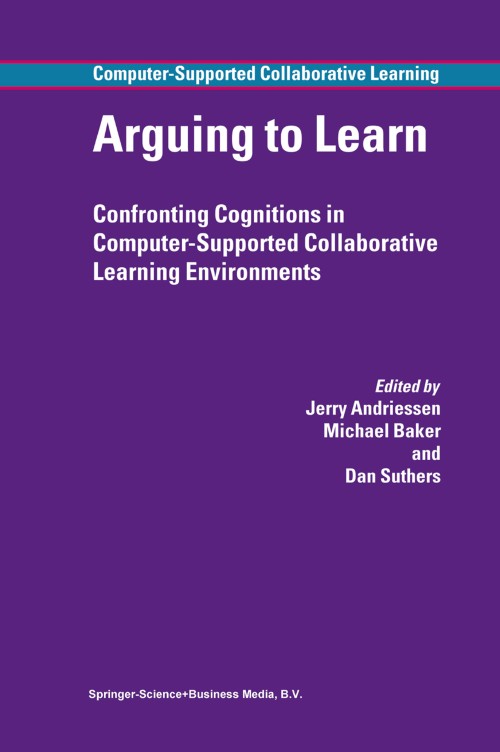
245 10|aArguing to Learn|h[electronic resource] :|bConfronting Cognitions in Computer-Supported Collaborative Learning Environments /|cedited by Jerry Andriessen, Michael Baker, Dan D. Suthers.
250 |a1st ed. 2003.
264 1|aDordrecht :|bSpringer Netherlands :|bImprint: Springer,|c2003.
300 |aIX, 269 p.|bonline resource.
336 |atext|btxt|2rdacontent
337 |acomputer|bc|2rdamedia
338 |aonline resource|bcr|2rdacarrier
347 |atext file|bPDF|2rda
490 1 |aComputer-Supported Collaborative Learning Series,|x2543-0157 ;|v1
505 0 |aTable of Contens -- 1 Argumentation, Computer Support, and the Educational Context of Confronting Cognitions -- 2 Representational Guidance for Collaborative Inquiry -- 3 Computer-Mediated Argumentative Interactions for the Co-Elaboration of Scientific Notions -- 4 Argumentation as Negotiation in Electronic Collaborative Writing -- 5 Constructive Discussions through Electronic Dialogue -- 6 Using CMC to Develop Argumentation Skills in Children with a ‘Literacy Deficit’ -- 7 Designing External Representations to Support Solving Wicked Problems -- 8 Elaborating New Arguments through a CSCL Script -- 9 The Blind and the Paralytic: Supporting Argumentation in Everyday and Scientific Issues -- 10 CSCL, Argumentation, and Deweyan Inquiry: Argumentation is Learning.
520 |aArguing to Learn: Confronting Cognitions in Computer-Supported Collaborative Learning Environments focuses on how new pedagogical scenarios, task environments and communication tools within Computer-Supported Collaborative Learning (CSCL) environments can favour collaborative and productive confrontations of ideas, evidence, arguments and explanations, or arguing to learn. This book is the first that has assembled the work of internationally renowned scholars on argumentation-related CSCL research. All chapters present in-depth analyses of the processes by which the interactive confrontation of cognitions can lead to collaborative learning, on the basis of a wide variety of theoretical models, empirical data and Internet-based tools.
532 8 |aAccessibility summary: This PDF is not accessible. It is based on scanned pages and does not support features such as screen reader compatibility or described non-text content (images, graphs etc). However, it likely supports searchable and selectable text based on OCR (Optical Character Recognition). Users with accessibility needs may not be able to use this content effectively. Please contact us at accessibilitysupport@springernature.com if you require assistance or an alternative format.
532 8 |aInaccessible, or known limited accessibility
532 8 |aNo reading system accessibility options actively disabled
532 8 |aPublisher contact for further accessibility information: accessibilitysupport@springernature.com
650 0|aEducation.
650 0|aEducational technology.
650 0|aUser interfaces (Computer systems).
650 0|aHuman-computer interaction.
650 0|aLogic.
650 14|aEducation.
650 24|aDigital Education and Educational Technology.
650 24|aUser Interfaces and Human Computer Interaction.
650 24|aLogic.
700 1 |aAndriessen, Jerry.|eeditor.|4edt|4http://id.loc.gov/vocabulary/relators/edt
700 1 |aBaker, Michael.|eeditor.|4edt|4http://id.loc.gov/vocabulary/relators/edt
700 1 |aSuthers, Dan D.|eeditor.|4edt|4http://id.loc.gov/vocabulary/relators/edt
710 2 |aSpringerLink (Online service)
773 0 |tSpringer Nature eBook
776 08|iPrinted edition:|z9781402013829
776 08|iPrinted edition:|z9789048163205
776 08|iPrinted edition:|z9789401707824
830 0|aComputer-Supported Collaborative Learning Series,|x2543-0157 ;|v1
856 40|uhttps://doi.org/10.1007/978-94-017-0781-7
912 |aZDB-2-SHU
912 |aZDB-2-SXED
912 |aZDB-2-BAE
950 |aHumanities, Social Sciences and Law (SpringerNature-11648)
950 |aEducation (R0) (SpringerNature-43721)