LEADER 03651nam a22006015i 4500
001 805847
003 TR_AnAIT
005 20260127000925
007 cr nn 008mamaa
008 130220s2003 ne | s |||| 0|eng d
020 |a9789401708234|9978-94-017-0823-4
024 7 |a10.1007/978-94-017-0823-4|2doi
041 |aeng
049 |aTürk Tarih Kurumu Kütüphanesi
050 4|aK201-487
072 7|aLAB|2bicssc
072 7|aPHI000000|2bisacsh
072 7|aLAB|2thema
082 04|a340.1|223
090 |aDK/7161
100 1 |aSantoro, Emilio.|eauthor.|4aut|4http://id.loc.gov/vocabulary/relators/aut
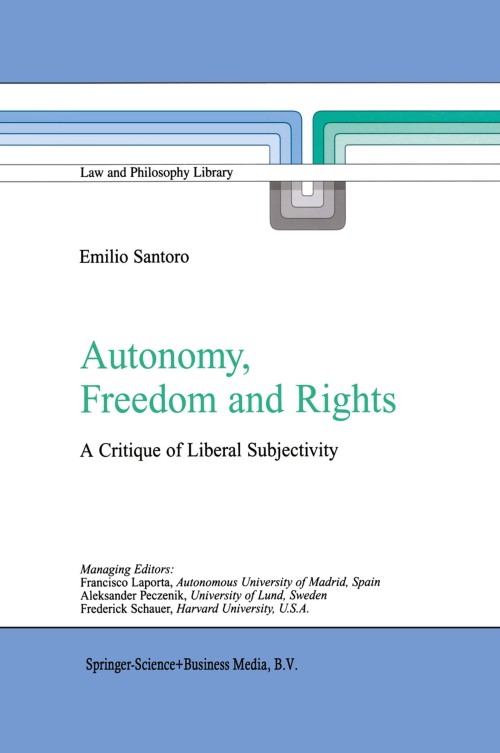
245 10|aAutonomy, Freedom and Rights|h[electronic resource] :|bA Critique of Liberal Subjectivity /|cby Emilio Santoro.
250 |a1st ed. 2003.
264 1|aDordrecht :|bSpringer Netherlands :|bImprint: Springer,|c2003.
300 |aX, 294 p.|bonline resource.
336 |atext|btxt|2rdacontent
337 |acomputer|bc|2rdamedia
338 |aonline resource|bcr|2rdacarrier
347 |atext file|bPDF|2rda
490 1 |aLaw and Philosophy Library,|x2215-0315 ;|v65
505 0 |a1. Individual Autonomy and Freedom -- 2. A Genealogical Approach -- 3. Neo-Contractarianism and the Double Order of Desires -- Conclusion -- References.
520 |aAutonomy, viewed as a subject's autonomous designing of her own distinctive 'individuality', is not a constitutive problem for liberal theory. Since its earliest formulations, liberalism has taken it for granted that protecting rights is a sufficient guarantee for the primacy of individual subjectivity. The most dangerous legacy of the 'hierarchical-dualist' representation of the subject is the primacy given to reason in defining an individual's identity. For Santoro freedom is not a fixed measure. It is not the container of powers and rights defining an individual's role and identity. It is rather the outcome of a process whereby individuals continuously re-define the shape of their individuality. Freedom is everything that each of us manages to be in his or her active and uncertain opposition to external 'pressures'.
532 8 |aAccessibility summary: This PDF is not accessible. It is based on scanned pages and does not support features such as screen reader compatibility or described non-text content (images, graphs etc). However, it likely supports searchable and selectable text based on OCR (Optical Character Recognition). Users with accessibility needs may not be able to use this content effectively. Please contact us at accessibilitysupport@springernature.com if you require assistance or an alternative format.
532 8 |aInaccessible, or known limited accessibility
532 8 |aNo reading system accessibility options actively disabled
532 8 |aPublisher contact for further accessibility information: accessibilitysupport@springernature.com
650 0|aLaw|xPhilosophy.
650 0|aPolitical science.
650 0|aLaw|xHistory.
650 0|aPhilosophy.
650 14|aPhilosophy of Law.
650 24|aPolitical Science.
650 24|aTheories of Law, Philosophy of Law, Legal History.
650 24|aPhilosophy.
710 2 |aSpringerLink (Online service)
773 0 |tSpringer Nature eBook
776 08|iPrinted edition:|z9781402014048
776 08|iPrinted edition:|z9789048163304
776 08|iPrinted edition:|z9789401708241
830 0|aLaw and Philosophy Library,|x2215-0315 ;|v65
856 40|uhttps://doi.org/10.1007/978-94-017-0823-4
912 |aZDB-2-SHU
912 |aZDB-2-SXPR
912 |aZDB-2-BAE
950 |aHumanities, Social Sciences and Law (SpringerNature-11648)
950 |aPhilosophy and Religion (R0) (SpringerNature-43725)