

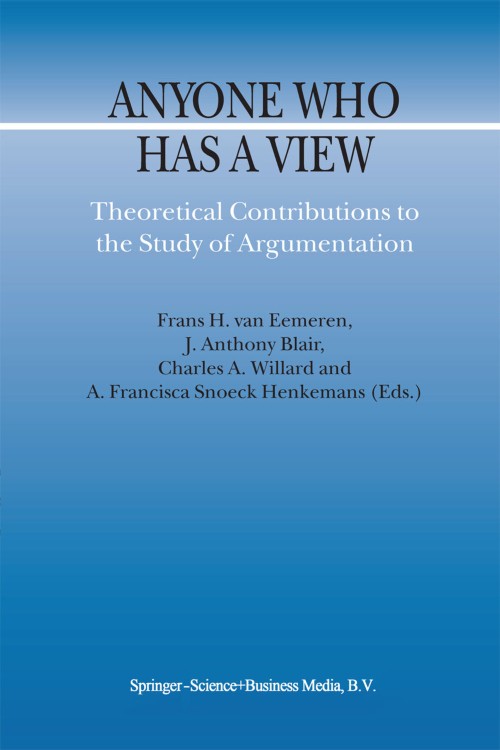
Anyone Who Has a View [electronic resource] : Theoretical Contributions to the Study of Argumentation / edited by F.H. van Eemeren, J. Anthony Blair, Charles A. Willard, A. Francisca Snoeck Henkemans.
Erişim Adresi
ISBN
9789400710788
Dil Kodu
İngilizce
Yer Numarası
DK/7175
Basım Bildirimi
1st ed. 2003.
Yayın Bilgisi
Dordrecht : Springer Netherlands : Imprint: Springer, 2003.
Fiziksel Niteleme
VII, 347 p. online resource.
Dizi
Argumentation Library, 2215-1907 ; 8
İçindekiler Notu
1. Reasons -- 2. The Pragmatic Dimension of Premise Acceptability -- 3. Rationality and Judgment -- 4. The Dialectical Tier Revisited -- 5. The Rabbit in the Hat: The Internal Relations of the Pragma-Dialectical Rules -- 6. Toulmin’s Warrants -- 7. Metadialogues -- 8. Relationships Among Logic, Dialectic and Rhetoric -- 9. Logical Fallacies, Dialectical Transgressions, Rhetorical Sins, and Other Failures of Rationality In Argumentation -- 10. A Pragmatic View of the Burden of Proof -- 11. The Ordinary Practice of Presuming and Presumption With Special Attention to Veracity and the Burden Of Proof -- 12. Two Conceptions of Openness in Argumentation Theory -- 13. Multidimensionality and Non-Deductiveness in Deliberative Argumentation -- 14. Argumentation Studies in France: A New Legitimacy -- 15. Discourse Correspondence Between Argumentative and Grammatical Sequences -- 16. Diagramming, Argumentation Schemes and Critical Questions -- 17. Legal Argumentation Theory and the Concept of Law -- 18. Arguer’sObligations: Another Perspective -- 19. Charles S. Peirce’s Theory of Abduction and the Aristotelian Enthymeme From Signs -- 20. Rhetoric and Dialectic in Martin Luther King’s ‘Letter From Birmingham Jail’ -- 21. On the Argumentative Quality of Explanatory Narratives -- 22. The Wiles of Argument: Protodeliberation and Heroic Prudence in Homer’s ‘Odyssey’ -- 23. Felicity Conditions for the Circumstantial ad Hominem: The Case of ‘Bush V. Gore’ -- 24. The Potential Conflict Between Normatively-Good Argumentative Practice and Persuasive Success: Evidence from Persuasion Effects Research -- 25. The Concept of Argument Quality in the Elaboration Likelihood Model: A Normative and Empirical Approach to Petty and Cacioppo’s ‘Strong’ and ‘Weak’ Arguments -- 26. How Narrative Argumentation Works: An Analysis of Argumentation Aimed at Reconsidering Goals -- 347.
Özet, vb.
This volume of the Argumentation Library contains a collection of twenty-six theor etical contributions to the study of argumentation. Together they provide an over view of recent developments in the theory of argumentation which does justice to the theoretical variety in the field. InAnyone Who Has a View, the subject of argu mentation is approached from different angles. Both the formal and informal logical approaches and the rhetorical and communicative approaches arc represented in various ways. We arc convinced that the collection of essays as a whole will be of interest not only to those engaged directly in the study of argumentation, but also to scholars from a variety of disciplines who arc interested in the recent developments in this field. The book opens with an essay by the informal logician Robert C. Pinto. For all the differences between them, James B. Freeman, Harvey Siegel, Ralph H. Johnson, Hans V. Hansen, and J. Anthony Blair are also prominent members of that move ment. Some informal logicians either eschew or simply do not use formal methods in their approach to argumentation, while others, such as David Hitchcock, use both formal and informal methods. Erik C.W. Krabbe is a logician who proudly defends a formal dialectical approach to argumentation. Daniel H. Cohen, Frans H. van Eemeren, Peter Houtlosser, Fred J. Kauffeld, C. Scott Jacobs, Christian Kock, Christian Plantin, Sorin Stati, Chris Reed, Douglas N.
Konu
Logic.
Social sciences.
Language and languages __ Philosophy.
Logic.
Society.
Philosophy of Language.
Social sciences.
Language and languages __ Philosophy.
Logic.
Society.
Philosophy of Language.
Diğer Yazarlar
Kurum Adı
Eseri Alıntıla
Referansları kullanmadan önce gözden geçirmeniz ve varsa gerekli düzeltmeleri yapmanız önerilir.
Dijital Kaynak
MARC Görünümü
LEADER 06382nam a22006135i 4500
001 805861
003 TR_AnAIT
005 20260127000941
007 cr nn 008mamaa
008 121227s2003 ne | s |||| 0|eng d
020 |a9789400710788|9978-94-007-1078-8
024 7 |a10.1007/978-94-007-1078-8|2doi
041 |aeng
049 |aTürk Tarih Kurumu Kütüphanesi
050 4|aBC1-199
072 7|aHPL|2bicssc
072 7|aPHI011000|2bisacsh
072 7|aQDTL|2thema
082 04|a160|223
090 |aDK/7175
245 10|aAnyone Who Has a View|h[electronic resource] :|bTheoretical Contributions to the Study of Argumentation /|cedited by F.H. van Eemeren, J. Anthony Blair, Charles A. Willard, A. Francisca Snoeck Henkemans.
250 |a1st ed. 2003.
264 1|aDordrecht :|bSpringer Netherlands :|bImprint: Springer,|c2003.
300 |aVII, 347 p.|bonline resource.
336 |atext|btxt|2rdacontent
337 |acomputer|bc|2rdamedia
338 |aonline resource|bcr|2rdacarrier
347 |atext file|bPDF|2rda
490 1 |aArgumentation Library,|x2215-1907 ;|v8
505 0 |a1. Reasons -- 2. The Pragmatic Dimension of Premise Acceptability -- 3. Rationality and Judgment -- 4. The Dialectical Tier Revisited -- 5. The Rabbit in the Hat: The Internal Relations of the Pragma-Dialectical Rules -- 6. Toulmin’s Warrants -- 7. Metadialogues -- 8. Relationships Among Logic, Dialectic and Rhetoric -- 9. Logical Fallacies, Dialectical Transgressions, Rhetorical Sins, and Other Failures of Rationality In Argumentation -- 10. A Pragmatic View of the Burden of Proof -- 11. The Ordinary Practice of Presuming and Presumption With Special Attention to Veracity and the Burden Of Proof -- 12. Two Conceptions of Openness in Argumentation Theory -- 13. Multidimensionality and Non-Deductiveness in Deliberative Argumentation -- 14. Argumentation Studies in France: A New Legitimacy -- 15. Discourse Correspondence Between Argumentative and Grammatical Sequences -- 16. Diagramming, Argumentation Schemes and Critical Questions -- 17. Legal Argumentation Theory and the Concept of Law -- 18. Arguer’sObligations: Another Perspective -- 19. Charles S. Peirce’s Theory of Abduction and the Aristotelian Enthymeme From Signs -- 20. Rhetoric and Dialectic in Martin Luther King’s ‘Letter From Birmingham Jail’ -- 21. On the Argumentative Quality of Explanatory Narratives -- 22. The Wiles of Argument: Protodeliberation and Heroic Prudence in Homer’s ‘Odyssey’ -- 23. Felicity Conditions for the Circumstantial ad Hominem: The Case of ‘Bush V. Gore’ -- 24. The Potential Conflict Between Normatively-Good Argumentative Practice and Persuasive Success: Evidence from Persuasion Effects Research -- 25. The Concept of Argument Quality in the Elaboration Likelihood Model: A Normative and Empirical Approach to Petty and Cacioppo’s ‘Strong’ and ‘Weak’ Arguments -- 26. How Narrative Argumentation Works: An Analysis of Argumentation Aimed at Reconsidering Goals -- 347.
520 |aThis volume of the Argumentation Library contains a collection of twenty-six theor etical contributions to the study of argumentation. Together they provide an over view of recent developments in the theory of argumentation which does justice to the theoretical variety in the field. InAnyone Who Has a View, the subject of argu mentation is approached from different angles. Both the formal and informal logical approaches and the rhetorical and communicative approaches arc represented in various ways. We arc convinced that the collection of essays as a whole will be of interest not only to those engaged directly in the study of argumentation, but also to scholars from a variety of disciplines who arc interested in the recent developments in this field. The book opens with an essay by the informal logician Robert C. Pinto. For all the differences between them, James B. Freeman, Harvey Siegel, Ralph H. Johnson, Hans V. Hansen, and J. Anthony Blair are also prominent members of that move ment. Some informal logicians either eschew or simply do not use formal methods in their approach to argumentation, while others, such as David Hitchcock, use both formal and informal methods. Erik C.W. Krabbe is a logician who proudly defends a formal dialectical approach to argumentation. Daniel H. Cohen, Frans H. van Eemeren, Peter Houtlosser, Fred J. Kauffeld, C. Scott Jacobs, Christian Kock, Christian Plantin, Sorin Stati, Chris Reed, Douglas N.
532 8 |aAccessibility summary: This PDF is not accessible. It is based on scanned pages and does not support features such as screen reader compatibility or described non-text content (images, graphs etc). However, it likely supports searchable and selectable text based on OCR (Optical Character Recognition). Users with accessibility needs may not be able to use this content effectively. Please contact us at accessibilitysupport@springernature.com if you require assistance or an alternative format.
532 8 |aInaccessible, or known limited accessibility
532 8 |aNo reading system accessibility options actively disabled
532 8 |aPublisher contact for further accessibility information: accessibilitysupport@springernature.com
650 0|aLogic.
650 0|aSocial sciences.
650 0|aLanguage and languages|xPhilosophy.
650 14|aLogic.
650 24|aSociety.
650 24|aPhilosophy of Language.
700 1 |avan Eemeren, F.H.|eeditor.|0(orcid)0000-0001-9298-4665|1https://orcid.org/0000-0001-9298-4665|4edt|4http://id.loc.gov/vocabulary/relators/edt
700 1 |aBlair, J. Anthony.|eeditor.|4edt|4http://id.loc.gov/vocabulary/relators/edt
700 1 |aWillard, Charles A.|eeditor.|4edt|4http://id.loc.gov/vocabulary/relators/edt
700 1 |aSnoeck Henkemans, A. Francisca.|eeditor.|4edt|4http://id.loc.gov/vocabulary/relators/edt
710 2 |aSpringerLink (Online service)
773 0 |tSpringer Nature eBook
776 08|iPrinted edition:|z9781402014550
776 08|iPrinted edition:|z9781402014567
776 08|iPrinted edition:|z9789400710795
830 0|aArgumentation Library,|x2215-1907 ;|v8
856 40|uhttps://doi.org/10.1007/978-94-007-1078-8
912 |aZDB-2-SHU
912 |aZDB-2-SXPR
912 |aZDB-2-BAE
950 |aHumanities, Social Sciences and Law (SpringerNature-11648)
950 |aPhilosophy and Religion (R0) (SpringerNature-43725)
001 805861
003 TR_AnAIT
005 20260127000941
007 cr nn 008mamaa
008 121227s2003 ne | s |||| 0|eng d
020 |a9789400710788|9978-94-007-1078-8
024 7 |a10.1007/978-94-007-1078-8|2doi
041 |aeng
049 |aTürk Tarih Kurumu Kütüphanesi
050 4|aBC1-199
072 7|aHPL|2bicssc
072 7|aPHI011000|2bisacsh
072 7|aQDTL|2thema
082 04|a160|223
090 |aDK/7175
245 10|aAnyone Who Has a View|h[electronic resource] :|bTheoretical Contributions to the Study of Argumentation /|cedited by F.H. van Eemeren, J. Anthony Blair, Charles A. Willard, A. Francisca Snoeck Henkemans.
250 |a1st ed. 2003.
264 1|aDordrecht :|bSpringer Netherlands :|bImprint: Springer,|c2003.
300 |aVII, 347 p.|bonline resource.
336 |atext|btxt|2rdacontent
337 |acomputer|bc|2rdamedia
338 |aonline resource|bcr|2rdacarrier
347 |atext file|bPDF|2rda
490 1 |aArgumentation Library,|x2215-1907 ;|v8
505 0 |a1. Reasons -- 2. The Pragmatic Dimension of Premise Acceptability -- 3. Rationality and Judgment -- 4. The Dialectical Tier Revisited -- 5. The Rabbit in the Hat: The Internal Relations of the Pragma-Dialectical Rules -- 6. Toulmin’s Warrants -- 7. Metadialogues -- 8. Relationships Among Logic, Dialectic and Rhetoric -- 9. Logical Fallacies, Dialectical Transgressions, Rhetorical Sins, and Other Failures of Rationality In Argumentation -- 10. A Pragmatic View of the Burden of Proof -- 11. The Ordinary Practice of Presuming and Presumption With Special Attention to Veracity and the Burden Of Proof -- 12. Two Conceptions of Openness in Argumentation Theory -- 13. Multidimensionality and Non-Deductiveness in Deliberative Argumentation -- 14. Argumentation Studies in France: A New Legitimacy -- 15. Discourse Correspondence Between Argumentative and Grammatical Sequences -- 16. Diagramming, Argumentation Schemes and Critical Questions -- 17. Legal Argumentation Theory and the Concept of Law -- 18. Arguer’sObligations: Another Perspective -- 19. Charles S. Peirce’s Theory of Abduction and the Aristotelian Enthymeme From Signs -- 20. Rhetoric and Dialectic in Martin Luther King’s ‘Letter From Birmingham Jail’ -- 21. On the Argumentative Quality of Explanatory Narratives -- 22. The Wiles of Argument: Protodeliberation and Heroic Prudence in Homer’s ‘Odyssey’ -- 23. Felicity Conditions for the Circumstantial ad Hominem: The Case of ‘Bush V. Gore’ -- 24. The Potential Conflict Between Normatively-Good Argumentative Practice and Persuasive Success: Evidence from Persuasion Effects Research -- 25. The Concept of Argument Quality in the Elaboration Likelihood Model: A Normative and Empirical Approach to Petty and Cacioppo’s ‘Strong’ and ‘Weak’ Arguments -- 26. How Narrative Argumentation Works: An Analysis of Argumentation Aimed at Reconsidering Goals -- 347.
520 |aThis volume of the Argumentation Library contains a collection of twenty-six theor etical contributions to the study of argumentation. Together they provide an over view of recent developments in the theory of argumentation which does justice to the theoretical variety in the field. InAnyone Who Has a View, the subject of argu mentation is approached from different angles. Both the formal and informal logical approaches and the rhetorical and communicative approaches arc represented in various ways. We arc convinced that the collection of essays as a whole will be of interest not only to those engaged directly in the study of argumentation, but also to scholars from a variety of disciplines who arc interested in the recent developments in this field. The book opens with an essay by the informal logician Robert C. Pinto. For all the differences between them, James B. Freeman, Harvey Siegel, Ralph H. Johnson, Hans V. Hansen, and J. Anthony Blair are also prominent members of that move ment. Some informal logicians either eschew or simply do not use formal methods in their approach to argumentation, while others, such as David Hitchcock, use both formal and informal methods. Erik C.W. Krabbe is a logician who proudly defends a formal dialectical approach to argumentation. Daniel H. Cohen, Frans H. van Eemeren, Peter Houtlosser, Fred J. Kauffeld, C. Scott Jacobs, Christian Kock, Christian Plantin, Sorin Stati, Chris Reed, Douglas N.
532 8 |aAccessibility summary: This PDF is not accessible. It is based on scanned pages and does not support features such as screen reader compatibility or described non-text content (images, graphs etc). However, it likely supports searchable and selectable text based on OCR (Optical Character Recognition). Users with accessibility needs may not be able to use this content effectively. Please contact us at accessibilitysupport@springernature.com if you require assistance or an alternative format.
532 8 |aInaccessible, or known limited accessibility
532 8 |aNo reading system accessibility options actively disabled
532 8 |aPublisher contact for further accessibility information: accessibilitysupport@springernature.com
650 0|aLogic.
650 0|aSocial sciences.
650 0|aLanguage and languages|xPhilosophy.
650 14|aLogic.
650 24|aSociety.
650 24|aPhilosophy of Language.
700 1 |avan Eemeren, F.H.|eeditor.|0(orcid)0000-0001-9298-4665|1https://orcid.org/0000-0001-9298-4665|4edt|4http://id.loc.gov/vocabulary/relators/edt
700 1 |aBlair, J. Anthony.|eeditor.|4edt|4http://id.loc.gov/vocabulary/relators/edt
700 1 |aWillard, Charles A.|eeditor.|4edt|4http://id.loc.gov/vocabulary/relators/edt
700 1 |aSnoeck Henkemans, A. Francisca.|eeditor.|4edt|4http://id.loc.gov/vocabulary/relators/edt
710 2 |aSpringerLink (Online service)
773 0 |tSpringer Nature eBook
776 08|iPrinted edition:|z9781402014550
776 08|iPrinted edition:|z9781402014567
776 08|iPrinted edition:|z9789400710795
830 0|aArgumentation Library,|x2215-1907 ;|v8
856 40|uhttps://doi.org/10.1007/978-94-007-1078-8
912 |aZDB-2-SHU
912 |aZDB-2-SXPR
912 |aZDB-2-BAE
950 |aHumanities, Social Sciences and Law (SpringerNature-11648)
950 |aPhilosophy and Religion (R0) (SpringerNature-43725)
Materyaller
Depodan talep edilen materyal sadece kütüphane içerisinde kullanılmaktadır.
Materyal dışarıya ödünç verilmemektedir.
Materyal dışarıya ödünç verilmemektedir.
