LEADER 03941nam a22005775i 4500
001 805862
003 TR_AnAIT
005 20260127000942
007 cr nn 008mamaa
008 110402s2009 xxu| s |||| 0|eng d
020 |a9780387772349|9978-0-387-77234-9
024 7 |a10.1007/978-0-387-77234-9|2doi
041 |aeng
049 |aTürk Tarih Kurumu Kütüphanesi
050 4|aLB1060-1077
072 7|aJNC|2bicssc
072 7|aEDU009000|2bisacsh
072 7|aJNC|2thema
082 04|a370.15|223
090 |aDK/7176
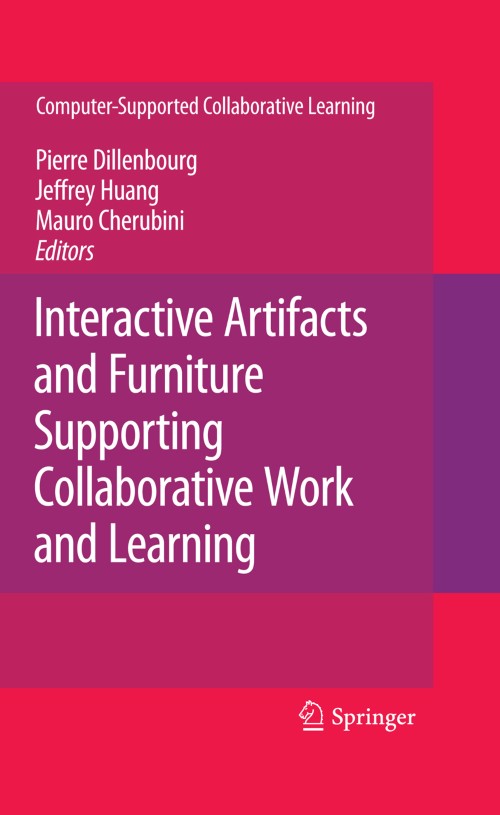
245 10|aInteractive Artifacts and Furniture Supporting Collaborative Work and Learning|h[electronic resource] /|cedited by Pierre Dillenbourg, Jeffrey Huang, Mauro Cherubini.
250 |a1st ed. 2009.
264 1|aNew York, NY :|bSpringer US :|bImprint: Springer,|c2009.
300 |aXV, 174 p.|bonline resource.
336 |atext|btxt|2rdacontent
337 |acomputer|bc|2rdamedia
338 |aonline resource|bcr|2rdacarrier
347 |atext file|bPDF|2rda
490 1 |aComputer-Supported Collaborative Learning Series,|x2543-0157 ;|v10
505 0 |aWhy Would Furniture Be Relevant for Collaborative Learning? -- Design of Systems for Supporting Collaborative Learning Augmented with Physical Artefacts -- Do Fewer Laptops Make a Better Team? -- The Disappearing Computer: Consequences for Educational Technology -- Supporting Collaboration with Augmented Environments -- Rethinking the Podium -- Collaborative Tabletop Research and Evaluation -- Interpersonal Computers for Higher Education -- Exploratory Design, Augmented Furniture?.
520 |aThe field of Computer-Supported Collaborative Learning (CSCL) has traditionally focused on virtual learning environments and has somewhat neglected the physical environments in which students interact with each other and with their teachers. However, over the last years, scholars have devoted growing attention to the interplay between digital and physical environments. Interactive Artifacts and Furniture Supporting Collaborative Work and Learning reveals how these advances in computer science and human-computer interaction impact CSCL environments. The underlying theme of the contributions is the social affordances of physical objects, i.e. the understanding of how technology-augmented physical objects support interactions among groups in a way more intuitive or natural than traditional computers. This collection of leading researchers investigates how artifacts may trigger rich interactions among groups, which is a central quest for researchers in CSCL. Interactive Artifacts and Furniture Supporting Collaborative Work and Learning illustrates a turn in the field of CSCL and emphasizes an important message for a generation of CSCL designers and researchers.
650 0|aLearning, Psychology of.
650 0|aEducational technology.
650 0|aUser interfaces (Computer systems).
650 0|aHuman-computer interaction.
650 0|aHuman-machine systems.
650 14|aInstructional Psychology.
650 24|aDigital Education and Educational Technology.
650 24|aUser Interfaces and Human Computer Interaction.
650 24|aInteraction Design.
700 1 |aDillenbourg, Pierre.|eeditor.|4edt|4http://id.loc.gov/vocabulary/relators/edt
700 1 |aHuang, Jeffrey.|eeditor.|4edt|4http://id.loc.gov/vocabulary/relators/edt
700 1 |aCherubini, Mauro.|eeditor.|4edt|4http://id.loc.gov/vocabulary/relators/edt
710 2 |aSpringerLink (Online service)
773 0 |tSpringer Nature eBook
776 08|iPrinted edition:|z9780387772332
776 08|iPrinted edition:|z9780387568706
776 08|iPrinted edition:|z9781441945815
830 0|aComputer-Supported Collaborative Learning Series,|x2543-0157 ;|v10
856 40|uhttps://doi.org/10.1007/978-0-387-77234-9
912 |aZDB-2-SHU
912 |aZDB-2-SXED
950 |aHumanities, Social Sciences and Law (SpringerNature-11648)
950 |aEducation (R0) (SpringerNature-43721)