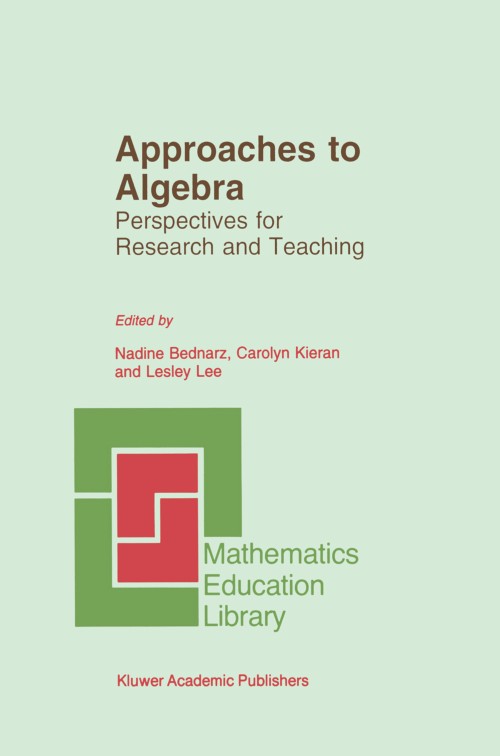
Approaches to Algebra [electronic resource] : Perspectives for Research and Teaching / edited by N. Bednarz, C. Kieran, L. Lee.
Erişim Adresi
ISBN
9789400917323
Dil Kodu
İngilizce
Yer Numarası
DK/7196
Basım Bildirimi
1st ed. 1996.
Yayın Bilgisi
Dordrecht : Springer Netherlands : Imprint: Springer, 1996.
Fiziksel Niteleme
XVI, 348 p. online resource.
Dizi
Mathematics Education Library, 2214-983X ; 18
İçindekiler Notu
1. Approaches to Algebra: Perspectives for Research and Teaching -- I. Historical Perspectives in the Development of Algebra -- 2. From Euclid to Descartes: Algebra and its Relation to Geometry -- 3. The Roles of Geometry and Arithmetic in the Development of Algebra: Historical Remarks from a Didactic Perspective -- 4. The Role of Problems and Problem Solving in the Development of Algebra -- II. A Generalization Perspective on the Introduction of Algebra -- 5. Expressing Generality and Roots of Algebra -- 6. An Initiation into Algebraic Culture through Generalization Activities -- 7. Some Reflections on Teaching Algebra through Generalization -- III. A Problem-Solving Perspective on the Introduction of Algebra -- 8. Emergence and Development of Algebra as a Problem-Solving Tool: Continuities and Discontinuities with Arithmetic -- 9. Developing Algebraic Aspects of Problem Solving within a Spreadsheet Environment -- 10. Rough or Smooth? The Transition from Arithmetic to Algebra in Problem Solving -- 11. Algebraic thought and the Role of a Manipulable Symbolic Language -- 12. Placement and Function of Problems in Algebraic Treatises from Diophantus to Viète -- 13. Problem-Solving Approaches to Algebra: Two Aspects -- 14. “When is a Problem?”: Questions from History and Classroom Practice in Algebra -- IV. A Modeling Perspective on the Introduction of Algebra -- 15. Mathematical Narratives, Modeling, and Algebra -- 16. Reflections on Mathematical Modeling and the Redefinition of Algebraic Thinking -- 17. Modeling and the Initiation into Algebra -- V. A Functional Perspective on the Introduction of Algebra -- 18. A Technology-Intensive Functional Approach to the Emergence of Algebraic Thinking -- 19. Introducing Algebra by Means of a Technology-Supported, Functional Approach -- 20. AFunctional Approach to Algebra: Two Issues that Emerge -- VI. Synthesis and Directions for Future Research -- 21. Backwards and Forwards: Reflections on Different Approaches to Algebra -- References -- Author Affiliations.
Özet, vb.
In Greek geometry, there is an arithmetic of magnitudes in which, in terms of numbers, only integers are involved. This theory of measure is limited to exact measure. Operations on magnitudes cannot be actually numerically calculated, except if those magnitudes are exactly measured by a certain unit. The theory of proportions does not have access to such operations. It cannot be seen as an "arithmetic" of ratios. Even if Euclidean geometry is done in a highly theoretical context, its axioms are essentially semantic. This is contrary to Mahoney's second characteristic. This cannot be said of the theory of proportions, which is less semantic. Only synthetic proofs are considered rigorous in Greek geometry. Arithmetic reasoning is also synthetic, going from the known to the unknown. Finally, analysis is an approach to geometrical problems that has some algebraic characteristics and involves a method for solving problems that is different from the arithmetical approach. 3. GEOMETRIC PROOFS OF ALGEBRAIC RULES Until the second half of the 19th century, Euclid's Elements was considered a model of a mathematical theory. This may be one reason why geometry was used by algebraists as a tool to demonstrate the accuracy of rules otherwise given as numerical algorithms. It may also be that geometry was one way to represent general reasoning without involving specific magnitudes. To go a bit deeper into this, here are three geometric proofs of algebraic rules, the frrst by Al-Khwarizmi, the other two by Cardano.
Konu
Mathematics __ Study and teaching .
Mathematics.
History.
Mathematics Education.
History of Mathematical Sciences.
Mathematics.
History.
Mathematics Education.
History of Mathematical Sciences.
Diğer Yazarlar
Kurum Adı

Eseri Alıntıla
Referansları kullanmadan önce gözden geçirmeniz ve varsa gerekli düzeltmeleri yapmanız önerilir.
Dijital Kaynak
MARC Görünümü
LEADER 06361nam a22006135i 4500
001 805882
003 TR_AnAIT
005 20260127001006
007 cr nn 008mamaa
008 121227s1996 ne | s |||| 0|eng d
020 |a9789400917323|9978-94-009-1732-3
024 7 |a10.1007/978-94-009-1732-3|2doi
041 |aeng
049 |aTürk Tarih Kurumu Kütüphanesi
050 4|aQA10.92-20
072 7|aJNU|2bicssc
072 7|aPB|2bicssc
072 7|aEDU029010|2bisacsh
072 7|aJNU|2thema
072 7|aPB|2thema
082 04|a510.71|223
090 |aDK/7196
245 10|aApproaches to Algebra|h[electronic resource] :|bPerspectives for Research and Teaching /|cedited by N. Bednarz, C. Kieran, L. Lee.
250 |a1st ed. 1996.
264 1|aDordrecht :|bSpringer Netherlands :|bImprint: Springer,|c1996.
300 |aXVI, 348 p.|bonline resource.
336 |atext|btxt|2rdacontent
337 |acomputer|bc|2rdamedia
338 |aonline resource|bcr|2rdacarrier
347 |atext file|bPDF|2rda
490 1 |aMathematics Education Library,|x2214-983X ;|v18
505 0 |a1. Approaches to Algebra: Perspectives for Research and Teaching -- I. Historical Perspectives in the Development of Algebra -- 2. From Euclid to Descartes: Algebra and its Relation to Geometry -- 3. The Roles of Geometry and Arithmetic in the Development of Algebra: Historical Remarks from a Didactic Perspective -- 4. The Role of Problems and Problem Solving in the Development of Algebra -- II. A Generalization Perspective on the Introduction of Algebra -- 5. Expressing Generality and Roots of Algebra -- 6. An Initiation into Algebraic Culture through Generalization Activities -- 7. Some Reflections on Teaching Algebra through Generalization -- III. A Problem-Solving Perspective on the Introduction of Algebra -- 8. Emergence and Development of Algebra as a Problem-Solving Tool: Continuities and Discontinuities with Arithmetic -- 9. Developing Algebraic Aspects of Problem Solving within a Spreadsheet Environment -- 10. Rough or Smooth? The Transition from Arithmetic to Algebra in Problem Solving -- 11. Algebraic thought and the Role of a Manipulable Symbolic Language -- 12. Placement and Function of Problems in Algebraic Treatises from Diophantus to Viète -- 13. Problem-Solving Approaches to Algebra: Two Aspects -- 14. “When is a Problem?”: Questions from History and Classroom Practice in Algebra -- IV. A Modeling Perspective on the Introduction of Algebra -- 15. Mathematical Narratives, Modeling, and Algebra -- 16. Reflections on Mathematical Modeling and the Redefinition of Algebraic Thinking -- 17. Modeling and the Initiation into Algebra -- V. A Functional Perspective on the Introduction of Algebra -- 18. A Technology-Intensive Functional Approach to the Emergence of Algebraic Thinking -- 19. Introducing Algebra by Means of a Technology-Supported, Functional Approach -- 20. AFunctional Approach to Algebra: Two Issues that Emerge -- VI. Synthesis and Directions for Future Research -- 21. Backwards and Forwards: Reflections on Different Approaches to Algebra -- References -- Author Affiliations.
520 |aIn Greek geometry, there is an arithmetic of magnitudes in which, in terms of numbers, only integers are involved. This theory of measure is limited to exact measure. Operations on magnitudes cannot be actually numerically calculated, except if those magnitudes are exactly measured by a certain unit. The theory of proportions does not have access to such operations. It cannot be seen as an "arithmetic" of ratios. Even if Euclidean geometry is done in a highly theoretical context, its axioms are essentially semantic. This is contrary to Mahoney's second characteristic. This cannot be said of the theory of proportions, which is less semantic. Only synthetic proofs are considered rigorous in Greek geometry. Arithmetic reasoning is also synthetic, going from the known to the unknown. Finally, analysis is an approach to geometrical problems that has some algebraic characteristics and involves a method for solving problems that is different from the arithmetical approach. 3. GEOMETRIC PROOFS OF ALGEBRAIC RULES Until the second half of the 19th century, Euclid's Elements was considered a model of a mathematical theory. This may be one reason why geometry was used by algebraists as a tool to demonstrate the accuracy of rules otherwise given as numerical algorithms. It may also be that geometry was one way to represent general reasoning without involving specific magnitudes. To go a bit deeper into this, here are three geometric proofs of algebraic rules, the frrst by Al-Khwarizmi, the other two by Cardano.
532 8 |aAccessibility summary: This PDF is not accessible. It is based on scanned pages and does not support features such as screen reader compatibility or described non-text content (images, graphs etc). However, it likely supports searchable and selectable text based on OCR (Optical Character Recognition). Users with accessibility needs may not be able to use this content effectively. Please contact us at accessibilitysupport@springernature.com if you require assistance or an alternative format.
532 8 |aInaccessible, or known limited accessibility
532 8 |aNo reading system accessibility options actively disabled
532 8 |aPublisher contact for further accessibility information: accessibilitysupport@springernature.com
650 0|aMathematics|xStudy and teaching .
650 0|aMathematics.
650 0|aHistory.
650 14|aMathematics Education.
650 24|aHistory of Mathematical Sciences.
700 1 |aBednarz, N.|eeditor.|4edt|4http://id.loc.gov/vocabulary/relators/edt
700 1 |aKieran, C.|eeditor.|4edt|4http://id.loc.gov/vocabulary/relators/edt
700 1 |aLee, L.|eeditor.|4edt|4http://id.loc.gov/vocabulary/relators/edt
710 2 |aSpringerLink (Online service)
773 0 |tSpringer Nature eBook
776 08|iPrinted edition:|z9780792341451
776 08|iPrinted edition:|z9780792341680
776 08|iPrinted edition:|z9789400917330
830 0|aMathematics Education Library,|x2214-983X ;|v18
856 40|uhttps://doi.org/10.1007/978-94-009-1732-3
912 |aZDB-2-SHU
912 |aZDB-2-SXED
912 |aZDB-2-BAE
950 |aHumanities, Social Sciences and Law (SpringerNature-11648)
950 |aEducation (R0) (SpringerNature-43721)
001 805882
003 TR_AnAIT
005 20260127001006
007 cr nn 008mamaa
008 121227s1996 ne | s |||| 0|eng d
020 |a9789400917323|9978-94-009-1732-3
024 7 |a10.1007/978-94-009-1732-3|2doi
041 |aeng
049 |aTürk Tarih Kurumu Kütüphanesi
050 4|aQA10.92-20
072 7|aJNU|2bicssc
072 7|aPB|2bicssc
072 7|aEDU029010|2bisacsh
072 7|aJNU|2thema
072 7|aPB|2thema
082 04|a510.71|223
090 |aDK/7196
245 10|aApproaches to Algebra|h[electronic resource] :|bPerspectives for Research and Teaching /|cedited by N. Bednarz, C. Kieran, L. Lee.
250 |a1st ed. 1996.
264 1|aDordrecht :|bSpringer Netherlands :|bImprint: Springer,|c1996.
300 |aXVI, 348 p.|bonline resource.
336 |atext|btxt|2rdacontent
337 |acomputer|bc|2rdamedia
338 |aonline resource|bcr|2rdacarrier
347 |atext file|bPDF|2rda
490 1 |aMathematics Education Library,|x2214-983X ;|v18
505 0 |a1. Approaches to Algebra: Perspectives for Research and Teaching -- I. Historical Perspectives in the Development of Algebra -- 2. From Euclid to Descartes: Algebra and its Relation to Geometry -- 3. The Roles of Geometry and Arithmetic in the Development of Algebra: Historical Remarks from a Didactic Perspective -- 4. The Role of Problems and Problem Solving in the Development of Algebra -- II. A Generalization Perspective on the Introduction of Algebra -- 5. Expressing Generality and Roots of Algebra -- 6. An Initiation into Algebraic Culture through Generalization Activities -- 7. Some Reflections on Teaching Algebra through Generalization -- III. A Problem-Solving Perspective on the Introduction of Algebra -- 8. Emergence and Development of Algebra as a Problem-Solving Tool: Continuities and Discontinuities with Arithmetic -- 9. Developing Algebraic Aspects of Problem Solving within a Spreadsheet Environment -- 10. Rough or Smooth? The Transition from Arithmetic to Algebra in Problem Solving -- 11. Algebraic thought and the Role of a Manipulable Symbolic Language -- 12. Placement and Function of Problems in Algebraic Treatises from Diophantus to Viète -- 13. Problem-Solving Approaches to Algebra: Two Aspects -- 14. “When is a Problem?”: Questions from History and Classroom Practice in Algebra -- IV. A Modeling Perspective on the Introduction of Algebra -- 15. Mathematical Narratives, Modeling, and Algebra -- 16. Reflections on Mathematical Modeling and the Redefinition of Algebraic Thinking -- 17. Modeling and the Initiation into Algebra -- V. A Functional Perspective on the Introduction of Algebra -- 18. A Technology-Intensive Functional Approach to the Emergence of Algebraic Thinking -- 19. Introducing Algebra by Means of a Technology-Supported, Functional Approach -- 20. AFunctional Approach to Algebra: Two Issues that Emerge -- VI. Synthesis and Directions for Future Research -- 21. Backwards and Forwards: Reflections on Different Approaches to Algebra -- References -- Author Affiliations.
520 |aIn Greek geometry, there is an arithmetic of magnitudes in which, in terms of numbers, only integers are involved. This theory of measure is limited to exact measure. Operations on magnitudes cannot be actually numerically calculated, except if those magnitudes are exactly measured by a certain unit. The theory of proportions does not have access to such operations. It cannot be seen as an "arithmetic" of ratios. Even if Euclidean geometry is done in a highly theoretical context, its axioms are essentially semantic. This is contrary to Mahoney's second characteristic. This cannot be said of the theory of proportions, which is less semantic. Only synthetic proofs are considered rigorous in Greek geometry. Arithmetic reasoning is also synthetic, going from the known to the unknown. Finally, analysis is an approach to geometrical problems that has some algebraic characteristics and involves a method for solving problems that is different from the arithmetical approach. 3. GEOMETRIC PROOFS OF ALGEBRAIC RULES Until the second half of the 19th century, Euclid's Elements was considered a model of a mathematical theory. This may be one reason why geometry was used by algebraists as a tool to demonstrate the accuracy of rules otherwise given as numerical algorithms. It may also be that geometry was one way to represent general reasoning without involving specific magnitudes. To go a bit deeper into this, here are three geometric proofs of algebraic rules, the frrst by Al-Khwarizmi, the other two by Cardano.
532 8 |aAccessibility summary: This PDF is not accessible. It is based on scanned pages and does not support features such as screen reader compatibility or described non-text content (images, graphs etc). However, it likely supports searchable and selectable text based on OCR (Optical Character Recognition). Users with accessibility needs may not be able to use this content effectively. Please contact us at accessibilitysupport@springernature.com if you require assistance or an alternative format.
532 8 |aInaccessible, or known limited accessibility
532 8 |aNo reading system accessibility options actively disabled
532 8 |aPublisher contact for further accessibility information: accessibilitysupport@springernature.com
650 0|aMathematics|xStudy and teaching .
650 0|aMathematics.
650 0|aHistory.
650 14|aMathematics Education.
650 24|aHistory of Mathematical Sciences.
700 1 |aBednarz, N.|eeditor.|4edt|4http://id.loc.gov/vocabulary/relators/edt
700 1 |aKieran, C.|eeditor.|4edt|4http://id.loc.gov/vocabulary/relators/edt
700 1 |aLee, L.|eeditor.|4edt|4http://id.loc.gov/vocabulary/relators/edt
710 2 |aSpringerLink (Online service)
773 0 |tSpringer Nature eBook
776 08|iPrinted edition:|z9780792341451
776 08|iPrinted edition:|z9780792341680
776 08|iPrinted edition:|z9789400917330
830 0|aMathematics Education Library,|x2214-983X ;|v18
856 40|uhttps://doi.org/10.1007/978-94-009-1732-3
912 |aZDB-2-SHU
912 |aZDB-2-SXED
912 |aZDB-2-BAE
950 |aHumanities, Social Sciences and Law (SpringerNature-11648)
950 |aEducation (R0) (SpringerNature-43721)
Materyaller
Depodan talep edilen materyal sadece kütüphane içerisinde kullanılmaktadır.
Materyal dışarıya ödünç verilmemektedir.
