

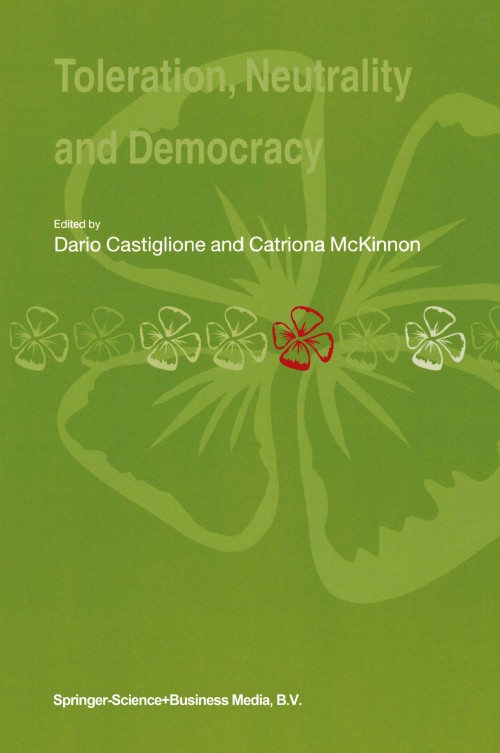
Toleration, Neutrality and Democracy [electronic resource] / edited by Dario Castiglione, Catriona McKinnon.
Erişim Adresi
ISBN
9789401702416
Dil Kodu
İngilizce
Yer Numarası
DK/7199
Basım Bildirimi
1st ed. 2003.
Yayın Bilgisi
Dordrecht : Springer Netherlands : Imprint: Springer, 2003.
Fiziksel Niteleme
X, 186 p. online resource.
İçindekiler Notu
I: Toleration: Moral and Political -- 1. Tolerance as a Primary Virtue -- 2. Montaigne: The Embodiment of Identity as Grounds for Toleration -- 3. Is Toleration a Moral Virtue? -- II: Toleration and Neutrality -- 4. Neutrality and the Virtue of Toleration -- 5. Toleration and Neutrality: Incompatible Ideals? -- 6. Toleration and Neutrality: Compatible Ideals? -- 7. Neutrality, Toleration, and Reasonable Agreement -- 8. John Stuart Mill as a Theorist of Toleration -- III: Toleration and Democracy -- 9. Is a Tolerant Democracy a Rubber Duck? -- 10. The Enforcement of Toleration -- 11. The Fraught Relation Between Toleration and Democracy -- Appendix: Reply to Jones.
Özet, vb.
Catriona McKinnon and Dario Castiglione It is not an overstatement to say that toleration is one of the most important issues for the defmition of a moral and political theory with application to modem globalised societies. Toleration is a value which no politician in any liberal democratic society would dare to reject. In the UK, its value is reflected in the learning outcomes of education for citizenship isolated by the Final Report of the Advisory Group on Citizenship (which schools have a statutory responsibility to deliver): children ought to be disposed to the 'practice of toleration', and have the 'ability to tolerate other view points'. In these days of feelings of heightened insecurity prompting suspicion of strangers and departures from the norm, toleration has again taken centre stage as one of the values defmitive of stable and just liberal democratic societies. Toleration is a matter of principled restraint with respect to differences which are opposed, either at the personal or at the political level. With respect to the former level, the tolerant person does not use the power she has over others she dislikes and/or disapproves of to interfere with them. However, the tolerant person does not thereby divest herself of her dislike or disapproval; the tolerant person does not transform her dislike and disapproval into warm feelings, and neither does she simply become indifferent to what she hitherto disliked and disapproved of when she practices toleration.
Konu
Political science.
Law __ Philosophy.
Sociology __ Methodology.
Political Science.
Philosophy of Law.
Sociological Methods.
Law __ Philosophy.
Sociology __ Methodology.
Political Science.
Philosophy of Law.
Sociological Methods.
Diğer Yazarlar
Kurum Adı
Eseri Alıntıla
Referansları kullanmadan önce gözden geçirmeniz ve varsa gerekli düzeltmeleri yapmanız önerilir.
Dijital Kaynak
MARC Görünümü
LEADER 04747nam a22005655i 4500
001 805885
003 TR_AnAIT
005 20260127001010
007 cr nn 008mamaa
008 130101s2003 ne | s |||| 0|eng d
020 |a9789401702416|9978-94-017-0241-6
024 7 |a10.1007/978-94-017-0241-6|2doi
041 |aeng
049 |aTürk Tarih Kurumu Kütüphanesi
050 4|aJA1-92
072 7|aJPA|2bicssc
072 7|aPOL000000|2bisacsh
072 7|aJPA|2thema
082 04|a320|223
090 |aDK/7199
245 10|aToleration, Neutrality and Democracy|h[electronic resource] /|cedited by Dario Castiglione, Catriona McKinnon.
250 |a1st ed. 2003.
264 1|aDordrecht :|bSpringer Netherlands :|bImprint: Springer,|c2003.
300 |aX, 186 p.|bonline resource.
336 |atext|btxt|2rdacontent
337 |acomputer|bc|2rdamedia
338 |aonline resource|bcr|2rdacarrier
347 |atext file|bPDF|2rda
505 0 |aI: Toleration: Moral and Political -- 1. Tolerance as a Primary Virtue -- 2. Montaigne: The Embodiment of Identity as Grounds for Toleration -- 3. Is Toleration a Moral Virtue? -- II: Toleration and Neutrality -- 4. Neutrality and the Virtue of Toleration -- 5. Toleration and Neutrality: Incompatible Ideals? -- 6. Toleration and Neutrality: Compatible Ideals? -- 7. Neutrality, Toleration, and Reasonable Agreement -- 8. John Stuart Mill as a Theorist of Toleration -- III: Toleration and Democracy -- 9. Is a Tolerant Democracy a Rubber Duck? -- 10. The Enforcement of Toleration -- 11. The Fraught Relation Between Toleration and Democracy -- Appendix: Reply to Jones.
520 |aCatriona McKinnon and Dario Castiglione It is not an overstatement to say that toleration is one of the most important issues for the defmition of a moral and political theory with application to modem globalised societies. Toleration is a value which no politician in any liberal democratic society would dare to reject. In the UK, its value is reflected in the learning outcomes of education for citizenship isolated by the Final Report of the Advisory Group on Citizenship (which schools have a statutory responsibility to deliver): children ought to be disposed to the 'practice of toleration', and have the 'ability to tolerate other view points'. In these days of feelings of heightened insecurity prompting suspicion of strangers and departures from the norm, toleration has again taken centre stage as one of the values defmitive of stable and just liberal democratic societies. Toleration is a matter of principled restraint with respect to differences which are opposed, either at the personal or at the political level. With respect to the former level, the tolerant person does not use the power she has over others she dislikes and/or disapproves of to interfere with them. However, the tolerant person does not thereby divest herself of her dislike or disapproval; the tolerant person does not transform her dislike and disapproval into warm feelings, and neither does she simply become indifferent to what she hitherto disliked and disapproved of when she practices toleration.
532 8 |aAccessibility summary: This PDF is not accessible. It is based on scanned pages and does not support features such as screen reader compatibility or described non-text content (images, graphs etc). However, it likely supports searchable and selectable text based on OCR (Optical Character Recognition). Users with accessibility needs may not be able to use this content effectively. Please contact us at accessibilitysupport@springernature.com if you require assistance or an alternative format.
532 8 |aInaccessible, or known limited accessibility
532 8 |aNo reading system accessibility options actively disabled
532 8 |aPublisher contact for further accessibility information: accessibilitysupport@springernature.com
650 0|aPolitical science.
650 0|aLaw|xPhilosophy.
650 0|aSociology|xMethodology.
650 14|aPolitical Science.
650 24|aPhilosophy of Law.
650 24|aSociological Methods.
700 1 |aCastiglione, Dario.|eeditor.|4edt|4http://id.loc.gov/vocabulary/relators/edt
700 1 |aMcKinnon, Catriona.|eeditor.|4edt|4http://id.loc.gov/vocabulary/relators/edt
710 2 |aSpringerLink (Online service)
773 0 |tSpringer Nature eBook
776 08|iPrinted edition:|z9781402017605
776 08|iPrinted edition:|z9789048164929
776 08|iPrinted edition:|z9789401702423
856 40|uhttps://doi.org/10.1007/978-94-017-0241-6
912 |aZDB-2-SHU
912 |aZDB-2-SXPI
912 |aZDB-2-BAE
950 |aHumanities, Social Sciences and Law (SpringerNature-11648)
950 |aPolitical Science and International Studies (R0) (SpringerNature-43724)
001 805885
003 TR_AnAIT
005 20260127001010
007 cr nn 008mamaa
008 130101s2003 ne | s |||| 0|eng d
020 |a9789401702416|9978-94-017-0241-6
024 7 |a10.1007/978-94-017-0241-6|2doi
041 |aeng
049 |aTürk Tarih Kurumu Kütüphanesi
050 4|aJA1-92
072 7|aJPA|2bicssc
072 7|aPOL000000|2bisacsh
072 7|aJPA|2thema
082 04|a320|223
090 |aDK/7199
245 10|aToleration, Neutrality and Democracy|h[electronic resource] /|cedited by Dario Castiglione, Catriona McKinnon.
250 |a1st ed. 2003.
264 1|aDordrecht :|bSpringer Netherlands :|bImprint: Springer,|c2003.
300 |aX, 186 p.|bonline resource.
336 |atext|btxt|2rdacontent
337 |acomputer|bc|2rdamedia
338 |aonline resource|bcr|2rdacarrier
347 |atext file|bPDF|2rda
505 0 |aI: Toleration: Moral and Political -- 1. Tolerance as a Primary Virtue -- 2. Montaigne: The Embodiment of Identity as Grounds for Toleration -- 3. Is Toleration a Moral Virtue? -- II: Toleration and Neutrality -- 4. Neutrality and the Virtue of Toleration -- 5. Toleration and Neutrality: Incompatible Ideals? -- 6. Toleration and Neutrality: Compatible Ideals? -- 7. Neutrality, Toleration, and Reasonable Agreement -- 8. John Stuart Mill as a Theorist of Toleration -- III: Toleration and Democracy -- 9. Is a Tolerant Democracy a Rubber Duck? -- 10. The Enforcement of Toleration -- 11. The Fraught Relation Between Toleration and Democracy -- Appendix: Reply to Jones.
520 |aCatriona McKinnon and Dario Castiglione It is not an overstatement to say that toleration is one of the most important issues for the defmition of a moral and political theory with application to modem globalised societies. Toleration is a value which no politician in any liberal democratic society would dare to reject. In the UK, its value is reflected in the learning outcomes of education for citizenship isolated by the Final Report of the Advisory Group on Citizenship (which schools have a statutory responsibility to deliver): children ought to be disposed to the 'practice of toleration', and have the 'ability to tolerate other view points'. In these days of feelings of heightened insecurity prompting suspicion of strangers and departures from the norm, toleration has again taken centre stage as one of the values defmitive of stable and just liberal democratic societies. Toleration is a matter of principled restraint with respect to differences which are opposed, either at the personal or at the political level. With respect to the former level, the tolerant person does not use the power she has over others she dislikes and/or disapproves of to interfere with them. However, the tolerant person does not thereby divest herself of her dislike or disapproval; the tolerant person does not transform her dislike and disapproval into warm feelings, and neither does she simply become indifferent to what she hitherto disliked and disapproved of when she practices toleration.
532 8 |aAccessibility summary: This PDF is not accessible. It is based on scanned pages and does not support features such as screen reader compatibility or described non-text content (images, graphs etc). However, it likely supports searchable and selectable text based on OCR (Optical Character Recognition). Users with accessibility needs may not be able to use this content effectively. Please contact us at accessibilitysupport@springernature.com if you require assistance or an alternative format.
532 8 |aInaccessible, or known limited accessibility
532 8 |aNo reading system accessibility options actively disabled
532 8 |aPublisher contact for further accessibility information: accessibilitysupport@springernature.com
650 0|aPolitical science.
650 0|aLaw|xPhilosophy.
650 0|aSociology|xMethodology.
650 14|aPolitical Science.
650 24|aPhilosophy of Law.
650 24|aSociological Methods.
700 1 |aCastiglione, Dario.|eeditor.|4edt|4http://id.loc.gov/vocabulary/relators/edt
700 1 |aMcKinnon, Catriona.|eeditor.|4edt|4http://id.loc.gov/vocabulary/relators/edt
710 2 |aSpringerLink (Online service)
773 0 |tSpringer Nature eBook
776 08|iPrinted edition:|z9781402017605
776 08|iPrinted edition:|z9789048164929
776 08|iPrinted edition:|z9789401702423
856 40|uhttps://doi.org/10.1007/978-94-017-0241-6
912 |aZDB-2-SHU
912 |aZDB-2-SXPI
912 |aZDB-2-BAE
950 |aHumanities, Social Sciences and Law (SpringerNature-11648)
950 |aPolitical Science and International Studies (R0) (SpringerNature-43724)
Materyaller
Depodan talep edilen materyal sadece kütüphane içerisinde kullanılmaktadır.
Materyal dışarıya ödünç verilmemektedir.
Materyal dışarıya ödünç verilmemektedir.
