

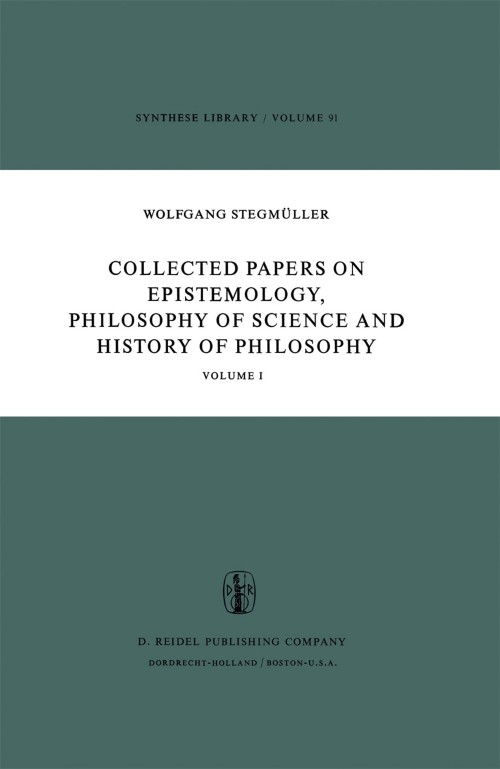
Collected Papers on Epistemology, Philosophy of Science and History of Philosophy [electronic resource] : Volume I / by W. Stegmüller.
Erişim Adresi
ISBN
9789401011297
Dil Kodu
İngilizce
Yer Numarası
DK/7225
Yazar
Basım Bildirimi
1st ed. 1977.
Yayın Bilgisi
Dordrecht : Springer Netherlands : Imprint: Springer, 1977.
Fiziksel Niteleme
XIII, 248 p. online resource.
Dizi
Synthese Library, Studies in Epistemology, Logic, Methodology, and Philosophy of Science, 2542-8292 ; 91
İçindekiler Notu
1. The Problem of Universals Then and Now -- 1. The Problem -- 2. Platonism and Nominalism -- 3. Historical Background -- 4. Epistemological Discussion of Platonism and Nominalism -- 5. Constructive Conceptualism -- 6. The Three Ontological Positions -- 7. Summary -- 2. Towards a Rational Reconstruction of Kant’s Metaphysics of Experience -- I: Kant’s Riddle of Experience -- 1. On Rational Reconstructions of Philosophical Theories -- 2. The Place of Kant’s Theory of Experience within His Theoretical Philosophy -- 3. Synthetic a priori Propositions -- 4. The Existential Hypothesis in Kant’s Fundamental Question -- 5. The Influence of Isaac Newton, Chr. Wolff and D. Hume upon Kant’s Conception of Science -- 6. Kant’s Antinomy of Experience -- 7. Kant’s Project for a Solution: Synthetic a priori Statements as the Way out of the Dilemma -- 8. A Remark on the Relation between the ‘Regressive’ and the ‘Progressive’ Argument -- II: The Logical Structure of the Progressive Argument -- 1. The Aim of the Progressive Argument -- 2. Kant as a Rationalist Precursor of the Theory of Eliminative and Enumerative Induction -- 3. Kant’s Theory of Structural Reduction or a priori Elimination (The Modal Argument) -- 4. Empirical Confirmation and Consolidation -- 5. The Gap in Kant’s Argument -- 6. Concluding Remarks -- 3. A Model Theoretic Explication of Wittgenstein’s Picture Theory -- 1. Introduction -- 2. Intensional Relational Systems, Model Worlds, Categorical Identity -- 3. Isomorphism, Homomorphism, Picture, Truth and Falsity -- 4. Logical Spaces, Isomorphism between Logical Spaces, Logically Adequate and Inadequate Pictures -- 5. Application of the Picture Theory to Language -- 4. Phenomenalism and Its Difficulties -- 1. Philosophy of Quantum Mechanics and Phenomenalism -- 2. ACharacterization of Phenomenalism -- 3. Motives for Phenomenalism -- 4. Difficulties in Carrying out the Phenomenalistic Programme -- 5. Conclusion -- 5. Ontology and Analyticity -- 1. The Ontological Problem -- 2. The Problem of Analytic Statements -- 3. Concluding Remarks -- Index of Names.
Özet, vb.
These two volumes contain all of my articles published between 1956 and 1975 which might be of interest to readers in the English-speaking world. The first three essays in Vol. 1 deal with historical themes. In each case I as far as possible, meets con have attempted a rational reconstruction which, temporary standards of exactness. In The Problem of Universals Then and Now some ideas of W.V. Quine and N. Goodman are used to create a modern sketch of the history of the debate on universals beginning with Plato and ending with Hao Wang's System L. The second article concerns Kant's Philosophy of Science. By analyzing his position vis-a-vis I. Newton, Christian Wolff, and D. Hume, it is shown that for Kant the very notion of empirical knowledge was beset with a funda mental logical difficulty. In his metaphysics of experience Kant offered a solution differing from all prior as well as subsequent attempts aimed at the problem of establishing a scientific theory. The last of the three historical papers utilizes some concepts of modern logic to give a precise account of Wittgenstein's so-called Picture Theory of Meaning. E. Stenius' interpretation of this theory is taken as an intuitive starting point while an intensional variant of Tarski's concept of a relational system furnishes a technical instrument. The concepts of inodel world and of logical space, together with those of homomorphism and isomorphism be tween model worlds and between logical spaces, form the conceptual basis of the reconstruction.
Konu
Logic.
Knowledge, Theory of.
Logic.
Epistemology.
Knowledge, Theory of.
Logic.
Epistemology.
Kurum Adı
Eseri Alıntıla
Referansları kullanmadan önce gözden geçirmeniz ve varsa gerekli düzeltmeleri yapmanız önerilir.
Dijital Kaynak
MARC Görünümü
LEADER 06289nam a22005535i 4500
001 805912
003 TR_AnAIT
005 20260127001041
007 cr nn 008mamaa
008 121227s1977 ne | s |||| 0|eng d
020 |a9789401011297|9978-94-010-1129-7
024 7 |a10.1007/978-94-010-1129-7|2doi
041 |aeng
049 |aTürk Tarih Kurumu Kütüphanesi
050 4|aBC1-199
072 7|aHPL|2bicssc
072 7|aPHI011000|2bisacsh
072 7|aQDTL|2thema
082 04|a160|223
090 |aDK/7225
100 1 |aStegmüller, W.|eauthor.|4aut|4http://id.loc.gov/vocabulary/relators/aut
245 10|aCollected Papers on Epistemology, Philosophy of Science and History of Philosophy|h[electronic resource] :|bVolume I /|cby W. Stegmüller.
250 |a1st ed. 1977.
264 1|aDordrecht :|bSpringer Netherlands :|bImprint: Springer,|c1977.
300 |aXIII, 248 p.|bonline resource.
336 |atext|btxt|2rdacontent
337 |acomputer|bc|2rdamedia
338 |aonline resource|bcr|2rdacarrier
347 |atext file|bPDF|2rda
490 1 |aSynthese Library, Studies in Epistemology, Logic, Methodology, and Philosophy of Science,|x2542-8292 ;|v91
505 0 |a1. The Problem of Universals Then and Now -- 1. The Problem -- 2. Platonism and Nominalism -- 3. Historical Background -- 4. Epistemological Discussion of Platonism and Nominalism -- 5. Constructive Conceptualism -- 6. The Three Ontological Positions -- 7. Summary -- 2. Towards a Rational Reconstruction of Kant’s Metaphysics of Experience -- I: Kant’s Riddle of Experience -- 1. On Rational Reconstructions of Philosophical Theories -- 2. The Place of Kant’s Theory of Experience within His Theoretical Philosophy -- 3. Synthetic a priori Propositions -- 4. The Existential Hypothesis in Kant’s Fundamental Question -- 5. The Influence of Isaac Newton, Chr. Wolff and D. Hume upon Kant’s Conception of Science -- 6. Kant’s Antinomy of Experience -- 7. Kant’s Project for a Solution: Synthetic a priori Statements as the Way out of the Dilemma -- 8. A Remark on the Relation between the ‘Regressive’ and the ‘Progressive’ Argument -- II: The Logical Structure of the Progressive Argument -- 1. The Aim of the Progressive Argument -- 2. Kant as a Rationalist Precursor of the Theory of Eliminative and Enumerative Induction -- 3. Kant’s Theory of Structural Reduction or a priori Elimination (The Modal Argument) -- 4. Empirical Confirmation and Consolidation -- 5. The Gap in Kant’s Argument -- 6. Concluding Remarks -- 3. A Model Theoretic Explication of Wittgenstein’s Picture Theory -- 1. Introduction -- 2. Intensional Relational Systems, Model Worlds, Categorical Identity -- 3. Isomorphism, Homomorphism, Picture, Truth and Falsity -- 4. Logical Spaces, Isomorphism between Logical Spaces, Logically Adequate and Inadequate Pictures -- 5. Application of the Picture Theory to Language -- 4. Phenomenalism and Its Difficulties -- 1. Philosophy of Quantum Mechanics and Phenomenalism -- 2. ACharacterization of Phenomenalism -- 3. Motives for Phenomenalism -- 4. Difficulties in Carrying out the Phenomenalistic Programme -- 5. Conclusion -- 5. Ontology and Analyticity -- 1. The Ontological Problem -- 2. The Problem of Analytic Statements -- 3. Concluding Remarks -- Index of Names.
520 |aThese two volumes contain all of my articles published between 1956 and 1975 which might be of interest to readers in the English-speaking world. The first three essays in Vol. 1 deal with historical themes. In each case I as far as possible, meets con have attempted a rational reconstruction which, temporary standards of exactness. In The Problem of Universals Then and Now some ideas of W.V. Quine and N. Goodman are used to create a modern sketch of the history of the debate on universals beginning with Plato and ending with Hao Wang's System L. The second article concerns Kant's Philosophy of Science. By analyzing his position vis-a-vis I. Newton, Christian Wolff, and D. Hume, it is shown that for Kant the very notion of empirical knowledge was beset with a funda mental logical difficulty. In his metaphysics of experience Kant offered a solution differing from all prior as well as subsequent attempts aimed at the problem of establishing a scientific theory. The last of the three historical papers utilizes some concepts of modern logic to give a precise account of Wittgenstein's so-called Picture Theory of Meaning. E. Stenius' interpretation of this theory is taken as an intuitive starting point while an intensional variant of Tarski's concept of a relational system furnishes a technical instrument. The concepts of inodel world and of logical space, together with those of homomorphism and isomorphism be tween model worlds and between logical spaces, form the conceptual basis of the reconstruction.
532 8 |aAccessibility summary: This PDF is not accessible. It is based on scanned pages and does not support features such as screen reader compatibility or described non-text content (images, graphs etc). However, it likely supports searchable and selectable text based on OCR (Optical Character Recognition). Users with accessibility needs may not be able to use this content effectively. Please contact us at accessibilitysupport@springernature.com if you require assistance or an alternative format.
532 8 |aInaccessible, or known limited accessibility
532 8 |aNo reading system accessibility options actively disabled
532 8 |aPublisher contact for further accessibility information: accessibilitysupport@springernature.com
650 0|aLogic.
650 0|aKnowledge, Theory of.
650 14|aLogic.
650 24|aEpistemology.
710 2 |aSpringerLink (Online service)
773 0 |tSpringer Nature eBook
776 08|iPrinted edition:|z9789027706423
776 08|iPrinted edition:|z9789401011303
776 08|iPrinted edition:|z9789401011310
830 0|aSynthese Library, Studies in Epistemology, Logic, Methodology, and Philosophy of Science,|x2542-8292 ;|v91
856 40|uhttps://doi.org/10.1007/978-94-010-1129-7
912 |aZDB-2-SHU
912 |aZDB-2-SXPR
912 |aZDB-2-BAE
950 |aHumanities, Social Sciences and Law (SpringerNature-11648)
950 |aPhilosophy and Religion (R0) (SpringerNature-43725)
001 805912
003 TR_AnAIT
005 20260127001041
007 cr nn 008mamaa
008 121227s1977 ne | s |||| 0|eng d
020 |a9789401011297|9978-94-010-1129-7
024 7 |a10.1007/978-94-010-1129-7|2doi
041 |aeng
049 |aTürk Tarih Kurumu Kütüphanesi
050 4|aBC1-199
072 7|aHPL|2bicssc
072 7|aPHI011000|2bisacsh
072 7|aQDTL|2thema
082 04|a160|223
090 |aDK/7225
100 1 |aStegmüller, W.|eauthor.|4aut|4http://id.loc.gov/vocabulary/relators/aut
245 10|aCollected Papers on Epistemology, Philosophy of Science and History of Philosophy|h[electronic resource] :|bVolume I /|cby W. Stegmüller.
250 |a1st ed. 1977.
264 1|aDordrecht :|bSpringer Netherlands :|bImprint: Springer,|c1977.
300 |aXIII, 248 p.|bonline resource.
336 |atext|btxt|2rdacontent
337 |acomputer|bc|2rdamedia
338 |aonline resource|bcr|2rdacarrier
347 |atext file|bPDF|2rda
490 1 |aSynthese Library, Studies in Epistemology, Logic, Methodology, and Philosophy of Science,|x2542-8292 ;|v91
505 0 |a1. The Problem of Universals Then and Now -- 1. The Problem -- 2. Platonism and Nominalism -- 3. Historical Background -- 4. Epistemological Discussion of Platonism and Nominalism -- 5. Constructive Conceptualism -- 6. The Three Ontological Positions -- 7. Summary -- 2. Towards a Rational Reconstruction of Kant’s Metaphysics of Experience -- I: Kant’s Riddle of Experience -- 1. On Rational Reconstructions of Philosophical Theories -- 2. The Place of Kant’s Theory of Experience within His Theoretical Philosophy -- 3. Synthetic a priori Propositions -- 4. The Existential Hypothesis in Kant’s Fundamental Question -- 5. The Influence of Isaac Newton, Chr. Wolff and D. Hume upon Kant’s Conception of Science -- 6. Kant’s Antinomy of Experience -- 7. Kant’s Project for a Solution: Synthetic a priori Statements as the Way out of the Dilemma -- 8. A Remark on the Relation between the ‘Regressive’ and the ‘Progressive’ Argument -- II: The Logical Structure of the Progressive Argument -- 1. The Aim of the Progressive Argument -- 2. Kant as a Rationalist Precursor of the Theory of Eliminative and Enumerative Induction -- 3. Kant’s Theory of Structural Reduction or a priori Elimination (The Modal Argument) -- 4. Empirical Confirmation and Consolidation -- 5. The Gap in Kant’s Argument -- 6. Concluding Remarks -- 3. A Model Theoretic Explication of Wittgenstein’s Picture Theory -- 1. Introduction -- 2. Intensional Relational Systems, Model Worlds, Categorical Identity -- 3. Isomorphism, Homomorphism, Picture, Truth and Falsity -- 4. Logical Spaces, Isomorphism between Logical Spaces, Logically Adequate and Inadequate Pictures -- 5. Application of the Picture Theory to Language -- 4. Phenomenalism and Its Difficulties -- 1. Philosophy of Quantum Mechanics and Phenomenalism -- 2. ACharacterization of Phenomenalism -- 3. Motives for Phenomenalism -- 4. Difficulties in Carrying out the Phenomenalistic Programme -- 5. Conclusion -- 5. Ontology and Analyticity -- 1. The Ontological Problem -- 2. The Problem of Analytic Statements -- 3. Concluding Remarks -- Index of Names.
520 |aThese two volumes contain all of my articles published between 1956 and 1975 which might be of interest to readers in the English-speaking world. The first three essays in Vol. 1 deal with historical themes. In each case I as far as possible, meets con have attempted a rational reconstruction which, temporary standards of exactness. In The Problem of Universals Then and Now some ideas of W.V. Quine and N. Goodman are used to create a modern sketch of the history of the debate on universals beginning with Plato and ending with Hao Wang's System L. The second article concerns Kant's Philosophy of Science. By analyzing his position vis-a-vis I. Newton, Christian Wolff, and D. Hume, it is shown that for Kant the very notion of empirical knowledge was beset with a funda mental logical difficulty. In his metaphysics of experience Kant offered a solution differing from all prior as well as subsequent attempts aimed at the problem of establishing a scientific theory. The last of the three historical papers utilizes some concepts of modern logic to give a precise account of Wittgenstein's so-called Picture Theory of Meaning. E. Stenius' interpretation of this theory is taken as an intuitive starting point while an intensional variant of Tarski's concept of a relational system furnishes a technical instrument. The concepts of inodel world and of logical space, together with those of homomorphism and isomorphism be tween model worlds and between logical spaces, form the conceptual basis of the reconstruction.
532 8 |aAccessibility summary: This PDF is not accessible. It is based on scanned pages and does not support features such as screen reader compatibility or described non-text content (images, graphs etc). However, it likely supports searchable and selectable text based on OCR (Optical Character Recognition). Users with accessibility needs may not be able to use this content effectively. Please contact us at accessibilitysupport@springernature.com if you require assistance or an alternative format.
532 8 |aInaccessible, or known limited accessibility
532 8 |aNo reading system accessibility options actively disabled
532 8 |aPublisher contact for further accessibility information: accessibilitysupport@springernature.com
650 0|aLogic.
650 0|aKnowledge, Theory of.
650 14|aLogic.
650 24|aEpistemology.
710 2 |aSpringerLink (Online service)
773 0 |tSpringer Nature eBook
776 08|iPrinted edition:|z9789027706423
776 08|iPrinted edition:|z9789401011303
776 08|iPrinted edition:|z9789401011310
830 0|aSynthese Library, Studies in Epistemology, Logic, Methodology, and Philosophy of Science,|x2542-8292 ;|v91
856 40|uhttps://doi.org/10.1007/978-94-010-1129-7
912 |aZDB-2-SHU
912 |aZDB-2-SXPR
912 |aZDB-2-BAE
950 |aHumanities, Social Sciences and Law (SpringerNature-11648)
950 |aPhilosophy and Religion (R0) (SpringerNature-43725)
Materyaller
Depodan talep edilen materyal sadece kütüphane içerisinde kullanılmaktadır.
Materyal dışarıya ödünç verilmemektedir.
Materyal dışarıya ödünç verilmemektedir.
