LEADER 03724nam a22004695i 4500
001 805928
003 TR_AnAIT
005 20260127001101
007 cr nn 008mamaa
008 120118s2011 ne | s |||| 0|eng d
020 |a9789460916335|9978-94-6091-633-5
024 7 |a10.1007/978-94-6091-633-5|2doi
041 |aeng
049 |aTürk Tarih Kurumu Kütüphanesi
050 4|aLC189-214.53
072 7|aJN|2bicssc
072 7|aJHB|2bicssc
072 7|aEDU040000|2bisacsh
072 7|aJN|2thema
072 7|aJHB|2thema
082 04|a306.43|223
090 |aDK/7241
100 1 |aMesquita, Mônica.|eauthor.|4aut|4http://id.loc.gov/vocabulary/relators/aut
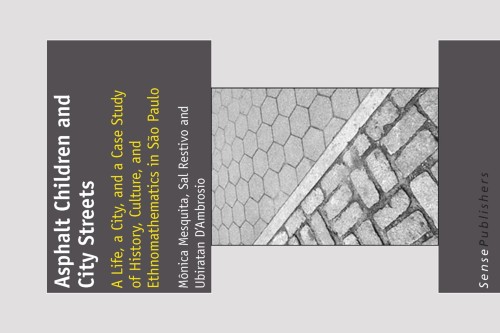
245 10|aAsphalt Children and City Streets|h[electronic resource] /|cby Mônica Mesquita, Sal Restivo, Ubiratan D’Ambrosio.
250 |a1st ed. 2011.
264 1|aRotterdam :|bSensePublishers :|bImprint: SensePublishers,|c2011.
300 |aXIV, 157 p.|bonline resource.
336 |atext|btxt|2rdacontent
337 |acomputer|bc|2rdamedia
338 |aonline resource|bcr|2rdacarrier
347 |atext file|bPDF|2rda
520 |aThis work explores the urban experiences of street children in sao paulo, brazil through the mathematical epistemic regimes at the core of their survival strategies. We also draw attention to the situation of street children across time, space, culture, and history. Our goal is to recognize, understand, and validate forms of mathematics constructed and used outside of the established institutions of mathematical production. We base our analysis on "the mathematical imagination", which draws together social constructionism and ethnomathematics. Theoretically, we draw heavily on the durkheimian tradition in sociology and anthropology. We focus on a form of practice that links the formal and the informal in order to realize the full power of mathematical knowledge as a social thing (in durkheim's sense), a product of the collective consciousness that expresses collective realities and a category of knowledge present in every culture. This is as true for mathematics at the margins as it is for professional mathematics. Our work contributes to an emerging political manifesto of the marginal that demonstrates the social realities and social power of their mathematics. This book should be of interest to social scientists, students of mathematics and ethnomathematics, and everyone interested in the situation of marginalized children.
532 8 |aAccessibility summary: This PDF eBook is produced by a third-party. We have requested that the file be made accessible and compliant with the European Accessibility Act (EAA). However, we have not been able to fully verify its compliance with recognized accessibility standards (such as PDF/UA or WCAG). For detailed accessibility information, please refer to the original publisher’s website. If you require an accessible version of this content, please contact accessibilitysupport@springernature.com. We are committed to improving accessibility and will work with the publisher to meet your needs wherever possible.
532 8 |aPublisher contact for further accessibility information: accessibilitysupport@springernature.com
650 0|aEducational sociology.
650 14|aSociology of Education.
700 1 |aRestivo, Sal.|eauthor.|4aut|4http://id.loc.gov/vocabulary/relators/aut
700 1 |aD’Ambrosio, Ubiratan.|eauthor.|4aut|4http://id.loc.gov/vocabulary/relators/aut
710 2 |aSpringerLink (Online service)
773 0 |tSpringer Nature eBook
856 40|uhttps://doi.org/10.1007/978-94-6091-633-5
912 |aZDB-2-SHU
912 |aZDB-2-SXED
950 |aHumanities, Social Sciences and Law (SpringerNature-11648)
950 |aEducation (R0) (SpringerNature-43721)