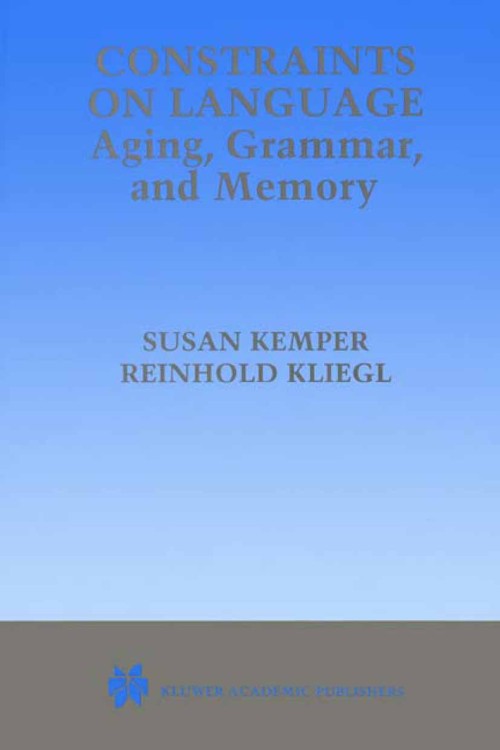
Constraints on Language: Aging, Grammar, and Memory [electronic resource] / edited by Susan Kemper, Reinhold Kliegl.
Erişim Adresi
ISBN
9780306469022
Dil Kodu
İngilizce
Yer Numarası
DK/7295
Basım Bildirimi
1st ed. 2002.
Yayın Bilgisi
New York, NY : Springer US : Imprint: Springer, 2002.
Fiziksel Niteleme
XVI, 324 p. online resource.
İçindekiler Notu
Constraints on Language: Aging -- Language Production and Aging -- Working Memory and Spoken Language Comprehension: The Case for Age Stability in Conceptual Short-Term Memory -- Discourse Processing and Aging: Resource Allocation As a Limiting Factor -- Constraints on Language: Memory -- Limitations on Syntactic Processing -- Verbal Working Memory Capacity and On-Line Sentence Processing Efficiency in the Elderly -- Testing Age Invariance in Language Processes -- Constraints on Language: Grammar -- Processing Difficulty and Principles of Grammar -- Parsing and Memory -- Constraints on Language: Neuroscience -- Working with Limited Memory: Sentence Comprehension in Alzheimer’s Disease -- Memory or Aging? That’s the Question: An Electrophysiological Perspective on Language -- Age Effects on the Functional Nueroanatomy of Syntactic Processing in Sentence Comprehension.
Özet, vb.
Susan Kemper A debate about the role of working memory in language processing has become center-most in psycholinguistics (Caplan & Waters, in press; Just & Carpenter, 1992; Just, Carpenter, & Keller, 1996; Waters & Caplan, 1996). This debate concerns which aspects of language processing are vulnerable to working memory limitations, how working memory is best measured, and whether compensatory processes can offset working memory limitations. Age-comparative studies are particularly relevant to this debate for several reasons: difficulties with language and communication are frequently mentioned by older adults and signal the onset of Alzheimer's dementia and other pathologies associated with age; older adults commonly experience working memory limitations that affect their ability to perform everyday activities; the rapid aging of the United States population has forced psychologists and gerontologists to examine the effects of aging on cognition, drawing many investigators to the study of cognitive aging. Older adults constitute ideal population for studying how working memory limitations affect cognitive performance, particularly language and communication. Age-comparative studies of cognitive processes have advanced our understanding of the temporal dynamics of cognition as well as the working memory demands of many types of tasks (Kliegl, Mayr, & Krampe, 1994; Mayr & Kliegl, 1993). The research findings reviewed in this volume have clear implications - for addressing the practical problems of older adults as consumers of leisure ti- reading, radio and television broadcasts, as targets of medical, legal, and financial documents, and as participants in a web of service agencies and volunteer activities.
Konu
Psycholinguistics.
Psychology.
Cognitive psychology.
Geriatrics.
Psycholinguistics and Cognitive Lingusitics.
Behavioral Sciences and Psychology.
Cognitive Psychology.
Geriatrics.
Psychology.
Cognitive psychology.
Geriatrics.
Psycholinguistics and Cognitive Lingusitics.
Behavioral Sciences and Psychology.
Cognitive Psychology.
Geriatrics.
Diğer Yazarlar
Kurum Adı

Eseri Alıntıla
Referansları kullanmadan önce gözden geçirmeniz ve varsa gerekli düzeltmeleri yapmanız önerilir.
Dijital Kaynak
MARC Görünümü
LEADER 04484nam a22005415i 4500
001 805982
003 TR_AnAIT
005 20260127001203
007 cr nn 008mamaa
008 100301s2002 xxu| s |||| 0|eng d
020 |a9780306469022|9978-0-306-46902-2
024 7 |a10.1007/b108296|2doi
041 |aeng
049 |aTürk Tarih Kurumu Kütüphanesi
050 4|aP37-37.5
072 7|aCFD|2bicssc
072 7|aLAN009040|2bisacsh
072 7|aCFD|2thema
082 04|a401.9|223
090 |aDK/7295
245 10|aConstraints on Language: Aging, Grammar, and Memory|h[electronic resource] /|cedited by Susan Kemper, Reinhold Kliegl.
250 |a1st ed. 2002.
264 1|aNew York, NY :|bSpringer US :|bImprint: Springer,|c2002.
300 |aXVI, 324 p.|bonline resource.
336 |atext|btxt|2rdacontent
337 |acomputer|bc|2rdamedia
338 |aonline resource|bcr|2rdacarrier
347 |atext file|bPDF|2rda
505 0 |aConstraints on Language: Aging -- Language Production and Aging -- Working Memory and Spoken Language Comprehension: The Case for Age Stability in Conceptual Short-Term Memory -- Discourse Processing and Aging: Resource Allocation As a Limiting Factor -- Constraints on Language: Memory -- Limitations on Syntactic Processing -- Verbal Working Memory Capacity and On-Line Sentence Processing Efficiency in the Elderly -- Testing Age Invariance in Language Processes -- Constraints on Language: Grammar -- Processing Difficulty and Principles of Grammar -- Parsing and Memory -- Constraints on Language: Neuroscience -- Working with Limited Memory: Sentence Comprehension in Alzheimer’s Disease -- Memory or Aging? That’s the Question: An Electrophysiological Perspective on Language -- Age Effects on the Functional Nueroanatomy of Syntactic Processing in Sentence Comprehension.
520 |aSusan Kemper A debate about the role of working memory in language processing has become center-most in psycholinguistics (Caplan & Waters, in press; Just & Carpenter, 1992; Just, Carpenter, & Keller, 1996; Waters & Caplan, 1996). This debate concerns which aspects of language processing are vulnerable to working memory limitations, how working memory is best measured, and whether compensatory processes can offset working memory limitations. Age-comparative studies are particularly relevant to this debate for several reasons: difficulties with language and communication are frequently mentioned by older adults and signal the onset of Alzheimer's dementia and other pathologies associated with age; older adults commonly experience working memory limitations that affect their ability to perform everyday activities; the rapid aging of the United States population has forced psychologists and gerontologists to examine the effects of aging on cognition, drawing many investigators to the study of cognitive aging. Older adults constitute ideal population for studying how working memory limitations affect cognitive performance, particularly language and communication. Age-comparative studies of cognitive processes have advanced our understanding of the temporal dynamics of cognition as well as the working memory demands of many types of tasks (Kliegl, Mayr, & Krampe, 1994; Mayr & Kliegl, 1993). The research findings reviewed in this volume have clear implications - for addressing the practical problems of older adults as consumers of leisure ti- reading, radio and television broadcasts, as targets of medical, legal, and financial documents, and as participants in a web of service agencies and volunteer activities.
650 0|aPsycholinguistics.
650 0|aPsychology.
650 0|aCognitive psychology.
650 0|aGeriatrics.
650 14|aPsycholinguistics and Cognitive Lingusitics.
650 24|aBehavioral Sciences and Psychology.
650 24|aCognitive Psychology.
650 24|aGeriatrics.
700 1 |aKemper, Susan.|eeditor.|4edt|4http://id.loc.gov/vocabulary/relators/edt
700 1 |aKliegl, Reinhold.|eeditor.|4edt|4http://id.loc.gov/vocabulary/relators/edt
710 2 |aSpringerLink (Online service)
773 0 |tSpringer Nature eBook
776 08|iPrinted edition:|z9780792385264
776 08|iPrinted edition:|z9781475771893
776 08|iPrinted edition:|z9781475771909
856 40|uhttps://doi.org/10.1007/b108296
912 |aZDB-2-SHU
912 |aZDB-2-SXS
912 |aZDB-2-BAE
950 |aHumanities, Social Sciences and Law (SpringerNature-11648)
950 |aSocial Sciences (R0) (SpringerNature-43726)
001 805982
003 TR_AnAIT
005 20260127001203
007 cr nn 008mamaa
008 100301s2002 xxu| s |||| 0|eng d
020 |a9780306469022|9978-0-306-46902-2
024 7 |a10.1007/b108296|2doi
041 |aeng
049 |aTürk Tarih Kurumu Kütüphanesi
050 4|aP37-37.5
072 7|aCFD|2bicssc
072 7|aLAN009040|2bisacsh
072 7|aCFD|2thema
082 04|a401.9|223
090 |aDK/7295
245 10|aConstraints on Language: Aging, Grammar, and Memory|h[electronic resource] /|cedited by Susan Kemper, Reinhold Kliegl.
250 |a1st ed. 2002.
264 1|aNew York, NY :|bSpringer US :|bImprint: Springer,|c2002.
300 |aXVI, 324 p.|bonline resource.
336 |atext|btxt|2rdacontent
337 |acomputer|bc|2rdamedia
338 |aonline resource|bcr|2rdacarrier
347 |atext file|bPDF|2rda
505 0 |aConstraints on Language: Aging -- Language Production and Aging -- Working Memory and Spoken Language Comprehension: The Case for Age Stability in Conceptual Short-Term Memory -- Discourse Processing and Aging: Resource Allocation As a Limiting Factor -- Constraints on Language: Memory -- Limitations on Syntactic Processing -- Verbal Working Memory Capacity and On-Line Sentence Processing Efficiency in the Elderly -- Testing Age Invariance in Language Processes -- Constraints on Language: Grammar -- Processing Difficulty and Principles of Grammar -- Parsing and Memory -- Constraints on Language: Neuroscience -- Working with Limited Memory: Sentence Comprehension in Alzheimer’s Disease -- Memory or Aging? That’s the Question: An Electrophysiological Perspective on Language -- Age Effects on the Functional Nueroanatomy of Syntactic Processing in Sentence Comprehension.
520 |aSusan Kemper A debate about the role of working memory in language processing has become center-most in psycholinguistics (Caplan & Waters, in press; Just & Carpenter, 1992; Just, Carpenter, & Keller, 1996; Waters & Caplan, 1996). This debate concerns which aspects of language processing are vulnerable to working memory limitations, how working memory is best measured, and whether compensatory processes can offset working memory limitations. Age-comparative studies are particularly relevant to this debate for several reasons: difficulties with language and communication are frequently mentioned by older adults and signal the onset of Alzheimer's dementia and other pathologies associated with age; older adults commonly experience working memory limitations that affect their ability to perform everyday activities; the rapid aging of the United States population has forced psychologists and gerontologists to examine the effects of aging on cognition, drawing many investigators to the study of cognitive aging. Older adults constitute ideal population for studying how working memory limitations affect cognitive performance, particularly language and communication. Age-comparative studies of cognitive processes have advanced our understanding of the temporal dynamics of cognition as well as the working memory demands of many types of tasks (Kliegl, Mayr, & Krampe, 1994; Mayr & Kliegl, 1993). The research findings reviewed in this volume have clear implications - for addressing the practical problems of older adults as consumers of leisure ti- reading, radio and television broadcasts, as targets of medical, legal, and financial documents, and as participants in a web of service agencies and volunteer activities.
650 0|aPsycholinguistics.
650 0|aPsychology.
650 0|aCognitive psychology.
650 0|aGeriatrics.
650 14|aPsycholinguistics and Cognitive Lingusitics.
650 24|aBehavioral Sciences and Psychology.
650 24|aCognitive Psychology.
650 24|aGeriatrics.
700 1 |aKemper, Susan.|eeditor.|4edt|4http://id.loc.gov/vocabulary/relators/edt
700 1 |aKliegl, Reinhold.|eeditor.|4edt|4http://id.loc.gov/vocabulary/relators/edt
710 2 |aSpringerLink (Online service)
773 0 |tSpringer Nature eBook
776 08|iPrinted edition:|z9780792385264
776 08|iPrinted edition:|z9781475771893
776 08|iPrinted edition:|z9781475771909
856 40|uhttps://doi.org/10.1007/b108296
912 |aZDB-2-SHU
912 |aZDB-2-SXS
912 |aZDB-2-BAE
950 |aHumanities, Social Sciences and Law (SpringerNature-11648)
950 |aSocial Sciences (R0) (SpringerNature-43726)
Materyaller
Depodan talep edilen materyal sadece kütüphane içerisinde kullanılmaktadır.
Materyal dışarıya ödünç verilmemektedir.
