

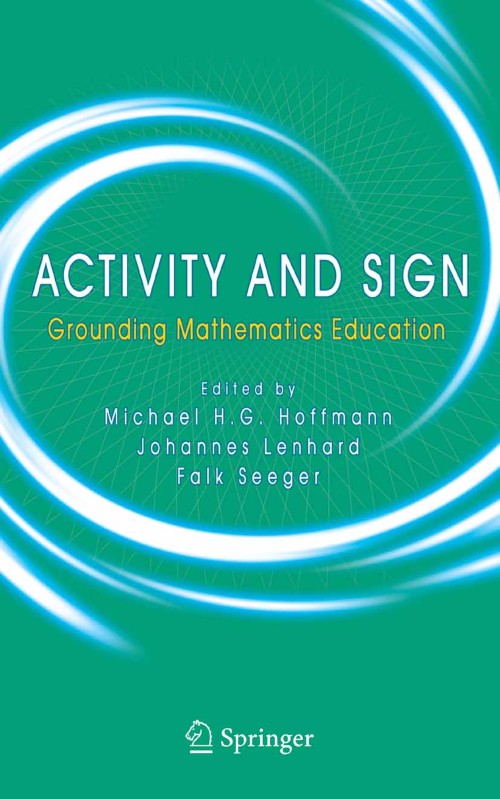
Activity and Sign [electronic resource] : Grounding Mathematics Education / edited by Michael H.G. Hoffmann, Johannes Lenhard, Falk Seeger.
Erişim Adresi
ISBN
9780387242705
Dil Kodu
İngilizce
Yer Numarası
DK/7302
Basım Bildirimi
1st ed. 2005.
Yayın Bilgisi
New York, NY : Springer US : Imprint: Springer, 2005.
Fiziksel Niteleme
VIII, 392 p. online resource.
İçindekiler Notu
Grounding Mathematics Education -- Sign Processes -- Agency and Creativity in the Semiotics of Learning Mathematics -- The Semiotic Approach to Mathematical Evidence and Generalization -- Signs as Means for Discoveries -- Diagrammatic Thinking -- Notes on a Semiotically Inspired Theory of Teaching and Learning -- Mathematics, Sign and Activity -- Sign Processes in the Mathematics Classroom -- Semiotic Mediation in the Primary School -- Do Mathematical Symbols Serve to Describe or Construct “Reality”? -- Metaphor and Metonymy in Processes of Semiosis in Mathematics Education -- On Practical and Theoretical Thinking and Other False Dichotomies in Mathematics Education -- The Semiotics of the Schema -- Mathematics Education as a Science -- Towards a Normal Science of Mathematics Education? -- The Study of the Didactical Conditions of School Learning in Mathematics -- The Formal, The Social and the Subjective -- Crossing Boundaries -- Reflective Learning -- Thinking and Knowing About Knowledge -- The Cognitive Unconscious -- History of Mathematics and Mathematics Education -- Hilbert, Weyl, and the Philosophy of Mathematics -- Mathematical Metaphors in Natorp’s Neo-Kantian Epistemology and Philosophy of Science -- Newton’s Program of Mathematizing Nature -- Did Hermann and Robert Graßmann Contribute to the Emergence of Formal Axiomatics? -- A Case Study in Generalisation -- Some German Contributions to Mathematics Research in Brazil -- Making Philosophy of Mathematics Relevant -- Data Structures and Virtual Worlds -- Variables, in Particular Random Variables -- Deduction, Perception, and Modeling -- Models of Data, Theoretical Models, and Ontology -- Some Sober Conceptions of Mathematical Truth -- Can There Be an Alternative Mathematics, Really? -- Coda -- An Interview with Michael Otte.
Özet, vb.
The advancement of a scientific discipline depends not only on the "big heroes" of a discipline, but also on a community’s ability to reflect on what has been done in the past and what should be done in the future. This volume combines perspectives on both. It celebrates the merits of Michael Otte as one of the most important founding fathers of mathematics education by bringing together all the new and fascinating perspectives, created through his career as a bridge builder in the field of interdisciplinary research and cooperation. The perspectives elaborated here are for the greatest part motivated by the impressing variety of Otte’s thoughts; however, the idea is not to look back, but to find out where the research agenda might lead us in the future. This volume provides new sources of knowledge based on Michael Otte’s fundamental insight that understanding the problems of mathematics education – how to teach, how to learn, how to communicate, how to do, and how to represent mathematics – depends on means, mainly philosophical and semiotic, that have to be created first of all, and to be reflected from the perspectives of a multitude of diverse disciplines.
Konu
Mathematics __ Study and teaching .
Philosophy.
Science __ History.
Mathematics Education.
Philosophy.
History of Science.
Philosophy.
Science __ History.
Mathematics Education.
Philosophy.
History of Science.
Diğer Yazarlar
Kurum Adı
Eseri Alıntıla
Referansları kullanmadan önce gözden geçirmeniz ve varsa gerekli düzeltmeleri yapmanız önerilir.
Dijital Kaynak
MARC Görünümü
LEADER 05693nam a22005895i 4500
001 805989
003 TR_AnAIT
005 20260127001212
007 cr nn 008mamaa
008 100301s2005 xxu| s |||| 0|eng d
020 |a9780387242705|9978-0-387-24270-5
024 7 |a10.1007/b105055|2doi
041 |aeng
049 |aTürk Tarih Kurumu Kütüphanesi
050 4|aQA10.92-20
072 7|aJNU|2bicssc
072 7|aPB|2bicssc
072 7|aEDU029010|2bisacsh
072 7|aJNU|2thema
072 7|aPB|2thema
082 04|a510.71|223
090 |aDK/7302
245 10|aActivity and Sign|h[electronic resource] :|bGrounding Mathematics Education /|cedited by Michael H.G. Hoffmann, Johannes Lenhard, Falk Seeger.
250 |a1st ed. 2005.
264 1|aNew York, NY :|bSpringer US :|bImprint: Springer,|c2005.
300 |aVIII, 392 p.|bonline resource.
336 |atext|btxt|2rdacontent
337 |acomputer|bc|2rdamedia
338 |aonline resource|bcr|2rdacarrier
347 |atext file|bPDF|2rda
505 0 |aGrounding Mathematics Education -- Sign Processes -- Agency and Creativity in the Semiotics of Learning Mathematics -- The Semiotic Approach to Mathematical Evidence and Generalization -- Signs as Means for Discoveries -- Diagrammatic Thinking -- Notes on a Semiotically Inspired Theory of Teaching and Learning -- Mathematics, Sign and Activity -- Sign Processes in the Mathematics Classroom -- Semiotic Mediation in the Primary School -- Do Mathematical Symbols Serve to Describe or Construct “Reality”? -- Metaphor and Metonymy in Processes of Semiosis in Mathematics Education -- On Practical and Theoretical Thinking and Other False Dichotomies in Mathematics Education -- The Semiotics of the Schema -- Mathematics Education as a Science -- Towards a Normal Science of Mathematics Education? -- The Study of the Didactical Conditions of School Learning in Mathematics -- The Formal, The Social and the Subjective -- Crossing Boundaries -- Reflective Learning -- Thinking and Knowing About Knowledge -- The Cognitive Unconscious -- History of Mathematics and Mathematics Education -- Hilbert, Weyl, and the Philosophy of Mathematics -- Mathematical Metaphors in Natorp’s Neo-Kantian Epistemology and Philosophy of Science -- Newton’s Program of Mathematizing Nature -- Did Hermann and Robert Graßmann Contribute to the Emergence of Formal Axiomatics? -- A Case Study in Generalisation -- Some German Contributions to Mathematics Research in Brazil -- Making Philosophy of Mathematics Relevant -- Data Structures and Virtual Worlds -- Variables, in Particular Random Variables -- Deduction, Perception, and Modeling -- Models of Data, Theoretical Models, and Ontology -- Some Sober Conceptions of Mathematical Truth -- Can There Be an Alternative Mathematics, Really? -- Coda -- An Interview with Michael Otte.
520 |aThe advancement of a scientific discipline depends not only on the "big heroes" of a discipline, but also on a community’s ability to reflect on what has been done in the past and what should be done in the future. This volume combines perspectives on both. It celebrates the merits of Michael Otte as one of the most important founding fathers of mathematics education by bringing together all the new and fascinating perspectives, created through his career as a bridge builder in the field of interdisciplinary research and cooperation. The perspectives elaborated here are for the greatest part motivated by the impressing variety of Otte’s thoughts; however, the idea is not to look back, but to find out where the research agenda might lead us in the future. This volume provides new sources of knowledge based on Michael Otte’s fundamental insight that understanding the problems of mathematics education – how to teach, how to learn, how to communicate, how to do, and how to represent mathematics – depends on means, mainly philosophical and semiotic, that have to be created first of all, and to be reflected from the perspectives of a multitude of diverse disciplines.
532 8 |aAccessibility summary: This PDF is not accessible. It is based on scanned pages and does not support features such as screen reader compatibility or described non-text content (images, graphs etc). However, it likely supports searchable and selectable text based on OCR (Optical Character Recognition). Users with accessibility needs may not be able to use this content effectively. Please contact us at accessibilitysupport@springernature.com if you require assistance or an alternative format.
532 8 |aInaccessible, or known limited accessibility
532 8 |aNo reading system accessibility options actively disabled
532 8 |aPublisher contact for further accessibility information: accessibilitysupport@springernature.com
650 0|aMathematics|xStudy and teaching .
650 0|aPhilosophy.
650 0|aScience|xHistory.
650 14|aMathematics Education.
650 24|aPhilosophy.
650 24|aHistory of Science.
700 1 |aHoffmann, Michael H.G.|eeditor.|4edt|4http://id.loc.gov/vocabulary/relators/edt
700 1 |aLenhard, Johannes.|eeditor.|4edt|4http://id.loc.gov/vocabulary/relators/edt
700 1 |aSeeger, Falk.|eeditor.|4edt|4http://id.loc.gov/vocabulary/relators/edt
710 2 |aSpringerLink (Online service)
773 0 |tSpringer Nature eBook
776 08|iPrinted edition:|z9780387242699
776 08|iPrinted edition:|z9780387504674
776 08|iPrinted edition:|z9781441937117
856 40|uhttps://doi.org/10.1007/b105055
912 |aZDB-2-SHU
912 |aZDB-2-SXED
950 |aHumanities, Social Sciences and Law (SpringerNature-11648)
950 |aEducation (R0) (SpringerNature-43721)
001 805989
003 TR_AnAIT
005 20260127001212
007 cr nn 008mamaa
008 100301s2005 xxu| s |||| 0|eng d
020 |a9780387242705|9978-0-387-24270-5
024 7 |a10.1007/b105055|2doi
041 |aeng
049 |aTürk Tarih Kurumu Kütüphanesi
050 4|aQA10.92-20
072 7|aJNU|2bicssc
072 7|aPB|2bicssc
072 7|aEDU029010|2bisacsh
072 7|aJNU|2thema
072 7|aPB|2thema
082 04|a510.71|223
090 |aDK/7302
245 10|aActivity and Sign|h[electronic resource] :|bGrounding Mathematics Education /|cedited by Michael H.G. Hoffmann, Johannes Lenhard, Falk Seeger.
250 |a1st ed. 2005.
264 1|aNew York, NY :|bSpringer US :|bImprint: Springer,|c2005.
300 |aVIII, 392 p.|bonline resource.
336 |atext|btxt|2rdacontent
337 |acomputer|bc|2rdamedia
338 |aonline resource|bcr|2rdacarrier
347 |atext file|bPDF|2rda
505 0 |aGrounding Mathematics Education -- Sign Processes -- Agency and Creativity in the Semiotics of Learning Mathematics -- The Semiotic Approach to Mathematical Evidence and Generalization -- Signs as Means for Discoveries -- Diagrammatic Thinking -- Notes on a Semiotically Inspired Theory of Teaching and Learning -- Mathematics, Sign and Activity -- Sign Processes in the Mathematics Classroom -- Semiotic Mediation in the Primary School -- Do Mathematical Symbols Serve to Describe or Construct “Reality”? -- Metaphor and Metonymy in Processes of Semiosis in Mathematics Education -- On Practical and Theoretical Thinking and Other False Dichotomies in Mathematics Education -- The Semiotics of the Schema -- Mathematics Education as a Science -- Towards a Normal Science of Mathematics Education? -- The Study of the Didactical Conditions of School Learning in Mathematics -- The Formal, The Social and the Subjective -- Crossing Boundaries -- Reflective Learning -- Thinking and Knowing About Knowledge -- The Cognitive Unconscious -- History of Mathematics and Mathematics Education -- Hilbert, Weyl, and the Philosophy of Mathematics -- Mathematical Metaphors in Natorp’s Neo-Kantian Epistemology and Philosophy of Science -- Newton’s Program of Mathematizing Nature -- Did Hermann and Robert Graßmann Contribute to the Emergence of Formal Axiomatics? -- A Case Study in Generalisation -- Some German Contributions to Mathematics Research in Brazil -- Making Philosophy of Mathematics Relevant -- Data Structures and Virtual Worlds -- Variables, in Particular Random Variables -- Deduction, Perception, and Modeling -- Models of Data, Theoretical Models, and Ontology -- Some Sober Conceptions of Mathematical Truth -- Can There Be an Alternative Mathematics, Really? -- Coda -- An Interview with Michael Otte.
520 |aThe advancement of a scientific discipline depends not only on the "big heroes" of a discipline, but also on a community’s ability to reflect on what has been done in the past and what should be done in the future. This volume combines perspectives on both. It celebrates the merits of Michael Otte as one of the most important founding fathers of mathematics education by bringing together all the new and fascinating perspectives, created through his career as a bridge builder in the field of interdisciplinary research and cooperation. The perspectives elaborated here are for the greatest part motivated by the impressing variety of Otte’s thoughts; however, the idea is not to look back, but to find out where the research agenda might lead us in the future. This volume provides new sources of knowledge based on Michael Otte’s fundamental insight that understanding the problems of mathematics education – how to teach, how to learn, how to communicate, how to do, and how to represent mathematics – depends on means, mainly philosophical and semiotic, that have to be created first of all, and to be reflected from the perspectives of a multitude of diverse disciplines.
532 8 |aAccessibility summary: This PDF is not accessible. It is based on scanned pages and does not support features such as screen reader compatibility or described non-text content (images, graphs etc). However, it likely supports searchable and selectable text based on OCR (Optical Character Recognition). Users with accessibility needs may not be able to use this content effectively. Please contact us at accessibilitysupport@springernature.com if you require assistance or an alternative format.
532 8 |aInaccessible, or known limited accessibility
532 8 |aNo reading system accessibility options actively disabled
532 8 |aPublisher contact for further accessibility information: accessibilitysupport@springernature.com
650 0|aMathematics|xStudy and teaching .
650 0|aPhilosophy.
650 0|aScience|xHistory.
650 14|aMathematics Education.
650 24|aPhilosophy.
650 24|aHistory of Science.
700 1 |aHoffmann, Michael H.G.|eeditor.|4edt|4http://id.loc.gov/vocabulary/relators/edt
700 1 |aLenhard, Johannes.|eeditor.|4edt|4http://id.loc.gov/vocabulary/relators/edt
700 1 |aSeeger, Falk.|eeditor.|4edt|4http://id.loc.gov/vocabulary/relators/edt
710 2 |aSpringerLink (Online service)
773 0 |tSpringer Nature eBook
776 08|iPrinted edition:|z9780387242699
776 08|iPrinted edition:|z9780387504674
776 08|iPrinted edition:|z9781441937117
856 40|uhttps://doi.org/10.1007/b105055
912 |aZDB-2-SHU
912 |aZDB-2-SXED
950 |aHumanities, Social Sciences and Law (SpringerNature-11648)
950 |aEducation (R0) (SpringerNature-43721)
Materyaller
Depodan talep edilen materyal sadece kütüphane içerisinde kullanılmaktadır.
Materyal dışarıya ödünç verilmemektedir.
Materyal dışarıya ödünç verilmemektedir.
