LEADER 03785nam a22005175i 4500
001 805993
003 TR_AnAIT
005 20260127001216
007 cr nn 008mamaa
008 100722s2010 gw | s |||| 0|eng d
020 |a9783642114342|9978-3-642-11434-2
024 7 |a10.1007/978-3-642-11434-2|2doi
041 |aeng
049 |aTürk Tarih Kurumu Kütüphanesi
050 4|aK201-487
072 7|aLAB|2bicssc
072 7|aPHI000000|2bisacsh
072 7|aLAB|2thema
082 04|a340.1|223
090 |aDK/7306
100 1 |aBenvindo, Juliano Zaiden.|eauthor.|4aut|4http://id.loc.gov/vocabulary/relators/aut
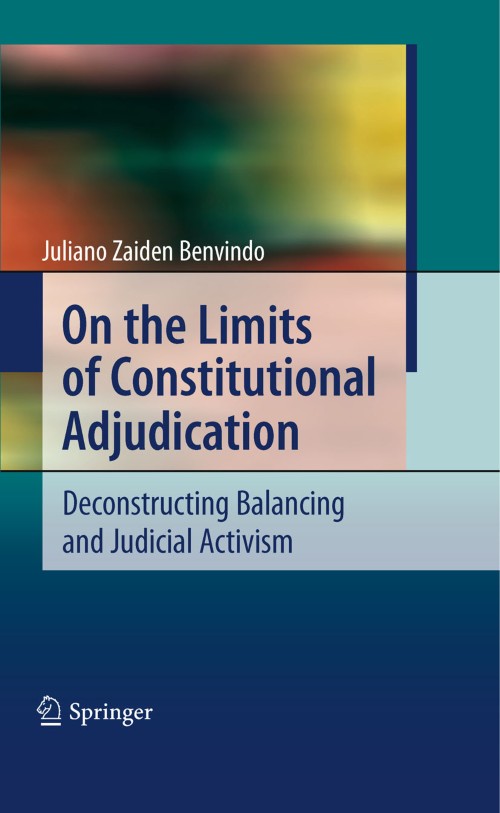
245 10|aOn the Limits of Constitutional Adjudication|h[electronic resource] :|bDeconstructing Balancing and Judicial Activism /|cby Juliano Zaiden Benvindo.
250 |a1st ed. 2010.
264 1|aBerlin, Heidelberg :|bSpringer Berlin Heidelberg :|bImprint: Springer,|c2010.
300 |aXX, 421 p.|bonline resource.
336 |atext|btxt|2rdacontent
337 |acomputer|bc|2rdamedia
338 |aonline resource|bcr|2rdacarrier
347 |atext file|bPDF|2rda
505 0 |aGerman and Brazilian Constitutional Cultures: Constitutional Adjudication and Activism -- An Approach to Decision-Making -- Balancing Within the Context of German Constitutionalism: The Bundesverfassungsgericht’s Shift to Activism -- Balancing Within the Context of Brazilian Constitutionalism: The Supremo Tribunal Federal’s Shift to Activism -- The Debate on the Rationality of Balancing -- The Aim to Rationalize Balancing Within the Context of Constitutional Courts’ Activism -- When Différance Comes to Light: Balancing Within the Context of Deconstruction -- When Procedures Towards Mutual Understanding Come to Light: Balancing Within the Context of Proceduralism -- The Concept of Limited Rationality -- Between Différance and Intersubjectivity: The Concept of Limited Rationality in Constitutional Democracy -- Between Différance and Intersubjectivity: The Concept of Limited Rationality in the Realm of Constitutional Adjudication.
520 |aJuliano Z. Benvindo investigates the current movement of constitutional courts towards political activism, especially by focusing on the increasing use of the balancing method as a “rational” justification for this process. From the critical perception of the serious risks of this movement to democracy, the book takes as examples two constitutional realities, Germany and Brazil, in order to discuss the rationality, correctness, and legitimacy of constitutional decisions within this context. Through a dialogue between Jacques Derrida’s deconstruction and Jürgen Habermas’s proceduralism, the author confronts Robert Alexy’s defense of the balancing method as well as those two constitutional realities. This confrontation leads to the introduction of the concept of limited rationality applied to constitutional democracy and constitutional adjudication, which affirms the double bind of history and justice as a condition for a practice of decision-making committed to the principle of separation of powers.
650 0|aLaw|xPhilosophy.
650 0|aLaw.
650 0|aLaw|xHistory.
650 0|aConstitutional law.
650 14|aPhilosophy of Law.
650 24|aLaw.
650 24|aTheories of Law, Philosophy of Law, Legal History.
650 24|aConstitutional Law.
710 2 |aSpringerLink (Online service)
773 0 |tSpringer Nature eBook
776 08|iPrinted edition:|z9783642114335
776 08|iPrinted edition:|z9783642114496
776 08|iPrinted edition:|z9783642423864
856 40|uhttps://doi.org/10.1007/978-3-642-11434-2
912 |aZDB-2-SHU
912 |aZDB-2-SXPR
950 |aHumanities, Social Sciences and Law (SpringerNature-11648)
950 |aPhilosophy and Religion (R0) (SpringerNature-43725)