LEADER 04222nam a22006735i 4500
001 806026
003 TR_AnAIT
005 20260127001256
007 cr nn 008mamaa
008 130220s2001 ne | s |||| 0|eng d
020 |a9789401598491|9978-94-015-9849-1
024 7 |a10.1007/978-94-015-9849-1|2doi
041 |aeng
049 |aTürk Tarih Kurumu Kütüphanesi
050 4|aD1-2027
072 7|aHB|2bicssc
072 7|aHBAH|2bicssc
072 7|aHIS000000|2bisacsh
072 7|aNH|2thema
072 7|aNHAH|2thema
082 04|a900|223
090 |aDK/7339
100 1 |aWilliams, R.L.|eauthor.|4aut|4http://id.loc.gov/vocabulary/relators/aut
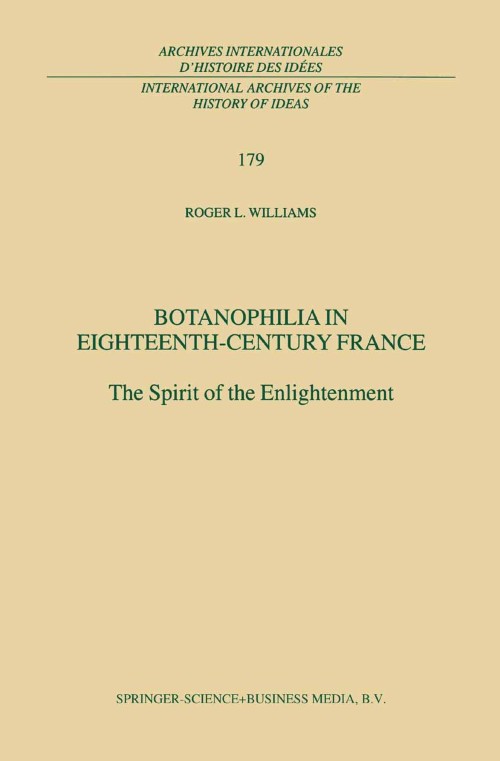
245 10|aBotanophilia in Eighteenth-Century France|h[electronic resource] :|bThe Spirit of the Enlightenment /|cby R.L. Williams.
250 |a1st ed. 2001.
264 1|aDordrecht :|bSpringer Netherlands :|bImprint: Springer,|c2001.
300 |aV, 197 p.|bonline resource.
336 |atext|btxt|2rdacontent
337 |acomputer|bc|2rdamedia
338 |aonline resource|bcr|2rdacarrier
347 |atext file|bPDF|2rda
490 1 |aInternational Archives of the History of Ideas Archives internationales d'histoire des idées,|x2215-0307 ;|v179
505 0 |aPrologue -- Sébastien Valliant and the Sexuality of Plants -- Linnaeus, Prince of Botanists -- Bernard de Jussieu and the Petit Trianon -- The Buffon Phenomenon -- From Jussieu to Candolle -- Plants and Medical Practices -- The Amiable Science and Sensibility -- Public Botanophilia: Floras -- Public Botanophilia: Learned Societies and Eminent Botanophiles -- Painting and Gardening: The Blending of Science and Art -- The Botanophiles Confront Deforestation -- Epilogue -- Finale.
520 |aThe book describes the innovations that enabled botany, in the Eighteenth century, to emerge as an independent science, independent from medicine and herbalism. This encompassed the development of a reliable system for plant classification and the invention of a nomenclature that could be universally applied and understood. The key that enabled Linnaeus to devise his classification system was the discovery of the sexuality of plants. The book, which is intended for the educated general reader, proceeds to illustrate how many aspects of French life were permeated by this revolution in botany between about 1760 to 1815, a botanophilia sometimes inflated into botanomania. The reader should emerge with a clearer understanding of what the Enlightenment actually was in contrast to some popular second-hand ideas today.
532 8 |aAccessibility summary: This PDF is not accessible. It is based on scanned pages and does not support features such as screen reader compatibility or described non-text content (images, graphs etc). However, it likely supports searchable and selectable text based on OCR (Optical Character Recognition). Users with accessibility needs may not be able to use this content effectively. Please contact us at accessibilitysupport@springernature.com if you require assistance or an alternative format.
532 8 |aInaccessible, or known limited accessibility
532 8 |aNo reading system accessibility options actively disabled
532 8 |aPublisher contact for further accessibility information: accessibilitysupport@springernature.com
650 0|aHistory.
650 0|aScience|xHistory.
650 0|aBotany.
650 0|aPlants|xEvolution.
650 0|aEnvironment.
650 0|aArts.
650 14|aHistory.
650 24|aHistory of Science.
650 24|aPlant Science.
650 24|aPlant Evolution.
650 24|aEnvironmental Sciences.
650 24|aFine Art.
710 2 |aSpringerLink (Online service)
773 0 |tSpringer Nature eBook
776 08|iPrinted edition:|z9780792368861
776 08|iPrinted edition:|z9789048156788
776 08|iPrinted edition:|z9789401598507
830 0|aInternational Archives of the History of Ideas Archives internationales d'histoire des idées,|x2215-0307 ;|v179
856 40|uhttps://doi.org/10.1007/978-94-015-9849-1
912 |aZDB-2-SHU
912 |aZDB-2-SXH
912 |aZDB-2-BAE
950 |aHumanities, Social Sciences and Law (SpringerNature-11648)
950 |aHistory (R0) (SpringerNature-43722)