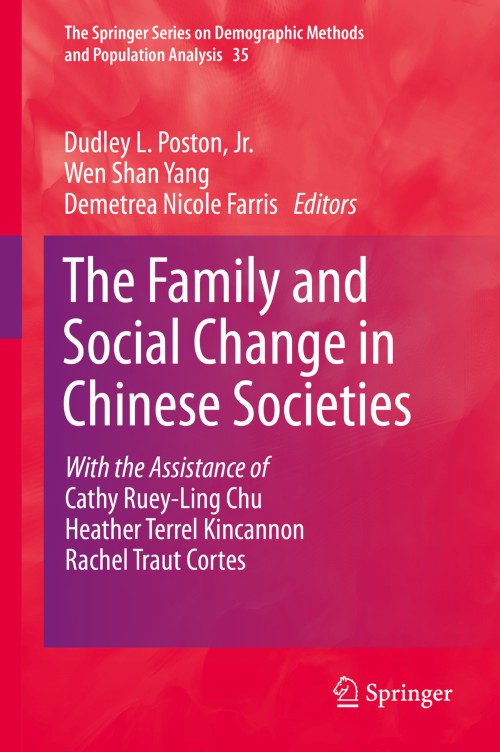
The Family and Social Change in Chinese Societies [electronic resource] / edited by Dudley L. Poston, Jr., Wen Shan Yang, Demetrea Nicole Farris.
Erişim Adresi
ISBN
9789400774452
Dil Kodu
İngilizce
Yer Numarası
DK/7356
Basım Bildirimi
1st ed. 2014.
Yayın Bilgisi
Dordrecht : Springer Netherlands : Imprint: Springer, 2014.
Fiziksel Niteleme
XVIII, 295 p. 41 illus. online resource.
Dizi
The Springer Series on Demographic Methods and Population Analysis, 2215-1990 ; 35
İçindekiler Notu
Introduction: Demetrea Nicole Farris and Dudley L. Poston, Jr., “Family Issues in Taiwan and China” -- I. The Family in Taiwan and China: 1. Chien-Liang Chen, “Models of Resource Distribution in the Family in Taiwan” -- 2. Kuang-Hui Yeh, “Filial Piety and the Autonomous Development of Adolescents in the Taiwanese Family” -- 3. Te-mu Wang and Hua-chin Ho, “Family Poverty in Taiwan” -- 4. Edward Jow-Ching Tu and Jianping Wang, “Patterns and Changes in Household Structure in Hong Kong” -- II. Issues of Marriage, the Family and Fertility in Taiwan and China: 5. Wen Shan Yang and Pei Chieh Yen. “Single and Happier?: A Comparative Study of Marital Status, Socioeconomic Security and Wellbeing of Women in Hong Kong and Taiwan” -- 6. Ginny Garcia, Heather Terrell Kincannon, Dudley L. Poston, Jr., and Carol S. Walther, “Patterns of Sexual Activity in China and the United States” -- 7. Wen Shan Yang and Ying-ying Tiffany Liu, “Gender Imbalances and the Twisted Marriage Market in Taiwan” -- 8. Hsiang-Ming Kung, “Like Mother, Like Daughter: The Effect of Mothers’ Attitudes on the Way Their Daughters Interact with Their Mothers-in-law” -- 9. Li Zhang, Dudley L. Poston, Jr., and Chiung-Fang Chang, “Male and Female Fertility in Taiwan” -- III. Children and the Family in East Asia and in Western Countries: Comparative Studies: 10. Feinian Chen, “The Dynamics of Grandparents Caring for Children in China” -- 11. Cathy Ruey-Ling Chu, “Family Values and Parent-Child Interaction in Taiwan” -- 12. Cherng-Tay Hsueh, “Diversity among Families in Contemporary Taiwan: Old Trunks or New Twigs?” -- 13. Lang-Wen Huang, “Adolescent Development in Taiwan” -- 14. Dudley L. Poston, Jr., Hosik Min, and Sherry L. McKibben, “Son Preference and Fertility in China, South Korea, and the United States” -- 15. Alfred Ko-wei Hu, “Determinants of Intergenerational Support in the Newly Industrialized Societies: The Case of Taiwan” -- IV. The Familyand the Future in Taiwan: 16. Dudley L. Poston, Jr. and Li Zhang, “Taiwan’s Demographic Destiny: Marriage Market and Aged Dependency Implications for the 21st Century” -- About the Authors -- Name Index -- Subject Index. .
Özet, vb.
This book focuses on families and their changes in Taiwan and China. Traditional notions of what constitutes a family have been changing in China, Taiwan and other Asian countries. The chapters in this book provide interesting methodological and substantive contributions to the discourse on family and social change in Chinese societies. They also underscore the implications of the various social changes in Chinese families. Written by Chinese and Western scholars, they provide an unprecedented overview of what is known about the effects of social change on Chinese families. One might think that defining a “family” is an easy task because the family is so significant to society and is universal. The family is the first place we learn culture, norms, values, and gender roles. Families exist in all societies throughout the world; but their constitution differs. In the past several decades there have been many changes in the family in Taiwan and China. For instance, whereas in the West, we use a bilineal system of descent in which descent is traced through both the mother’s side and the father’s side of the family, in many parts of China, descent is patrilineal, although this is changing, and China and Taiwan are starting to assume a family constitution similar to that in the West. This and other issues are discussed in great detail in this book. Indeed it is the very nature of the differences that motivated the writing of this book on changing families in Taiwan and China. The chapters in Part I: The Family in Taiwan and China focus on the basic family issues in Taiwan and China that provide the groundwork for many of the chapters that follow. Chapter 1 is about the distribution of resources in the family in Taiwan. Chapter 2 focuses on filial piety and the autonomous development of adolescents in the Taiwanese family, and Chapter 3 explores the important issue of familypoverty in Taiwan. Chapter 4 moves away from Taiwan and looks at several issues of family growth and change in Hong Kong, noting the interesting similarities and differences between Hong Kong and China. Part II: Issues of Marriage, the Family and Fertility in Taiwan and China focuses specifically on marriage, family and fertility. In Chapter 5 the authors discuss the relationships between marital status, socioeconomic status and the subjective well-being among women in Hong Kong and Taiwan. Chapter 6 describes patterns of sexual activity in China and the United States. Chapter 7 considers gender imbalances in Taiwan and their impact on the marriage market. Chapter 8 also focuses on Taiwan and examines the effects of mothers’ attitudes on daughters’ interaction with their mothers-in-law. Chapter 9 compares female and male fertility trends and changes in Taiwan. Part III: Children and the Family in East Asia and in Western Countries consists of comparative studies of the family and children. Chapter 10 examines the dynamics of grandparents caring for children in China. Chapter 11 explores family values and parent-child interaction in Taiwan. Chapter 12 examines the significant amount of diversity among families in contemporary Taiwan. Chapter 13 describes adolescent development in Taiwan. Chapter 14 examines the impact of son preference on fertility in China, South Korea and the United States. And Chapter 15 explores the determinants of intergenerational support in Taiwan. The final chapter in our book, the only chapter in Part IV: The Family and the Future in Taiwan, examines the future of the family in Taiwan with respect especially to the marriage market and aged dependency.
Konu
Sociology.
Social groups.
Demography.
Population.
Sociology of Family, Youth and Aging.
Population and Demography.
Sociology.
Social groups.
Demography.
Population.
Sociology of Family, Youth and Aging.
Population and Demography.
Sociology.
Kurum Adı

Eseri Alıntıla
Referansları kullanmadan önce gözden geçirmeniz ve varsa gerekli düzeltmeleri yapmanız önerilir.
Dijital Kaynak
MARC Görünümü
LEADER 08027nam a22005655i 4500
001 806043
003 TR_AnAIT
005 20260127001316
007 cr nn 008mamaa
008 131125s2014 ne | s |||| 0|eng d
020 |a9789400774452|9978-94-007-7445-2
024 7 |a10.1007/978-94-007-7445-2|2doi
041 |aeng
049 |aTürk Tarih Kurumu Kütüphanesi
050 4|aHM716-753.2
072 7|aJHBK|2bicssc
072 7|aSOC026010|2bisacsh
072 7|aJHBK|2thema
082 04|a305.2|223
082 04|a306.87|223
090 |aDK/7356
245 14|aThe Family and Social Change in Chinese Societies|h[electronic resource] /|cedited by Dudley L. Poston, Jr., Wen Shan Yang, Demetrea Nicole Farris.
250 |a1st ed. 2014.
264 1|aDordrecht :|bSpringer Netherlands :|bImprint: Springer,|c2014.
300 |aXVIII, 295 p. 41 illus.|bonline resource.
336 |atext|btxt|2rdacontent
337 |acomputer|bc|2rdamedia
338 |aonline resource|bcr|2rdacarrier
347 |atext file|bPDF|2rda
490 1 |aThe Springer Series on Demographic Methods and Population Analysis,|x2215-1990 ;|v35
505 0 |aIntroduction: Demetrea Nicole Farris and Dudley L. Poston, Jr., “Family Issues in Taiwan and China” -- I. The Family in Taiwan and China: 1. Chien-Liang Chen, “Models of Resource Distribution in the Family in Taiwan” -- 2. Kuang-Hui Yeh, “Filial Piety and the Autonomous Development of Adolescents in the Taiwanese Family” -- 3. Te-mu Wang and Hua-chin Ho, “Family Poverty in Taiwan” -- 4. Edward Jow-Ching Tu and Jianping Wang, “Patterns and Changes in Household Structure in Hong Kong” -- II. Issues of Marriage, the Family and Fertility in Taiwan and China: 5. Wen Shan Yang and Pei Chieh Yen. “Single and Happier?: A Comparative Study of Marital Status, Socioeconomic Security and Wellbeing of Women in Hong Kong and Taiwan” -- 6. Ginny Garcia, Heather Terrell Kincannon, Dudley L. Poston, Jr., and Carol S. Walther, “Patterns of Sexual Activity in China and the United States” -- 7. Wen Shan Yang and Ying-ying Tiffany Liu, “Gender Imbalances and the Twisted Marriage Market in Taiwan” -- 8. Hsiang-Ming Kung, “Like Mother, Like Daughter: The Effect of Mothers’ Attitudes on the Way Their Daughters Interact with Their Mothers-in-law” -- 9. Li Zhang, Dudley L. Poston, Jr., and Chiung-Fang Chang, “Male and Female Fertility in Taiwan” -- III. Children and the Family in East Asia and in Western Countries: Comparative Studies: 10. Feinian Chen, “The Dynamics of Grandparents Caring for Children in China” -- 11. Cathy Ruey-Ling Chu, “Family Values and Parent-Child Interaction in Taiwan” -- 12. Cherng-Tay Hsueh, “Diversity among Families in Contemporary Taiwan: Old Trunks or New Twigs?” -- 13. Lang-Wen Huang, “Adolescent Development in Taiwan” -- 14. Dudley L. Poston, Jr., Hosik Min, and Sherry L. McKibben, “Son Preference and Fertility in China, South Korea, and the United States” -- 15. Alfred Ko-wei Hu, “Determinants of Intergenerational Support in the Newly Industrialized Societies: The Case of Taiwan” -- IV. The Familyand the Future in Taiwan: 16. Dudley L. Poston, Jr. and Li Zhang, “Taiwan’s Demographic Destiny: Marriage Market and Aged Dependency Implications for the 21st Century” -- About the Authors -- Name Index -- Subject Index. .
520 |aThis book focuses on families and their changes in Taiwan and China. Traditional notions of what constitutes a family have been changing in China, Taiwan and other Asian countries. The chapters in this book provide interesting methodological and substantive contributions to the discourse on family and social change in Chinese societies. They also underscore the implications of the various social changes in Chinese families. Written by Chinese and Western scholars, they provide an unprecedented overview of what is known about the effects of social change on Chinese families. One might think that defining a “family” is an easy task because the family is so significant to society and is universal. The family is the first place we learn culture, norms, values, and gender roles. Families exist in all societies throughout the world; but their constitution differs. In the past several decades there have been many changes in the family in Taiwan and China. For instance, whereas in the West, we use a bilineal system of descent in which descent is traced through both the mother’s side and the father’s side of the family, in many parts of China, descent is patrilineal, although this is changing, and China and Taiwan are starting to assume a family constitution similar to that in the West. This and other issues are discussed in great detail in this book. Indeed it is the very nature of the differences that motivated the writing of this book on changing families in Taiwan and China. The chapters in Part I: The Family in Taiwan and China focus on the basic family issues in Taiwan and China that provide the groundwork for many of the chapters that follow. Chapter 1 is about the distribution of resources in the family in Taiwan. Chapter 2 focuses on filial piety and the autonomous development of adolescents in the Taiwanese family, and Chapter 3 explores the important issue of familypoverty in Taiwan. Chapter 4 moves away from Taiwan and looks at several issues of family growth and change in Hong Kong, noting the interesting similarities and differences between Hong Kong and China. Part II: Issues of Marriage, the Family and Fertility in Taiwan and China focuses specifically on marriage, family and fertility. In Chapter 5 the authors discuss the relationships between marital status, socioeconomic status and the subjective well-being among women in Hong Kong and Taiwan. Chapter 6 describes patterns of sexual activity in China and the United States. Chapter 7 considers gender imbalances in Taiwan and their impact on the marriage market. Chapter 8 also focuses on Taiwan and examines the effects of mothers’ attitudes on daughters’ interaction with their mothers-in-law. Chapter 9 compares female and male fertility trends and changes in Taiwan. Part III: Children and the Family in East Asia and in Western Countries consists of comparative studies of the family and children. Chapter 10 examines the dynamics of grandparents caring for children in China. Chapter 11 explores family values and parent-child interaction in Taiwan. Chapter 12 examines the significant amount of diversity among families in contemporary Taiwan. Chapter 13 describes adolescent development in Taiwan. Chapter 14 examines the impact of son preference on fertility in China, South Korea and the United States. And Chapter 15 explores the determinants of intergenerational support in Taiwan. The final chapter in our book, the only chapter in Part IV: The Family and the Future in Taiwan, examines the future of the family in Taiwan with respect especially to the marriage market and aged dependency.
650 0|aSociology.
650 0|aSocial groups.
650 0|aDemography.
650 0|aPopulation.
650 14|aSociology of Family, Youth and Aging.
650 24|aPopulation and Demography.
650 24|aSociology.
700 1 |aPoston, Jr., Dudley L.|eeditor.|4edt|4http://id.loc.gov/vocabulary/relators/edt
700 1 |aYang, Wen Shan.|eeditor.|4edt|4http://id.loc.gov/vocabulary/relators/edt
700 1 |aFarris, Demetrea Nicole.|eeditor.|4edt|4http://id.loc.gov/vocabulary/relators/edt
710 2 |aSpringerLink (Online service)
773 0 |tSpringer Nature eBook
776 08|iPrinted edition:|z9789400774445
776 08|iPrinted edition:|z9789400774469
776 08|iPrinted edition:|z9789402404722
830 0|aThe Springer Series on Demographic Methods and Population Analysis,|x2215-1990 ;|v35
856 40|uhttps://doi.org/10.1007/978-94-007-7445-2
912 |aZDB-2-SHU
912 |aZDB-2-SXS
950 |aHumanities, Social Sciences and Law (SpringerNature-11648)
950 |aSocial Sciences (R0) (SpringerNature-43726)
001 806043
003 TR_AnAIT
005 20260127001316
007 cr nn 008mamaa
008 131125s2014 ne | s |||| 0|eng d
020 |a9789400774452|9978-94-007-7445-2
024 7 |a10.1007/978-94-007-7445-2|2doi
041 |aeng
049 |aTürk Tarih Kurumu Kütüphanesi
050 4|aHM716-753.2
072 7|aJHBK|2bicssc
072 7|aSOC026010|2bisacsh
072 7|aJHBK|2thema
082 04|a305.2|223
082 04|a306.87|223
090 |aDK/7356
245 14|aThe Family and Social Change in Chinese Societies|h[electronic resource] /|cedited by Dudley L. Poston, Jr., Wen Shan Yang, Demetrea Nicole Farris.
250 |a1st ed. 2014.
264 1|aDordrecht :|bSpringer Netherlands :|bImprint: Springer,|c2014.
300 |aXVIII, 295 p. 41 illus.|bonline resource.
336 |atext|btxt|2rdacontent
337 |acomputer|bc|2rdamedia
338 |aonline resource|bcr|2rdacarrier
347 |atext file|bPDF|2rda
490 1 |aThe Springer Series on Demographic Methods and Population Analysis,|x2215-1990 ;|v35
505 0 |aIntroduction: Demetrea Nicole Farris and Dudley L. Poston, Jr., “Family Issues in Taiwan and China” -- I. The Family in Taiwan and China: 1. Chien-Liang Chen, “Models of Resource Distribution in the Family in Taiwan” -- 2. Kuang-Hui Yeh, “Filial Piety and the Autonomous Development of Adolescents in the Taiwanese Family” -- 3. Te-mu Wang and Hua-chin Ho, “Family Poverty in Taiwan” -- 4. Edward Jow-Ching Tu and Jianping Wang, “Patterns and Changes in Household Structure in Hong Kong” -- II. Issues of Marriage, the Family and Fertility in Taiwan and China: 5. Wen Shan Yang and Pei Chieh Yen. “Single and Happier?: A Comparative Study of Marital Status, Socioeconomic Security and Wellbeing of Women in Hong Kong and Taiwan” -- 6. Ginny Garcia, Heather Terrell Kincannon, Dudley L. Poston, Jr., and Carol S. Walther, “Patterns of Sexual Activity in China and the United States” -- 7. Wen Shan Yang and Ying-ying Tiffany Liu, “Gender Imbalances and the Twisted Marriage Market in Taiwan” -- 8. Hsiang-Ming Kung, “Like Mother, Like Daughter: The Effect of Mothers’ Attitudes on the Way Their Daughters Interact with Their Mothers-in-law” -- 9. Li Zhang, Dudley L. Poston, Jr., and Chiung-Fang Chang, “Male and Female Fertility in Taiwan” -- III. Children and the Family in East Asia and in Western Countries: Comparative Studies: 10. Feinian Chen, “The Dynamics of Grandparents Caring for Children in China” -- 11. Cathy Ruey-Ling Chu, “Family Values and Parent-Child Interaction in Taiwan” -- 12. Cherng-Tay Hsueh, “Diversity among Families in Contemporary Taiwan: Old Trunks or New Twigs?” -- 13. Lang-Wen Huang, “Adolescent Development in Taiwan” -- 14. Dudley L. Poston, Jr., Hosik Min, and Sherry L. McKibben, “Son Preference and Fertility in China, South Korea, and the United States” -- 15. Alfred Ko-wei Hu, “Determinants of Intergenerational Support in the Newly Industrialized Societies: The Case of Taiwan” -- IV. The Familyand the Future in Taiwan: 16. Dudley L. Poston, Jr. and Li Zhang, “Taiwan’s Demographic Destiny: Marriage Market and Aged Dependency Implications for the 21st Century” -- About the Authors -- Name Index -- Subject Index. .
520 |aThis book focuses on families and their changes in Taiwan and China. Traditional notions of what constitutes a family have been changing in China, Taiwan and other Asian countries. The chapters in this book provide interesting methodological and substantive contributions to the discourse on family and social change in Chinese societies. They also underscore the implications of the various social changes in Chinese families. Written by Chinese and Western scholars, they provide an unprecedented overview of what is known about the effects of social change on Chinese families. One might think that defining a “family” is an easy task because the family is so significant to society and is universal. The family is the first place we learn culture, norms, values, and gender roles. Families exist in all societies throughout the world; but their constitution differs. In the past several decades there have been many changes in the family in Taiwan and China. For instance, whereas in the West, we use a bilineal system of descent in which descent is traced through both the mother’s side and the father’s side of the family, in many parts of China, descent is patrilineal, although this is changing, and China and Taiwan are starting to assume a family constitution similar to that in the West. This and other issues are discussed in great detail in this book. Indeed it is the very nature of the differences that motivated the writing of this book on changing families in Taiwan and China. The chapters in Part I: The Family in Taiwan and China focus on the basic family issues in Taiwan and China that provide the groundwork for many of the chapters that follow. Chapter 1 is about the distribution of resources in the family in Taiwan. Chapter 2 focuses on filial piety and the autonomous development of adolescents in the Taiwanese family, and Chapter 3 explores the important issue of familypoverty in Taiwan. Chapter 4 moves away from Taiwan and looks at several issues of family growth and change in Hong Kong, noting the interesting similarities and differences between Hong Kong and China. Part II: Issues of Marriage, the Family and Fertility in Taiwan and China focuses specifically on marriage, family and fertility. In Chapter 5 the authors discuss the relationships between marital status, socioeconomic status and the subjective well-being among women in Hong Kong and Taiwan. Chapter 6 describes patterns of sexual activity in China and the United States. Chapter 7 considers gender imbalances in Taiwan and their impact on the marriage market. Chapter 8 also focuses on Taiwan and examines the effects of mothers’ attitudes on daughters’ interaction with their mothers-in-law. Chapter 9 compares female and male fertility trends and changes in Taiwan. Part III: Children and the Family in East Asia and in Western Countries consists of comparative studies of the family and children. Chapter 10 examines the dynamics of grandparents caring for children in China. Chapter 11 explores family values and parent-child interaction in Taiwan. Chapter 12 examines the significant amount of diversity among families in contemporary Taiwan. Chapter 13 describes adolescent development in Taiwan. Chapter 14 examines the impact of son preference on fertility in China, South Korea and the United States. And Chapter 15 explores the determinants of intergenerational support in Taiwan. The final chapter in our book, the only chapter in Part IV: The Family and the Future in Taiwan, examines the future of the family in Taiwan with respect especially to the marriage market and aged dependency.
650 0|aSociology.
650 0|aSocial groups.
650 0|aDemography.
650 0|aPopulation.
650 14|aSociology of Family, Youth and Aging.
650 24|aPopulation and Demography.
650 24|aSociology.
700 1 |aPoston, Jr., Dudley L.|eeditor.|4edt|4http://id.loc.gov/vocabulary/relators/edt
700 1 |aYang, Wen Shan.|eeditor.|4edt|4http://id.loc.gov/vocabulary/relators/edt
700 1 |aFarris, Demetrea Nicole.|eeditor.|4edt|4http://id.loc.gov/vocabulary/relators/edt
710 2 |aSpringerLink (Online service)
773 0 |tSpringer Nature eBook
776 08|iPrinted edition:|z9789400774445
776 08|iPrinted edition:|z9789400774469
776 08|iPrinted edition:|z9789402404722
830 0|aThe Springer Series on Demographic Methods and Population Analysis,|x2215-1990 ;|v35
856 40|uhttps://doi.org/10.1007/978-94-007-7445-2
912 |aZDB-2-SHU
912 |aZDB-2-SXS
950 |aHumanities, Social Sciences and Law (SpringerNature-11648)
950 |aSocial Sciences (R0) (SpringerNature-43726)
Materyaller
Depodan talep edilen materyal sadece kütüphane içerisinde kullanılmaktadır.
Materyal dışarıya ödünç verilmemektedir.
