

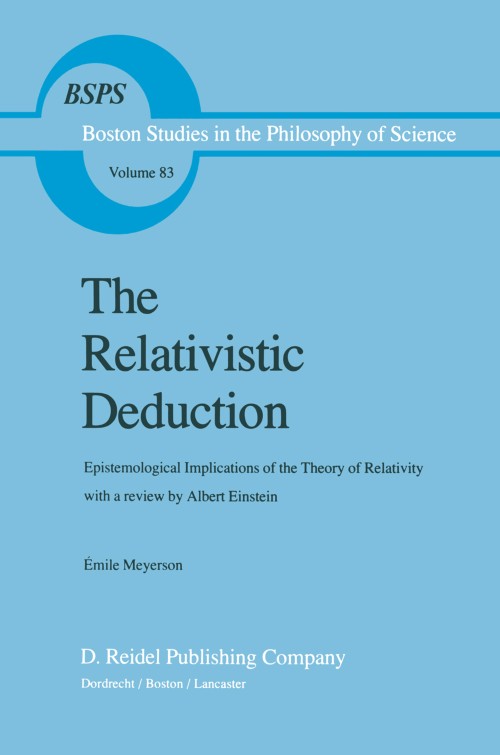
The Relativistic Deduction [electronic resource] : Epistemological Implications of the Theory of Relativity With a Review by Albert Einstein and an Introduction by Mili? ?apek / by Émile Meyerson.
Erişim Adresi
ISBN
9789400952119
Dil Kodu
İngilizce
Yer Numarası
DK/7364
Yazar
Basım Bildirimi
1st ed. 1985.
Yayın Bilgisi
Dordrecht : Springer Netherlands : Imprint: Springer, 1985.
Fiziksel Niteleme
290 p. online resource.
Dizi
Boston Studies in the Philosophy and History of Science, 2214-7942 ; 83
İçindekiler Notu
The Relativistic Deduction -- Preface -- 1. The Quantitative -- 2. Reality -- 3. The Spatial -- 4. The Principle of Inertia -- 5. Relativism, a Theory About Reality -- 6. Gravitation -- 7. Time -- 8. Electrical Phenomena -- 9. Biological Phenomena -- 10. Universal Explanation -- 11. Matter -- 12. Essence and Existence -- 13. Diversity -- 14. Interpretation -- 15. The Relativistic Imagination -- 16. The Appeal of Relativism -- 17. The Deducible and the Real -- 18. The System -- 19. Relativism and Mechanism -- 20. Rational Explanation and the Progress Of Mathematics -- 21. Progress in Making Things Rational -- 22. The Aprioristic Tendency and Experience -- 23. The Evolution of Reason -- 24. Dogmatism and Skepticism in Science -- 25. The Outlook for the Future -- Appendix 1. Review by Albert Einstein -- Appendix 2. Einstein—Meyerson Exchange -- Name Index.
Özet, vb.
When the author of Identity and Reality accepted Langevin's suggestion that Meyerson "identify the thought processes" of Einstein's relativity theory, he turned from his assured perspective as historian of the sciences to the risky bias of contemporary philosophical critic. But Emile Meyerson, the epis temologist as historian, could not find a more rigorous test of his conclusions from historical learning than the interpretation of Einstein's work, unless perhaps he were to turn from the classical revolution of Einstein's relativity to the non-classical quantum theory. Meyerson captures our sympathy in all his writings: " . . . the role of the epistemologist is . . . in following the development of science" (250); the study of the evolution of reason leads us to see that "man does not experience himself reasoning . . . which is carried on unconsciously," and as the summation of his empirical studies of the works and practices of scientists, "reason . . . behaves in an altogether predict able way: . . . first by making the consequent equivalent to the antecedent, and then by actually denying all diversity in space" (202). If logic - and to Meyerson the epistemologist is logician - is to understand reason, then "logic proceeds a posteriori. " And so we are faced with an empirically based Par menides, and, as we shall see, with an ineliminable 'irrational' within science. Meyerson's story, written in 1924, is still exciting, 60 years later.
Konu
Science __ Philosophy.
History.
Philosophy of Science.
History.
History.
Philosophy of Science.
History.
Kurum Adı
Eseri Alıntıla
Referansları kullanmadan önce gözden geçirmeniz ve varsa gerekli düzeltmeleri yapmanız önerilir.
Dijital Kaynak
MARC Görünümü
LEADER 05003nam a22005655i 4500
001 806051
003 TR_AnAIT
005 20260127001325
007 cr nn 008mamaa
008 121227s1985 ne | s |||| 0|eng d
020 |a9789400952119|9978-94-009-5211-9
024 7 |a10.1007/978-94-009-5211-9|2doi
041 |aeng
049 |aTürk Tarih Kurumu Kütüphanesi
050 4|aQ174-175.3
050 4|aB67
072 7|aPDA|2bicssc
072 7|aSCI075000|2bisacsh
072 7|aPDA|2thema
082 04|a501|223
090 |aDK/7364
100 1 |aMeyerson, Émile.|eauthor.|4aut|4http://id.loc.gov/vocabulary/relators/aut
245 14|aThe Relativistic Deduction|h[electronic resource] :|bEpistemological Implications of the Theory of Relativity With a Review by Albert Einstein and an Introduction by Mili? ?apek /|cby Émile Meyerson.
250 |a1st ed. 1985.
264 1|aDordrecht :|bSpringer Netherlands :|bImprint: Springer,|c1985.
300 |a290 p.|bonline resource.
336 |atext|btxt|2rdacontent
337 |acomputer|bc|2rdamedia
338 |aonline resource|bcr|2rdacarrier
347 |atext file|bPDF|2rda
490 1 |aBoston Studies in the Philosophy and History of Science,|x2214-7942 ;|v83
505 0 |aThe Relativistic Deduction -- Preface -- 1. The Quantitative -- 2. Reality -- 3. The Spatial -- 4. The Principle of Inertia -- 5. Relativism, a Theory About Reality -- 6. Gravitation -- 7. Time -- 8. Electrical Phenomena -- 9. Biological Phenomena -- 10. Universal Explanation -- 11. Matter -- 12. Essence and Existence -- 13. Diversity -- 14. Interpretation -- 15. The Relativistic Imagination -- 16. The Appeal of Relativism -- 17. The Deducible and the Real -- 18. The System -- 19. Relativism and Mechanism -- 20. Rational Explanation and the Progress Of Mathematics -- 21. Progress in Making Things Rational -- 22. The Aprioristic Tendency and Experience -- 23. The Evolution of Reason -- 24. Dogmatism and Skepticism in Science -- 25. The Outlook for the Future -- Appendix 1. Review by Albert Einstein -- Appendix 2. Einstein—Meyerson Exchange -- Name Index.
520 |aWhen the author of Identity and Reality accepted Langevin's suggestion that Meyerson "identify the thought processes" of Einstein's relativity theory, he turned from his assured perspective as historian of the sciences to the risky bias of contemporary philosophical critic. But Emile Meyerson, the epis temologist as historian, could not find a more rigorous test of his conclusions from historical learning than the interpretation of Einstein's work, unless perhaps he were to turn from the classical revolution of Einstein's relativity to the non-classical quantum theory. Meyerson captures our sympathy in all his writings: " . . . the role of the epistemologist is . . . in following the development of science" (250); the study of the evolution of reason leads us to see that "man does not experience himself reasoning . . . which is carried on unconsciously," and as the summation of his empirical studies of the works and practices of scientists, "reason . . . behaves in an altogether predict able way: . . . first by making the consequent equivalent to the antecedent, and then by actually denying all diversity in space" (202). If logic - and to Meyerson the epistemologist is logician - is to understand reason, then "logic proceeds a posteriori. " And so we are faced with an empirically based Par menides, and, as we shall see, with an ineliminable 'irrational' within science. Meyerson's story, written in 1924, is still exciting, 60 years later.
532 8 |aAccessibility summary: This PDF is not accessible. It is based on scanned pages and does not support features such as screen reader compatibility or described non-text content (images, graphs etc). However, it likely supports searchable and selectable text based on OCR (Optical Character Recognition). Users with accessibility needs may not be able to use this content effectively. Please contact us at accessibilitysupport@springernature.com if you require assistance or an alternative format.
532 8 |aInaccessible, or known limited accessibility
532 8 |aNo reading system accessibility options actively disabled
532 8 |aPublisher contact for further accessibility information: accessibilitysupport@springernature.com
650 0|aScience|xPhilosophy.
650 0|aHistory.
650 14|aPhilosophy of Science.
650 24|aHistory.
710 2 |aSpringerLink (Online service)
773 0 |tSpringer Nature eBook
776 08|iPrinted edition:|z9789027716996
776 08|iPrinted edition:|z9789400952126
776 08|iPrinted edition:|z9789401088053
830 0|aBoston Studies in the Philosophy and History of Science,|x2214-7942 ;|v83
856 40|uhttps://doi.org/10.1007/978-94-009-5211-9
912 |aZDB-2-SHU
912 |aZDB-2-SXPR
912 |aZDB-2-BAE
950 |aHumanities, Social Sciences and Law (SpringerNature-11648)
950 |aPhilosophy and Religion (R0) (SpringerNature-43725)
001 806051
003 TR_AnAIT
005 20260127001325
007 cr nn 008mamaa
008 121227s1985 ne | s |||| 0|eng d
020 |a9789400952119|9978-94-009-5211-9
024 7 |a10.1007/978-94-009-5211-9|2doi
041 |aeng
049 |aTürk Tarih Kurumu Kütüphanesi
050 4|aQ174-175.3
050 4|aB67
072 7|aPDA|2bicssc
072 7|aSCI075000|2bisacsh
072 7|aPDA|2thema
082 04|a501|223
090 |aDK/7364
100 1 |aMeyerson, Émile.|eauthor.|4aut|4http://id.loc.gov/vocabulary/relators/aut
245 14|aThe Relativistic Deduction|h[electronic resource] :|bEpistemological Implications of the Theory of Relativity With a Review by Albert Einstein and an Introduction by Mili? ?apek /|cby Émile Meyerson.
250 |a1st ed. 1985.
264 1|aDordrecht :|bSpringer Netherlands :|bImprint: Springer,|c1985.
300 |a290 p.|bonline resource.
336 |atext|btxt|2rdacontent
337 |acomputer|bc|2rdamedia
338 |aonline resource|bcr|2rdacarrier
347 |atext file|bPDF|2rda
490 1 |aBoston Studies in the Philosophy and History of Science,|x2214-7942 ;|v83
505 0 |aThe Relativistic Deduction -- Preface -- 1. The Quantitative -- 2. Reality -- 3. The Spatial -- 4. The Principle of Inertia -- 5. Relativism, a Theory About Reality -- 6. Gravitation -- 7. Time -- 8. Electrical Phenomena -- 9. Biological Phenomena -- 10. Universal Explanation -- 11. Matter -- 12. Essence and Existence -- 13. Diversity -- 14. Interpretation -- 15. The Relativistic Imagination -- 16. The Appeal of Relativism -- 17. The Deducible and the Real -- 18. The System -- 19. Relativism and Mechanism -- 20. Rational Explanation and the Progress Of Mathematics -- 21. Progress in Making Things Rational -- 22. The Aprioristic Tendency and Experience -- 23. The Evolution of Reason -- 24. Dogmatism and Skepticism in Science -- 25. The Outlook for the Future -- Appendix 1. Review by Albert Einstein -- Appendix 2. Einstein—Meyerson Exchange -- Name Index.
520 |aWhen the author of Identity and Reality accepted Langevin's suggestion that Meyerson "identify the thought processes" of Einstein's relativity theory, he turned from his assured perspective as historian of the sciences to the risky bias of contemporary philosophical critic. But Emile Meyerson, the epis temologist as historian, could not find a more rigorous test of his conclusions from historical learning than the interpretation of Einstein's work, unless perhaps he were to turn from the classical revolution of Einstein's relativity to the non-classical quantum theory. Meyerson captures our sympathy in all his writings: " . . . the role of the epistemologist is . . . in following the development of science" (250); the study of the evolution of reason leads us to see that "man does not experience himself reasoning . . . which is carried on unconsciously," and as the summation of his empirical studies of the works and practices of scientists, "reason . . . behaves in an altogether predict able way: . . . first by making the consequent equivalent to the antecedent, and then by actually denying all diversity in space" (202). If logic - and to Meyerson the epistemologist is logician - is to understand reason, then "logic proceeds a posteriori. " And so we are faced with an empirically based Par menides, and, as we shall see, with an ineliminable 'irrational' within science. Meyerson's story, written in 1924, is still exciting, 60 years later.
532 8 |aAccessibility summary: This PDF is not accessible. It is based on scanned pages and does not support features such as screen reader compatibility or described non-text content (images, graphs etc). However, it likely supports searchable and selectable text based on OCR (Optical Character Recognition). Users with accessibility needs may not be able to use this content effectively. Please contact us at accessibilitysupport@springernature.com if you require assistance or an alternative format.
532 8 |aInaccessible, or known limited accessibility
532 8 |aNo reading system accessibility options actively disabled
532 8 |aPublisher contact for further accessibility information: accessibilitysupport@springernature.com
650 0|aScience|xPhilosophy.
650 0|aHistory.
650 14|aPhilosophy of Science.
650 24|aHistory.
710 2 |aSpringerLink (Online service)
773 0 |tSpringer Nature eBook
776 08|iPrinted edition:|z9789027716996
776 08|iPrinted edition:|z9789400952126
776 08|iPrinted edition:|z9789401088053
830 0|aBoston Studies in the Philosophy and History of Science,|x2214-7942 ;|v83
856 40|uhttps://doi.org/10.1007/978-94-009-5211-9
912 |aZDB-2-SHU
912 |aZDB-2-SXPR
912 |aZDB-2-BAE
950 |aHumanities, Social Sciences and Law (SpringerNature-11648)
950 |aPhilosophy and Religion (R0) (SpringerNature-43725)
Materyaller
Depodan talep edilen materyal sadece kütüphane içerisinde kullanılmaktadır.
Materyal dışarıya ödünç verilmemektedir.
Materyal dışarıya ödünç verilmemektedir.
