

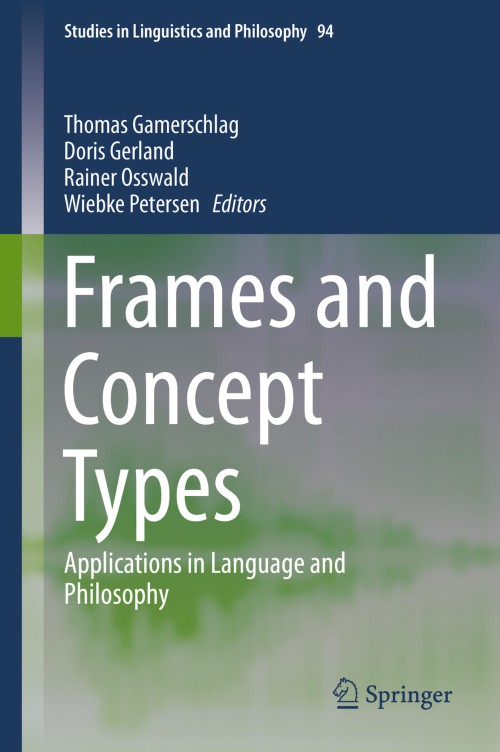
Frames and Concept Types [electronic resource] : Applications in Language and Philosophy / edited by Thomas Gamerschlag, Doris Gerland, Rainer Osswald, Wiebke Petersen.
Erişim Adresi
ISBN
9783319015415
Dil Kodu
İngilizce
Yer Numarası
DK/7396
Basım Bildirimi
1st ed. 2014.
Yayın Bilgisi
Cham : Springer International Publishing : Imprint: Springer, 2014.
Fiziksel Niteleme
X, 362 p. 95 illus., 5 illus. in color. online resource.
Dizi
Studies in Linguistics and Philosophy, 2215-034X ; 94
İçindekiler Notu
A. Introduction to Frames and Concept Types. 1. General Introduction. 2. Evidence for Frames from Human Language. 3. From Features via Frames to Spaces: Modeling Scientific Conceptual Change without Incommensurability or Aprioricity -- B. Frame Analysis of Changes in Scientific Concepts. 4. Reconstructing Scientific Theory Change by Means of Frames. 5. Interests in Conceptual Changes: a Frame Analysis -- C. Event Frames and Lexical Decomposition. 6. FrameNet, Frame Structure, and the Syntax-Semantics Interface. 7. The Deep Lexical Semantics of Event Words -- D. Properties, Frame Attributes and Adjectives. 8. Distinguishing Properties and Relations in the Denotation of Adjectives: an Empirical Investigation. 9. Why Chocolate Eggs can Taste Old but not Oval: a Frame-Theoretic Analysis of Inferential Evidentials -- E. Frames in Concept Composition. 10. A Frame Approach to Metonymical Processes in some Common Types of German Word Formation. 11. Concept Composition in Frames – Focusing on Genitive Constructions. F. Nominal Concept Types and Determination. 12. Definitely Not Possessed? Possessive Suffixes with Definiteness Marking Function. 13. Definite Article Asymmetries and Concept Types: Semantic and Pragmatic Uniqueness. 14. The Indefiniteness of Definiteness. 15. Nominal Concept Types in German fictional Texts.
Özet, vb.
The articles in this volume showcase the potential richness of frame representations. The presentation includes introductory articles on the application of frames to linguistics and philosophy of science, offering readers the tools to conduct the interdisciplinary investigation of concepts that frames allow. * Introductory articles on the application of frames to linguistics and philosophy of science * Frame analysis of changes in scientific concepts * Event frames and lexical decomposition * Properties, frame attributes and adjectives * Frames in concept composition * Nominal concept types and determination "This volume deals with frame representations and their relations to concept types in linguistics and philosophy of science. It aims at reviving concepts and frames as a common model across disciplines for representing semantic and conceptual knowledge. Departing from the general assumption that frames are not just an arbitrary format of representation but essential to human cognition, a number of case studies apply frames as an analytical tool to a wide range of phenomena, from changes in scientific concepts to particular linguistic phenomena. This provides new insights into long-standing semantic issues, such as the lexical representation of verbs (as predicative frames specifying particular event descriptions or situation types and their participants), adjectives and nominals (as concept frames, which provide attributes and properties of an entity), as well as modification, complementation, possessive constructions, compounding, nominal concept types, determination, or definiteness marking." Bert Gehrke, Pompeu, Fabra University, Barcelona, Spain.
Konu
Semiotics.
Language and languages __ Philosophy.
Semiotics.
Philosophy of Language.
Language and languages __ Philosophy.
Semiotics.
Philosophy of Language.
Kurum Adı
Eseri Alıntıla
Referansları kullanmadan önce gözden geçirmeniz ve varsa gerekli düzeltmeleri yapmanız önerilir.
Dijital Kaynak
MARC Görünümü
LEADER 05139nam a22005295i 4500
001 806086
003 TR_AnAIT
005 20260127001405
007 cr nn 008mamaa
008 131125s2014 sz | s |||| 0|eng d
020 |a9783319015415|9978-3-319-01541-5
024 7 |a10.1007/978-3-319-01541-5|2doi
041 |aeng
049 |aTürk Tarih Kurumu Kütüphanesi
050 4|aP99-99.4
072 7|aGTE|2bicssc
072 7|aLIT006000|2bisacsh
072 7|aGTD|2thema
082 04|a401.4|223
090 |aDK/7396
245 10|aFrames and Concept Types|h[electronic resource] :|bApplications in Language and Philosophy /|cedited by Thomas Gamerschlag, Doris Gerland, Rainer Osswald, Wiebke Petersen.
250 |a1st ed. 2014.
264 1|aCham :|bSpringer International Publishing :|bImprint: Springer,|c2014.
300 |aX, 362 p. 95 illus., 5 illus. in color.|bonline resource.
336 |atext|btxt|2rdacontent
337 |acomputer|bc|2rdamedia
338 |aonline resource|bcr|2rdacarrier
347 |atext file|bPDF|2rda
490 1 |aStudies in Linguistics and Philosophy,|x2215-034X ;|v94
505 0 |aA. Introduction to Frames and Concept Types. 1. General Introduction. 2. Evidence for Frames from Human Language. 3. From Features via Frames to Spaces: Modeling Scientific Conceptual Change without Incommensurability or Aprioricity -- B. Frame Analysis of Changes in Scientific Concepts. 4. Reconstructing Scientific Theory Change by Means of Frames. 5. Interests in Conceptual Changes: a Frame Analysis -- C. Event Frames and Lexical Decomposition. 6. FrameNet, Frame Structure, and the Syntax-Semantics Interface. 7. The Deep Lexical Semantics of Event Words -- D. Properties, Frame Attributes and Adjectives. 8. Distinguishing Properties and Relations in the Denotation of Adjectives: an Empirical Investigation. 9. Why Chocolate Eggs can Taste Old but not Oval: a Frame-Theoretic Analysis of Inferential Evidentials -- E. Frames in Concept Composition. 10. A Frame Approach to Metonymical Processes in some Common Types of German Word Formation. 11. Concept Composition in Frames – Focusing on Genitive Constructions. F. Nominal Concept Types and Determination. 12. Definitely Not Possessed? Possessive Suffixes with Definiteness Marking Function. 13. Definite Article Asymmetries and Concept Types: Semantic and Pragmatic Uniqueness. 14. The Indefiniteness of Definiteness. 15. Nominal Concept Types in German fictional Texts.
520 |aThe articles in this volume showcase the potential richness of frame representations. The presentation includes introductory articles on the application of frames to linguistics and philosophy of science, offering readers the tools to conduct the interdisciplinary investigation of concepts that frames allow. * Introductory articles on the application of frames to linguistics and philosophy of science * Frame analysis of changes in scientific concepts * Event frames and lexical decomposition * Properties, frame attributes and adjectives * Frames in concept composition * Nominal concept types and determination "This volume deals with frame representations and their relations to concept types in linguistics and philosophy of science. It aims at reviving concepts and frames as a common model across disciplines for representing semantic and conceptual knowledge. Departing from the general assumption that frames are not just an arbitrary format of representation but essential to human cognition, a number of case studies apply frames as an analytical tool to a wide range of phenomena, from changes in scientific concepts to particular linguistic phenomena. This provides new insights into long-standing semantic issues, such as the lexical representation of verbs (as predicative frames specifying particular event descriptions or situation types and their participants), adjectives and nominals (as concept frames, which provide attributes and properties of an entity), as well as modification, complementation, possessive constructions, compounding, nominal concept types, determination, or definiteness marking." Bert Gehrke, Pompeu, Fabra University, Barcelona, Spain.
650 0|aSemiotics.
650 0|aLanguage and languages|xPhilosophy.
650 14|aSemiotics.
650 24|aPhilosophy of Language.
700 1 |aGamerschlag, Thomas.|eeditor.|4edt|4http://id.loc.gov/vocabulary/relators/edt
700 1 |aGerland, Doris.|eeditor.|4edt|4http://id.loc.gov/vocabulary/relators/edt
700 1 |aOsswald, Rainer.|eeditor.|4edt|4http://id.loc.gov/vocabulary/relators/edt
700 1 |aPetersen, Wiebke.|eeditor.|4edt|4http://id.loc.gov/vocabulary/relators/edt
710 2 |aSpringerLink (Online service)
773 0 |tSpringer Nature eBook
776 08|iPrinted edition:|z9783319015408
776 08|iPrinted edition:|z9783319015422
776 08|iPrinted edition:|z9783319345437
830 0|aStudies in Linguistics and Philosophy,|x2215-034X ;|v94
856 40|uhttps://doi.org/10.1007/978-3-319-01541-5
912 |aZDB-2-SHU
912 |aZDB-2-SXS
950 |aHumanities, Social Sciences and Law (SpringerNature-11648)
950 |aSocial Sciences (R0) (SpringerNature-43726)
001 806086
003 TR_AnAIT
005 20260127001405
007 cr nn 008mamaa
008 131125s2014 sz | s |||| 0|eng d
020 |a9783319015415|9978-3-319-01541-5
024 7 |a10.1007/978-3-319-01541-5|2doi
041 |aeng
049 |aTürk Tarih Kurumu Kütüphanesi
050 4|aP99-99.4
072 7|aGTE|2bicssc
072 7|aLIT006000|2bisacsh
072 7|aGTD|2thema
082 04|a401.4|223
090 |aDK/7396
245 10|aFrames and Concept Types|h[electronic resource] :|bApplications in Language and Philosophy /|cedited by Thomas Gamerschlag, Doris Gerland, Rainer Osswald, Wiebke Petersen.
250 |a1st ed. 2014.
264 1|aCham :|bSpringer International Publishing :|bImprint: Springer,|c2014.
300 |aX, 362 p. 95 illus., 5 illus. in color.|bonline resource.
336 |atext|btxt|2rdacontent
337 |acomputer|bc|2rdamedia
338 |aonline resource|bcr|2rdacarrier
347 |atext file|bPDF|2rda
490 1 |aStudies in Linguistics and Philosophy,|x2215-034X ;|v94
505 0 |aA. Introduction to Frames and Concept Types. 1. General Introduction. 2. Evidence for Frames from Human Language. 3. From Features via Frames to Spaces: Modeling Scientific Conceptual Change without Incommensurability or Aprioricity -- B. Frame Analysis of Changes in Scientific Concepts. 4. Reconstructing Scientific Theory Change by Means of Frames. 5. Interests in Conceptual Changes: a Frame Analysis -- C. Event Frames and Lexical Decomposition. 6. FrameNet, Frame Structure, and the Syntax-Semantics Interface. 7. The Deep Lexical Semantics of Event Words -- D. Properties, Frame Attributes and Adjectives. 8. Distinguishing Properties and Relations in the Denotation of Adjectives: an Empirical Investigation. 9. Why Chocolate Eggs can Taste Old but not Oval: a Frame-Theoretic Analysis of Inferential Evidentials -- E. Frames in Concept Composition. 10. A Frame Approach to Metonymical Processes in some Common Types of German Word Formation. 11. Concept Composition in Frames – Focusing on Genitive Constructions. F. Nominal Concept Types and Determination. 12. Definitely Not Possessed? Possessive Suffixes with Definiteness Marking Function. 13. Definite Article Asymmetries and Concept Types: Semantic and Pragmatic Uniqueness. 14. The Indefiniteness of Definiteness. 15. Nominal Concept Types in German fictional Texts.
520 |aThe articles in this volume showcase the potential richness of frame representations. The presentation includes introductory articles on the application of frames to linguistics and philosophy of science, offering readers the tools to conduct the interdisciplinary investigation of concepts that frames allow. * Introductory articles on the application of frames to linguistics and philosophy of science * Frame analysis of changes in scientific concepts * Event frames and lexical decomposition * Properties, frame attributes and adjectives * Frames in concept composition * Nominal concept types and determination "This volume deals with frame representations and their relations to concept types in linguistics and philosophy of science. It aims at reviving concepts and frames as a common model across disciplines for representing semantic and conceptual knowledge. Departing from the general assumption that frames are not just an arbitrary format of representation but essential to human cognition, a number of case studies apply frames as an analytical tool to a wide range of phenomena, from changes in scientific concepts to particular linguistic phenomena. This provides new insights into long-standing semantic issues, such as the lexical representation of verbs (as predicative frames specifying particular event descriptions or situation types and their participants), adjectives and nominals (as concept frames, which provide attributes and properties of an entity), as well as modification, complementation, possessive constructions, compounding, nominal concept types, determination, or definiteness marking." Bert Gehrke, Pompeu, Fabra University, Barcelona, Spain.
650 0|aSemiotics.
650 0|aLanguage and languages|xPhilosophy.
650 14|aSemiotics.
650 24|aPhilosophy of Language.
700 1 |aGamerschlag, Thomas.|eeditor.|4edt|4http://id.loc.gov/vocabulary/relators/edt
700 1 |aGerland, Doris.|eeditor.|4edt|4http://id.loc.gov/vocabulary/relators/edt
700 1 |aOsswald, Rainer.|eeditor.|4edt|4http://id.loc.gov/vocabulary/relators/edt
700 1 |aPetersen, Wiebke.|eeditor.|4edt|4http://id.loc.gov/vocabulary/relators/edt
710 2 |aSpringerLink (Online service)
773 0 |tSpringer Nature eBook
776 08|iPrinted edition:|z9783319015408
776 08|iPrinted edition:|z9783319015422
776 08|iPrinted edition:|z9783319345437
830 0|aStudies in Linguistics and Philosophy,|x2215-034X ;|v94
856 40|uhttps://doi.org/10.1007/978-3-319-01541-5
912 |aZDB-2-SHU
912 |aZDB-2-SXS
950 |aHumanities, Social Sciences and Law (SpringerNature-11648)
950 |aSocial Sciences (R0) (SpringerNature-43726)
Materyaller
Depodan talep edilen materyal sadece kütüphane içerisinde kullanılmaktadır.
Materyal dışarıya ödünç verilmemektedir.
Materyal dışarıya ödünç verilmemektedir.
