

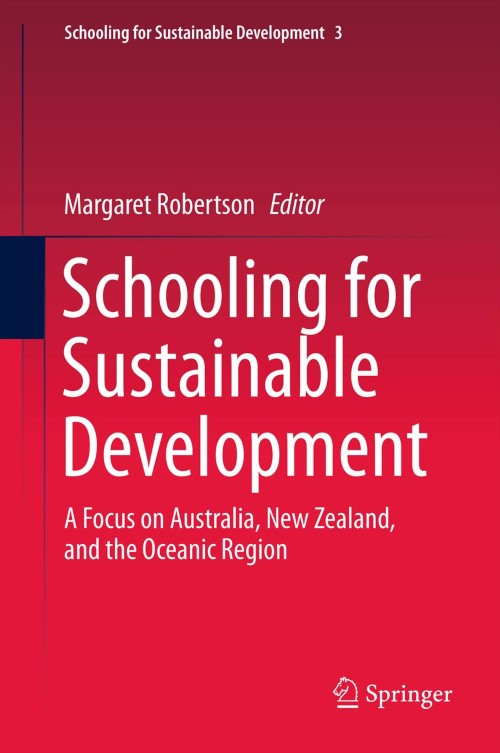
Schooling for Sustainable Development: [electronic resource] : A Focus on Australia, New Zealand, and the Oceanic Region / edited by Margaret Robertson.
Erişim Adresi
ISBN
9789400728820
Dil Kodu
İngilizce
Yer Numarası
DK/7425
Basım Bildirimi
1st ed. 2012.
Yayın Bilgisi
Dordrecht : Springer Netherlands : Imprint: Springer, 2012.
Fiziksel Niteleme
XVIII, 222 p. online resource.
Dizi
Schooling for Sustainable Development ; 3
İçindekiler Notu
Chapter 1: Introduction and regional overview: Margaret Robertson -- Chapter 2: Sustainability education in classrooms: Developing teacher expertise: Allan Harrison and Ken Purnell.-Chapter 3: Educating for sustainability in New Zealand: Pamela Williams -- Chapter 4: Defining and explaining sustainable development and sustainability: A review of curriculum guides and school texts: Alaric Maude.-Chapter 5: Contradictory practices and geographical imaginaries in the rolling out of education for sustainability in Auckland New Zealand secondary schools: Richard Le Heron, Nick Lewis and Amy Harris.-Chapter 6: Fieldwork, schooling, sustainbility: A Tasmanian case: Robbie Johnston -- Chapter 7: Navigating through new terrain: Pre-service teachers' journeys in teaching "sustainability" : Alison Lugg -- Chapter 8: Indigenous perspectives on sustainable development: Children's views from the "top end": Jenni Webber and Margaret Robertson -- Chapter 9: A sustainability agenda in planning education: Trevor Budge and Andrew Butt -- Chapter 10: Earning a living in Papua New Gunea: From subsistence to a cash economy: George N. Curry, Gina Koczberski, Joachim Lummani, Sean Ryan and Veronica Bue -- Chapter 11: Adapting urban environments to climate change: A case study of Melbourne Australia: Nigel Tapper -- Chapter 12: Spatial models as a hub for sustainability education: Exemplifying the transition from producer to user-defined maps in the classroom: Jim Peterson and Margaret Robertson -- Chapter 13: Concluding comments: Margaret Robertson.
Özet, vb.
"This book Schooling for Sustainable Development: A Focus on Australia, New Zealand and the Oceanic Region, is the product of passionate interests of teachers, scholars and researchers located in diverse parts of the Australasian region. Working with their colleagues within local contexts they have conducted research and gathered together information for practitioners and students interested in learning more about sustainable lifestyle practices. Some of the work has taken place in remote locations and some has been in within the confines of major cities. The Australasian Region brings together people and cultures that link traditional economies to global networks and lifestyles. Diverse terrain, politics and responses typify the region. Close to Asia there are lingering ties with old European ways and cultural beliefs. The major economies of Australia and New Zealand provide the lead with development practices for lesser economies such as Papua New Guinea, Fiji and the many island nations scattered throughout the South Pacific. This complexity is not easily represented. Key issues relate to land ownership, mobilities within the region and the gradual dissemination of knowledge, skills and wealth. The book will provide both reference material and interesting reading for teachers, researchers and practitioners in interested in community based perspectives on sustainability. We have learnt from each other and hope that others will benefit from our efforts.".
Konu
Education and state.
Sustainability.
Educational Policy and Politics.
Sustainability.
Sustainability.
Educational Policy and Politics.
Sustainability.
Diğer Yazarlar
Kurum Adı
Eseri Alıntıla
Referansları kullanmadan önce gözden geçirmeniz ve varsa gerekli düzeltmeleri yapmanız önerilir.
Dijital Kaynak
MARC Görünümü
LEADER 04807nam a22004935i 4500
001 806115
003 TR_AnAIT
005 20260127001440
007 cr nn 008mamaa
008 120302s2012 ne | s |||| 0|eng d
020 |a9789400728820|9978-94-007-2882-0
024 7 |a10.1007/978-94-007-2882-0|2doi
041 |aeng
049 |aTürk Tarih Kurumu Kütüphanesi
050 4|aLC71-188
072 7|aJNF|2bicssc
072 7|aEDU034000|2bisacsh
072 7|aJNF|2thema
082 04|a379|223
090 |aDK/7425
245 10|aSchooling for Sustainable Development:|h[electronic resource] :|bA Focus on Australia, New Zealand, and the Oceanic Region /|cedited by Margaret Robertson.
250 |a1st ed. 2012.
264 1|aDordrecht :|bSpringer Netherlands :|bImprint: Springer,|c2012.
300 |aXVIII, 222 p.|bonline resource.
336 |atext|btxt|2rdacontent
337 |acomputer|bc|2rdamedia
338 |aonline resource|bcr|2rdacarrier
347 |atext file|bPDF|2rda
490 1 |aSchooling for Sustainable Development ;|v3
505 0 |aChapter 1: Introduction and regional overview: Margaret Robertson -- Chapter 2: Sustainability education in classrooms: Developing teacher expertise: Allan Harrison and Ken Purnell.-Chapter 3: Educating for sustainability in New Zealand: Pamela Williams -- Chapter 4: Defining and explaining sustainable development and sustainability: A review of curriculum guides and school texts: Alaric Maude.-Chapter 5: Contradictory practices and geographical imaginaries in the rolling out of education for sustainability in Auckland New Zealand secondary schools: Richard Le Heron, Nick Lewis and Amy Harris.-Chapter 6: Fieldwork, schooling, sustainbility: A Tasmanian case: Robbie Johnston -- Chapter 7: Navigating through new terrain: Pre-service teachers' journeys in teaching "sustainability" : Alison Lugg -- Chapter 8: Indigenous perspectives on sustainable development: Children's views from the "top end": Jenni Webber and Margaret Robertson -- Chapter 9: A sustainability agenda in planning education: Trevor Budge and Andrew Butt -- Chapter 10: Earning a living in Papua New Gunea: From subsistence to a cash economy: George N. Curry, Gina Koczberski, Joachim Lummani, Sean Ryan and Veronica Bue -- Chapter 11: Adapting urban environments to climate change: A case study of Melbourne Australia: Nigel Tapper -- Chapter 12: Spatial models as a hub for sustainability education: Exemplifying the transition from producer to user-defined maps in the classroom: Jim Peterson and Margaret Robertson -- Chapter 13: Concluding comments: Margaret Robertson.
520 |a"This book Schooling for Sustainable Development: A Focus on Australia, New Zealand and the Oceanic Region, is the product of passionate interests of teachers, scholars and researchers located in diverse parts of the Australasian region. Working with their colleagues within local contexts they have conducted research and gathered together information for practitioners and students interested in learning more about sustainable lifestyle practices. Some of the work has taken place in remote locations and some has been in within the confines of major cities. The Australasian Region brings together people and cultures that link traditional economies to global networks and lifestyles. Diverse terrain, politics and responses typify the region. Close to Asia there are lingering ties with old European ways and cultural beliefs. The major economies of Australia and New Zealand provide the lead with development practices for lesser economies such as Papua New Guinea, Fiji and the many island nations scattered throughout the South Pacific. This complexity is not easily represented. Key issues relate to land ownership, mobilities within the region and the gradual dissemination of knowledge, skills and wealth. The book will provide both reference material and interesting reading for teachers, researchers and practitioners in interested in community based perspectives on sustainability. We have learnt from each other and hope that others will benefit from our efforts.".
650 0|aEducation and state.
650 0|aSustainability.
650 14|aEducational Policy and Politics.
650 24|aSustainability.
700 1 |aRobertson, Margaret.|eeditor.|4edt|4http://id.loc.gov/vocabulary/relators/edt
710 2 |aSpringerLink (Online service)
773 0 |tSpringer Nature eBook
776 08|iPrinted edition:|z9789400728813
776 08|iPrinted edition:|z9789400728837
776 08|iPrinted edition:|z9789400798878
830 0|aSchooling for Sustainable Development ;|v3
856 40|uhttps://doi.org/10.1007/978-94-007-2882-0
912 |aZDB-2-SHU
912 |aZDB-2-SXED
950 |aHumanities, Social Sciences and Law (SpringerNature-11648)
950 |aEducation (R0) (SpringerNature-43721)
001 806115
003 TR_AnAIT
005 20260127001440
007 cr nn 008mamaa
008 120302s2012 ne | s |||| 0|eng d
020 |a9789400728820|9978-94-007-2882-0
024 7 |a10.1007/978-94-007-2882-0|2doi
041 |aeng
049 |aTürk Tarih Kurumu Kütüphanesi
050 4|aLC71-188
072 7|aJNF|2bicssc
072 7|aEDU034000|2bisacsh
072 7|aJNF|2thema
082 04|a379|223
090 |aDK/7425
245 10|aSchooling for Sustainable Development:|h[electronic resource] :|bA Focus on Australia, New Zealand, and the Oceanic Region /|cedited by Margaret Robertson.
250 |a1st ed. 2012.
264 1|aDordrecht :|bSpringer Netherlands :|bImprint: Springer,|c2012.
300 |aXVIII, 222 p.|bonline resource.
336 |atext|btxt|2rdacontent
337 |acomputer|bc|2rdamedia
338 |aonline resource|bcr|2rdacarrier
347 |atext file|bPDF|2rda
490 1 |aSchooling for Sustainable Development ;|v3
505 0 |aChapter 1: Introduction and regional overview: Margaret Robertson -- Chapter 2: Sustainability education in classrooms: Developing teacher expertise: Allan Harrison and Ken Purnell.-Chapter 3: Educating for sustainability in New Zealand: Pamela Williams -- Chapter 4: Defining and explaining sustainable development and sustainability: A review of curriculum guides and school texts: Alaric Maude.-Chapter 5: Contradictory practices and geographical imaginaries in the rolling out of education for sustainability in Auckland New Zealand secondary schools: Richard Le Heron, Nick Lewis and Amy Harris.-Chapter 6: Fieldwork, schooling, sustainbility: A Tasmanian case: Robbie Johnston -- Chapter 7: Navigating through new terrain: Pre-service teachers' journeys in teaching "sustainability" : Alison Lugg -- Chapter 8: Indigenous perspectives on sustainable development: Children's views from the "top end": Jenni Webber and Margaret Robertson -- Chapter 9: A sustainability agenda in planning education: Trevor Budge and Andrew Butt -- Chapter 10: Earning a living in Papua New Gunea: From subsistence to a cash economy: George N. Curry, Gina Koczberski, Joachim Lummani, Sean Ryan and Veronica Bue -- Chapter 11: Adapting urban environments to climate change: A case study of Melbourne Australia: Nigel Tapper -- Chapter 12: Spatial models as a hub for sustainability education: Exemplifying the transition from producer to user-defined maps in the classroom: Jim Peterson and Margaret Robertson -- Chapter 13: Concluding comments: Margaret Robertson.
520 |a"This book Schooling for Sustainable Development: A Focus on Australia, New Zealand and the Oceanic Region, is the product of passionate interests of teachers, scholars and researchers located in diverse parts of the Australasian region. Working with their colleagues within local contexts they have conducted research and gathered together information for practitioners and students interested in learning more about sustainable lifestyle practices. Some of the work has taken place in remote locations and some has been in within the confines of major cities. The Australasian Region brings together people and cultures that link traditional economies to global networks and lifestyles. Diverse terrain, politics and responses typify the region. Close to Asia there are lingering ties with old European ways and cultural beliefs. The major economies of Australia and New Zealand provide the lead with development practices for lesser economies such as Papua New Guinea, Fiji and the many island nations scattered throughout the South Pacific. This complexity is not easily represented. Key issues relate to land ownership, mobilities within the region and the gradual dissemination of knowledge, skills and wealth. The book will provide both reference material and interesting reading for teachers, researchers and practitioners in interested in community based perspectives on sustainability. We have learnt from each other and hope that others will benefit from our efforts.".
650 0|aEducation and state.
650 0|aSustainability.
650 14|aEducational Policy and Politics.
650 24|aSustainability.
700 1 |aRobertson, Margaret.|eeditor.|4edt|4http://id.loc.gov/vocabulary/relators/edt
710 2 |aSpringerLink (Online service)
773 0 |tSpringer Nature eBook
776 08|iPrinted edition:|z9789400728813
776 08|iPrinted edition:|z9789400728837
776 08|iPrinted edition:|z9789400798878
830 0|aSchooling for Sustainable Development ;|v3
856 40|uhttps://doi.org/10.1007/978-94-007-2882-0
912 |aZDB-2-SHU
912 |aZDB-2-SXED
950 |aHumanities, Social Sciences and Law (SpringerNature-11648)
950 |aEducation (R0) (SpringerNature-43721)
Materyaller
Depodan talep edilen materyal sadece kütüphane içerisinde kullanılmaktadır.
Materyal dışarıya ödünç verilmemektedir.
Materyal dışarıya ödünç verilmemektedir.
