LEADER 04085nam a22005535i 4500
001 806150
003 TR_AnAIT
005 20260127001523
007 cr nn 008mamaa
008 130519s1960 ne | s |||| 0|eng d
020 |a9789401195225|9978-94-011-9522-5
024 7 |a10.1007/978-94-011-9522-5|2doi
041 |aeng
049 |aTürk Tarih Kurumu Kütüphanesi
050 4|aBD143-237
072 7|aHPK|2bicssc
072 7|aPHI004000|2bisacsh
072 7|aQDTK|2thema
082 04|a120|223
090 |aDK/7460
100 1 |aLachelier, Jules.|eauthor.|4aut|4http://id.loc.gov/vocabulary/relators/aut
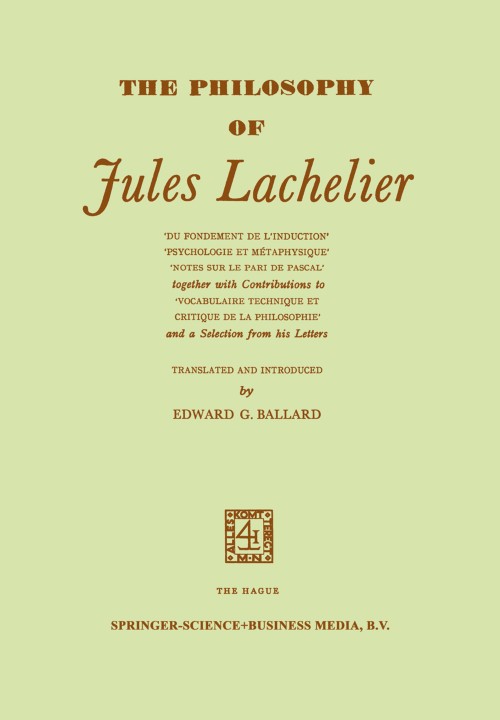
245 14|aThe philosophy of Jules Lachelier|h[electronic resource] /|cby Jules Lachelier ; edited by Edward Goodwin Ballard.
250 |a1st ed. 1960.
264 1|aDordrecht :|bSpringer Netherlands :|bImprint: Springer,|c1960.
300 |aXV, 118 p.|bonline resource.
336 |atext|btxt|2rdacontent
337 |acomputer|bc|2rdamedia
338 |aonline resource|bcr|2rdacarrier
347 |atext file|bPDF|2rda
505 0 |aI. The Foundations of Induction -- II. Psychology and Metaphysics -- III. Notes on Pascal’s Wager -- Appendices -- A. Idealism -- B. On Logic -- C. On ‘Objective’ -- D. Spiritualism -- E. Realism -- F. Philosophy -- G. Liberty.
520 |aGabriel Seailles remarked that Lachelier had the happy for tune "of exercising a profound and decisive influence upon all who heard him, yet without acquiring perhaps a single disciple in the narrow sense of the word. He liberated minds. He rid them of 1 ready-made ideas. " This liberating influence was exercised by means of lecture, conversation, and personal relationship as much as through writing. Its nature is suggested by the character of his better known students, among whom are Boutroux, Bra chard, and Lagneau. Lachelier's writings, however, remain sig nificant and are commonly looked upon by French philosophers as constituting a very important element of their heritage. During his lifetime, Lachelier's position was somewhat ana logous to Victor Cousin's; however, his thinking was far more critical and disciplined than Cousin's and its effect has been all 2 the more fertile. Benrubi places him, along with Ravaisson, as one of the two leading pioneers of the spiritual-metaphysical positivistic movement in France, a movement which provides an interesting contrast to the anti-intellectualism associated with Bergson. Along with Bergson, however, he opposed what has been called "scientism" in philosophy, but he opposed this trend in his own way. R. G. Collingwood, who calls Lachelier one of the greatest of modern French philosophers (cf.
532 8 |aAccessibility summary: This PDF is not accessible. It is based on scanned pages and does not support features such as screen reader compatibility or described non-text content (images, graphs etc). However, it likely supports searchable and selectable text based on OCR (Optical Character Recognition). Users with accessibility needs may not be able to use this content effectively. Please contact us at accessibilitysupport@springernature.com if you require assistance or an alternative format.
532 8 |aInaccessible, or known limited accessibility
532 8 |aNo reading system accessibility options actively disabled
532 8 |aPublisher contact for further accessibility information: accessibilitysupport@springernature.com
650 0|aKnowledge, Theory of.
650 0|aOntology.
650 0|aHistory.
650 14|aEpistemology.
650 24|aOntology.
650 24|aHistory.
700 1 |aBallard, Edward Goodwin.|eeditor.|4edt|4http://id.loc.gov/vocabulary/relators/edt
710 2 |aSpringerLink (Online service)
773 0 |tSpringer Nature eBook
776 08|iPrinted edition:|z9789401186995
776 08|iPrinted edition:|z9789401195232
856 40|uhttps://doi.org/10.1007/978-94-011-9522-5
912 |aZDB-2-SHU
912 |aZDB-2-SXPR
912 |aZDB-2-BAE
950 |aHumanities, Social Sciences and Law (SpringerNature-11648)
950 |aPhilosophy and Religion (R0) (SpringerNature-43725)