

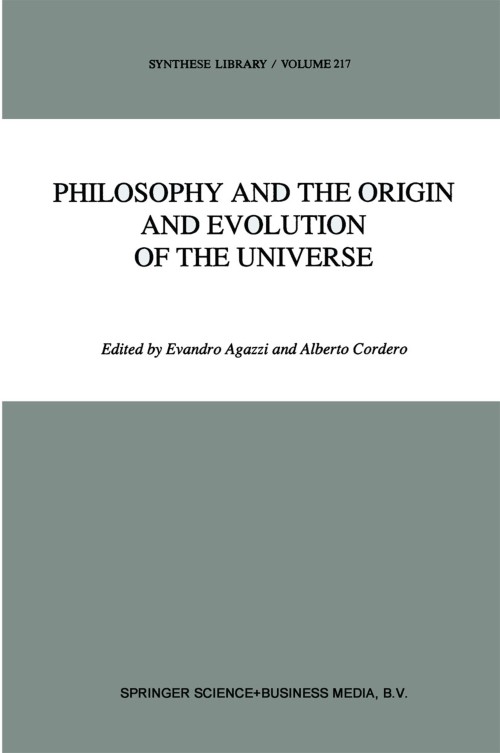
Philosophy and the Origin and Evolution of the Universe [electronic resource] / edited by E. Agazzi, A. Cordero.
Erişim Adresi
ISBN
9789401135986
Dil Kodu
İngilizce
Yer Numarası
DK/7489
Basım Bildirimi
1st ed. 1991.
Yayın Bilgisi
Dordrecht : Springer Netherlands : Imprint: Springer, 1991.
Fiziksel Niteleme
XII, 466 p. online resource.
Dizi
Synthese Library, Studies in Epistemology, Logic, Methodology, and Philosophy of Science, 2542-8292 ; 217
İçindekiler Notu
The Universe as a Scientific and Philosophical Problem -- The Geometric Structure of the Universe -- Superstring Unification and the Existence of Gravity -- The Universe of Modern Science and its Philosophical Exploration -- From Molecules to Life -- Meta-Neuroanatomy: The Myth of the Unbounded Main/Brain -- Emergence and Reduction in Morphogenetic Theories -- What can we know about the Universe? -- The Universe as a Scientific Object -- General Laws of Nature and The Uniqueness of the Universe -- The Anthropic Principle and its Epistemological Status in Modern Physical Cosmology -- Evolutionary Ideas and Contemporary Naturalism -- Origin and Evolution of the Universe and Mankind -- Index of Names.
Özet, vb.
It has often been noted that a kind of double dynamics char- terizes the development of science. On the one hand the progress in every discipline appears as the consequence of an increasing specialization, implying the restriction of the inquiry to very partial fields or aspects of a given domain. On the other hand, an opposite (but one might better say a complementary) trend points towards the construction of theoretical frameworks of great ge- rality, the aim of which seems to correspond not so much to the need of providing «explanations» for the details accumulated through partial investigation, as to the desire of attaining an - rizon of global comprehension of the whole field. This intell- tual dialectics is perceivable in every discipline, from mathe- tics, to physics, to biology, to history, to economics, to sociology, and it is not difficult to recognize there the presence of the two main attitudes according to which human beings try to make «intelligible» the world surrounding them (including themselves), attitudes which are sometimes called analysis and synthesis. They correspond respectively to the spontaneous inclination which pushes us to try to understand things by seeing «how they are made», in the sense of «looking into them» and breaking them into their constitutive parts, or rather to encompass things in a global picture, where they are accounted for as occupying a place, or playing a role, which are understandable from the point of view of the whole.
Konu
Science __ Philosophy.
Mathematical physics.
Philosophy of nature.
Gravitation.
Philosophy of Science.
Theoretical, Mathematical and Computational Physics.
Philosophy of Nature.
Classical and Quantum Gravity.
Mathematical physics.
Philosophy of nature.
Gravitation.
Philosophy of Science.
Theoretical, Mathematical and Computational Physics.
Philosophy of Nature.
Classical and Quantum Gravity.
Diğer Yazarlar
Kurum Adı
Eseri Alıntıla
Referansları kullanmadan önce gözden geçirmeniz ve varsa gerekli düzeltmeleri yapmanız önerilir.
Dijital Kaynak
MARC Görünümü
LEADER 05151nam a22006255i 4500
001 806179
003 TR_AnAIT
005 20260127001557
007 cr nn 008mamaa
008 121227s1991 ne | s |||| 0|eng d
020 |a9789401135986|9978-94-011-3598-6
024 7 |a10.1007/978-94-011-3598-6|2doi
041 |aeng
049 |aTürk Tarih Kurumu Kütüphanesi
050 4|aQ174-175.3
050 4|aB67
072 7|aPDA|2bicssc
072 7|aSCI075000|2bisacsh
072 7|aPDA|2thema
082 04|a501|223
090 |aDK/7489
245 10|aPhilosophy and the Origin and Evolution of the Universe|h[electronic resource] /|cedited by E. Agazzi, A. Cordero.
250 |a1st ed. 1991.
264 1|aDordrecht :|bSpringer Netherlands :|bImprint: Springer,|c1991.
300 |aXII, 466 p.|bonline resource.
336 |atext|btxt|2rdacontent
337 |acomputer|bc|2rdamedia
338 |aonline resource|bcr|2rdacarrier
347 |atext file|bPDF|2rda
490 1 |aSynthese Library, Studies in Epistemology, Logic, Methodology, and Philosophy of Science,|x2542-8292 ;|v217
505 0 |aThe Universe as a Scientific and Philosophical Problem -- The Geometric Structure of the Universe -- Superstring Unification and the Existence of Gravity -- The Universe of Modern Science and its Philosophical Exploration -- From Molecules to Life -- Meta-Neuroanatomy: The Myth of the Unbounded Main/Brain -- Emergence and Reduction in Morphogenetic Theories -- What can we know about the Universe? -- The Universe as a Scientific Object -- General Laws of Nature and The Uniqueness of the Universe -- The Anthropic Principle and its Epistemological Status in Modern Physical Cosmology -- Evolutionary Ideas and Contemporary Naturalism -- Origin and Evolution of the Universe and Mankind -- Index of Names.
520 |aIt has often been noted that a kind of double dynamics char- terizes the development of science. On the one hand the progress in every discipline appears as the consequence of an increasing specialization, implying the restriction of the inquiry to very partial fields or aspects of a given domain. On the other hand, an opposite (but one might better say a complementary) trend points towards the construction of theoretical frameworks of great ge- rality, the aim of which seems to correspond not so much to the need of providing «explanations» for the details accumulated through partial investigation, as to the desire of attaining an - rizon of global comprehension of the whole field. This intell- tual dialectics is perceivable in every discipline, from mathe- tics, to physics, to biology, to history, to economics, to sociology, and it is not difficult to recognize there the presence of the two main attitudes according to which human beings try to make «intelligible» the world surrounding them (including themselves), attitudes which are sometimes called analysis and synthesis. They correspond respectively to the spontaneous inclination which pushes us to try to understand things by seeing «how they are made», in the sense of «looking into them» and breaking them into their constitutive parts, or rather to encompass things in a global picture, where they are accounted for as occupying a place, or playing a role, which are understandable from the point of view of the whole.
532 8 |aAccessibility summary: This PDF is not accessible. It is based on scanned pages and does not support features such as screen reader compatibility or described non-text content (images, graphs etc). However, it likely supports searchable and selectable text based on OCR (Optical Character Recognition). Users with accessibility needs may not be able to use this content effectively. Please contact us at accessibilitysupport@springernature.com if you require assistance or an alternative format.
532 8 |aInaccessible, or known limited accessibility
532 8 |aNo reading system accessibility options actively disabled
532 8 |aPublisher contact for further accessibility information: accessibilitysupport@springernature.com
650 0|aScience|xPhilosophy.
650 0|aMathematical physics.
650 0|aPhilosophy of nature.
650 0|aGravitation.
650 14|aPhilosophy of Science.
650 24|aTheoretical, Mathematical and Computational Physics.
650 24|aPhilosophy of Nature.
650 24|aClassical and Quantum Gravity.
700 1 |aAgazzi, E.|eeditor.|4edt|4http://id.loc.gov/vocabulary/relators/edt
700 1 |aCordero, A.|eeditor.|4edt|4http://id.loc.gov/vocabulary/relators/edt
710 2 |aSpringerLink (Online service)
773 0 |tSpringer Nature eBook
776 08|iPrinted edition:|z9780792313229
776 08|iPrinted edition:|z9789401135993
776 08|iPrinted edition:|z9789401055956
830 0|aSynthese Library, Studies in Epistemology, Logic, Methodology, and Philosophy of Science,|x2542-8292 ;|v217
856 40|uhttps://doi.org/10.1007/978-94-011-3598-6
912 |aZDB-2-SHU
912 |aZDB-2-SXPR
912 |aZDB-2-BAE
950 |aHumanities, Social Sciences and Law (SpringerNature-11648)
950 |aPhilosophy and Religion (R0) (SpringerNature-43725)
001 806179
003 TR_AnAIT
005 20260127001557
007 cr nn 008mamaa
008 121227s1991 ne | s |||| 0|eng d
020 |a9789401135986|9978-94-011-3598-6
024 7 |a10.1007/978-94-011-3598-6|2doi
041 |aeng
049 |aTürk Tarih Kurumu Kütüphanesi
050 4|aQ174-175.3
050 4|aB67
072 7|aPDA|2bicssc
072 7|aSCI075000|2bisacsh
072 7|aPDA|2thema
082 04|a501|223
090 |aDK/7489
245 10|aPhilosophy and the Origin and Evolution of the Universe|h[electronic resource] /|cedited by E. Agazzi, A. Cordero.
250 |a1st ed. 1991.
264 1|aDordrecht :|bSpringer Netherlands :|bImprint: Springer,|c1991.
300 |aXII, 466 p.|bonline resource.
336 |atext|btxt|2rdacontent
337 |acomputer|bc|2rdamedia
338 |aonline resource|bcr|2rdacarrier
347 |atext file|bPDF|2rda
490 1 |aSynthese Library, Studies in Epistemology, Logic, Methodology, and Philosophy of Science,|x2542-8292 ;|v217
505 0 |aThe Universe as a Scientific and Philosophical Problem -- The Geometric Structure of the Universe -- Superstring Unification and the Existence of Gravity -- The Universe of Modern Science and its Philosophical Exploration -- From Molecules to Life -- Meta-Neuroanatomy: The Myth of the Unbounded Main/Brain -- Emergence and Reduction in Morphogenetic Theories -- What can we know about the Universe? -- The Universe as a Scientific Object -- General Laws of Nature and The Uniqueness of the Universe -- The Anthropic Principle and its Epistemological Status in Modern Physical Cosmology -- Evolutionary Ideas and Contemporary Naturalism -- Origin and Evolution of the Universe and Mankind -- Index of Names.
520 |aIt has often been noted that a kind of double dynamics char- terizes the development of science. On the one hand the progress in every discipline appears as the consequence of an increasing specialization, implying the restriction of the inquiry to very partial fields or aspects of a given domain. On the other hand, an opposite (but one might better say a complementary) trend points towards the construction of theoretical frameworks of great ge- rality, the aim of which seems to correspond not so much to the need of providing «explanations» for the details accumulated through partial investigation, as to the desire of attaining an - rizon of global comprehension of the whole field. This intell- tual dialectics is perceivable in every discipline, from mathe- tics, to physics, to biology, to history, to economics, to sociology, and it is not difficult to recognize there the presence of the two main attitudes according to which human beings try to make «intelligible» the world surrounding them (including themselves), attitudes which are sometimes called analysis and synthesis. They correspond respectively to the spontaneous inclination which pushes us to try to understand things by seeing «how they are made», in the sense of «looking into them» and breaking them into their constitutive parts, or rather to encompass things in a global picture, where they are accounted for as occupying a place, or playing a role, which are understandable from the point of view of the whole.
532 8 |aAccessibility summary: This PDF is not accessible. It is based on scanned pages and does not support features such as screen reader compatibility or described non-text content (images, graphs etc). However, it likely supports searchable and selectable text based on OCR (Optical Character Recognition). Users with accessibility needs may not be able to use this content effectively. Please contact us at accessibilitysupport@springernature.com if you require assistance or an alternative format.
532 8 |aInaccessible, or known limited accessibility
532 8 |aNo reading system accessibility options actively disabled
532 8 |aPublisher contact for further accessibility information: accessibilitysupport@springernature.com
650 0|aScience|xPhilosophy.
650 0|aMathematical physics.
650 0|aPhilosophy of nature.
650 0|aGravitation.
650 14|aPhilosophy of Science.
650 24|aTheoretical, Mathematical and Computational Physics.
650 24|aPhilosophy of Nature.
650 24|aClassical and Quantum Gravity.
700 1 |aAgazzi, E.|eeditor.|4edt|4http://id.loc.gov/vocabulary/relators/edt
700 1 |aCordero, A.|eeditor.|4edt|4http://id.loc.gov/vocabulary/relators/edt
710 2 |aSpringerLink (Online service)
773 0 |tSpringer Nature eBook
776 08|iPrinted edition:|z9780792313229
776 08|iPrinted edition:|z9789401135993
776 08|iPrinted edition:|z9789401055956
830 0|aSynthese Library, Studies in Epistemology, Logic, Methodology, and Philosophy of Science,|x2542-8292 ;|v217
856 40|uhttps://doi.org/10.1007/978-94-011-3598-6
912 |aZDB-2-SHU
912 |aZDB-2-SXPR
912 |aZDB-2-BAE
950 |aHumanities, Social Sciences and Law (SpringerNature-11648)
950 |aPhilosophy and Religion (R0) (SpringerNature-43725)
Materyaller
Depodan talep edilen materyal sadece kütüphane içerisinde kullanılmaktadır.
Materyal dışarıya ödünç verilmemektedir.
Materyal dışarıya ödünç verilmemektedir.
