

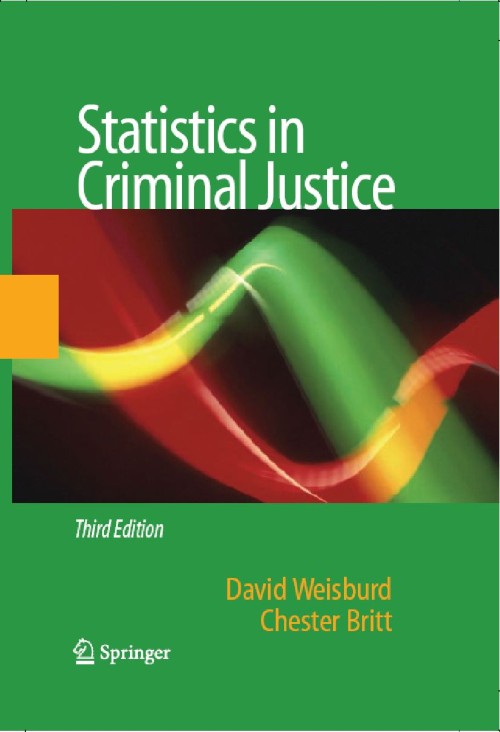
Statistics in Criminal Justice [electronic resource] / by David Weisburd, Chester Britt.
Erişim Adresi
ISBN
9780387341132
Dil Kodu
İngilizce
Yer Numarası
DK/7499
Yazar
Basım Bildirimi
3rd ed. 2007.
Yayın Bilgisi
New York, NY : Springer US : Imprint: Springer, 2007.
Fiziksel Niteleme
XVI, 674 p. online resource.
İçindekiler Notu
Introduction: Statistics as a Research Tool -- Measurement: The Basic Building Block of Research -- Representing and Displaying Data -- Describing the Typical Case: Measures of Central Tendency -- How Typical Is the Typical Case?: Measuring Dispersion -- The Logic of Statistical Inference: Making Statements About Populations from Sample Statistics -- Defining the Observed Significance Level of a Test: A Simple Example Using the Binomial Distribution -- Steps in a Statistical Test: Using the Binomial Distribution to Make Decisions About Hypotheses -- Chi-Square: A Test Commonly Used for Nominal-Level Measures -- The Normal Distribution and Its Application to Tests of Statistical Significance -- Comparing Means and Proportions in Two Samples -- Comparing Means Among More Than Two Samples: Analysis of Variance -- Measures of Association for Nominal and Ordinal Variables -- Measuring Association for Interval-Level Data: Pearson's Correlation Coefficient -- An Introduction to Bivariate Regression -- Multivariate Regression -- Multivariate Regression: Additional Topics -- Logistic Regression -- Multivariate Regression with Multiple Category Nominal or Ordinal Measures: Extending the Basic Logistic Regression Model -- Special Topics: Confidence Intervals -- Special Topics: Statistical Power.
Özet, vb.
Statistics in Criminal Justice takes an approach that emphasizes the uses of statistics in research in crime and justice. This text is meant for students and professionals who want to gain a basic understanding of statistics in this field. The text takes a building-block approach, meaning that each chapter helps to prepare the student for the chapters that follow. It also means that the level of sophistication of the text increases as the text progresses. Throughout the text there is an emphasis on comprehension and interpretation, rather than computation. However, it takes a serious approach to statistics, which is relevant to the real world of research in crime and justice. This approach is meant to provide the reader with an accessible but sophisticated understanding of statistics that can be used to examine real-life criminal justice problems. The goal of the text is to give the student a basic understanding of statistics and statistical concepts that will leave the student with the confidence and the tools for tackling more complex problems on their own. Statistics in Criminal Justice is meant not only as an introduction for students but as a reference for researchers. New to the 3rd Edition A number of changes have been made to the 3rd edition, including the following: Additional exercises at the end of each chapter. Expanded computer exercises that can be performed in the Student Version of SPSS. Extended discussion of multivariate regression models, including interaction and non-linear effects. A new chapter on multinomial and ordinal logistic regression models, examined in a way that highlights comprehension and interpretation. With the additional material on multivariate regression models, the text is appropriate for both undergraduate and beginning graduate statistics courses in criminal justice.
Konu
Criminology.
Criminology.
Criminology.
Diğer Yazarlar
Kurum Adı
Eseri Alıntıla
Referansları kullanmadan önce gözden geçirmeniz ve varsa gerekli düzeltmeleri yapmanız önerilir.
Dijital Kaynak
MARC Görünümü
LEADER 04729nam a22004575i 4500
001 806192
003 TR_AnAIT
005 20260127001613
007 cr nn 008mamaa
008 100301s2007 xxu| s |||| 0|eng d
020 |a9780387341132|9978-0-387-34113-2
024 7 |a10.1007/978-0-387-34113-2|2doi
041 |aeng
049 |aTürk Tarih Kurumu Kütüphanesi
050 4|aHV6001-7220.5
072 7|aJKV|2bicssc
072 7|aSOC004000|2bisacsh
072 7|aJKV|2thema
082 04|a364|223
090 |aDK/7499
100 1 |aWeisburd, David.|eauthor.|4aut|4http://id.loc.gov/vocabulary/relators/aut
245 10|aStatistics in Criminal Justice|h[electronic resource] /|cby David Weisburd, Chester Britt.
250 |a3rd ed. 2007.
264 1|aNew York, NY :|bSpringer US :|bImprint: Springer,|c2007.
300 |aXVI, 674 p.|bonline resource.
336 |atext|btxt|2rdacontent
337 |acomputer|bc|2rdamedia
338 |aonline resource|bcr|2rdacarrier
347 |atext file|bPDF|2rda
505 0 |aIntroduction: Statistics as a Research Tool -- Measurement: The Basic Building Block of Research -- Representing and Displaying Data -- Describing the Typical Case: Measures of Central Tendency -- How Typical Is the Typical Case?: Measuring Dispersion -- The Logic of Statistical Inference: Making Statements About Populations from Sample Statistics -- Defining the Observed Significance Level of a Test: A Simple Example Using the Binomial Distribution -- Steps in a Statistical Test: Using the Binomial Distribution to Make Decisions About Hypotheses -- Chi-Square: A Test Commonly Used for Nominal-Level Measures -- The Normal Distribution and Its Application to Tests of Statistical Significance -- Comparing Means and Proportions in Two Samples -- Comparing Means Among More Than Two Samples: Analysis of Variance -- Measures of Association for Nominal and Ordinal Variables -- Measuring Association for Interval-Level Data: Pearson's Correlation Coefficient -- An Introduction to Bivariate Regression -- Multivariate Regression -- Multivariate Regression: Additional Topics -- Logistic Regression -- Multivariate Regression with Multiple Category Nominal or Ordinal Measures: Extending the Basic Logistic Regression Model -- Special Topics: Confidence Intervals -- Special Topics: Statistical Power.
520 |aStatistics in Criminal Justice takes an approach that emphasizes the uses of statistics in research in crime and justice. This text is meant for students and professionals who want to gain a basic understanding of statistics in this field. The text takes a building-block approach, meaning that each chapter helps to prepare the student for the chapters that follow. It also means that the level of sophistication of the text increases as the text progresses. Throughout the text there is an emphasis on comprehension and interpretation, rather than computation. However, it takes a serious approach to statistics, which is relevant to the real world of research in crime and justice. This approach is meant to provide the reader with an accessible but sophisticated understanding of statistics that can be used to examine real-life criminal justice problems. The goal of the text is to give the student a basic understanding of statistics and statistical concepts that will leave the student with the confidence and the tools for tackling more complex problems on their own. Statistics in Criminal Justice is meant not only as an introduction for students but as a reference for researchers. New to the 3rd Edition A number of changes have been made to the 3rd edition, including the following: Additional exercises at the end of each chapter. Expanded computer exercises that can be performed in the Student Version of SPSS. Extended discussion of multivariate regression models, including interaction and non-linear effects. A new chapter on multinomial and ordinal logistic regression models, examined in a way that highlights comprehension and interpretation. With the additional material on multivariate regression models, the text is appropriate for both undergraduate and beginning graduate statistics courses in criminal justice.
650 0|aCriminology.
650 14|aCriminology.
700 1 |aBritt, Chester.|eauthor.|4aut|4http://id.loc.gov/vocabulary/relators/aut
710 2 |aSpringerLink (Online service)
773 0 |tSpringer Nature eBook
776 08|iPrinted edition:|z9780387341125
776 08|iPrinted edition:|z9780387513850
776 08|iPrinted edition:|z9781441941626
856 40|uhttps://doi.org/10.1007/978-0-387-34113-2
912 |aZDB-2-SHU
912 |aZDB-2-SXS
950 |aHumanities, Social Sciences and Law (SpringerNature-11648)
950 |aSocial Sciences (R0) (SpringerNature-43726)
001 806192
003 TR_AnAIT
005 20260127001613
007 cr nn 008mamaa
008 100301s2007 xxu| s |||| 0|eng d
020 |a9780387341132|9978-0-387-34113-2
024 7 |a10.1007/978-0-387-34113-2|2doi
041 |aeng
049 |aTürk Tarih Kurumu Kütüphanesi
050 4|aHV6001-7220.5
072 7|aJKV|2bicssc
072 7|aSOC004000|2bisacsh
072 7|aJKV|2thema
082 04|a364|223
090 |aDK/7499
100 1 |aWeisburd, David.|eauthor.|4aut|4http://id.loc.gov/vocabulary/relators/aut
245 10|aStatistics in Criminal Justice|h[electronic resource] /|cby David Weisburd, Chester Britt.
250 |a3rd ed. 2007.
264 1|aNew York, NY :|bSpringer US :|bImprint: Springer,|c2007.
300 |aXVI, 674 p.|bonline resource.
336 |atext|btxt|2rdacontent
337 |acomputer|bc|2rdamedia
338 |aonline resource|bcr|2rdacarrier
347 |atext file|bPDF|2rda
505 0 |aIntroduction: Statistics as a Research Tool -- Measurement: The Basic Building Block of Research -- Representing and Displaying Data -- Describing the Typical Case: Measures of Central Tendency -- How Typical Is the Typical Case?: Measuring Dispersion -- The Logic of Statistical Inference: Making Statements About Populations from Sample Statistics -- Defining the Observed Significance Level of a Test: A Simple Example Using the Binomial Distribution -- Steps in a Statistical Test: Using the Binomial Distribution to Make Decisions About Hypotheses -- Chi-Square: A Test Commonly Used for Nominal-Level Measures -- The Normal Distribution and Its Application to Tests of Statistical Significance -- Comparing Means and Proportions in Two Samples -- Comparing Means Among More Than Two Samples: Analysis of Variance -- Measures of Association for Nominal and Ordinal Variables -- Measuring Association for Interval-Level Data: Pearson's Correlation Coefficient -- An Introduction to Bivariate Regression -- Multivariate Regression -- Multivariate Regression: Additional Topics -- Logistic Regression -- Multivariate Regression with Multiple Category Nominal or Ordinal Measures: Extending the Basic Logistic Regression Model -- Special Topics: Confidence Intervals -- Special Topics: Statistical Power.
520 |aStatistics in Criminal Justice takes an approach that emphasizes the uses of statistics in research in crime and justice. This text is meant for students and professionals who want to gain a basic understanding of statistics in this field. The text takes a building-block approach, meaning that each chapter helps to prepare the student for the chapters that follow. It also means that the level of sophistication of the text increases as the text progresses. Throughout the text there is an emphasis on comprehension and interpretation, rather than computation. However, it takes a serious approach to statistics, which is relevant to the real world of research in crime and justice. This approach is meant to provide the reader with an accessible but sophisticated understanding of statistics that can be used to examine real-life criminal justice problems. The goal of the text is to give the student a basic understanding of statistics and statistical concepts that will leave the student with the confidence and the tools for tackling more complex problems on their own. Statistics in Criminal Justice is meant not only as an introduction for students but as a reference for researchers. New to the 3rd Edition A number of changes have been made to the 3rd edition, including the following: Additional exercises at the end of each chapter. Expanded computer exercises that can be performed in the Student Version of SPSS. Extended discussion of multivariate regression models, including interaction and non-linear effects. A new chapter on multinomial and ordinal logistic regression models, examined in a way that highlights comprehension and interpretation. With the additional material on multivariate regression models, the text is appropriate for both undergraduate and beginning graduate statistics courses in criminal justice.
650 0|aCriminology.
650 14|aCriminology.
700 1 |aBritt, Chester.|eauthor.|4aut|4http://id.loc.gov/vocabulary/relators/aut
710 2 |aSpringerLink (Online service)
773 0 |tSpringer Nature eBook
776 08|iPrinted edition:|z9780387341125
776 08|iPrinted edition:|z9780387513850
776 08|iPrinted edition:|z9781441941626
856 40|uhttps://doi.org/10.1007/978-0-387-34113-2
912 |aZDB-2-SHU
912 |aZDB-2-SXS
950 |aHumanities, Social Sciences and Law (SpringerNature-11648)
950 |aSocial Sciences (R0) (SpringerNature-43726)
Materyaller
Depodan talep edilen materyal sadece kütüphane içerisinde kullanılmaktadır.
Materyal dışarıya ödünç verilmemektedir.
Materyal dışarıya ödünç verilmemektedir.
