

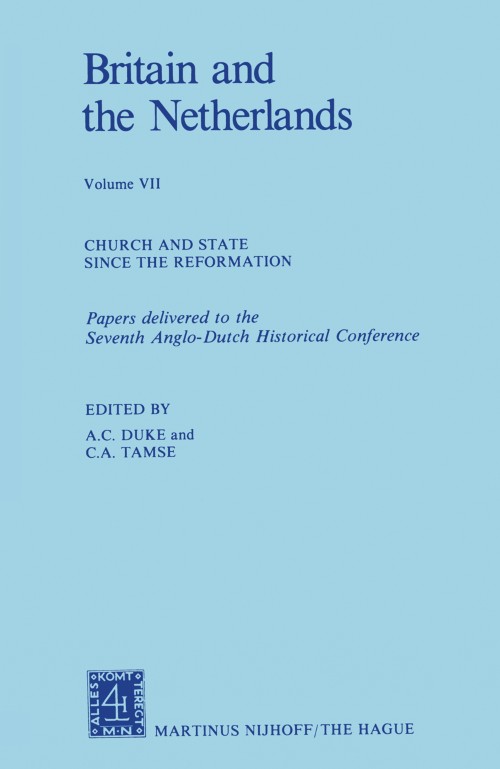
Britain and The Netherlands [electronic resource] : Volume VII Church and State Since the Reformation Papers Delivered to the Seventh Anglo-Dutch Historical Conference / by A. C. Duke, C. A. Tamse.
Erişim Adresi
ISBN
9789400976955
Dil Kodu
İngilizce
Yer Numarası
DK/7550
Yazar
Basım Bildirimi
1st ed. 1981.
Yayın Bilgisi
Dordrecht : Springer Netherlands : Imprint: Springer, 1981.
Fiziksel Niteleme
VII, 249 p. 7 illus. online resource.
İçindekiler Notu
Relations between Church and State in Britain and the Netherlands: an Introductory Essay -- 1 The State and Development of Protestantism in English Towns, 1520–1603 -- 2 Building Heaven in Hell’s Despite: The Early History of the Reformation in the Towns of the Low Countries by -- 3 The Family of Love (Huis der Liefde) and the Dutch Revolt -- 4 Arminianism and English Culture -- 5 Calvinism and National Consciousness: the Dutch Republic as the New Israel -- 6 Contrasting and Converging Patterns: Relations between Church and State in Western Europe, 1660–1715 by -- 7 The Authority of the Dutch State over the Churches, 1795–1853 -- 8 ‘Bridled Emotion’: English Free Churchmen, Culture and Catholic Values, c. 1870 to c. 1945 -- 9 ‘Verzuiling’: A Confessional Road to Secularization. Emancipation and the Decline of Political Catholicism, 1920–1970 -- 10 ‘A Protestant Parliament and a Protestant State’: Regional Government and Religious Discrimination in Northern Ireland, 1921–1939.
Özet, vb.
The theme chosen for the seventh conference of Dutch and British historians - relations between Church and State in the two countries since the Reformation - cannot pretend to any originality. A subject so germane to the history of Europe, and indeed of those parts of the world colonized by Europeans and evangelized by the Christian churches, has naturally attracted the attention of numerous scholars. The particular attraction of this study of the action and reaction of Church and State in Britain and the Netherlands lies in the scope it offers historians and political scientists for making comparisons be tween two states, both of which endorsed the Protestant Reformation while rejecting absolutism. But the dissimilarities are quite as striking. In the Netherlands the Reformed Church came to hold a curiously equivocal position, being neither an established Church in the English sense nor an independent sect. Yet even after the formal separation of Church and State in 1796 and the rise to political prominence of Dutch Catholicism, ties of sentiment continued to link the Dutch nation and the Reformed Church for some time to come. Within England the Anglican Church maintained its constitutional standing as the established Church and its social position as the Church of the 'Establishment', though it had to recognize a non-episcopal estab lished Church of Scotland and accept its disestablishment in Ireland and Wales.
Konu
History.
History.
History.
Diğer Yazarlar
Kurum Adı
Eseri Alıntıla
Referansları kullanmadan önce gözden geçirmeniz ve varsa gerekli düzeltmeleri yapmanız önerilir.
Dijital Kaynak
MARC Görünümü
LEADER 04928nam a22005295i 4500
001 806243
003 TR_AnAIT
005 20260127001720
007 cr nn 008mamaa
008 121227s1981 ne | s |||| 0|eng d
020 |a9789400976955|9978-94-009-7695-5
024 7 |a10.1007/978-94-009-7695-5|2doi
041 |aeng
049 |aTürk Tarih Kurumu Kütüphanesi
050 4|aD1-2027
072 7|aHB|2bicssc
072 7|aHBAH|2bicssc
072 7|aHIS000000|2bisacsh
072 7|aNH|2thema
072 7|aNHAH|2thema
082 04|a900|223
090 |aDK/7550
100 1 |aDuke, A. C.|eauthor.|4aut|4http://id.loc.gov/vocabulary/relators/aut
245 10|aBritain and The Netherlands|h[electronic resource] :|bVolume VII Church and State Since the Reformation Papers Delivered to the Seventh Anglo-Dutch Historical Conference /|cby A. C. Duke, C. A. Tamse.
250 |a1st ed. 1981.
264 1|aDordrecht :|bSpringer Netherlands :|bImprint: Springer,|c1981.
300 |aVII, 249 p. 7 illus.|bonline resource.
336 |atext|btxt|2rdacontent
337 |acomputer|bc|2rdamedia
338 |aonline resource|bcr|2rdacarrier
347 |atext file|bPDF|2rda
505 0 |aRelations between Church and State in Britain and the Netherlands: an Introductory Essay -- 1 The State and Development of Protestantism in English Towns, 1520–1603 -- 2 Building Heaven in Hell’s Despite: The Early History of the Reformation in the Towns of the Low Countries by -- 3 The Family of Love (Huis der Liefde) and the Dutch Revolt -- 4 Arminianism and English Culture -- 5 Calvinism and National Consciousness: the Dutch Republic as the New Israel -- 6 Contrasting and Converging Patterns: Relations between Church and State in Western Europe, 1660–1715 by -- 7 The Authority of the Dutch State over the Churches, 1795–1853 -- 8 ‘Bridled Emotion’: English Free Churchmen, Culture and Catholic Values, c. 1870 to c. 1945 -- 9 ‘Verzuiling’: A Confessional Road to Secularization. Emancipation and the Decline of Political Catholicism, 1920–1970 -- 10 ‘A Protestant Parliament and a Protestant State’: Regional Government and Religious Discrimination in Northern Ireland, 1921–1939.
520 |aThe theme chosen for the seventh conference of Dutch and British historians - relations between Church and State in the two countries since the Reformation - cannot pretend to any originality. A subject so germane to the history of Europe, and indeed of those parts of the world colonized by Europeans and evangelized by the Christian churches, has naturally attracted the attention of numerous scholars. The particular attraction of this study of the action and reaction of Church and State in Britain and the Netherlands lies in the scope it offers historians and political scientists for making comparisons be tween two states, both of which endorsed the Protestant Reformation while rejecting absolutism. But the dissimilarities are quite as striking. In the Netherlands the Reformed Church came to hold a curiously equivocal position, being neither an established Church in the English sense nor an independent sect. Yet even after the formal separation of Church and State in 1796 and the rise to political prominence of Dutch Catholicism, ties of sentiment continued to link the Dutch nation and the Reformed Church for some time to come. Within England the Anglican Church maintained its constitutional standing as the established Church and its social position as the Church of the 'Establishment', though it had to recognize a non-episcopal estab lished Church of Scotland and accept its disestablishment in Ireland and Wales.
532 8 |aAccessibility summary: This PDF is not accessible. It is based on scanned pages and does not support features such as screen reader compatibility or described non-text content (images, graphs etc). However, it likely supports searchable and selectable text based on OCR (Optical Character Recognition). Users with accessibility needs may not be able to use this content effectively. Please contact us at accessibilitysupport@springernature.com if you require assistance or an alternative format.
532 8 |aInaccessible, or known limited accessibility
532 8 |aNo reading system accessibility options actively disabled
532 8 |aPublisher contact for further accessibility information: accessibilitysupport@springernature.com
650 0|aHistory.
650 14|aHistory.
700 1 |aTamse, C. A.|eauthor.|4aut|4http://id.loc.gov/vocabulary/relators/aut
710 2 |aSpringerLink (Online service)
773 0 |tSpringer Nature eBook
776 08|iPrinted edition:|z9789024790777
776 08|iPrinted edition:|z9789400976962
856 40|uhttps://doi.org/10.1007/978-94-009-7695-5
912 |aZDB-2-SHU
912 |aZDB-2-SXH
912 |aZDB-2-BAE
950 |aHumanities, Social Sciences and Law (SpringerNature-11648)
950 |aHistory (R0) (SpringerNature-43722)
001 806243
003 TR_AnAIT
005 20260127001720
007 cr nn 008mamaa
008 121227s1981 ne | s |||| 0|eng d
020 |a9789400976955|9978-94-009-7695-5
024 7 |a10.1007/978-94-009-7695-5|2doi
041 |aeng
049 |aTürk Tarih Kurumu Kütüphanesi
050 4|aD1-2027
072 7|aHB|2bicssc
072 7|aHBAH|2bicssc
072 7|aHIS000000|2bisacsh
072 7|aNH|2thema
072 7|aNHAH|2thema
082 04|a900|223
090 |aDK/7550
100 1 |aDuke, A. C.|eauthor.|4aut|4http://id.loc.gov/vocabulary/relators/aut
245 10|aBritain and The Netherlands|h[electronic resource] :|bVolume VII Church and State Since the Reformation Papers Delivered to the Seventh Anglo-Dutch Historical Conference /|cby A. C. Duke, C. A. Tamse.
250 |a1st ed. 1981.
264 1|aDordrecht :|bSpringer Netherlands :|bImprint: Springer,|c1981.
300 |aVII, 249 p. 7 illus.|bonline resource.
336 |atext|btxt|2rdacontent
337 |acomputer|bc|2rdamedia
338 |aonline resource|bcr|2rdacarrier
347 |atext file|bPDF|2rda
505 0 |aRelations between Church and State in Britain and the Netherlands: an Introductory Essay -- 1 The State and Development of Protestantism in English Towns, 1520–1603 -- 2 Building Heaven in Hell’s Despite: The Early History of the Reformation in the Towns of the Low Countries by -- 3 The Family of Love (Huis der Liefde) and the Dutch Revolt -- 4 Arminianism and English Culture -- 5 Calvinism and National Consciousness: the Dutch Republic as the New Israel -- 6 Contrasting and Converging Patterns: Relations between Church and State in Western Europe, 1660–1715 by -- 7 The Authority of the Dutch State over the Churches, 1795–1853 -- 8 ‘Bridled Emotion’: English Free Churchmen, Culture and Catholic Values, c. 1870 to c. 1945 -- 9 ‘Verzuiling’: A Confessional Road to Secularization. Emancipation and the Decline of Political Catholicism, 1920–1970 -- 10 ‘A Protestant Parliament and a Protestant State’: Regional Government and Religious Discrimination in Northern Ireland, 1921–1939.
520 |aThe theme chosen for the seventh conference of Dutch and British historians - relations between Church and State in the two countries since the Reformation - cannot pretend to any originality. A subject so germane to the history of Europe, and indeed of those parts of the world colonized by Europeans and evangelized by the Christian churches, has naturally attracted the attention of numerous scholars. The particular attraction of this study of the action and reaction of Church and State in Britain and the Netherlands lies in the scope it offers historians and political scientists for making comparisons be tween two states, both of which endorsed the Protestant Reformation while rejecting absolutism. But the dissimilarities are quite as striking. In the Netherlands the Reformed Church came to hold a curiously equivocal position, being neither an established Church in the English sense nor an independent sect. Yet even after the formal separation of Church and State in 1796 and the rise to political prominence of Dutch Catholicism, ties of sentiment continued to link the Dutch nation and the Reformed Church for some time to come. Within England the Anglican Church maintained its constitutional standing as the established Church and its social position as the Church of the 'Establishment', though it had to recognize a non-episcopal estab lished Church of Scotland and accept its disestablishment in Ireland and Wales.
532 8 |aAccessibility summary: This PDF is not accessible. It is based on scanned pages and does not support features such as screen reader compatibility or described non-text content (images, graphs etc). However, it likely supports searchable and selectable text based on OCR (Optical Character Recognition). Users with accessibility needs may not be able to use this content effectively. Please contact us at accessibilitysupport@springernature.com if you require assistance or an alternative format.
532 8 |aInaccessible, or known limited accessibility
532 8 |aNo reading system accessibility options actively disabled
532 8 |aPublisher contact for further accessibility information: accessibilitysupport@springernature.com
650 0|aHistory.
650 14|aHistory.
700 1 |aTamse, C. A.|eauthor.|4aut|4http://id.loc.gov/vocabulary/relators/aut
710 2 |aSpringerLink (Online service)
773 0 |tSpringer Nature eBook
776 08|iPrinted edition:|z9789024790777
776 08|iPrinted edition:|z9789400976962
856 40|uhttps://doi.org/10.1007/978-94-009-7695-5
912 |aZDB-2-SHU
912 |aZDB-2-SXH
912 |aZDB-2-BAE
950 |aHumanities, Social Sciences and Law (SpringerNature-11648)
950 |aHistory (R0) (SpringerNature-43722)
Materyaller
Depodan talep edilen materyal sadece kütüphane içerisinde kullanılmaktadır.
Materyal dışarıya ödünç verilmemektedir.
Materyal dışarıya ödünç verilmemektedir.
