

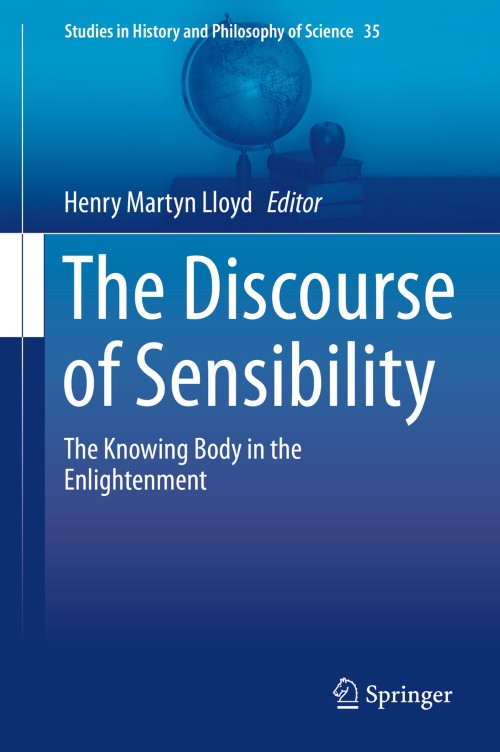
The Discourse of Sensibility [electronic resource] : The Knowing Body in the Enlightenment / edited by Henry Martyn Lloyd.
Erişim Adresi
ISBN
9783319027029
Dil Kodu
İngilizce
Yer Numarası
DK/7553
Basım Bildirimi
1st ed. 2013.
Yayın Bilgisi
Cham : Springer International Publishing : Imprint: Springer, 2013.
Fiziksel Niteleme
XII, 215 p. online resource.
Dizi
Studies in History and Philosophy of Science, 2215-1958 ; 35
İçindekiler Notu
Acknowledgements -- Table of Contents -- Contributors -- 1. The Discourse of Sensibilité: The Knowing Body in the Enlightenment; Henry Martyn Lloyd -- 2. Richard Steele and the Rise of Sentiment’s Empire; Bridget Orr -- 3. Rochester’s Libertine Poetry as Philosophical Education; Brandon Chua and Justin Clemens -- 4. Emotional Sensations and the Moral Imagination in Malebranche; Jordan Taylor -- 5. Feeling Better: Moral Sense and Sensibility in Enlightenment Thought; Alexander Cook -- 6. Physician, Heal Thyself! Emotions and the Health of the Learned in Samuel Auguste André David Tissot (1727–1797) and Gerard Nicolaas Heerkens (1726–1801); Yasmin Haskell -- 7. Penseurs profonds: Sensibility and the Knowledge-Seeker in Eighteenth-Century France; Anne C. Vila -- 8. Sensibility as Vital Force or as Property of Matter in Mid-Eighteenth-Century Debates; Charles T. Wolfe -- 9. Sensibilité, Embodied Epistemology, and the French Enlightenment; Henry Martyn Lloyd -- 10. Sensibility in Ruins: Imagined Realities, Perception Machines, and the Problem of Experience in Modernity -- Peter Otto.
Özet, vb.
This volume reconstructs the body of sensibility and the discourse which constructed it. The discourse of sensibility was deployed very widely throughout the mid- to late-eighteenth century, particularly in France and Britain. To inquire into the body of sensibility is then necessarily to enter into an interdisciplinary space and so to invite the plurality of methodological approaches which this collection exemplifies. The chapters collected here draw together the histories of literature and aesthetics, metaphysics and epistemology, moral theory, medicine, and cultural history. Together, they contribute to four major themes: First, the collection reconstructs various modes by which the sympathetic subject was construed or scripted, including through the theatre, poetry, literature, and medical and philosophical treaties. It secondly draws out those techniques of affective pedagogy which were implied by the medicalisation of the knowing body, and thirdly highlights the manner in which the body of sensibility was constructed as simultaneously particular and universal. Finally, it illustrates the ‘centrifugal forces’ at play within the discourse, and the anxiety which often accompanied them. At the centre of eighteenth-century thought was a very particular object: the body of sensibility, the Enlightenment’s knowing body. The persona of the knowledge-seeker was constructed by drawing together mind and matter, thought and feeling. And so where the Enlightenment thinker is generally associated with reason, truth-telling, and social and political reform, the Enlightenment is also known for its valorisation of emotion. During the period, intellectual pursuits were envisioned as having a distinctly embodied and emotional aspect. The body of ‘sensibility’ encompassed theseapparently disparate strands and was associated with terms including ‘sentimental’, ‘sentiment’, ‘sense’, ‘sensation’, and ‘sympathy’.
Konu
Science __ History.
Philosophy __ History.
Medicine __ History.
History of Science.
History of Philosophy.
History of Medicine.
Philosophy __ History.
Medicine __ History.
History of Science.
History of Philosophy.
History of Medicine.
Diğer Yazarlar
Kurum Adı
Eseri Alıntıla
Referansları kullanmadan önce gözden geçirmeniz ve varsa gerekli düzeltmeleri yapmanız önerilir.
Dijital Kaynak
MARC Görünümü
LEADER 04924nam a22005175i 4500
001 806246
003 TR_AnAIT
005 20260127001724
007 cr nn 008mamaa
008 131207s2013 sz | s |||| 0|eng d
020 |a9783319027029|9978-3-319-02702-9
024 7 |a10.1007/978-3-319-02702-9|2doi
041 |aeng
049 |aTürk Tarih Kurumu Kütüphanesi
050 4|aQ124.6-127.2
072 7|aPDX|2bicssc
072 7|aSCI034000|2bisacsh
072 7|aPDX|2thema
082 04|a509|223
090 |aDK/7553
245 14|aThe Discourse of Sensibility|h[electronic resource] :|bThe Knowing Body in the Enlightenment /|cedited by Henry Martyn Lloyd.
250 |a1st ed. 2013.
264 1|aCham :|bSpringer International Publishing :|bImprint: Springer,|c2013.
300 |aXII, 215 p.|bonline resource.
336 |atext|btxt|2rdacontent
337 |acomputer|bc|2rdamedia
338 |aonline resource|bcr|2rdacarrier
347 |atext file|bPDF|2rda
490 1 |aStudies in History and Philosophy of Science,|x2215-1958 ;|v35
505 0 |aAcknowledgements -- Table of Contents -- Contributors -- 1. The Discourse of Sensibilité: The Knowing Body in the Enlightenment; Henry Martyn Lloyd -- 2. Richard Steele and the Rise of Sentiment’s Empire; Bridget Orr -- 3. Rochester’s Libertine Poetry as Philosophical Education; Brandon Chua and Justin Clemens -- 4. Emotional Sensations and the Moral Imagination in Malebranche; Jordan Taylor -- 5. Feeling Better: Moral Sense and Sensibility in Enlightenment Thought; Alexander Cook -- 6. Physician, Heal Thyself! Emotions and the Health of the Learned in Samuel Auguste André David Tissot (1727–1797) and Gerard Nicolaas Heerkens (1726–1801); Yasmin Haskell -- 7. Penseurs profonds: Sensibility and the Knowledge-Seeker in Eighteenth-Century France; Anne C. Vila -- 8. Sensibility as Vital Force or as Property of Matter in Mid-Eighteenth-Century Debates; Charles T. Wolfe -- 9. Sensibilité, Embodied Epistemology, and the French Enlightenment; Henry Martyn Lloyd -- 10. Sensibility in Ruins: Imagined Realities, Perception Machines, and the Problem of Experience in Modernity -- Peter Otto.
520 |aThis volume reconstructs the body of sensibility and the discourse which constructed it. The discourse of sensibility was deployed very widely throughout the mid- to late-eighteenth century, particularly in France and Britain. To inquire into the body of sensibility is then necessarily to enter into an interdisciplinary space and so to invite the plurality of methodological approaches which this collection exemplifies. The chapters collected here draw together the histories of literature and aesthetics, metaphysics and epistemology, moral theory, medicine, and cultural history. Together, they contribute to four major themes: First, the collection reconstructs various modes by which the sympathetic subject was construed or scripted, including through the theatre, poetry, literature, and medical and philosophical treaties. It secondly draws out those techniques of affective pedagogy which were implied by the medicalisation of the knowing body, and thirdly highlights the manner in which the body of sensibility was constructed as simultaneously particular and universal. Finally, it illustrates the ‘centrifugal forces’ at play within the discourse, and the anxiety which often accompanied them. At the centre of eighteenth-century thought was a very particular object: the body of sensibility, the Enlightenment’s knowing body. The persona of the knowledge-seeker was constructed by drawing together mind and matter, thought and feeling. And so where the Enlightenment thinker is generally associated with reason, truth-telling, and social and political reform, the Enlightenment is also known for its valorisation of emotion. During the period, intellectual pursuits were envisioned as having a distinctly embodied and emotional aspect. The body of ‘sensibility’ encompassed theseapparently disparate strands and was associated with terms including ‘sentimental’, ‘sentiment’, ‘sense’, ‘sensation’, and ‘sympathy’.
650 0|aScience|xHistory.
650 0|aPhilosophy|xHistory.
650 0|aMedicine|xHistory.
650 14|aHistory of Science.
650 24|aHistory of Philosophy.
650 24|aHistory of Medicine.
700 1 |aLloyd, Henry Martyn.|eeditor.|4edt|4http://id.loc.gov/vocabulary/relators/edt
710 2 |aSpringerLink (Online service)
773 0 |tSpringer Nature eBook
776 08|iPrinted edition:|z9783319027012
776 08|iPrinted edition:|z9783319027036
776 08|iPrinted edition:|z9783319344072
830 0|aStudies in History and Philosophy of Science,|x2215-1958 ;|v35
856 40|uhttps://doi.org/10.1007/978-3-319-02702-9
912 |aZDB-2-SHU
912 |aZDB-2-SXH
950 |aHumanities, Social Sciences and Law (SpringerNature-11648)
950 |aHistory (R0) (SpringerNature-43722)
001 806246
003 TR_AnAIT
005 20260127001724
007 cr nn 008mamaa
008 131207s2013 sz | s |||| 0|eng d
020 |a9783319027029|9978-3-319-02702-9
024 7 |a10.1007/978-3-319-02702-9|2doi
041 |aeng
049 |aTürk Tarih Kurumu Kütüphanesi
050 4|aQ124.6-127.2
072 7|aPDX|2bicssc
072 7|aSCI034000|2bisacsh
072 7|aPDX|2thema
082 04|a509|223
090 |aDK/7553
245 14|aThe Discourse of Sensibility|h[electronic resource] :|bThe Knowing Body in the Enlightenment /|cedited by Henry Martyn Lloyd.
250 |a1st ed. 2013.
264 1|aCham :|bSpringer International Publishing :|bImprint: Springer,|c2013.
300 |aXII, 215 p.|bonline resource.
336 |atext|btxt|2rdacontent
337 |acomputer|bc|2rdamedia
338 |aonline resource|bcr|2rdacarrier
347 |atext file|bPDF|2rda
490 1 |aStudies in History and Philosophy of Science,|x2215-1958 ;|v35
505 0 |aAcknowledgements -- Table of Contents -- Contributors -- 1. The Discourse of Sensibilité: The Knowing Body in the Enlightenment; Henry Martyn Lloyd -- 2. Richard Steele and the Rise of Sentiment’s Empire; Bridget Orr -- 3. Rochester’s Libertine Poetry as Philosophical Education; Brandon Chua and Justin Clemens -- 4. Emotional Sensations and the Moral Imagination in Malebranche; Jordan Taylor -- 5. Feeling Better: Moral Sense and Sensibility in Enlightenment Thought; Alexander Cook -- 6. Physician, Heal Thyself! Emotions and the Health of the Learned in Samuel Auguste André David Tissot (1727–1797) and Gerard Nicolaas Heerkens (1726–1801); Yasmin Haskell -- 7. Penseurs profonds: Sensibility and the Knowledge-Seeker in Eighteenth-Century France; Anne C. Vila -- 8. Sensibility as Vital Force or as Property of Matter in Mid-Eighteenth-Century Debates; Charles T. Wolfe -- 9. Sensibilité, Embodied Epistemology, and the French Enlightenment; Henry Martyn Lloyd -- 10. Sensibility in Ruins: Imagined Realities, Perception Machines, and the Problem of Experience in Modernity -- Peter Otto.
520 |aThis volume reconstructs the body of sensibility and the discourse which constructed it. The discourse of sensibility was deployed very widely throughout the mid- to late-eighteenth century, particularly in France and Britain. To inquire into the body of sensibility is then necessarily to enter into an interdisciplinary space and so to invite the plurality of methodological approaches which this collection exemplifies. The chapters collected here draw together the histories of literature and aesthetics, metaphysics and epistemology, moral theory, medicine, and cultural history. Together, they contribute to four major themes: First, the collection reconstructs various modes by which the sympathetic subject was construed or scripted, including through the theatre, poetry, literature, and medical and philosophical treaties. It secondly draws out those techniques of affective pedagogy which were implied by the medicalisation of the knowing body, and thirdly highlights the manner in which the body of sensibility was constructed as simultaneously particular and universal. Finally, it illustrates the ‘centrifugal forces’ at play within the discourse, and the anxiety which often accompanied them. At the centre of eighteenth-century thought was a very particular object: the body of sensibility, the Enlightenment’s knowing body. The persona of the knowledge-seeker was constructed by drawing together mind and matter, thought and feeling. And so where the Enlightenment thinker is generally associated with reason, truth-telling, and social and political reform, the Enlightenment is also known for its valorisation of emotion. During the period, intellectual pursuits were envisioned as having a distinctly embodied and emotional aspect. The body of ‘sensibility’ encompassed theseapparently disparate strands and was associated with terms including ‘sentimental’, ‘sentiment’, ‘sense’, ‘sensation’, and ‘sympathy’.
650 0|aScience|xHistory.
650 0|aPhilosophy|xHistory.
650 0|aMedicine|xHistory.
650 14|aHistory of Science.
650 24|aHistory of Philosophy.
650 24|aHistory of Medicine.
700 1 |aLloyd, Henry Martyn.|eeditor.|4edt|4http://id.loc.gov/vocabulary/relators/edt
710 2 |aSpringerLink (Online service)
773 0 |tSpringer Nature eBook
776 08|iPrinted edition:|z9783319027012
776 08|iPrinted edition:|z9783319027036
776 08|iPrinted edition:|z9783319344072
830 0|aStudies in History and Philosophy of Science,|x2215-1958 ;|v35
856 40|uhttps://doi.org/10.1007/978-3-319-02702-9
912 |aZDB-2-SHU
912 |aZDB-2-SXH
950 |aHumanities, Social Sciences and Law (SpringerNature-11648)
950 |aHistory (R0) (SpringerNature-43722)
Materyaller
Depodan talep edilen materyal sadece kütüphane içerisinde kullanılmaktadır.
Materyal dışarıya ödünç verilmemektedir.
Materyal dışarıya ödünç verilmemektedir.
