

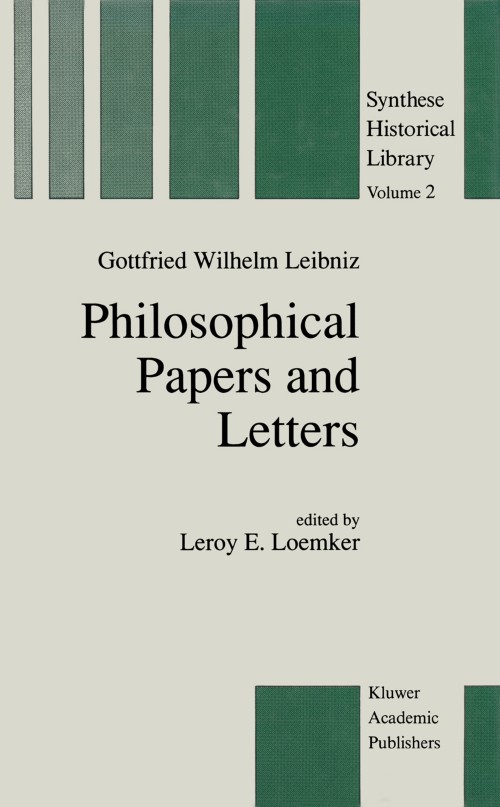
Philosophical Papers and Letters [electronic resource] : A Selection / by G.W. Leibniz.
Erişim Adresi
ISBN
9789401014267
Dil Kodu
İngilizce
Yer Numarası
DK/7608
Yazar
Basım Bildirimi
2nd ed. 1989.
Yayın Bilgisi
Dordrecht : Springer Netherlands : Imprint: Springer, 1989.
Fiziksel Niteleme
XII, 736 p. online resource.
Dizi
Synthese Historical Library ; 2
İçindekiler Notu
Introduction: Leibniz as Philosopher -- I. The 17th Century -- II. Leibniz’s Life and Work -- III. The Metaphysical Pattern -- IV. Leibniz’s Method 19 V. Logic and the Principles of Truth and Reality -- VI. Mathematics and Philosophy -- VII. Physics and the Realm of Nature -- VIII. Biology -- IX. Psychology -- X. Theory of Knowledge -- XI. Summary: Structure and Purpose -- XII. Ethics and Social Thought -- XIII. Theology -- XIV. Leibniz’s Consistency and Influence -- I. Mainz and Paris, 1666–76 -- 1. Dissertation on the Art of Combinations, 1666 (Selections) -- I. Demonstration of the Existence of God -- II. Corollaries for Disputation -- III. Cum Deo! -- Definitions -- Problems -- 2. A New Method for Learning and Teaching Jurisprudence, 1667 (Selections from Part I) -- I. General and Common to All Faculties: on a Basis for Studies in General -- 3. Letter to Jacob Thomasius, 1669 -- 4. Letter to Thomas Hobbes, 1670 -- 5. Theological Writings Related to the Catholic Demonstrations, 1668–70 -- I. The Confession of Nature against Atheists, 1669 -- II. A Fragment on Dreams -- III. On Transubstantiation, 1668(?) -- Supplement: Notes on the Eucharist, 1668 -- 6. Preface to an Edition of Nizolius, 1670 (Selections) -- 7. Elements of Natural Law, 1670–71 -- 8. Studies in Physics and the Nature of Body, 1671 -- I. The Theory of Abstract Motion: Fundamental Principles -- II. An Example of Demonstrations about the Nature of Corporeal Things Drawn from Phenomena -- 9. Letter to Magnus Wedderkopf, 1671 -- 10. Letter to Antoine Arnauld, 1671 (Selection) -- 11. Letter to Simon Foucher, with Notes on Fouche?s Reply to Des Gabets, 1675 -- 12. Selections from the Paris Notes, 1676 -- 13. Letter to Henry Oldenburg, 1675 -- 14. Two Notations for Discussion with Spinoza, 1676 -- II. Hanover to the Italian Journey,1676–87 -- 15. On a Method of Arriving at a True Analysis of Bodies and the Causes of Natural Things, 1677 -- 16. Letter to Arnold Eckhard, 1677 -- 17. Dialogue, 1677 -- 18. Letter to Herman Conring, 1678 -- 19. Letter to Walter von Tschirnhaus, 1678 -- 20. On the Ethics of Benedict de Spinoza, 1678 -- I. On God -- 21. What is an Idea? 1678 -- 22. Letters to Nicolas Malebranche, 1679 (Selections) -- 23. Two Dialogues on Religion, ca. 1678 (Selections) -- I. Dialogue between Poliander and Theophile -- II. Dialogue between Polidore and Theophile -- 24. On the General Characteristic, ca. 1679 -- 25. On Universal Synthesis and Analysis, or the Art of Disco very and Judgment, 1679(?) -- 26. Two Studies in the Logical Calculus, 1679 -- I. Elements of Calculus -- II. Specimen of Universal Calculus -- 27. Studies in a Geometry of Situation, 1679 -- I. Letter to Christian Huygens, 1679 -- II. Supplement -- III. On Analysis Situs -- 28. Letter to John Frederick, Duke of Brunswick-Hanover, 1679 -- 29. On Freedom, ca. 1679 -- 30. “First Truths”, ca. 1680–84 -- 31. Selections from Leibniz’s Correspondence, 1679–84 -- I. To Christian Philipp, 1679 -- II. To Philipp, 1680 -- III. To François de la Chaise, 1680 -- IV. To Veit Ludwig von Seckendorf, 1683 -- V. To Walter von Tschirnhaus, 1684 -- 32. On the Elements of Natural Science, ca. 1682–84 -- I. The Plan of the Book277 II. An Introduction on the Value and Method of Natural Science -- 33. Meditations on Knowledge, Truth, and Ideas, 1684 -- 34. A Brief Demonstration of a Notable Error of Descartes and Others Concerning a Natural Law, 1686 -- 35. “Discourse on Metaphysics”, 1686 -- 36. Correspondence with Arnauld, 1686–87 (Selections) -- 37. Letter of Mr. Leibniz on a General Principle Useful in Explaining the Laws of Nature through a Considerationof the Divine Wisdom; to Serve as a Reply to the Response of the Rev. Father Malebranche, 1687 -- to Parts III and IV -- III. Hanover to the Death of Ernest August, 1690–98 -- 38. Letter to Arnauld, 1690 -- 39. On the Method of Distinguishing Real from Imaginary Phenomena -- 40. On the True Theologia Mystica, ca. 1690(?) -- 41. A Study in the Logical Calculus -- 42. Critical Thoughts on the General Part of the Principles of Descartes, 1692 -- On Part I -- On Part II -- 43. Correspondence with Huygens, 1692–94 (Selections) -- 44. From the Ethical and Legal Writings, 1693–1700 -- I. From the Preface of the ‘Codex Juris Gentium Diplomaticus’ -- II. From the Preface to the Mantissa Codicis Juris Gentium -- III. On Wisdom -- IV. On Natural Law 428 A Classification of Societies or Communities -- 45. On the Correction of Metaphysics and the Concept of Substance, 1694 -- 46. Specimen Dynamicum, 1695 -- 47. I. A New System of the Nature and the Communication of Substances, as well as the Union between the Soul and the Body, 1695 -- II. “Second Explanation of the New System”, 1696 -- 48. Letter to Gabriel Wagner on the Value of Logic, 1696 -- 49. Letters to Des Billettes, 1696–97 -- 50. Tentamen Anagogicum: An Anagogical Essay in the Investigation of Causes, ca. 1696 -- 51. On the Radical Origination of Things, 1697 -- 52. Clarification of the Difficulties which Mr. Bayle has found in the New System of the Union of Soul and Body, 1698 -- 53. On Nature Itself, or on the Inherent Force and Actions of Created Things, 1698 -- IV. Hanover under George Louis, 1698–1716 -- 54. Correspondence with John Bernoulli, 1698–99 -- 55. Correspondence with De Voider, 1699–1706 -- 56. Letter to Varignon, with a Note on the ‘Justification of the Infinitesimal Calculus by That of Ordinary Algebra’,1702 -- I. Letter to Varignon, February 2, 1702 -- II. Justification of the Infinitesimal Calculus by That of Ordinary Algebra, 1701 -- 57. On What is Independent of Sense and of Matter, 1702 -- 58. Reflections on the Doctrine of a Single Universal Spirit, 1702 -- 59. Reflections on the Common Concept of Justice, 1702(?) -- 60. Reply to the Thoughts on the System of Pre-Established Harmony contained in the Second Edition of Mr. Bayle’s Critical Dictionary, Article Rorarius 1702 -- 61. Considerations on Vital Principles and Plastic Natures, by the Author of the System of Pre-Established Harmony, 1705 -- 62. Letter to Hansch on the Platonic Philosophy or on Platonic Enthusiasm, 1707 -- 63. Correspondence with Des Bosses, 1709–15 -- 64. Conversation of Philarète and Ariste, following a Conversation of Ariste and Theodore, ca. 1711 -- 65. Remarks on the three Volumes Entitled Characteristics of Men, Manners, Opinions, Times,... 1711, 1712 -- 66. The Principles of Nature and of Grace, based on Reason, 1714 -- 67. “The Monadology”, 1714 -- 68. Letters to Nicolas Remond, 1714–15 -- 69. Letters to Louis Bourguet, 1714–15 -- 70. The Metaphysical Foundations of Mathematics, after 1714 -- 71. The Controversy between Leibniz and Clarke, 1715–16.
Özet, vb.
The selections contained in these volumes from the papers and letters of Leibniz are intended to serve the student in two ways: first, by providing a more adequate and balanced conception of the full range and penetration of Leibniz's creative intellectual powers; second, by inviting a fresher approach to his intellectual growth and a clearer perception of the internal strains in his thinking, through a chronological arrangement. Much confusion has arisen in the past through a neglect of the develop ment of Leibniz's ideas, and Couturat's impressive plea, in his edition of the Opuscu/es et fragments (p. xii), for such an arrangement is valid even for incomplete editions. The beginning student will do well, however, to read the maturer writings of Parts II, III, and IV first, leaving Part I, from a period too largely neglected by Leibniz criticism, for a later study of the still obscure sources and motives of his thought. The Introduction aims primarily to provide cultural orientation and an exposition of the structure and the underlying assumptions of the philosophical system rather than a critical evaluation. I hope that together with the notes and the Index, it will provide those aids to the understanding which the originality of Leibniz's scientific, ethical, and metaphysical efforts deserve.
Konu
History.
Religion __ Philosophy.
History.
Philosophy of Religion.
Religion __ Philosophy.
History.
Philosophy of Religion.
Kurum Adı
Eseri Alıntıla
Referansları kullanmadan önce gözden geçirmeniz ve varsa gerekli düzeltmeleri yapmanız önerilir.
Dijital Kaynak
MARC Görünümü
LEADER 10578nam a22005775i 4500
001 806303
003 TR_AnAIT
005 20260127001830
007 cr nn 008mamaa
008 121227s1989 ne | s |||| 0|eng d
020 |a9789401014267|9978-94-010-1426-7
024 7 |a10.1007/978-94-010-1426-7|2doi
041 |aeng
049 |aTürk Tarih Kurumu Kütüphanesi
050 4|aD1-2027
072 7|aHB|2bicssc
072 7|aHBAH|2bicssc
072 7|aHIS000000|2bisacsh
072 7|aNH|2thema
072 7|aNHAH|2thema
082 04|a900|223
090 |aDK/7608
100 1 |aLeibniz, G.W.|eauthor.|4aut|4http://id.loc.gov/vocabulary/relators/aut
245 10|aPhilosophical Papers and Letters|h[electronic resource] :|bA Selection /|cby G.W. Leibniz.
250 |a2nd ed. 1989.
264 1|aDordrecht :|bSpringer Netherlands :|bImprint: Springer,|c1989.
300 |aXII, 736 p.|bonline resource.
336 |atext|btxt|2rdacontent
337 |acomputer|bc|2rdamedia
338 |aonline resource|bcr|2rdacarrier
347 |atext file|bPDF|2rda
490 1 |aSynthese Historical Library ;|v2
505 0 |aIntroduction: Leibniz as Philosopher -- I. The 17th Century -- II. Leibniz’s Life and Work -- III. The Metaphysical Pattern -- IV. Leibniz’s Method 19 V. Logic and the Principles of Truth and Reality -- VI. Mathematics and Philosophy -- VII. Physics and the Realm of Nature -- VIII. Biology -- IX. Psychology -- X. Theory of Knowledge -- XI. Summary: Structure and Purpose -- XII. Ethics and Social Thought -- XIII. Theology -- XIV. Leibniz’s Consistency and Influence -- I. Mainz and Paris, 1666–76 -- 1. Dissertation on the Art of Combinations, 1666 (Selections) -- I. Demonstration of the Existence of God -- II. Corollaries for Disputation -- III. Cum Deo! -- Definitions -- Problems -- 2. A New Method for Learning and Teaching Jurisprudence, 1667 (Selections from Part I) -- I. General and Common to All Faculties: on a Basis for Studies in General -- 3. Letter to Jacob Thomasius, 1669 -- 4. Letter to Thomas Hobbes, 1670 -- 5. Theological Writings Related to the Catholic Demonstrations, 1668–70 -- I. The Confession of Nature against Atheists, 1669 -- II. A Fragment on Dreams -- III. On Transubstantiation, 1668(?) -- Supplement: Notes on the Eucharist, 1668 -- 6. Preface to an Edition of Nizolius, 1670 (Selections) -- 7. Elements of Natural Law, 1670–71 -- 8. Studies in Physics and the Nature of Body, 1671 -- I. The Theory of Abstract Motion: Fundamental Principles -- II. An Example of Demonstrations about the Nature of Corporeal Things Drawn from Phenomena -- 9. Letter to Magnus Wedderkopf, 1671 -- 10. Letter to Antoine Arnauld, 1671 (Selection) -- 11. Letter to Simon Foucher, with Notes on Fouche?s Reply to Des Gabets, 1675 -- 12. Selections from the Paris Notes, 1676 -- 13. Letter to Henry Oldenburg, 1675 -- 14. Two Notations for Discussion with Spinoza, 1676 -- II. Hanover to the Italian Journey,1676–87 -- 15. On a Method of Arriving at a True Analysis of Bodies and the Causes of Natural Things, 1677 -- 16. Letter to Arnold Eckhard, 1677 -- 17. Dialogue, 1677 -- 18. Letter to Herman Conring, 1678 -- 19. Letter to Walter von Tschirnhaus, 1678 -- 20. On the Ethics of Benedict de Spinoza, 1678 -- I. On God -- 21. What is an Idea? 1678 -- 22. Letters to Nicolas Malebranche, 1679 (Selections) -- 23. Two Dialogues on Religion, ca. 1678 (Selections) -- I. Dialogue between Poliander and Theophile -- II. Dialogue between Polidore and Theophile -- 24. On the General Characteristic, ca. 1679 -- 25. On Universal Synthesis and Analysis, or the Art of Disco very and Judgment, 1679(?) -- 26. Two Studies in the Logical Calculus, 1679 -- I. Elements of Calculus -- II. Specimen of Universal Calculus -- 27. Studies in a Geometry of Situation, 1679 -- I. Letter to Christian Huygens, 1679 -- II. Supplement -- III. On Analysis Situs -- 28. Letter to John Frederick, Duke of Brunswick-Hanover, 1679 -- 29. On Freedom, ca. 1679 -- 30. “First Truths”, ca. 1680–84 -- 31. Selections from Leibniz’s Correspondence, 1679–84 -- I. To Christian Philipp, 1679 -- II. To Philipp, 1680 -- III. To François de la Chaise, 1680 -- IV. To Veit Ludwig von Seckendorf, 1683 -- V. To Walter von Tschirnhaus, 1684 -- 32. On the Elements of Natural Science, ca. 1682–84 -- I. The Plan of the Book277 II. An Introduction on the Value and Method of Natural Science -- 33. Meditations on Knowledge, Truth, and Ideas, 1684 -- 34. A Brief Demonstration of a Notable Error of Descartes and Others Concerning a Natural Law, 1686 -- 35. “Discourse on Metaphysics”, 1686 -- 36. Correspondence with Arnauld, 1686–87 (Selections) -- 37. Letter of Mr. Leibniz on a General Principle Useful in Explaining the Laws of Nature through a Considerationof the Divine Wisdom; to Serve as a Reply to the Response of the Rev. Father Malebranche, 1687 -- to Parts III and IV -- III. Hanover to the Death of Ernest August, 1690–98 -- 38. Letter to Arnauld, 1690 -- 39. On the Method of Distinguishing Real from Imaginary Phenomena -- 40. On the True Theologia Mystica, ca. 1690(?) -- 41. A Study in the Logical Calculus -- 42. Critical Thoughts on the General Part of the Principles of Descartes, 1692 -- On Part I -- On Part II -- 43. Correspondence with Huygens, 1692–94 (Selections) -- 44. From the Ethical and Legal Writings, 1693–1700 -- I. From the Preface of the ‘Codex Juris Gentium Diplomaticus’ -- II. From the Preface to the Mantissa Codicis Juris Gentium -- III. On Wisdom -- IV. On Natural Law 428 A Classification of Societies or Communities -- 45. On the Correction of Metaphysics and the Concept of Substance, 1694 -- 46. Specimen Dynamicum, 1695 -- 47. I. A New System of the Nature and the Communication of Substances, as well as the Union between the Soul and the Body, 1695 -- II. “Second Explanation of the New System”, 1696 -- 48. Letter to Gabriel Wagner on the Value of Logic, 1696 -- 49. Letters to Des Billettes, 1696–97 -- 50. Tentamen Anagogicum: An Anagogical Essay in the Investigation of Causes, ca. 1696 -- 51. On the Radical Origination of Things, 1697 -- 52. Clarification of the Difficulties which Mr. Bayle has found in the New System of the Union of Soul and Body, 1698 -- 53. On Nature Itself, or on the Inherent Force and Actions of Created Things, 1698 -- IV. Hanover under George Louis, 1698–1716 -- 54. Correspondence with John Bernoulli, 1698–99 -- 55. Correspondence with De Voider, 1699–1706 -- 56. Letter to Varignon, with a Note on the ‘Justification of the Infinitesimal Calculus by That of Ordinary Algebra’,1702 -- I. Letter to Varignon, February 2, 1702 -- II. Justification of the Infinitesimal Calculus by That of Ordinary Algebra, 1701 -- 57. On What is Independent of Sense and of Matter, 1702 -- 58. Reflections on the Doctrine of a Single Universal Spirit, 1702 -- 59. Reflections on the Common Concept of Justice, 1702(?) -- 60. Reply to the Thoughts on the System of Pre-Established Harmony contained in the Second Edition of Mr. Bayle’s Critical Dictionary, Article Rorarius 1702 -- 61. Considerations on Vital Principles and Plastic Natures, by the Author of the System of Pre-Established Harmony, 1705 -- 62. Letter to Hansch on the Platonic Philosophy or on Platonic Enthusiasm, 1707 -- 63. Correspondence with Des Bosses, 1709–15 -- 64. Conversation of Philarète and Ariste, following a Conversation of Ariste and Theodore, ca. 1711 -- 65. Remarks on the three Volumes Entitled Characteristics of Men, Manners, Opinions, Times,... 1711, 1712 -- 66. The Principles of Nature and of Grace, based on Reason, 1714 -- 67. “The Monadology”, 1714 -- 68. Letters to Nicolas Remond, 1714–15 -- 69. Letters to Louis Bourguet, 1714–15 -- 70. The Metaphysical Foundations of Mathematics, after 1714 -- 71. The Controversy between Leibniz and Clarke, 1715–16.
520 |aThe selections contained in these volumes from the papers and letters of Leibniz are intended to serve the student in two ways: first, by providing a more adequate and balanced conception of the full range and penetration of Leibniz's creative intellectual powers; second, by inviting a fresher approach to his intellectual growth and a clearer perception of the internal strains in his thinking, through a chronological arrangement. Much confusion has arisen in the past through a neglect of the develop ment of Leibniz's ideas, and Couturat's impressive plea, in his edition of the Opuscu/es et fragments (p. xii), for such an arrangement is valid even for incomplete editions. The beginning student will do well, however, to read the maturer writings of Parts II, III, and IV first, leaving Part I, from a period too largely neglected by Leibniz criticism, for a later study of the still obscure sources and motives of his thought. The Introduction aims primarily to provide cultural orientation and an exposition of the structure and the underlying assumptions of the philosophical system rather than a critical evaluation. I hope that together with the notes and the Index, it will provide those aids to the understanding which the originality of Leibniz's scientific, ethical, and metaphysical efforts deserve.
532 8 |aAccessibility summary: This PDF is not accessible. It is based on scanned pages and does not support features such as screen reader compatibility or described non-text content (images, graphs etc). However, it likely supports searchable and selectable text based on OCR (Optical Character Recognition). Users with accessibility needs may not be able to use this content effectively. Please contact us at accessibilitysupport@springernature.com if you require assistance or an alternative format.
532 8 |aInaccessible, or known limited accessibility
532 8 |aNo reading system accessibility options actively disabled
532 8 |aPublisher contact for further accessibility information: accessibilitysupport@springernature.com
650 0|aHistory.
650 0|aReligion|xPhilosophy.
650 14|aHistory.
650 24|aPhilosophy of Religion.
710 2 |aSpringerLink (Online service)
773 0 |tSpringer Nature eBook
776 08|iPrinted edition:|z9789027700087
776 08|iPrinted edition:|z9789027706935
776 08|iPrinted edition:|z9789401014274
830 0|aSynthese Historical Library ;|v2
856 40|uhttps://doi.org/10.1007/978-94-010-1426-7
912 |aZDB-2-SHU
912 |aZDB-2-SXH
912 |aZDB-2-BAE
950 |aHumanities, Social Sciences and Law (SpringerNature-11648)
950 |aHistory (R0) (SpringerNature-43722)
001 806303
003 TR_AnAIT
005 20260127001830
007 cr nn 008mamaa
008 121227s1989 ne | s |||| 0|eng d
020 |a9789401014267|9978-94-010-1426-7
024 7 |a10.1007/978-94-010-1426-7|2doi
041 |aeng
049 |aTürk Tarih Kurumu Kütüphanesi
050 4|aD1-2027
072 7|aHB|2bicssc
072 7|aHBAH|2bicssc
072 7|aHIS000000|2bisacsh
072 7|aNH|2thema
072 7|aNHAH|2thema
082 04|a900|223
090 |aDK/7608
100 1 |aLeibniz, G.W.|eauthor.|4aut|4http://id.loc.gov/vocabulary/relators/aut
245 10|aPhilosophical Papers and Letters|h[electronic resource] :|bA Selection /|cby G.W. Leibniz.
250 |a2nd ed. 1989.
264 1|aDordrecht :|bSpringer Netherlands :|bImprint: Springer,|c1989.
300 |aXII, 736 p.|bonline resource.
336 |atext|btxt|2rdacontent
337 |acomputer|bc|2rdamedia
338 |aonline resource|bcr|2rdacarrier
347 |atext file|bPDF|2rda
490 1 |aSynthese Historical Library ;|v2
505 0 |aIntroduction: Leibniz as Philosopher -- I. The 17th Century -- II. Leibniz’s Life and Work -- III. The Metaphysical Pattern -- IV. Leibniz’s Method 19 V. Logic and the Principles of Truth and Reality -- VI. Mathematics and Philosophy -- VII. Physics and the Realm of Nature -- VIII. Biology -- IX. Psychology -- X. Theory of Knowledge -- XI. Summary: Structure and Purpose -- XII. Ethics and Social Thought -- XIII. Theology -- XIV. Leibniz’s Consistency and Influence -- I. Mainz and Paris, 1666–76 -- 1. Dissertation on the Art of Combinations, 1666 (Selections) -- I. Demonstration of the Existence of God -- II. Corollaries for Disputation -- III. Cum Deo! -- Definitions -- Problems -- 2. A New Method for Learning and Teaching Jurisprudence, 1667 (Selections from Part I) -- I. General and Common to All Faculties: on a Basis for Studies in General -- 3. Letter to Jacob Thomasius, 1669 -- 4. Letter to Thomas Hobbes, 1670 -- 5. Theological Writings Related to the Catholic Demonstrations, 1668–70 -- I. The Confession of Nature against Atheists, 1669 -- II. A Fragment on Dreams -- III. On Transubstantiation, 1668(?) -- Supplement: Notes on the Eucharist, 1668 -- 6. Preface to an Edition of Nizolius, 1670 (Selections) -- 7. Elements of Natural Law, 1670–71 -- 8. Studies in Physics and the Nature of Body, 1671 -- I. The Theory of Abstract Motion: Fundamental Principles -- II. An Example of Demonstrations about the Nature of Corporeal Things Drawn from Phenomena -- 9. Letter to Magnus Wedderkopf, 1671 -- 10. Letter to Antoine Arnauld, 1671 (Selection) -- 11. Letter to Simon Foucher, with Notes on Fouche?s Reply to Des Gabets, 1675 -- 12. Selections from the Paris Notes, 1676 -- 13. Letter to Henry Oldenburg, 1675 -- 14. Two Notations for Discussion with Spinoza, 1676 -- II. Hanover to the Italian Journey,1676–87 -- 15. On a Method of Arriving at a True Analysis of Bodies and the Causes of Natural Things, 1677 -- 16. Letter to Arnold Eckhard, 1677 -- 17. Dialogue, 1677 -- 18. Letter to Herman Conring, 1678 -- 19. Letter to Walter von Tschirnhaus, 1678 -- 20. On the Ethics of Benedict de Spinoza, 1678 -- I. On God -- 21. What is an Idea? 1678 -- 22. Letters to Nicolas Malebranche, 1679 (Selections) -- 23. Two Dialogues on Religion, ca. 1678 (Selections) -- I. Dialogue between Poliander and Theophile -- II. Dialogue between Polidore and Theophile -- 24. On the General Characteristic, ca. 1679 -- 25. On Universal Synthesis and Analysis, or the Art of Disco very and Judgment, 1679(?) -- 26. Two Studies in the Logical Calculus, 1679 -- I. Elements of Calculus -- II. Specimen of Universal Calculus -- 27. Studies in a Geometry of Situation, 1679 -- I. Letter to Christian Huygens, 1679 -- II. Supplement -- III. On Analysis Situs -- 28. Letter to John Frederick, Duke of Brunswick-Hanover, 1679 -- 29. On Freedom, ca. 1679 -- 30. “First Truths”, ca. 1680–84 -- 31. Selections from Leibniz’s Correspondence, 1679–84 -- I. To Christian Philipp, 1679 -- II. To Philipp, 1680 -- III. To François de la Chaise, 1680 -- IV. To Veit Ludwig von Seckendorf, 1683 -- V. To Walter von Tschirnhaus, 1684 -- 32. On the Elements of Natural Science, ca. 1682–84 -- I. The Plan of the Book277 II. An Introduction on the Value and Method of Natural Science -- 33. Meditations on Knowledge, Truth, and Ideas, 1684 -- 34. A Brief Demonstration of a Notable Error of Descartes and Others Concerning a Natural Law, 1686 -- 35. “Discourse on Metaphysics”, 1686 -- 36. Correspondence with Arnauld, 1686–87 (Selections) -- 37. Letter of Mr. Leibniz on a General Principle Useful in Explaining the Laws of Nature through a Considerationof the Divine Wisdom; to Serve as a Reply to the Response of the Rev. Father Malebranche, 1687 -- to Parts III and IV -- III. Hanover to the Death of Ernest August, 1690–98 -- 38. Letter to Arnauld, 1690 -- 39. On the Method of Distinguishing Real from Imaginary Phenomena -- 40. On the True Theologia Mystica, ca. 1690(?) -- 41. A Study in the Logical Calculus -- 42. Critical Thoughts on the General Part of the Principles of Descartes, 1692 -- On Part I -- On Part II -- 43. Correspondence with Huygens, 1692–94 (Selections) -- 44. From the Ethical and Legal Writings, 1693–1700 -- I. From the Preface of the ‘Codex Juris Gentium Diplomaticus’ -- II. From the Preface to the Mantissa Codicis Juris Gentium -- III. On Wisdom -- IV. On Natural Law 428 A Classification of Societies or Communities -- 45. On the Correction of Metaphysics and the Concept of Substance, 1694 -- 46. Specimen Dynamicum, 1695 -- 47. I. A New System of the Nature and the Communication of Substances, as well as the Union between the Soul and the Body, 1695 -- II. “Second Explanation of the New System”, 1696 -- 48. Letter to Gabriel Wagner on the Value of Logic, 1696 -- 49. Letters to Des Billettes, 1696–97 -- 50. Tentamen Anagogicum: An Anagogical Essay in the Investigation of Causes, ca. 1696 -- 51. On the Radical Origination of Things, 1697 -- 52. Clarification of the Difficulties which Mr. Bayle has found in the New System of the Union of Soul and Body, 1698 -- 53. On Nature Itself, or on the Inherent Force and Actions of Created Things, 1698 -- IV. Hanover under George Louis, 1698–1716 -- 54. Correspondence with John Bernoulli, 1698–99 -- 55. Correspondence with De Voider, 1699–1706 -- 56. Letter to Varignon, with a Note on the ‘Justification of the Infinitesimal Calculus by That of Ordinary Algebra’,1702 -- I. Letter to Varignon, February 2, 1702 -- II. Justification of the Infinitesimal Calculus by That of Ordinary Algebra, 1701 -- 57. On What is Independent of Sense and of Matter, 1702 -- 58. Reflections on the Doctrine of a Single Universal Spirit, 1702 -- 59. Reflections on the Common Concept of Justice, 1702(?) -- 60. Reply to the Thoughts on the System of Pre-Established Harmony contained in the Second Edition of Mr. Bayle’s Critical Dictionary, Article Rorarius 1702 -- 61. Considerations on Vital Principles and Plastic Natures, by the Author of the System of Pre-Established Harmony, 1705 -- 62. Letter to Hansch on the Platonic Philosophy or on Platonic Enthusiasm, 1707 -- 63. Correspondence with Des Bosses, 1709–15 -- 64. Conversation of Philarète and Ariste, following a Conversation of Ariste and Theodore, ca. 1711 -- 65. Remarks on the three Volumes Entitled Characteristics of Men, Manners, Opinions, Times,... 1711, 1712 -- 66. The Principles of Nature and of Grace, based on Reason, 1714 -- 67. “The Monadology”, 1714 -- 68. Letters to Nicolas Remond, 1714–15 -- 69. Letters to Louis Bourguet, 1714–15 -- 70. The Metaphysical Foundations of Mathematics, after 1714 -- 71. The Controversy between Leibniz and Clarke, 1715–16.
520 |aThe selections contained in these volumes from the papers and letters of Leibniz are intended to serve the student in two ways: first, by providing a more adequate and balanced conception of the full range and penetration of Leibniz's creative intellectual powers; second, by inviting a fresher approach to his intellectual growth and a clearer perception of the internal strains in his thinking, through a chronological arrangement. Much confusion has arisen in the past through a neglect of the develop ment of Leibniz's ideas, and Couturat's impressive plea, in his edition of the Opuscu/es et fragments (p. xii), for such an arrangement is valid even for incomplete editions. The beginning student will do well, however, to read the maturer writings of Parts II, III, and IV first, leaving Part I, from a period too largely neglected by Leibniz criticism, for a later study of the still obscure sources and motives of his thought. The Introduction aims primarily to provide cultural orientation and an exposition of the structure and the underlying assumptions of the philosophical system rather than a critical evaluation. I hope that together with the notes and the Index, it will provide those aids to the understanding which the originality of Leibniz's scientific, ethical, and metaphysical efforts deserve.
532 8 |aAccessibility summary: This PDF is not accessible. It is based on scanned pages and does not support features such as screen reader compatibility or described non-text content (images, graphs etc). However, it likely supports searchable and selectable text based on OCR (Optical Character Recognition). Users with accessibility needs may not be able to use this content effectively. Please contact us at accessibilitysupport@springernature.com if you require assistance or an alternative format.
532 8 |aInaccessible, or known limited accessibility
532 8 |aNo reading system accessibility options actively disabled
532 8 |aPublisher contact for further accessibility information: accessibilitysupport@springernature.com
650 0|aHistory.
650 0|aReligion|xPhilosophy.
650 14|aHistory.
650 24|aPhilosophy of Religion.
710 2 |aSpringerLink (Online service)
773 0 |tSpringer Nature eBook
776 08|iPrinted edition:|z9789027700087
776 08|iPrinted edition:|z9789027706935
776 08|iPrinted edition:|z9789401014274
830 0|aSynthese Historical Library ;|v2
856 40|uhttps://doi.org/10.1007/978-94-010-1426-7
912 |aZDB-2-SHU
912 |aZDB-2-SXH
912 |aZDB-2-BAE
950 |aHumanities, Social Sciences and Law (SpringerNature-11648)
950 |aHistory (R0) (SpringerNature-43722)
Materyaller
Depodan talep edilen materyal sadece kütüphane içerisinde kullanılmaktadır.
Materyal dışarıya ödünç verilmemektedir.
Materyal dışarıya ödünç verilmemektedir.
