LEADER 03956nam a22006015i 4500
001 806331
003 TR_AnAIT
005 20260127001903
007 cr nn 008mamaa
008 101209s2011 ne | s |||| 0|eng d
020 |a9789048199686|9978-90-481-9968-6
024 7 |a10.1007/978-90-481-9968-6|2doi
041 |aeng
049 |aTürk Tarih Kurumu Kütüphanesi
050 4|aQ124.6-127.2
072 7|aPDX|2bicssc
072 7|aSCI034000|2bisacsh
072 7|aPDX|2thema
082 04|a509|223
090 |aDK/7636
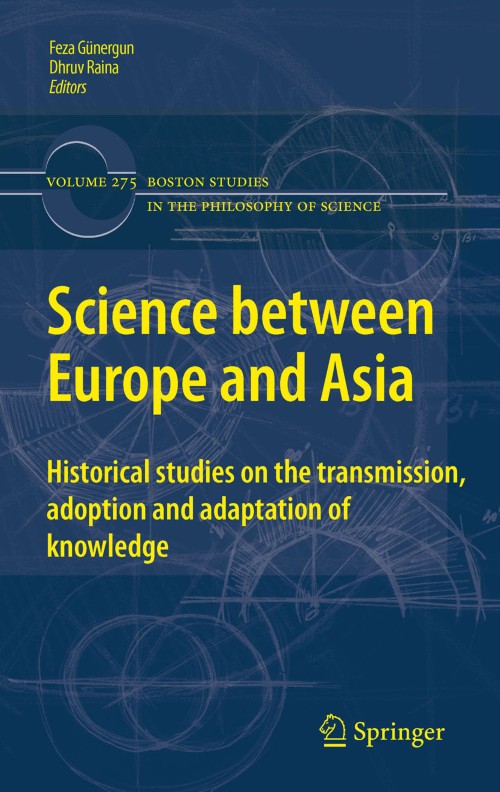
245 10|aScience between Europe and Asia|h[electronic resource] :|bHistorical Studies on the Transmission, Adoption and Adaptation of Knowledge /|cedited by Feza Günergun, Dhruv Raina.
250 |a1st ed. 2011.
264 1|aDordrecht :|bSpringer Netherlands :|bImprint: Springer,|c2011.
300 |aXIII, 279 p.|bonline resource.
336 |atext|btxt|2rdacontent
337 |acomputer|bc|2rdamedia
338 |aonline resource|bcr|2rdacarrier
347 |atext file|bPDF|2rda
490 1 |aBoston Studies in the Philosophy and History of Science,|x2214-7942 ;|v275
505 0 |aOn technologies -- On maps, astronomical instruments, clocks and calendars -- On localizing, appropriating and translating new knowledge -- On medicine and medical practices.
520 |aThis book explores the various historical and cultural aspects of scientific, medical and technical exchanges that occurred between central Europe and Asia. A number of papers investigate the printing, gunpowder, guncasting, shipbuilding, metallurgical and drilling technologies while others deal with mapping techniques, the adoption of written calculation and mechanical clocks as well as the use of medical techniques such as pulse taking and electrotherapy. While human mobility played a significant role in the exchange of knowledge, translating European books into local languages helped the introduction of new knowledge in mathematical, physical and natural sciences from central Europe to its periphery and to the Middle East and Asian cultures. The book argues that the process of transmission of knowledge whether theoretical or practical was not a simple and one-way process from the donor to the receiver as it is often admitted, but a multi-dimensional and complex cultural process of selection and transformation where ancient scientific and local traditions and elements. The book explores the issue from a different geopolitical perspective, namely not focusing on a singular recipient and several points of distribution, namely the metropolitan centres of science, medicine, and technology, but on regions that are both recipients and distributors and provides new perspectives based on newly investigated material for historical studies on the cross scientific exchanges between different parts of the world.
650 0|aScience|xHistory.
650 0|aMedicine|xHistory.
650 0|aHistory.
650 0|aScience|xPhilosophy.
650 0|aComputers|xHistory.
650 14|aHistory of Science.
650 24|aHistory of Medicine.
650 24|aHistory.
650 24|aPhilosophy of Science.
650 24|aHistory of Computing.
700 1 |aGünergun, Feza.|eeditor.|4edt|4http://id.loc.gov/vocabulary/relators/edt
700 1 |aRaina, Dhruv.|eeditor.|4edt|4http://id.loc.gov/vocabulary/relators/edt
710 2 |aSpringerLink (Online service)
773 0 |tSpringer Nature eBook
776 08|iPrinted edition:|z9789048199679
776 08|iPrinted edition:|z9789048199693
776 08|iPrinted edition:|z9789400734647
830 0|aBoston Studies in the Philosophy and History of Science,|x2214-7942 ;|v275
856 40|uhttps://doi.org/10.1007/978-90-481-9968-6
912 |aZDB-2-SHU
912 |aZDB-2-SXH
912 |aZDB-2-SXPE
950 |aHumanities, Social Sciences and Law (SpringerNature-11648)
950 |aHistory (R0) (SpringerNature-43722)
950 |aSpringer Nature Proceedings excluding Computer Science (SpringerNature-85345)