

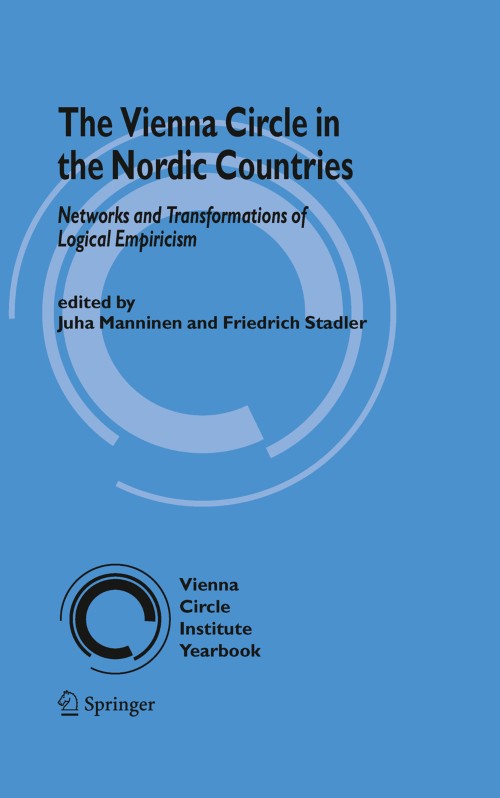
The Vienna Circle in the Nordic Countries. [electronic resource] : Networks and Transformations of Logical Empiricism / edited by Juha Manninen, Friedrich Stadler.
Erişim Adresi
ISBN
9789048136834
Dil Kodu
İngilizce
Yer Numarası
DK/7637
Basım Bildirimi
1st ed. 2010.
Yayın Bilgisi
Dordrecht : Springer Netherlands : Imprint: Springer, 2010.
Fiziksel Niteleme
VI, 322 p. online resource.
Dizi
Vienna Circle Institute Yearbook, Institute Vienna Circle, University of Vienna Vienna Circle Society, Society for the Advancement of Scientific World Conceptions, 2215-1818 ; 14
İçindekiler Notu
The Vienna Circle in the Nordic Countries -- Arne Naess — Dogmas and Problems of Empiricism -- Niels Bohr and the Vienna Circle -- Between the Vienna Circle and Ludwig Wittgenstein — The Philosophical Teachers of G. H. von Wright -- Theoria and Logical Empiricism On the tensions between the National and the International in Philosophy -- Positivism before Logical Positivism in Nordic Philosophy -- The Earliest Extensive Receptions of Mach in the North -- Kaila's Critique of Vitalism -- Kaila and Reichenbach as Protagonists of ‘Naturphilosophie’ -- Jørgen Jørgensen and Logical Positivism -- The Debate on Begriffstheorie Between Cassirer, Marc-Wogau — and Schlick -- The Nature and Status of Scientific Metatheory. The Debate between Otto Neurath and Åke Petzäll -- Young Ketonen and his Supreme Logical Discovery -- Empiricism, Pragmatism, Behaviorism: Arne NÆss and the Growth of American-styled Social Research in Norway after World War II -- General Part -- Jaakko Hintikka in the Library of Living Philosophers: A Dialogue -- On Unity and Disunity in the Sciences: Variations of Ancient Themata -- Enlightenment and Formal Romanticism — Carnap's Account of Philosophy as Explication -- An Improbable Case of Philosophy: Arne Naess between Empiricism, Existentialism and Metaphysics.
Özet, vb.
The rise of scientific (analytic) philosophy since the turn of the twentieth century is linked to the philosophical interaction between, on the one hand, Ernst Mach, the Vienna Circle around Moritz Schlick and Otto Neurath, the Berlin Group (Hans Reichenbach, Carl G. Hempel), and the Prague Group (Rudolf Carnap, Philipp Frank), and, on the other, philosophers and scientists in Denmark (Niels Bohr, Joergen Joergensen), Finland (Eino Kaila, Georg Henrik von Wright and their disciples), Norway (Arne Næss and his students), and Sweden (Åke Petzäll, the journal Theoria and a younger generation of philosophers in Uppsala). In addition, the pure theory of law of Hans Kelsen achieved wide dissemination in the Nordic countries (through, for example, Alf Ross). One of the key events in the relations between the Central European philosophers and those of the Nordic countries was the Second International Congress for the Unity of Science which was arranged in Copenhagen in 1936. Besides considering the interactions of these groups, the book also pays special attention to their interactions, in the context of the Cold War period following the Second World War, with the so-called Third Vienna Circle and with the Forum Alpbach/Austrian College around Viktor Kraft and Bela Juhos (along with Ludwig Wittgenstein and Paul Feyerabend), where the issues of (philosophical and scientific) realism and "psychologism"—the relationship between psychology and philosophy—were matters of controversy. By comparison with the more extensively investigated and better known transatlantic transfer and transformation of "positivism" and logical empiricism, the developments outlined above remain neglected and marginalized topics in historiography. The symposium aims to reveal the remarkable continuity of the philosophical enlightened "Nordic Connection". We intend to shed light on this forgotten communication and to reconstruct these hidden scholarly networks from anhistorical and logical point of view, thereby evaluating their significance for today’s research.
Konu
Logic.
Philosophy.
Philosophy __ History.
Philosophy, Modern.
Science __ Philosophy.
Logic.
Philosophy.
History of Philosophy.
Early Modern Philosophy.
Philosophy of Science.
Philosophy.
Philosophy __ History.
Philosophy, Modern.
Science __ Philosophy.
Logic.
Philosophy.
History of Philosophy.
Early Modern Philosophy.
Philosophy of Science.
Diğer Yazarlar
Kurum Adı
Eseri Alıntıla
Referansları kullanmadan önce gözden geçirmeniz ve varsa gerekli düzeltmeleri yapmanız önerilir.
Dijital Kaynak
MARC Görünümü
LEADER 05720nam a22005775i 4500
001 806332
003 TR_AnAIT
005 20260127001904
007 cr nn 008mamaa
008 100301s2010 ne | s |||| 0|eng d
020 |a9789048136834|9978-90-481-3683-4
024 7 |a10.1007/978-90-481-3683-4|2doi
041 |aeng
049 |aTürk Tarih Kurumu Kütüphanesi
050 4|aBC1-199
072 7|aHPL|2bicssc
072 7|aPHI011000|2bisacsh
072 7|aQDTL|2thema
082 04|a160|223
090 |aDK/7637
245 14|aThe Vienna Circle in the Nordic Countries.|h[electronic resource] :|bNetworks and Transformations of Logical Empiricism /|cedited by Juha Manninen, Friedrich Stadler.
250 |a1st ed. 2010.
264 1|aDordrecht :|bSpringer Netherlands :|bImprint: Springer,|c2010.
300 |aVI, 322 p.|bonline resource.
336 |atext|btxt|2rdacontent
337 |acomputer|bc|2rdamedia
338 |aonline resource|bcr|2rdacarrier
347 |atext file|bPDF|2rda
490 1 |aVienna Circle Institute Yearbook, Institute Vienna Circle, University of Vienna Vienna Circle Society, Society for the Advancement of Scientific World Conceptions,|x2215-1818 ;|v14
505 0 |aThe Vienna Circle in the Nordic Countries -- Arne Naess — Dogmas and Problems of Empiricism -- Niels Bohr and the Vienna Circle -- Between the Vienna Circle and Ludwig Wittgenstein — The Philosophical Teachers of G. H. von Wright -- Theoria and Logical Empiricism On the tensions between the National and the International in Philosophy -- Positivism before Logical Positivism in Nordic Philosophy -- The Earliest Extensive Receptions of Mach in the North -- Kaila's Critique of Vitalism -- Kaila and Reichenbach as Protagonists of ‘Naturphilosophie’ -- Jørgen Jørgensen and Logical Positivism -- The Debate on Begriffstheorie Between Cassirer, Marc-Wogau — and Schlick -- The Nature and Status of Scientific Metatheory. The Debate between Otto Neurath and Åke Petzäll -- Young Ketonen and his Supreme Logical Discovery -- Empiricism, Pragmatism, Behaviorism: Arne NÆss and the Growth of American-styled Social Research in Norway after World War II -- General Part -- Jaakko Hintikka in the Library of Living Philosophers: A Dialogue -- On Unity and Disunity in the Sciences: Variations of Ancient Themata -- Enlightenment and Formal Romanticism — Carnap's Account of Philosophy as Explication -- An Improbable Case of Philosophy: Arne Naess between Empiricism, Existentialism and Metaphysics.
520 |aThe rise of scientific (analytic) philosophy since the turn of the twentieth century is linked to the philosophical interaction between, on the one hand, Ernst Mach, the Vienna Circle around Moritz Schlick and Otto Neurath, the Berlin Group (Hans Reichenbach, Carl G. Hempel), and the Prague Group (Rudolf Carnap, Philipp Frank), and, on the other, philosophers and scientists in Denmark (Niels Bohr, Joergen Joergensen), Finland (Eino Kaila, Georg Henrik von Wright and their disciples), Norway (Arne Næss and his students), and Sweden (Åke Petzäll, the journal Theoria and a younger generation of philosophers in Uppsala). In addition, the pure theory of law of Hans Kelsen achieved wide dissemination in the Nordic countries (through, for example, Alf Ross). One of the key events in the relations between the Central European philosophers and those of the Nordic countries was the Second International Congress for the Unity of Science which was arranged in Copenhagen in 1936. Besides considering the interactions of these groups, the book also pays special attention to their interactions, in the context of the Cold War period following the Second World War, with the so-called Third Vienna Circle and with the Forum Alpbach/Austrian College around Viktor Kraft and Bela Juhos (along with Ludwig Wittgenstein and Paul Feyerabend), where the issues of (philosophical and scientific) realism and "psychologism"—the relationship between psychology and philosophy—were matters of controversy. By comparison with the more extensively investigated and better known transatlantic transfer and transformation of "positivism" and logical empiricism, the developments outlined above remain neglected and marginalized topics in historiography. The symposium aims to reveal the remarkable continuity of the philosophical enlightened "Nordic Connection". We intend to shed light on this forgotten communication and to reconstruct these hidden scholarly networks from anhistorical and logical point of view, thereby evaluating their significance for today’s research.
650 0|aLogic.
650 0|aPhilosophy.
650 0|aPhilosophy|xHistory.
650 0|aPhilosophy, Modern.
650 0|aScience|xPhilosophy.
650 14|aLogic.
650 24|aPhilosophy.
650 24|aHistory of Philosophy.
650 24|aEarly Modern Philosophy.
650 24|aPhilosophy of Science.
700 1 |aManninen, Juha.|eeditor.|4edt|4http://id.loc.gov/vocabulary/relators/edt
700 1 |aStadler, Friedrich.|eeditor.|4edt|4http://id.loc.gov/vocabulary/relators/edt
710 2 |aSpringerLink (Online service)
773 0 |tSpringer Nature eBook
776 08|iPrinted edition:|z9789048136827
776 08|iPrinted edition:|z9789048137008
776 08|iPrinted edition:|z9789400730625
830 0|aVienna Circle Institute Yearbook, Institute Vienna Circle, University of Vienna Vienna Circle Society, Society for the Advancement of Scientific World Conceptions,|x2215-1818 ;|v14
856 40|uhttps://doi.org/10.1007/978-90-481-3683-4
912 |aZDB-2-SHU
912 |aZDB-2-SXPR
950 |aHumanities, Social Sciences and Law (SpringerNature-11648)
950 |aPhilosophy and Religion (R0) (SpringerNature-43725)
001 806332
003 TR_AnAIT
005 20260127001904
007 cr nn 008mamaa
008 100301s2010 ne | s |||| 0|eng d
020 |a9789048136834|9978-90-481-3683-4
024 7 |a10.1007/978-90-481-3683-4|2doi
041 |aeng
049 |aTürk Tarih Kurumu Kütüphanesi
050 4|aBC1-199
072 7|aHPL|2bicssc
072 7|aPHI011000|2bisacsh
072 7|aQDTL|2thema
082 04|a160|223
090 |aDK/7637
245 14|aThe Vienna Circle in the Nordic Countries.|h[electronic resource] :|bNetworks and Transformations of Logical Empiricism /|cedited by Juha Manninen, Friedrich Stadler.
250 |a1st ed. 2010.
264 1|aDordrecht :|bSpringer Netherlands :|bImprint: Springer,|c2010.
300 |aVI, 322 p.|bonline resource.
336 |atext|btxt|2rdacontent
337 |acomputer|bc|2rdamedia
338 |aonline resource|bcr|2rdacarrier
347 |atext file|bPDF|2rda
490 1 |aVienna Circle Institute Yearbook, Institute Vienna Circle, University of Vienna Vienna Circle Society, Society for the Advancement of Scientific World Conceptions,|x2215-1818 ;|v14
505 0 |aThe Vienna Circle in the Nordic Countries -- Arne Naess — Dogmas and Problems of Empiricism -- Niels Bohr and the Vienna Circle -- Between the Vienna Circle and Ludwig Wittgenstein — The Philosophical Teachers of G. H. von Wright -- Theoria and Logical Empiricism On the tensions between the National and the International in Philosophy -- Positivism before Logical Positivism in Nordic Philosophy -- The Earliest Extensive Receptions of Mach in the North -- Kaila's Critique of Vitalism -- Kaila and Reichenbach as Protagonists of ‘Naturphilosophie’ -- Jørgen Jørgensen and Logical Positivism -- The Debate on Begriffstheorie Between Cassirer, Marc-Wogau — and Schlick -- The Nature and Status of Scientific Metatheory. The Debate between Otto Neurath and Åke Petzäll -- Young Ketonen and his Supreme Logical Discovery -- Empiricism, Pragmatism, Behaviorism: Arne NÆss and the Growth of American-styled Social Research in Norway after World War II -- General Part -- Jaakko Hintikka in the Library of Living Philosophers: A Dialogue -- On Unity and Disunity in the Sciences: Variations of Ancient Themata -- Enlightenment and Formal Romanticism — Carnap's Account of Philosophy as Explication -- An Improbable Case of Philosophy: Arne Naess between Empiricism, Existentialism and Metaphysics.
520 |aThe rise of scientific (analytic) philosophy since the turn of the twentieth century is linked to the philosophical interaction between, on the one hand, Ernst Mach, the Vienna Circle around Moritz Schlick and Otto Neurath, the Berlin Group (Hans Reichenbach, Carl G. Hempel), and the Prague Group (Rudolf Carnap, Philipp Frank), and, on the other, philosophers and scientists in Denmark (Niels Bohr, Joergen Joergensen), Finland (Eino Kaila, Georg Henrik von Wright and their disciples), Norway (Arne Næss and his students), and Sweden (Åke Petzäll, the journal Theoria and a younger generation of philosophers in Uppsala). In addition, the pure theory of law of Hans Kelsen achieved wide dissemination in the Nordic countries (through, for example, Alf Ross). One of the key events in the relations between the Central European philosophers and those of the Nordic countries was the Second International Congress for the Unity of Science which was arranged in Copenhagen in 1936. Besides considering the interactions of these groups, the book also pays special attention to their interactions, in the context of the Cold War period following the Second World War, with the so-called Third Vienna Circle and with the Forum Alpbach/Austrian College around Viktor Kraft and Bela Juhos (along with Ludwig Wittgenstein and Paul Feyerabend), where the issues of (philosophical and scientific) realism and "psychologism"—the relationship between psychology and philosophy—were matters of controversy. By comparison with the more extensively investigated and better known transatlantic transfer and transformation of "positivism" and logical empiricism, the developments outlined above remain neglected and marginalized topics in historiography. The symposium aims to reveal the remarkable continuity of the philosophical enlightened "Nordic Connection". We intend to shed light on this forgotten communication and to reconstruct these hidden scholarly networks from anhistorical and logical point of view, thereby evaluating their significance for today’s research.
650 0|aLogic.
650 0|aPhilosophy.
650 0|aPhilosophy|xHistory.
650 0|aPhilosophy, Modern.
650 0|aScience|xPhilosophy.
650 14|aLogic.
650 24|aPhilosophy.
650 24|aHistory of Philosophy.
650 24|aEarly Modern Philosophy.
650 24|aPhilosophy of Science.
700 1 |aManninen, Juha.|eeditor.|4edt|4http://id.loc.gov/vocabulary/relators/edt
700 1 |aStadler, Friedrich.|eeditor.|4edt|4http://id.loc.gov/vocabulary/relators/edt
710 2 |aSpringerLink (Online service)
773 0 |tSpringer Nature eBook
776 08|iPrinted edition:|z9789048136827
776 08|iPrinted edition:|z9789048137008
776 08|iPrinted edition:|z9789400730625
830 0|aVienna Circle Institute Yearbook, Institute Vienna Circle, University of Vienna Vienna Circle Society, Society for the Advancement of Scientific World Conceptions,|x2215-1818 ;|v14
856 40|uhttps://doi.org/10.1007/978-90-481-3683-4
912 |aZDB-2-SHU
912 |aZDB-2-SXPR
950 |aHumanities, Social Sciences and Law (SpringerNature-11648)
950 |aPhilosophy and Religion (R0) (SpringerNature-43725)
Materyaller
Depodan talep edilen materyal sadece kütüphane içerisinde kullanılmaktadır.
Materyal dışarıya ödünç verilmemektedir.
Materyal dışarıya ödünç verilmemektedir.
