LEADER 03547nam a22004815i 4500
001 806346
003 TR_AnAIT
005 20260127001922
007 cr nn 008mamaa
008 111123s2012 xxu| s |||| 0|eng d
020 |a9781441966674|9978-1-4419-6667-4
024 7 |a10.1007/978-1-4419-6667-4|2doi
041 |aeng
049 |aTürk Tarih Kurumu Kütüphanesi
050 4|aJA1-92
072 7|aJPA|2bicssc
072 7|aPOL000000|2bisacsh
072 7|aJPA|2thema
082 04|a320|223
090 |aDK/7651
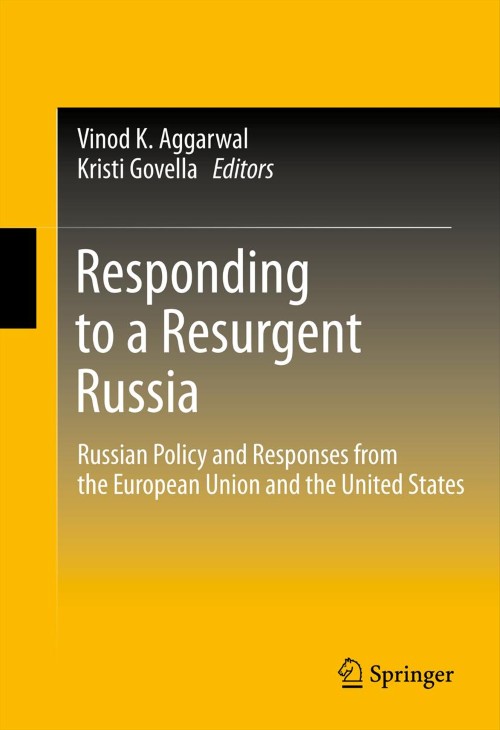
245 10|aResponding to a Resurgent Russia|h[electronic resource] :|bRussian Policy and Responses from the European Union and the United States /|cedited by Vinod K. Aggarwal, Kristi Govella.
250 |a1st ed. 2012.
264 1|aNew York, NY :|bSpringer New York :|bImprint: Springer,|c2012.
300 |aXII, 144 p.|bonline resource.
336 |atext|btxt|2rdacontent
337 |acomputer|bc|2rdamedia
338 |aonline resource|bcr|2rdacarrier
347 |atext file|bPDF|2rda
505 0 |aIntroduction -- How Russia Sees the World -- US-Russia Relations in the Post-Western World -- Russia and the West: Partners, Allies, or Adversaries?- Russia in the Global Economy -- Nuclear Power Regulation in Russia and France: Innovation and Public Interest as Determinants of Sustainable Development -- Meeting the Russian Challenge in the Obama Era -- Reformatting the EU-Russia Pseudo-Partnership: What a Difference a Crisis Makes -- Conclusion.
520 |aIn this volume, a set of issue and country experts tackle the questions surrounding the challenges of a resurgent Russia for the world order as well as for relations between the European Union and the United States. Following a brief introduction laying out the circumstances of Russia’s rise, the book proceeds in three sections. In the first, Russian scholars tackle the topic of how a newly resurgent Russia sees the world. The second section examines Russia’s role in the contemporary global political economy in terms of trade and financial flows and nuclear energy. The third section looks at American and European responses to Russia, and the conclusion draws together the findings from each of the chapters and presents some broad propositions regarding Russia’s rise and the challenges that it presents for the US, EU and the international order in the years to come. The implications of this collection are very broad and far-reaching, with ramifications for each of the players involved as well as for the development and refinement of general international relations theories concerning global conflict and cooperation, making the book relevant for both policy-makers and scholars of international relations, Russian studies, and international political economy.
650 0|aPolitical science.
650 0|aEurope|xEconomic integration.
650 14|aPolitical Science.
650 24|aEuropean Economic Integration.
700 1 |aAggarwal, Vinod K.|eeditor.|4edt|4http://id.loc.gov/vocabulary/relators/edt
700 1 |aGovella, Kristi.|eeditor.|4edt|4http://id.loc.gov/vocabulary/relators/edt
710 2 |aSpringerLink (Online service)
773 0 |tSpringer Nature eBook
776 08|iPrinted edition:|z9781441966667
776 08|iPrinted edition:|z9781441966681
776 08|iPrinted edition:|z9781489988706
856 40|uhttps://doi.org/10.1007/978-1-4419-6667-4
912 |aZDB-2-SHU
912 |aZDB-2-SXPI
950 |aHumanities, Social Sciences and Law (SpringerNature-11648)
950 |aPolitical Science and International Studies (R0) (SpringerNature-43724)