

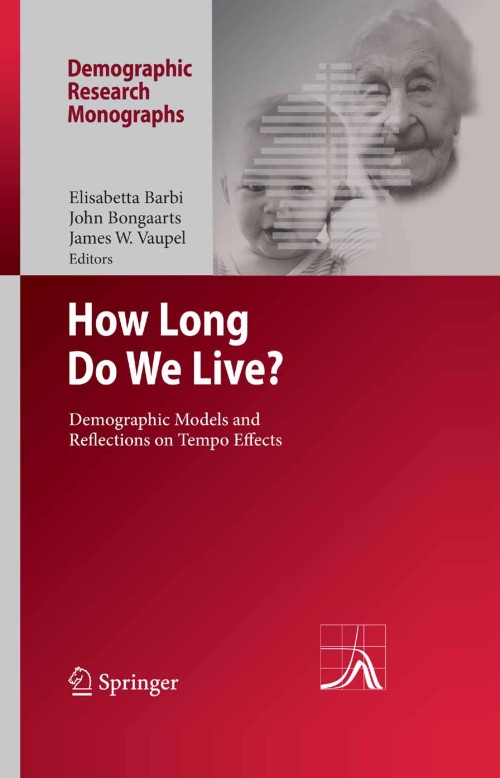
How Long Do We Live? [electronic resource] : Demographic Models and Reflections on Tempo Effects / edited by Elisabetta Barbi, John Bongaarts, James W. Vaupel.
Erişim Adresi
ISBN
9783540785200
Dil Kodu
İngilizce
Yer Numarası
DK/7656
Basım Bildirimi
1st ed. 2008.
Yayın Bilgisi
Berlin, Heidelberg : Springer Berlin Heidelberg : Imprint: Springer, 2008.
Fiziksel Niteleme
XIV, 284 p. 58 illus. online resource.
Dizi
Demographic Research Monographs, A Series of the Max Planck Institute for Demographic Research, 2197-9286
İçindekiler Notu
How long do we live? Demographic models and reflections on tempo effects: An introduction -- How long do we live? Demographic models and reflections on tempo effects: An introduction -- Theoretical basis for the mortality tempo effect -- Estimating mean lifetime -- The quantum and tempo of life-cycle events -- Critiques, extensions and applications of the mortality tempo effect -- Demographic translation and tempo effects: An accelerated failure time perspective -- Lifesaving, lifetimes and lifetables -- Tempo and its tribulations -- Tempo effects in mortality: An appraisal -- Increments to life and mortality tempo -- Mortality tempo versus removal of causes of mortality: Opposite views leading to different estimations of life expectancy -- Tempo effect on age-specific death rates -- Mortality tempo-adjustment: Theoretical considerations and an empirical application -- Comparison of period and cohort measures of longevity -- Five period measures of longevity -- Found in translation? A cohort perspective on tempo-adjusted life expectancy -- Conclusions -- Afterthoughts on the mortality tempo effect -- Turbulence in lifetables: Demonstration by four simple examples.
Özet, vb.
The most widely used measure of longevity is the period life expectancy at birth which is calculated from age specific death rates by life table methods. In 2002, John Bongaarts and Griffith Feeney introduced the revolutionary idea that this conventional estimate of period life expectancy is distorted by a tempo effect whenever longevity is changing. The tempo effect is defined as an inflation or deflation of the period incidence of a demographic event resulting from a rise or fall in the mean age at which the event occurs. Some demographers agree with this radical argument; others disagree. The book reviews the debate on how best to measure period longevity. In the various chapters, leading experts in demography critically examine the existence of the tempo effect in mortality, present extensions and applications, and compare period and cohort longevity measures. The book provides a deeper understanding of and new insights into the fundamental question "How long do we live"?
Konu
Demography.
Population.
Population __ Economic aspects.
Aging.
Social sciences __ Statistical methods.
Population and Demography.
Population Economics.
Ageing.
Statistics in Social Sciences, Humanities, Law, Education, Behavorial Sciences, Public Policy.
Population.
Population __ Economic aspects.
Aging.
Social sciences __ Statistical methods.
Population and Demography.
Population Economics.
Ageing.
Statistics in Social Sciences, Humanities, Law, Education, Behavorial Sciences, Public Policy.
Diğer Yazarlar
Kurum Adı
Eseri Alıntıla
Referansları kullanmadan önce gözden geçirmeniz ve varsa gerekli düzeltmeleri yapmanız önerilir.
Dijital Kaynak
MARC Görünümü
LEADER 04538nam a22005775i 4500
001 806351
003 TR_AnAIT
005 20260127001930
007 cr nn 008mamaa
008 100301s2008 gw | s |||| 0|eng d
020 |a9783540785200|9978-3-540-78520-0
024 7 |a10.1007/978-3-540-78520-0|2doi
041 |aeng
049 |aTürk Tarih Kurumu Kütüphanesi
050 4|aHB848-3697
072 7|aJHBD|2bicssc
072 7|aSOC006000|2bisacsh
072 7|aJHBD|2thema
082 04|a304.6|223
090 |aDK/7656
245 10|aHow Long Do We Live?|h[electronic resource] :|bDemographic Models and Reflections on Tempo Effects /|cedited by Elisabetta Barbi, John Bongaarts, James W. Vaupel.
250 |a1st ed. 2008.
264 1|aBerlin, Heidelberg :|bSpringer Berlin Heidelberg :|bImprint: Springer,|c2008.
300 |aXIV, 284 p. 58 illus.|bonline resource.
336 |atext|btxt|2rdacontent
337 |acomputer|bc|2rdamedia
338 |aonline resource|bcr|2rdacarrier
347 |atext file|bPDF|2rda
490 1 |aDemographic Research Monographs, A Series of the Max Planck Institute for Demographic Research,|x2197-9286
505 0 |aHow long do we live? Demographic models and reflections on tempo effects: An introduction -- How long do we live? Demographic models and reflections on tempo effects: An introduction -- Theoretical basis for the mortality tempo effect -- Estimating mean lifetime -- The quantum and tempo of life-cycle events -- Critiques, extensions and applications of the mortality tempo effect -- Demographic translation and tempo effects: An accelerated failure time perspective -- Lifesaving, lifetimes and lifetables -- Tempo and its tribulations -- Tempo effects in mortality: An appraisal -- Increments to life and mortality tempo -- Mortality tempo versus removal of causes of mortality: Opposite views leading to different estimations of life expectancy -- Tempo effect on age-specific death rates -- Mortality tempo-adjustment: Theoretical considerations and an empirical application -- Comparison of period and cohort measures of longevity -- Five period measures of longevity -- Found in translation? A cohort perspective on tempo-adjusted life expectancy -- Conclusions -- Afterthoughts on the mortality tempo effect -- Turbulence in lifetables: Demonstration by four simple examples.
520 |aThe most widely used measure of longevity is the period life expectancy at birth which is calculated from age specific death rates by life table methods. In 2002, John Bongaarts and Griffith Feeney introduced the revolutionary idea that this conventional estimate of period life expectancy is distorted by a tempo effect whenever longevity is changing. The tempo effect is defined as an inflation or deflation of the period incidence of a demographic event resulting from a rise or fall in the mean age at which the event occurs. Some demographers agree with this radical argument; others disagree. The book reviews the debate on how best to measure period longevity. In the various chapters, leading experts in demography critically examine the existence of the tempo effect in mortality, present extensions and applications, and compare period and cohort longevity measures. The book provides a deeper understanding of and new insights into the fundamental question "How long do we live"?
650 0|aDemography.
650 0|aPopulation.
650 0|aPopulation|xEconomic aspects.
650 0|aAging.
650 0|aSocial sciences|xStatistical methods.
650 14|aPopulation and Demography.
650 24|aPopulation Economics.
650 24|aAgeing.
650 24|aStatistics in Social Sciences, Humanities, Law, Education, Behavorial Sciences, Public Policy.
700 1 |aBarbi, Elisabetta.|eeditor.|4edt|4http://id.loc.gov/vocabulary/relators/edt
700 1 |aBongaarts, John.|eeditor.|4edt|4http://id.loc.gov/vocabulary/relators/edt
700 1 |aVaupel, James W.|eeditor.|4edt|4http://id.loc.gov/vocabulary/relators/edt
710 2 |aSpringerLink (Online service)
773 0 |tSpringer Nature eBook
776 08|iPrinted edition:|z9783540785194
776 08|iPrinted edition:|z9783540847748
776 08|iPrinted edition:|z9783642097270
830 0|aDemographic Research Monographs, A Series of the Max Planck Institute for Demographic Research,|x2197-9286
856 40|uhttps://doi.org/10.1007/978-3-540-78520-0
912 |aZDB-2-SHU
912 |aZDB-2-SXS
950 |aHumanities, Social Sciences and Law (SpringerNature-11648)
950 |aSocial Sciences (R0) (SpringerNature-43726)
001 806351
003 TR_AnAIT
005 20260127001930
007 cr nn 008mamaa
008 100301s2008 gw | s |||| 0|eng d
020 |a9783540785200|9978-3-540-78520-0
024 7 |a10.1007/978-3-540-78520-0|2doi
041 |aeng
049 |aTürk Tarih Kurumu Kütüphanesi
050 4|aHB848-3697
072 7|aJHBD|2bicssc
072 7|aSOC006000|2bisacsh
072 7|aJHBD|2thema
082 04|a304.6|223
090 |aDK/7656
245 10|aHow Long Do We Live?|h[electronic resource] :|bDemographic Models and Reflections on Tempo Effects /|cedited by Elisabetta Barbi, John Bongaarts, James W. Vaupel.
250 |a1st ed. 2008.
264 1|aBerlin, Heidelberg :|bSpringer Berlin Heidelberg :|bImprint: Springer,|c2008.
300 |aXIV, 284 p. 58 illus.|bonline resource.
336 |atext|btxt|2rdacontent
337 |acomputer|bc|2rdamedia
338 |aonline resource|bcr|2rdacarrier
347 |atext file|bPDF|2rda
490 1 |aDemographic Research Monographs, A Series of the Max Planck Institute for Demographic Research,|x2197-9286
505 0 |aHow long do we live? Demographic models and reflections on tempo effects: An introduction -- How long do we live? Demographic models and reflections on tempo effects: An introduction -- Theoretical basis for the mortality tempo effect -- Estimating mean lifetime -- The quantum and tempo of life-cycle events -- Critiques, extensions and applications of the mortality tempo effect -- Demographic translation and tempo effects: An accelerated failure time perspective -- Lifesaving, lifetimes and lifetables -- Tempo and its tribulations -- Tempo effects in mortality: An appraisal -- Increments to life and mortality tempo -- Mortality tempo versus removal of causes of mortality: Opposite views leading to different estimations of life expectancy -- Tempo effect on age-specific death rates -- Mortality tempo-adjustment: Theoretical considerations and an empirical application -- Comparison of period and cohort measures of longevity -- Five period measures of longevity -- Found in translation? A cohort perspective on tempo-adjusted life expectancy -- Conclusions -- Afterthoughts on the mortality tempo effect -- Turbulence in lifetables: Demonstration by four simple examples.
520 |aThe most widely used measure of longevity is the period life expectancy at birth which is calculated from age specific death rates by life table methods. In 2002, John Bongaarts and Griffith Feeney introduced the revolutionary idea that this conventional estimate of period life expectancy is distorted by a tempo effect whenever longevity is changing. The tempo effect is defined as an inflation or deflation of the period incidence of a demographic event resulting from a rise or fall in the mean age at which the event occurs. Some demographers agree with this radical argument; others disagree. The book reviews the debate on how best to measure period longevity. In the various chapters, leading experts in demography critically examine the existence of the tempo effect in mortality, present extensions and applications, and compare period and cohort longevity measures. The book provides a deeper understanding of and new insights into the fundamental question "How long do we live"?
650 0|aDemography.
650 0|aPopulation.
650 0|aPopulation|xEconomic aspects.
650 0|aAging.
650 0|aSocial sciences|xStatistical methods.
650 14|aPopulation and Demography.
650 24|aPopulation Economics.
650 24|aAgeing.
650 24|aStatistics in Social Sciences, Humanities, Law, Education, Behavorial Sciences, Public Policy.
700 1 |aBarbi, Elisabetta.|eeditor.|4edt|4http://id.loc.gov/vocabulary/relators/edt
700 1 |aBongaarts, John.|eeditor.|4edt|4http://id.loc.gov/vocabulary/relators/edt
700 1 |aVaupel, James W.|eeditor.|4edt|4http://id.loc.gov/vocabulary/relators/edt
710 2 |aSpringerLink (Online service)
773 0 |tSpringer Nature eBook
776 08|iPrinted edition:|z9783540785194
776 08|iPrinted edition:|z9783540847748
776 08|iPrinted edition:|z9783642097270
830 0|aDemographic Research Monographs, A Series of the Max Planck Institute for Demographic Research,|x2197-9286
856 40|uhttps://doi.org/10.1007/978-3-540-78520-0
912 |aZDB-2-SHU
912 |aZDB-2-SXS
950 |aHumanities, Social Sciences and Law (SpringerNature-11648)
950 |aSocial Sciences (R0) (SpringerNature-43726)
Materyaller
Depodan talep edilen materyal sadece kütüphane içerisinde kullanılmaktadır.
Materyal dışarıya ödünç verilmemektedir.
Materyal dışarıya ödünç verilmemektedir.
