LEADER 04370nam a22005535i 4500
001 806361
003 TR_AnAIT
005 20260127001942
007 cr nn 008mamaa
008 121227s1978 ne | s |||| 0|eng d
020 |a9789400996632|9978-94-009-9663-2
024 7 |a10.1007/978-94-009-9663-2|2doi
041 |aeng
049 |aTürk Tarih Kurumu Kütüphanesi
050 4|aD1-2027
072 7|aHB|2bicssc
072 7|aHBAH|2bicssc
072 7|aHIS000000|2bisacsh
072 7|aNH|2thema
072 7|aNHAH|2thema
082 04|a900|223
090 |aDK/7666
100 1 |aWhite, Howard B.|eauthor.|4aut|4http://id.loc.gov/vocabulary/relators/aut
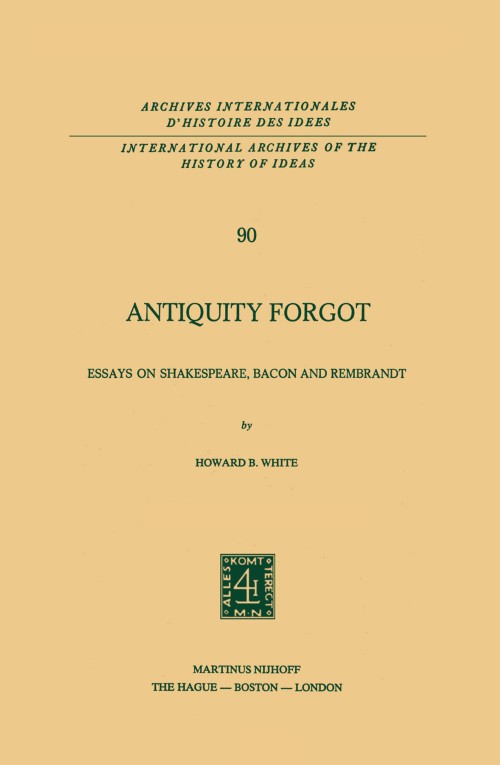
245 10|aAntiquity Forgot|h[electronic resource] :|bEssays on Shakespeare, Bacon and Rembrandt /|cby Howard B. White.
250 |a1st ed. 1978.
264 1|aDordrecht :|bSpringer Netherlands :|bImprint: Springer,|c1978.
300 |aVII, 160 p.|bonline resource.
336 |atext|btxt|2rdacontent
337 |acomputer|bc|2rdamedia
338 |aonline resource|bcr|2rdacarrier
347 |atext file|bPDF|2rda
490 1 |aInternational Archives of the History of Ideas Archives internationales d'histoire des idées,|x2215-0307 ;|v90
505 0 |aI. Introduction -- II. Politics in Shakespeare -- III. Macbeth and the Tyrannical Man -- IV. Bastards and Usurpers -- V. “Ciphers to this Great Accompt” -- VI. “The English Solomon” -- VII. Bacon’s “Wisdom of the Ancients” -- VIII. Rembrandt and the Human Condition.
520 |aIt was probably Rousseau who first thought of dreams as ennobling experiences. Anyone who has ever read Reveries du Promeneur Solitaire must be struck by the dreamlike quality of Rousseau's meditations. This dreamlike quality is still with us, and those who experience it find themselves ennobled by it. Witness Martin Luther King's famous "1 have a dream. " Dreaming and inspiration raise the artist to the top rung in the ladder ofhuman relations. That is probably the prevailing view among educated people of our time. Rousseau made that view respectable and predominant. Yet in another sense, the problem is much older. It is the problem of political philosophy and poetry, the problem of Socrates and Aristophanes, of Plato and Homer. Yet, while antiquity usually gives the crown to philosophy, since Rous seau, the alternative view tends to prevail. The distinction is not, however, a formal one. Sir Philip Sidney enlisted Plato on the side of poetry. The true distinction is between imagination and reason. If reason is to rule, as Aristotle points out,l the most architectonic of the sciences, that is political science, should rule. It is political philosophy which must determine the nature of the arts which will help or which will hinder the good of the city or the polity. That does not mean that a mere professor should stand in judgment of Shake speare, Bacon, and Rembrandt. It means that ifhe studies these three great artists, he is not over-stepping disciplinary limits.
532 8 |aAccessibility summary: This PDF is not accessible. It is based on scanned pages and does not support features such as screen reader compatibility or described non-text content (images, graphs etc). However, it likely supports searchable and selectable text based on OCR (Optical Character Recognition). Users with accessibility needs may not be able to use this content effectively. Please contact us at accessibilitysupport@springernature.com if you require assistance or an alternative format.
532 8 |aInaccessible, or known limited accessibility
532 8 |aNo reading system accessibility options actively disabled
532 8 |aPublisher contact for further accessibility information: accessibilitysupport@springernature.com
650 0|aHistory.
650 14|aHistory.
710 2 |aSpringerLink (Online service)
773 0 |tSpringer Nature eBook
776 08|iPrinted edition:|z9789024719716
776 08|iPrinted edition:|z9789400996649
776 08|iPrinted edition:|z9789400996656
830 0|aInternational Archives of the History of Ideas Archives internationales d'histoire des idées,|x2215-0307 ;|v90
856 40|uhttps://doi.org/10.1007/978-94-009-9663-2
912 |aZDB-2-SHU
912 |aZDB-2-SXH
912 |aZDB-2-BAE
950 |aHumanities, Social Sciences and Law (SpringerNature-11648)
950 |aHistory (R0) (SpringerNature-43722)