

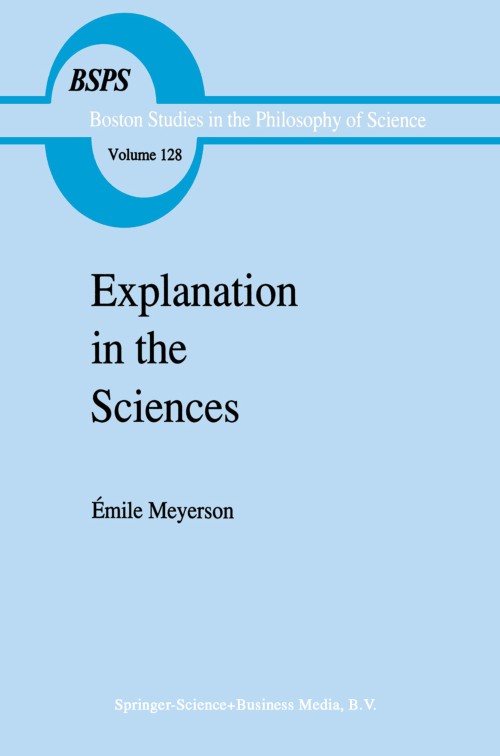
Explanation in the Sciences [electronic resource] / by Émile Meyerson.
Erişim Adresi
ISBN
9789401134149
Dil Kodu
İngilizce
Yer Numarası
DK/7672
Yazar
Basım Bildirimi
1st ed. 1991.
Yayın Bilgisi
Dordrecht : Springer Netherlands : Imprint: Springer, 1991.
Fiziksel Niteleme
XXXVII, 623 p. online resource.
Dizi
Boston Studies in the Philosophy and History of Science, 2214-7942 ; 128
İçindekiler Notu
Book One The Two Fundamental Observations -- 1. Science Demands the Concept of Thing -- 2. Science Seeks Explanation -- Book Two The Explanatory Process -- 3. Deduction -- 4. Rationality Postulated -- 5. Identity and Identification -- 6. The Irrational -- 7. Biological Phenomena -- 8. Forms of Spatial Explanation -- 9. The Possibilities of Scientific Explanation -- 10. The State of Potentiality -- Book Three Global Explanation -- 11. Hegel’s Attempt -- 12. Schelling’s Objections -- 13. Hegel and Comte -- 14. Hegel, Descartes and Kant -- Book Four Scientific and Philosophic Reason -- 15. Science and Philosophic Systems -- 16. The Rationality of the Real Reconsidered -- 17. The Epistemological Paradox -- 18. The Oneness of Human Reason -- Appendices -- 1 The Precursors of Hume -- 2 The Resistance to Lavoisier’s Theory -- 3 The Formula of the Universe in Laplace and in Taine -- 4 Arrhenius’s Theory and Other Such Efforts -- 5 Hegel’s Political Attitude -- 6 The Prestige and the Decline of Hegelian Philosophy -- 7 Abstract and Concrete Reason in Hegel -- 8 Hegel’s Panlogism -- 10 The Philosophy of Nature and Scientific Progress -- 11 Hegel, Schelling and Chemical Theory -- 12 Hegel and National Science -- 13 Hegel’s Artistic Sense and Sense of Rhythm -- 14 The Hegelian Dialectic and Experience -- 15 Schelling, Hegel and Victor Cousin -- 16 The Identity of Thought and Reality in Schelling -- 17 Schelling’s Announced Works -- 18 Caroline Schelling -- 19 Personal Relations Between Schelling and 20 Hegel -- 20 Tycho Brahe, Astrology and the Motion of the Earth -- 21 Non-Euclidean Space and Physical Verification -- Index of Names.
Özet, vb.
Emile Meyerson's writings on the philosophy of science are a rich source of ideas and information concerning many philosophical and historical aspects of the development of modem science. Meyerson's works are not widely read or cited today by philosophers or even philosophers of science, in part because they have long been out of print and are often not available even in research libraries. There are additional chevaux de !rise for all but the hardiest scholars: Meyerson's books are written in French (and do not all exist in English versions) and deal with the subject matter of science - ideas or concepts, laws or principles, theories - and epis temological questions rather than today's more fashionable topics of the social matrix and external influences on science with the concomitant neglect of the intellectual content of science. Born in Lublin, Poland, in 1859, Meyerson received most of his education in Germany, where he studied from the age of 12 to 23, preparing himself for a career in chemistry. ! He moved to Paris in 1882, where he began a career as an industrial chemist. Changing his profession, he then worked for a time as the foreign news editor of the HAVAS News Agency in Paris. In 1898 he joined the agency established by Edmond Rothschild that had as its purpose the settling of Jews in Palestine and became the Director of the Jewish Colonization Association for Europe and Asia Minor. These activities represent Meyerson's formal career.
Konu
Science __ Philosophy.
History.
Knowledge, Theory of.
Metaphysics.
Philosophy of Science.
History.
Epistemology.
Metaphysics.
History.
Knowledge, Theory of.
Metaphysics.
Philosophy of Science.
History.
Epistemology.
Metaphysics.
Kurum Adı
Eseri Alıntıla
Referansları kullanmadan önce gözden geçirmeniz ve varsa gerekli düzeltmeleri yapmanız önerilir.
Dijital Kaynak
MARC Görünümü
LEADER 05817nam a22006135i 4500
001 806367
003 TR_AnAIT
005 20260127001949
007 cr nn 008mamaa
008 121227s1991 ne | s |||| 0|eng d
020 |a9789401134149|9978-94-011-3414-9
024 7 |a10.1007/978-94-011-3414-9|2doi
041 |aeng
049 |aTürk Tarih Kurumu Kütüphanesi
050 4|aQ174-175.3
050 4|aB67
072 7|aPDA|2bicssc
072 7|aSCI075000|2bisacsh
072 7|aPDA|2thema
082 04|a501|223
090 |aDK/7672
100 1 |aMeyerson, Émile.|eauthor.|4aut|4http://id.loc.gov/vocabulary/relators/aut
245 10|aExplanation in the Sciences|h[electronic resource] /|cby Émile Meyerson.
250 |a1st ed. 1991.
264 1|aDordrecht :|bSpringer Netherlands :|bImprint: Springer,|c1991.
300 |aXXXVII, 623 p.|bonline resource.
336 |atext|btxt|2rdacontent
337 |acomputer|bc|2rdamedia
338 |aonline resource|bcr|2rdacarrier
347 |atext file|bPDF|2rda
490 1 |aBoston Studies in the Philosophy and History of Science,|x2214-7942 ;|v128
505 0 |aBook One The Two Fundamental Observations -- 1. Science Demands the Concept of Thing -- 2. Science Seeks Explanation -- Book Two The Explanatory Process -- 3. Deduction -- 4. Rationality Postulated -- 5. Identity and Identification -- 6. The Irrational -- 7. Biological Phenomena -- 8. Forms of Spatial Explanation -- 9. The Possibilities of Scientific Explanation -- 10. The State of Potentiality -- Book Three Global Explanation -- 11. Hegel’s Attempt -- 12. Schelling’s Objections -- 13. Hegel and Comte -- 14. Hegel, Descartes and Kant -- Book Four Scientific and Philosophic Reason -- 15. Science and Philosophic Systems -- 16. The Rationality of the Real Reconsidered -- 17. The Epistemological Paradox -- 18. The Oneness of Human Reason -- Appendices -- 1 The Precursors of Hume -- 2 The Resistance to Lavoisier’s Theory -- 3 The Formula of the Universe in Laplace and in Taine -- 4 Arrhenius’s Theory and Other Such Efforts -- 5 Hegel’s Political Attitude -- 6 The Prestige and the Decline of Hegelian Philosophy -- 7 Abstract and Concrete Reason in Hegel -- 8 Hegel’s Panlogism -- 10 The Philosophy of Nature and Scientific Progress -- 11 Hegel, Schelling and Chemical Theory -- 12 Hegel and National Science -- 13 Hegel’s Artistic Sense and Sense of Rhythm -- 14 The Hegelian Dialectic and Experience -- 15 Schelling, Hegel and Victor Cousin -- 16 The Identity of Thought and Reality in Schelling -- 17 Schelling’s Announced Works -- 18 Caroline Schelling -- 19 Personal Relations Between Schelling and 20 Hegel -- 20 Tycho Brahe, Astrology and the Motion of the Earth -- 21 Non-Euclidean Space and Physical Verification -- Index of Names.
520 |aEmile Meyerson's writings on the philosophy of science are a rich source of ideas and information concerning many philosophical and historical aspects of the development of modem science. Meyerson's works are not widely read or cited today by philosophers or even philosophers of science, in part because they have long been out of print and are often not available even in research libraries. There are additional chevaux de !rise for all but the hardiest scholars: Meyerson's books are written in French (and do not all exist in English versions) and deal with the subject matter of science - ideas or concepts, laws or principles, theories - and epis temological questions rather than today's more fashionable topics of the social matrix and external influences on science with the concomitant neglect of the intellectual content of science. Born in Lublin, Poland, in 1859, Meyerson received most of his education in Germany, where he studied from the age of 12 to 23, preparing himself for a career in chemistry. ! He moved to Paris in 1882, where he began a career as an industrial chemist. Changing his profession, he then worked for a time as the foreign news editor of the HAVAS News Agency in Paris. In 1898 he joined the agency established by Edmond Rothschild that had as its purpose the settling of Jews in Palestine and became the Director of the Jewish Colonization Association for Europe and Asia Minor. These activities represent Meyerson's formal career.
532 8 |aAccessibility summary: This PDF is not accessible. It is based on scanned pages and does not support features such as screen reader compatibility or described non-text content (images, graphs etc). However, it likely supports searchable and selectable text based on OCR (Optical Character Recognition). Users with accessibility needs may not be able to use this content effectively. Please contact us at accessibilitysupport@springernature.com if you require assistance or an alternative format.
532 8 |aInaccessible, or known limited accessibility
532 8 |aNo reading system accessibility options actively disabled
532 8 |aPublisher contact for further accessibility information: accessibilitysupport@springernature.com
650 0|aScience|xPhilosophy.
650 0|aHistory.
650 0|aKnowledge, Theory of.
650 0|aMetaphysics.
650 14|aPhilosophy of Science.
650 24|aHistory.
650 24|aEpistemology.
650 24|aMetaphysics.
710 2 |aSpringerLink (Online service)
773 0 |tSpringer Nature eBook
776 08|iPrinted edition:|z9780792311294
776 08|iPrinted edition:|z9789401134156
776 08|iPrinted edition:|z9789401055116
830 0|aBoston Studies in the Philosophy and History of Science,|x2214-7942 ;|v128
856 40|uhttps://doi.org/10.1007/978-94-011-3414-9
912 |aZDB-2-SHU
912 |aZDB-2-SXPR
912 |aZDB-2-BAE
950 |aHumanities, Social Sciences and Law (SpringerNature-11648)
950 |aPhilosophy and Religion (R0) (SpringerNature-43725)
001 806367
003 TR_AnAIT
005 20260127001949
007 cr nn 008mamaa
008 121227s1991 ne | s |||| 0|eng d
020 |a9789401134149|9978-94-011-3414-9
024 7 |a10.1007/978-94-011-3414-9|2doi
041 |aeng
049 |aTürk Tarih Kurumu Kütüphanesi
050 4|aQ174-175.3
050 4|aB67
072 7|aPDA|2bicssc
072 7|aSCI075000|2bisacsh
072 7|aPDA|2thema
082 04|a501|223
090 |aDK/7672
100 1 |aMeyerson, Émile.|eauthor.|4aut|4http://id.loc.gov/vocabulary/relators/aut
245 10|aExplanation in the Sciences|h[electronic resource] /|cby Émile Meyerson.
250 |a1st ed. 1991.
264 1|aDordrecht :|bSpringer Netherlands :|bImprint: Springer,|c1991.
300 |aXXXVII, 623 p.|bonline resource.
336 |atext|btxt|2rdacontent
337 |acomputer|bc|2rdamedia
338 |aonline resource|bcr|2rdacarrier
347 |atext file|bPDF|2rda
490 1 |aBoston Studies in the Philosophy and History of Science,|x2214-7942 ;|v128
505 0 |aBook One The Two Fundamental Observations -- 1. Science Demands the Concept of Thing -- 2. Science Seeks Explanation -- Book Two The Explanatory Process -- 3. Deduction -- 4. Rationality Postulated -- 5. Identity and Identification -- 6. The Irrational -- 7. Biological Phenomena -- 8. Forms of Spatial Explanation -- 9. The Possibilities of Scientific Explanation -- 10. The State of Potentiality -- Book Three Global Explanation -- 11. Hegel’s Attempt -- 12. Schelling’s Objections -- 13. Hegel and Comte -- 14. Hegel, Descartes and Kant -- Book Four Scientific and Philosophic Reason -- 15. Science and Philosophic Systems -- 16. The Rationality of the Real Reconsidered -- 17. The Epistemological Paradox -- 18. The Oneness of Human Reason -- Appendices -- 1 The Precursors of Hume -- 2 The Resistance to Lavoisier’s Theory -- 3 The Formula of the Universe in Laplace and in Taine -- 4 Arrhenius’s Theory and Other Such Efforts -- 5 Hegel’s Political Attitude -- 6 The Prestige and the Decline of Hegelian Philosophy -- 7 Abstract and Concrete Reason in Hegel -- 8 Hegel’s Panlogism -- 10 The Philosophy of Nature and Scientific Progress -- 11 Hegel, Schelling and Chemical Theory -- 12 Hegel and National Science -- 13 Hegel’s Artistic Sense and Sense of Rhythm -- 14 The Hegelian Dialectic and Experience -- 15 Schelling, Hegel and Victor Cousin -- 16 The Identity of Thought and Reality in Schelling -- 17 Schelling’s Announced Works -- 18 Caroline Schelling -- 19 Personal Relations Between Schelling and 20 Hegel -- 20 Tycho Brahe, Astrology and the Motion of the Earth -- 21 Non-Euclidean Space and Physical Verification -- Index of Names.
520 |aEmile Meyerson's writings on the philosophy of science are a rich source of ideas and information concerning many philosophical and historical aspects of the development of modem science. Meyerson's works are not widely read or cited today by philosophers or even philosophers of science, in part because they have long been out of print and are often not available even in research libraries. There are additional chevaux de !rise for all but the hardiest scholars: Meyerson's books are written in French (and do not all exist in English versions) and deal with the subject matter of science - ideas or concepts, laws or principles, theories - and epis temological questions rather than today's more fashionable topics of the social matrix and external influences on science with the concomitant neglect of the intellectual content of science. Born in Lublin, Poland, in 1859, Meyerson received most of his education in Germany, where he studied from the age of 12 to 23, preparing himself for a career in chemistry. ! He moved to Paris in 1882, where he began a career as an industrial chemist. Changing his profession, he then worked for a time as the foreign news editor of the HAVAS News Agency in Paris. In 1898 he joined the agency established by Edmond Rothschild that had as its purpose the settling of Jews in Palestine and became the Director of the Jewish Colonization Association for Europe and Asia Minor. These activities represent Meyerson's formal career.
532 8 |aAccessibility summary: This PDF is not accessible. It is based on scanned pages and does not support features such as screen reader compatibility or described non-text content (images, graphs etc). However, it likely supports searchable and selectable text based on OCR (Optical Character Recognition). Users with accessibility needs may not be able to use this content effectively. Please contact us at accessibilitysupport@springernature.com if you require assistance or an alternative format.
532 8 |aInaccessible, or known limited accessibility
532 8 |aNo reading system accessibility options actively disabled
532 8 |aPublisher contact for further accessibility information: accessibilitysupport@springernature.com
650 0|aScience|xPhilosophy.
650 0|aHistory.
650 0|aKnowledge, Theory of.
650 0|aMetaphysics.
650 14|aPhilosophy of Science.
650 24|aHistory.
650 24|aEpistemology.
650 24|aMetaphysics.
710 2 |aSpringerLink (Online service)
773 0 |tSpringer Nature eBook
776 08|iPrinted edition:|z9780792311294
776 08|iPrinted edition:|z9789401134156
776 08|iPrinted edition:|z9789401055116
830 0|aBoston Studies in the Philosophy and History of Science,|x2214-7942 ;|v128
856 40|uhttps://doi.org/10.1007/978-94-011-3414-9
912 |aZDB-2-SHU
912 |aZDB-2-SXPR
912 |aZDB-2-BAE
950 |aHumanities, Social Sciences and Law (SpringerNature-11648)
950 |aPhilosophy and Religion (R0) (SpringerNature-43725)
Materyaller
Depodan talep edilen materyal sadece kütüphane içerisinde kullanılmaktadır.
Materyal dışarıya ödünç verilmemektedir.
Materyal dışarıya ödünç verilmemektedir.
