

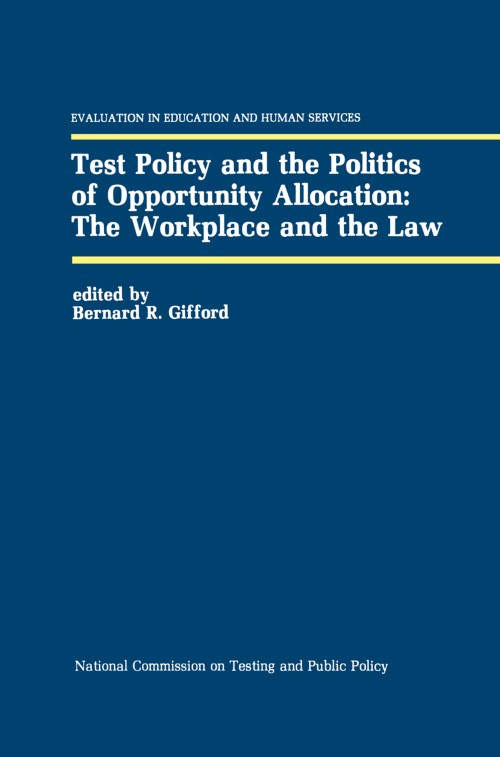
Test Policy and the Politics of Opportunity Allocation: The Workplace and the Law [electronic resource] / edited by Bernard R. Gifford.
Erişim Adresi
ISBN
9789400925021
Dil Kodu
İngilizce
Yer Numarası
DK/7675
Basım Bildirimi
1st ed. 1989.
Yayın Bilgisi
Dordrecht : Springer Netherlands : Imprint: Springer, 1989.
Fiziksel Niteleme
XII, 308 p. online resource.
Dizi
Evaluation in Education and Human Services ; 22
İçindekiler Notu
I Grounding Testing Policy: Three Perspectives -- The Allocation of Opportunities and the Politics of Testing: A Policy Analytic Perspective -- The Mandarin Mentality: Civil Service and University Admissions Testing in Europe and Asia -- Testing Companies, Trends, and Policy Issues: A Current View from the Testing Industry -- II Testing and the Law: Title VII and the Federal Guidelines -- Employment Testing and Title VII of the Civil Rights Act of 1964 -- Non-Discriminatory Use of Personnel Tests Conference Remarks -- The Uniform Guidelines and Subjective Selection Criteria and Procedures Conference Remarks -- III Testing and the Law: The Role of the Courts -- Testing, Public Policy, and the Courts -- Testing in Elementary and Secondary Schools: Can Misuse Be Avoided? -- IV Testing in the Workplace: Theoretical and Practical Perspectives -- Economic Models of Discrimination, Testing, and Public Policy -- Ability Testing for Job Selection: Are the Economic Claims Justified? -- Examples of Testing Programs in the Insurance Industry and a Discussion of Employment Testing Policy Issues -- Test Scores and Evaluation: The Military as Data -- Los Angeles Testing Policies Conference Remarks.
Özet, vb.
Bernard R. Gifford In the United States, the standardized test has become one of the major sources of information for reducing uncertainty in the determination of individual merit and in the allocation of merit-based educational, training, and employment opportunities. Most major institutions of higher education require applicants to supplement their records of academic achievements with scores on standardized tests. Similarly, in the workplace, as a condition of employment or assignment to training programs, more and more employers are requiring prospective employees to sit for standardized tests. In short, with increasing frequency and intensity, individual members of the political economy are required to transmit to the opportunity marketplace scores on standardized examinations that purport to be objective measures of their and potential. In many instances, these test scores are the abilities, talents, only signals about their skills that job applicants are permitted to send to prospective employers. THE NATIONAL COMMISSION ON TESTING AND PUBLIC POLICY In view of the importance of these issues to our current national agenda, it was proposed that the Human Rights and Governance and the Education and Culture Programs of the Ford Foundation support the establishment of a ''blue ribbon" National Commission on Testing and Public Policy to investigate some of the major problems as well as the untapped opportunities created by recent trends in the use of standardized tests, particularly in the workplace and in schools.
Konu
Educational tests and measurements.
Economic policy.
Assessment and Testing.
Economic Policy.
Economic policy.
Assessment and Testing.
Economic Policy.
Diğer Yazarlar
Kurum Adı
Eseri Alıntıla
Referansları kullanmadan önce gözden geçirmeniz ve varsa gerekli düzeltmeleri yapmanız önerilir.
Dijital Kaynak
MARC Görünümü
LEADER 05313nam a22005535i 4500
001 806370
003 TR_AnAIT
005 20260127001953
007 cr nn 008mamaa
008 121227s1989 ne | s |||| 0|eng d
020 |a9789400925021|9978-94-009-2502-1
024 7 |a10.1007/978-94-009-2502-1|2doi
041 |aeng
049 |aTürk Tarih Kurumu Kütüphanesi
050 4|aLB3050-3060.87
072 7|aJNKD|2bicssc
072 7|aEDU030000|2bisacsh
072 7|aJNDH|2thema
082 04|a371.26|223
090 |aDK/7675
245 10|aTest Policy and the Politics of Opportunity Allocation: The Workplace and the Law|h[electronic resource] /|cedited by Bernard R. Gifford.
250 |a1st ed. 1989.
264 1|aDordrecht :|bSpringer Netherlands :|bImprint: Springer,|c1989.
300 |aXII, 308 p.|bonline resource.
336 |atext|btxt|2rdacontent
337 |acomputer|bc|2rdamedia
338 |aonline resource|bcr|2rdacarrier
347 |atext file|bPDF|2rda
490 1 |aEvaluation in Education and Human Services ;|v22
505 0 |aI Grounding Testing Policy: Three Perspectives -- The Allocation of Opportunities and the Politics of Testing: A Policy Analytic Perspective -- The Mandarin Mentality: Civil Service and University Admissions Testing in Europe and Asia -- Testing Companies, Trends, and Policy Issues: A Current View from the Testing Industry -- II Testing and the Law: Title VII and the Federal Guidelines -- Employment Testing and Title VII of the Civil Rights Act of 1964 -- Non-Discriminatory Use of Personnel Tests Conference Remarks -- The Uniform Guidelines and Subjective Selection Criteria and Procedures Conference Remarks -- III Testing and the Law: The Role of the Courts -- Testing, Public Policy, and the Courts -- Testing in Elementary and Secondary Schools: Can Misuse Be Avoided? -- IV Testing in the Workplace: Theoretical and Practical Perspectives -- Economic Models of Discrimination, Testing, and Public Policy -- Ability Testing for Job Selection: Are the Economic Claims Justified? -- Examples of Testing Programs in the Insurance Industry and a Discussion of Employment Testing Policy Issues -- Test Scores and Evaluation: The Military as Data -- Los Angeles Testing Policies Conference Remarks.
520 |aBernard R. Gifford In the United States, the standardized test has become one of the major sources of information for reducing uncertainty in the determination of individual merit and in the allocation of merit-based educational, training, and employment opportunities. Most major institutions of higher education require applicants to supplement their records of academic achievements with scores on standardized tests. Similarly, in the workplace, as a condition of employment or assignment to training programs, more and more employers are requiring prospective employees to sit for standardized tests. In short, with increasing frequency and intensity, individual members of the political economy are required to transmit to the opportunity marketplace scores on standardized examinations that purport to be objective measures of their and potential. In many instances, these test scores are the abilities, talents, only signals about their skills that job applicants are permitted to send to prospective employers. THE NATIONAL COMMISSION ON TESTING AND PUBLIC POLICY In view of the importance of these issues to our current national agenda, it was proposed that the Human Rights and Governance and the Education and Culture Programs of the Ford Foundation support the establishment of a ''blue ribbon" National Commission on Testing and Public Policy to investigate some of the major problems as well as the untapped opportunities created by recent trends in the use of standardized tests, particularly in the workplace and in schools.
532 8 |aAccessibility summary: This PDF is not accessible. It is based on scanned pages and does not support features such as screen reader compatibility or described non-text content (images, graphs etc). However, it likely supports searchable and selectable text based on OCR (Optical Character Recognition). Users with accessibility needs may not be able to use this content effectively. Please contact us at accessibilitysupport@springernature.com if you require assistance or an alternative format.
532 8 |aInaccessible, or known limited accessibility
532 8 |aNo reading system accessibility options actively disabled
532 8 |aPublisher contact for further accessibility information: accessibilitysupport@springernature.com
650 0|aEducational tests and measurements.
650 0|aEconomic policy.
650 14|aAssessment and Testing.
650 24|aEconomic Policy.
700 1 |aGifford, Bernard R.|eeditor.|4edt|4http://id.loc.gov/vocabulary/relators/edt
710 2 |aSpringerLink (Online service)
773 0 |tSpringer Nature eBook
776 08|iPrinted edition:|z9780792390152
776 08|iPrinted edition:|z9789400925038
776 08|iPrinted edition:|z9789401076296
830 0|aEvaluation in Education and Human Services ;|v22
856 40|uhttps://doi.org/10.1007/978-94-009-2502-1
912 |aZDB-2-SHU
912 |aZDB-2-SXED
912 |aZDB-2-BAE
950 |aHumanities, Social Sciences and Law (SpringerNature-11648)
950 |aEducation (R0) (SpringerNature-43721)
001 806370
003 TR_AnAIT
005 20260127001953
007 cr nn 008mamaa
008 121227s1989 ne | s |||| 0|eng d
020 |a9789400925021|9978-94-009-2502-1
024 7 |a10.1007/978-94-009-2502-1|2doi
041 |aeng
049 |aTürk Tarih Kurumu Kütüphanesi
050 4|aLB3050-3060.87
072 7|aJNKD|2bicssc
072 7|aEDU030000|2bisacsh
072 7|aJNDH|2thema
082 04|a371.26|223
090 |aDK/7675
245 10|aTest Policy and the Politics of Opportunity Allocation: The Workplace and the Law|h[electronic resource] /|cedited by Bernard R. Gifford.
250 |a1st ed. 1989.
264 1|aDordrecht :|bSpringer Netherlands :|bImprint: Springer,|c1989.
300 |aXII, 308 p.|bonline resource.
336 |atext|btxt|2rdacontent
337 |acomputer|bc|2rdamedia
338 |aonline resource|bcr|2rdacarrier
347 |atext file|bPDF|2rda
490 1 |aEvaluation in Education and Human Services ;|v22
505 0 |aI Grounding Testing Policy: Three Perspectives -- The Allocation of Opportunities and the Politics of Testing: A Policy Analytic Perspective -- The Mandarin Mentality: Civil Service and University Admissions Testing in Europe and Asia -- Testing Companies, Trends, and Policy Issues: A Current View from the Testing Industry -- II Testing and the Law: Title VII and the Federal Guidelines -- Employment Testing and Title VII of the Civil Rights Act of 1964 -- Non-Discriminatory Use of Personnel Tests Conference Remarks -- The Uniform Guidelines and Subjective Selection Criteria and Procedures Conference Remarks -- III Testing and the Law: The Role of the Courts -- Testing, Public Policy, and the Courts -- Testing in Elementary and Secondary Schools: Can Misuse Be Avoided? -- IV Testing in the Workplace: Theoretical and Practical Perspectives -- Economic Models of Discrimination, Testing, and Public Policy -- Ability Testing for Job Selection: Are the Economic Claims Justified? -- Examples of Testing Programs in the Insurance Industry and a Discussion of Employment Testing Policy Issues -- Test Scores and Evaluation: The Military as Data -- Los Angeles Testing Policies Conference Remarks.
520 |aBernard R. Gifford In the United States, the standardized test has become one of the major sources of information for reducing uncertainty in the determination of individual merit and in the allocation of merit-based educational, training, and employment opportunities. Most major institutions of higher education require applicants to supplement their records of academic achievements with scores on standardized tests. Similarly, in the workplace, as a condition of employment or assignment to training programs, more and more employers are requiring prospective employees to sit for standardized tests. In short, with increasing frequency and intensity, individual members of the political economy are required to transmit to the opportunity marketplace scores on standardized examinations that purport to be objective measures of their and potential. In many instances, these test scores are the abilities, talents, only signals about their skills that job applicants are permitted to send to prospective employers. THE NATIONAL COMMISSION ON TESTING AND PUBLIC POLICY In view of the importance of these issues to our current national agenda, it was proposed that the Human Rights and Governance and the Education and Culture Programs of the Ford Foundation support the establishment of a ''blue ribbon" National Commission on Testing and Public Policy to investigate some of the major problems as well as the untapped opportunities created by recent trends in the use of standardized tests, particularly in the workplace and in schools.
532 8 |aAccessibility summary: This PDF is not accessible. It is based on scanned pages and does not support features such as screen reader compatibility or described non-text content (images, graphs etc). However, it likely supports searchable and selectable text based on OCR (Optical Character Recognition). Users with accessibility needs may not be able to use this content effectively. Please contact us at accessibilitysupport@springernature.com if you require assistance or an alternative format.
532 8 |aInaccessible, or known limited accessibility
532 8 |aNo reading system accessibility options actively disabled
532 8 |aPublisher contact for further accessibility information: accessibilitysupport@springernature.com
650 0|aEducational tests and measurements.
650 0|aEconomic policy.
650 14|aAssessment and Testing.
650 24|aEconomic Policy.
700 1 |aGifford, Bernard R.|eeditor.|4edt|4http://id.loc.gov/vocabulary/relators/edt
710 2 |aSpringerLink (Online service)
773 0 |tSpringer Nature eBook
776 08|iPrinted edition:|z9780792390152
776 08|iPrinted edition:|z9789400925038
776 08|iPrinted edition:|z9789401076296
830 0|aEvaluation in Education and Human Services ;|v22
856 40|uhttps://doi.org/10.1007/978-94-009-2502-1
912 |aZDB-2-SHU
912 |aZDB-2-SXED
912 |aZDB-2-BAE
950 |aHumanities, Social Sciences and Law (SpringerNature-11648)
950 |aEducation (R0) (SpringerNature-43721)
Materyaller
Depodan talep edilen materyal sadece kütüphane içerisinde kullanılmaktadır.
Materyal dışarıya ödünç verilmemektedir.
Materyal dışarıya ödünç verilmemektedir.
