

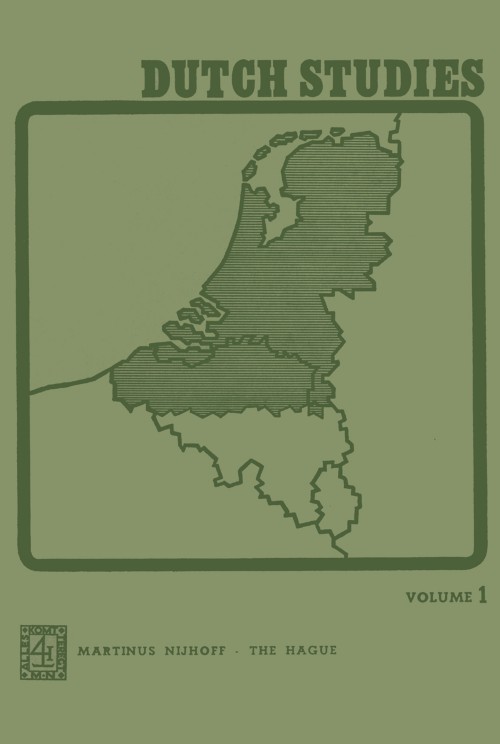
Dutch Studies [electronic resource] : An annual review of the language, literature and life of the Low Countries / by P. Brachin, J. Goossens, P. K. King, J. de Rooij.
Erişim Adresi
ISBN
9789401175067
Dil Kodu
İngilizce
Yer Numarası
DK/7678
Yazar
Basım Bildirimi
1st ed. 1974.
Yayın Bilgisi
Dordrecht : Springer Netherlands : Imprint: Springer, 1974.
Fiziksel Niteleme
XII, 216 p. online resource.
İçindekiler Notu
Linguistics -- Germanic Studies in Germany and their Relation to the Study of German and Dutch -- Modern Dutch Grammar as a Science -- Accentual Relationships as viewed and used in Language -- Literature -- A Philological Paternity Test -- The Dutch Theatre in the Renaissance — A Problem and a Task for the Literary Historian -- The Project on Renaissance Drama in Antwerp -- Studies on Hooft, 1947–1972 -- Blue Skiff of the Soul. The Significance of the Color Blue in Paul van Ostaijen’s Poetry -- History -- Johan Huizinga (1872–1945) -- Reviews -- Martien J. G. de Jong (ed.), Literaire Verkenningen -- Gilbert A. R. de Smet (ed.), Heinric van Veldeken. Symposion Gent 23–24 oktober 1970 -- William Z. Shetter, The Pillars of Society, Six centuries of Civilization in the Netherlands -- General Information -- Source Material for the Study of Dutch Literature. A Bibliographical Survey -- Dutch Studies written in English 1962–71 -- Publications on Dutch Language and Literature in Languages other than Dutch, 1971 -- The Authors.
Özet, vb.
The language of some eighteen million people living at the junction of the two great cultures of western Europe, Romance and Germanic, is now taught by some 262 teachers at I43 universities outside the Netherlands, ineluding Finland, Hungary, Poland, Russia, Czecho slovakia, Portugal, Japan, Malaysia and South Korea. These teachers obviously need to keep in regular and elose touch with the two countries whose culturallife forms the subject of their courses. Yet the first international congress of Dutch teachers abroad did not take place until the early sixties, since when the Colloquium Neerlandicum has become a triennial event, meeting alternately in the Netherlands and Belgium, in The Hague (I96I and I967), Brussels (I964) Ghent (I970) with the fifth Colloquium planned for Leiden in I973. Financial support from the Dutch and Belgian governments enables the majority of European colleagues, and a number of those from other continents, to attend a conference lasting for four or five days and ineluding discussions of the problems involved in teaching Dutch abroad and papers on various aspects of current Dutch studies of interest to those who are working in a certain degree of isolation abroad. At the first Colloquium a Working Committee of Professors and Lecturers in Dutch studies at Universities abroad was set up.
Konu
Germanic languages.
Germanic Languages.
Germanic Languages.
Diğer Yazarlar
Kurum Adı
Eseri Alıntıla
Referansları kullanmadan önce gözden geçirmeniz ve varsa gerekli düzeltmeleri yapmanız önerilir.
Dijital Kaynak
MARC Görünümü
LEADER 04996nam a22005415i 4500
001 806373
003 TR_AnAIT
005 20260127001956
007 cr nn 008mamaa
008 121227s1974 ne | s |||| 0|eng d
020 |a9789401175067|9978-94-011-7506-7
024 7 |a10.1007/978-94-011-7506-7|2doi
041 |aeng
049 |aTürk Tarih Kurumu Kütüphanesi
050 4|aPD1-7159
072 7|aCB|2bicssc
072 7|a2AC|2bicssc
072 7|aFOR009000|2bisacsh
072 7|aCB|x2AC|2thema
082 04|a430|223
090 |aDK/7678
100 1 |aBrachin, P.|eauthor.|4aut|4http://id.loc.gov/vocabulary/relators/aut
245 10|aDutch Studies|h[electronic resource] :|bAn annual review of the language, literature and life of the Low Countries /|cby P. Brachin, J. Goossens, P. K. King, J. de Rooij.
250 |a1st ed. 1974.
264 1|aDordrecht :|bSpringer Netherlands :|bImprint: Springer,|c1974.
300 |aXII, 216 p.|bonline resource.
336 |atext|btxt|2rdacontent
337 |acomputer|bc|2rdamedia
338 |aonline resource|bcr|2rdacarrier
347 |atext file|bPDF|2rda
505 0 |aLinguistics -- Germanic Studies in Germany and their Relation to the Study of German and Dutch -- Modern Dutch Grammar as a Science -- Accentual Relationships as viewed and used in Language -- Literature -- A Philological Paternity Test -- The Dutch Theatre in the Renaissance — A Problem and a Task for the Literary Historian -- The Project on Renaissance Drama in Antwerp -- Studies on Hooft, 1947–1972 -- Blue Skiff of the Soul. The Significance of the Color Blue in Paul van Ostaijen’s Poetry -- History -- Johan Huizinga (1872–1945) -- Reviews -- Martien J. G. de Jong (ed.), Literaire Verkenningen -- Gilbert A. R. de Smet (ed.), Heinric van Veldeken. Symposion Gent 23–24 oktober 1970 -- William Z. Shetter, The Pillars of Society, Six centuries of Civilization in the Netherlands -- General Information -- Source Material for the Study of Dutch Literature. A Bibliographical Survey -- Dutch Studies written in English 1962–71 -- Publications on Dutch Language and Literature in Languages other than Dutch, 1971 -- The Authors.
520 |aThe language of some eighteen million people living at the junction of the two great cultures of western Europe, Romance and Germanic, is now taught by some 262 teachers at I43 universities outside the Netherlands, ineluding Finland, Hungary, Poland, Russia, Czecho slovakia, Portugal, Japan, Malaysia and South Korea. These teachers obviously need to keep in regular and elose touch with the two countries whose culturallife forms the subject of their courses. Yet the first international congress of Dutch teachers abroad did not take place until the early sixties, since when the Colloquium Neerlandicum has become a triennial event, meeting alternately in the Netherlands and Belgium, in The Hague (I96I and I967), Brussels (I964) Ghent (I970) with the fifth Colloquium planned for Leiden in I973. Financial support from the Dutch and Belgian governments enables the majority of European colleagues, and a number of those from other continents, to attend a conference lasting for four or five days and ineluding discussions of the problems involved in teaching Dutch abroad and papers on various aspects of current Dutch studies of interest to those who are working in a certain degree of isolation abroad. At the first Colloquium a Working Committee of Professors and Lecturers in Dutch studies at Universities abroad was set up.
532 8 |aAccessibility summary: This PDF is not accessible. It is based on scanned pages and does not support features such as screen reader compatibility or described non-text content (images, graphs etc). However, it likely supports searchable and selectable text based on OCR (Optical Character Recognition). Users with accessibility needs may not be able to use this content effectively. Please contact us at accessibilitysupport@springernature.com if you require assistance or an alternative format.
532 8 |aInaccessible, or known limited accessibility
532 8 |aNo reading system accessibility options actively disabled
532 8 |aPublisher contact for further accessibility information: accessibilitysupport@springernature.com
650 0|aGermanic languages.
650 14|aGermanic Languages.
700 1 |aGoossens, J.|eauthor.|4aut|4http://id.loc.gov/vocabulary/relators/aut
700 1 |aKing, P. K.|eauthor.|4aut|4http://id.loc.gov/vocabulary/relators/aut
700 1 |aRooij, J. de.|eauthor.|4aut|4http://id.loc.gov/vocabulary/relators/aut
710 2 |aSpringerLink (Online service)
773 0 |tSpringer Nature eBook
776 08|iPrinted edition:|z9789024716326
776 08|iPrinted edition:|z9789401175074
856 40|uhttps://doi.org/10.1007/978-94-011-7506-7
912 |aZDB-2-SHU
912 |aZDB-2-SXS
912 |aZDB-2-BAE
950 |aHumanities, Social Sciences and Law (SpringerNature-11648)
950 |aSocial Sciences (R0) (SpringerNature-43726)
001 806373
003 TR_AnAIT
005 20260127001956
007 cr nn 008mamaa
008 121227s1974 ne | s |||| 0|eng d
020 |a9789401175067|9978-94-011-7506-7
024 7 |a10.1007/978-94-011-7506-7|2doi
041 |aeng
049 |aTürk Tarih Kurumu Kütüphanesi
050 4|aPD1-7159
072 7|aCB|2bicssc
072 7|a2AC|2bicssc
072 7|aFOR009000|2bisacsh
072 7|aCB|x2AC|2thema
082 04|a430|223
090 |aDK/7678
100 1 |aBrachin, P.|eauthor.|4aut|4http://id.loc.gov/vocabulary/relators/aut
245 10|aDutch Studies|h[electronic resource] :|bAn annual review of the language, literature and life of the Low Countries /|cby P. Brachin, J. Goossens, P. K. King, J. de Rooij.
250 |a1st ed. 1974.
264 1|aDordrecht :|bSpringer Netherlands :|bImprint: Springer,|c1974.
300 |aXII, 216 p.|bonline resource.
336 |atext|btxt|2rdacontent
337 |acomputer|bc|2rdamedia
338 |aonline resource|bcr|2rdacarrier
347 |atext file|bPDF|2rda
505 0 |aLinguistics -- Germanic Studies in Germany and their Relation to the Study of German and Dutch -- Modern Dutch Grammar as a Science -- Accentual Relationships as viewed and used in Language -- Literature -- A Philological Paternity Test -- The Dutch Theatre in the Renaissance — A Problem and a Task for the Literary Historian -- The Project on Renaissance Drama in Antwerp -- Studies on Hooft, 1947–1972 -- Blue Skiff of the Soul. The Significance of the Color Blue in Paul van Ostaijen’s Poetry -- History -- Johan Huizinga (1872–1945) -- Reviews -- Martien J. G. de Jong (ed.), Literaire Verkenningen -- Gilbert A. R. de Smet (ed.), Heinric van Veldeken. Symposion Gent 23–24 oktober 1970 -- William Z. Shetter, The Pillars of Society, Six centuries of Civilization in the Netherlands -- General Information -- Source Material for the Study of Dutch Literature. A Bibliographical Survey -- Dutch Studies written in English 1962–71 -- Publications on Dutch Language and Literature in Languages other than Dutch, 1971 -- The Authors.
520 |aThe language of some eighteen million people living at the junction of the two great cultures of western Europe, Romance and Germanic, is now taught by some 262 teachers at I43 universities outside the Netherlands, ineluding Finland, Hungary, Poland, Russia, Czecho slovakia, Portugal, Japan, Malaysia and South Korea. These teachers obviously need to keep in regular and elose touch with the two countries whose culturallife forms the subject of their courses. Yet the first international congress of Dutch teachers abroad did not take place until the early sixties, since when the Colloquium Neerlandicum has become a triennial event, meeting alternately in the Netherlands and Belgium, in The Hague (I96I and I967), Brussels (I964) Ghent (I970) with the fifth Colloquium planned for Leiden in I973. Financial support from the Dutch and Belgian governments enables the majority of European colleagues, and a number of those from other continents, to attend a conference lasting for four or five days and ineluding discussions of the problems involved in teaching Dutch abroad and papers on various aspects of current Dutch studies of interest to those who are working in a certain degree of isolation abroad. At the first Colloquium a Working Committee of Professors and Lecturers in Dutch studies at Universities abroad was set up.
532 8 |aAccessibility summary: This PDF is not accessible. It is based on scanned pages and does not support features such as screen reader compatibility or described non-text content (images, graphs etc). However, it likely supports searchable and selectable text based on OCR (Optical Character Recognition). Users with accessibility needs may not be able to use this content effectively. Please contact us at accessibilitysupport@springernature.com if you require assistance or an alternative format.
532 8 |aInaccessible, or known limited accessibility
532 8 |aNo reading system accessibility options actively disabled
532 8 |aPublisher contact for further accessibility information: accessibilitysupport@springernature.com
650 0|aGermanic languages.
650 14|aGermanic Languages.
700 1 |aGoossens, J.|eauthor.|4aut|4http://id.loc.gov/vocabulary/relators/aut
700 1 |aKing, P. K.|eauthor.|4aut|4http://id.loc.gov/vocabulary/relators/aut
700 1 |aRooij, J. de.|eauthor.|4aut|4http://id.loc.gov/vocabulary/relators/aut
710 2 |aSpringerLink (Online service)
773 0 |tSpringer Nature eBook
776 08|iPrinted edition:|z9789024716326
776 08|iPrinted edition:|z9789401175074
856 40|uhttps://doi.org/10.1007/978-94-011-7506-7
912 |aZDB-2-SHU
912 |aZDB-2-SXS
912 |aZDB-2-BAE
950 |aHumanities, Social Sciences and Law (SpringerNature-11648)
950 |aSocial Sciences (R0) (SpringerNature-43726)
Materyaller
Depodan talep edilen materyal sadece kütüphane içerisinde kullanılmaktadır.
Materyal dışarıya ödünç verilmemektedir.
Materyal dışarıya ödünç verilmemektedir.
