

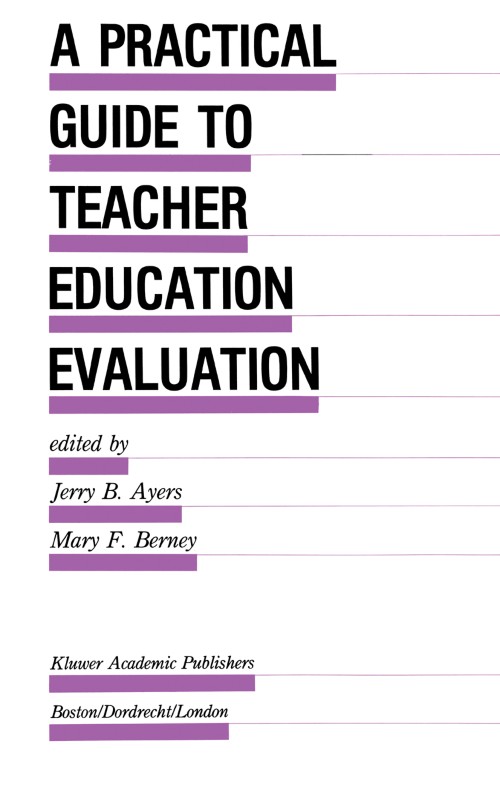
A Practical Guide to Teacher Education Evaluation [electronic resource] / edited by Jerry B. Ayers, Mary F. Berney.
Erişim Adresi
ISBN
9789400925120
Dil Kodu
İngilizce
Yer Numarası
DK/7698
Basım Bildirimi
1st ed. 1989.
Yayın Bilgisi
Dordrecht : Springer Netherlands : Imprint: Springer, 1989.
Fiziksel Niteleme
XVI, 270 p. online resource.
Dizi
Evaluation in Education and Human Services ; 27
İçindekiler Notu
1 Introduction -- 2 Background for Teacher Education Program Evaluation -- 3 The Accreditation Plus Model -- 4 Selection and Evaluation of Knowledge Bases for Teacher Education Programs -- 5 Quality Controls in Teacher Education Programs -- 6 Testing for Admissions -- 7 Evaluating Field-Based Experiences in Teacher Education -- 8 Assessing Student Performance Outcomes in Teacher Education Programs -- 9 Assessment of Faculty in Teacher Education Programs -- 10 Use of Mail Surveys to Collect Information for Program Improvement -- 11 Follow-Up Evaluation of Teacher Education Programs -- 12 Evaluating the Structure of the Education Unit -- 13 Physical Facilities Evaluation in Teacher Education Programs -- 14 Evaluating Financial Resources for Teacher Education Programs -- 15 Evaluation of Library Resources for a Teacher Education Program -- 16 Models and Modeling for Teacher Education Evaluation -- 17 Implementation of Evaluation Results -- 18 Elements of Law as They Relate to Teacher Education Evaluation -- 19 We Can Get There from Here -- Author Index -- NCATE Standards Index.
Özet, vb.
J. T. Sandefur Western Kentucky University American's ability to compete in world markets is eroding. The productivity growth of our competitors outdistances our own. The capacity of our economy to provide a high standard of living for all our people is increasingly in doubt. As jobs requiring little skill are automated or go offshore and demand increases for the highly skilled, the pool of educated and skilled people grows smaller and the backwater of the unemployable rises. Large numbers of American children are in limbo--ignorant of the past and unprepared for the future. Many are dropping out--notjust out of school--but out of productive society. These are not my words. They are a direct quote from the Executive Summary of the Carnegie Forum Report on Education and the Economy entitled A Nation Prepared: Teachers for the 21st Century (p. 2, 1986). This report was motivated by four purposes: 1. To remind Americans, yet again, of the economic challenges pressing us on all sides; 2. To assert the primacy of education as the foundation of economic growth, equal opportunity and a shared national vision; 3. To reaffirm that the teaching profession is the best hope for establishing new standards of excellence as the hallmark of American education; and 4. To point out that a remarkable window of opportunity lies before us in the next decade to reform education, an opportunity that may not present itself again until well into the next century.
Konu
Educational tests and measurements.
Education.
Assessment and Testing.
Education.
Education.
Assessment and Testing.
Education.
Diğer Yazarlar
Kurum Adı
Eseri Alıntıla
Referansları kullanmadan önce gözden geçirmeniz ve varsa gerekli düzeltmeleri yapmanız önerilir.
Dijital Kaynak
MARC Görünümü
LEADER 05176nam a22005655i 4500
001 806398
003 TR_AnAIT
005 20260127002027
007 cr nn 008mamaa
008 121227s1989 ne | s |||| 0|eng d
020 |a9789400925120|9978-94-009-2512-0
024 7 |a10.1007/978-94-009-2512-0|2doi
041 |aeng
049 |aTürk Tarih Kurumu Kütüphanesi
050 4|aLB3050-3060.87
072 7|aJNKD|2bicssc
072 7|aEDU030000|2bisacsh
072 7|aJNDH|2thema
082 04|a371.26|223
090 |aDK/7698
245 12|aA Practical Guide to Teacher Education Evaluation|h[electronic resource] /|cedited by Jerry B. Ayers, Mary F. Berney.
250 |a1st ed. 1989.
264 1|aDordrecht :|bSpringer Netherlands :|bImprint: Springer,|c1989.
300 |aXVI, 270 p.|bonline resource.
336 |atext|btxt|2rdacontent
337 |acomputer|bc|2rdamedia
338 |aonline resource|bcr|2rdacarrier
347 |atext file|bPDF|2rda
490 1 |aEvaluation in Education and Human Services ;|v27
505 0 |a1 Introduction -- 2 Background for Teacher Education Program Evaluation -- 3 The Accreditation Plus Model -- 4 Selection and Evaluation of Knowledge Bases for Teacher Education Programs -- 5 Quality Controls in Teacher Education Programs -- 6 Testing for Admissions -- 7 Evaluating Field-Based Experiences in Teacher Education -- 8 Assessing Student Performance Outcomes in Teacher Education Programs -- 9 Assessment of Faculty in Teacher Education Programs -- 10 Use of Mail Surveys to Collect Information for Program Improvement -- 11 Follow-Up Evaluation of Teacher Education Programs -- 12 Evaluating the Structure of the Education Unit -- 13 Physical Facilities Evaluation in Teacher Education Programs -- 14 Evaluating Financial Resources for Teacher Education Programs -- 15 Evaluation of Library Resources for a Teacher Education Program -- 16 Models and Modeling for Teacher Education Evaluation -- 17 Implementation of Evaluation Results -- 18 Elements of Law as They Relate to Teacher Education Evaluation -- 19 We Can Get There from Here -- Author Index -- NCATE Standards Index.
520 |aJ. T. Sandefur Western Kentucky University American's ability to compete in world markets is eroding. The productivity growth of our competitors outdistances our own. The capacity of our economy to provide a high standard of living for all our people is increasingly in doubt. As jobs requiring little skill are automated or go offshore and demand increases for the highly skilled, the pool of educated and skilled people grows smaller and the backwater of the unemployable rises. Large numbers of American children are in limbo--ignorant of the past and unprepared for the future. Many are dropping out--notjust out of school--but out of productive society. These are not my words. They are a direct quote from the Executive Summary of the Carnegie Forum Report on Education and the Economy entitled A Nation Prepared: Teachers for the 21st Century (p. 2, 1986). This report was motivated by four purposes: 1. To remind Americans, yet again, of the economic challenges pressing us on all sides; 2. To assert the primacy of education as the foundation of economic growth, equal opportunity and a shared national vision; 3. To reaffirm that the teaching profession is the best hope for establishing new standards of excellence as the hallmark of American education; and 4. To point out that a remarkable window of opportunity lies before us in the next decade to reform education, an opportunity that may not present itself again until well into the next century.
532 8 |aAccessibility summary: This PDF is not accessible. It is based on scanned pages and does not support features such as screen reader compatibility or described non-text content (images, graphs etc). However, it likely supports searchable and selectable text based on OCR (Optical Character Recognition). Users with accessibility needs may not be able to use this content effectively. Please contact us at accessibilitysupport@springernature.com if you require assistance or an alternative format.
532 8 |aInaccessible, or known limited accessibility
532 8 |aNo reading system accessibility options actively disabled
532 8 |aPublisher contact for further accessibility information: accessibilitysupport@springernature.com
650 0|aEducational tests and measurements.
650 0|aEducation.
650 14|aAssessment and Testing.
650 24|aEducation.
700 1 |aAyers, Jerry B.|eeditor.|4edt|4http://id.loc.gov/vocabulary/relators/edt
700 1 |aBerney, Mary F.|eeditor.|4edt|4http://id.loc.gov/vocabulary/relators/edt
710 2 |aSpringerLink (Online service)
773 0 |tSpringer Nature eBook
776 08|iPrinted edition:|z9780792390428
776 08|iPrinted edition:|z9789400925137
776 08|iPrinted edition:|z9789401076340
830 0|aEvaluation in Education and Human Services ;|v27
856 40|uhttps://doi.org/10.1007/978-94-009-2512-0
912 |aZDB-2-SHU
912 |aZDB-2-SXED
912 |aZDB-2-BAE
950 |aHumanities, Social Sciences and Law (SpringerNature-11648)
950 |aEducation (R0) (SpringerNature-43721)
001 806398
003 TR_AnAIT
005 20260127002027
007 cr nn 008mamaa
008 121227s1989 ne | s |||| 0|eng d
020 |a9789400925120|9978-94-009-2512-0
024 7 |a10.1007/978-94-009-2512-0|2doi
041 |aeng
049 |aTürk Tarih Kurumu Kütüphanesi
050 4|aLB3050-3060.87
072 7|aJNKD|2bicssc
072 7|aEDU030000|2bisacsh
072 7|aJNDH|2thema
082 04|a371.26|223
090 |aDK/7698
245 12|aA Practical Guide to Teacher Education Evaluation|h[electronic resource] /|cedited by Jerry B. Ayers, Mary F. Berney.
250 |a1st ed. 1989.
264 1|aDordrecht :|bSpringer Netherlands :|bImprint: Springer,|c1989.
300 |aXVI, 270 p.|bonline resource.
336 |atext|btxt|2rdacontent
337 |acomputer|bc|2rdamedia
338 |aonline resource|bcr|2rdacarrier
347 |atext file|bPDF|2rda
490 1 |aEvaluation in Education and Human Services ;|v27
505 0 |a1 Introduction -- 2 Background for Teacher Education Program Evaluation -- 3 The Accreditation Plus Model -- 4 Selection and Evaluation of Knowledge Bases for Teacher Education Programs -- 5 Quality Controls in Teacher Education Programs -- 6 Testing for Admissions -- 7 Evaluating Field-Based Experiences in Teacher Education -- 8 Assessing Student Performance Outcomes in Teacher Education Programs -- 9 Assessment of Faculty in Teacher Education Programs -- 10 Use of Mail Surveys to Collect Information for Program Improvement -- 11 Follow-Up Evaluation of Teacher Education Programs -- 12 Evaluating the Structure of the Education Unit -- 13 Physical Facilities Evaluation in Teacher Education Programs -- 14 Evaluating Financial Resources for Teacher Education Programs -- 15 Evaluation of Library Resources for a Teacher Education Program -- 16 Models and Modeling for Teacher Education Evaluation -- 17 Implementation of Evaluation Results -- 18 Elements of Law as They Relate to Teacher Education Evaluation -- 19 We Can Get There from Here -- Author Index -- NCATE Standards Index.
520 |aJ. T. Sandefur Western Kentucky University American's ability to compete in world markets is eroding. The productivity growth of our competitors outdistances our own. The capacity of our economy to provide a high standard of living for all our people is increasingly in doubt. As jobs requiring little skill are automated or go offshore and demand increases for the highly skilled, the pool of educated and skilled people grows smaller and the backwater of the unemployable rises. Large numbers of American children are in limbo--ignorant of the past and unprepared for the future. Many are dropping out--notjust out of school--but out of productive society. These are not my words. They are a direct quote from the Executive Summary of the Carnegie Forum Report on Education and the Economy entitled A Nation Prepared: Teachers for the 21st Century (p. 2, 1986). This report was motivated by four purposes: 1. To remind Americans, yet again, of the economic challenges pressing us on all sides; 2. To assert the primacy of education as the foundation of economic growth, equal opportunity and a shared national vision; 3. To reaffirm that the teaching profession is the best hope for establishing new standards of excellence as the hallmark of American education; and 4. To point out that a remarkable window of opportunity lies before us in the next decade to reform education, an opportunity that may not present itself again until well into the next century.
532 8 |aAccessibility summary: This PDF is not accessible. It is based on scanned pages and does not support features such as screen reader compatibility or described non-text content (images, graphs etc). However, it likely supports searchable and selectable text based on OCR (Optical Character Recognition). Users with accessibility needs may not be able to use this content effectively. Please contact us at accessibilitysupport@springernature.com if you require assistance or an alternative format.
532 8 |aInaccessible, or known limited accessibility
532 8 |aNo reading system accessibility options actively disabled
532 8 |aPublisher contact for further accessibility information: accessibilitysupport@springernature.com
650 0|aEducational tests and measurements.
650 0|aEducation.
650 14|aAssessment and Testing.
650 24|aEducation.
700 1 |aAyers, Jerry B.|eeditor.|4edt|4http://id.loc.gov/vocabulary/relators/edt
700 1 |aBerney, Mary F.|eeditor.|4edt|4http://id.loc.gov/vocabulary/relators/edt
710 2 |aSpringerLink (Online service)
773 0 |tSpringer Nature eBook
776 08|iPrinted edition:|z9780792390428
776 08|iPrinted edition:|z9789400925137
776 08|iPrinted edition:|z9789401076340
830 0|aEvaluation in Education and Human Services ;|v27
856 40|uhttps://doi.org/10.1007/978-94-009-2512-0
912 |aZDB-2-SHU
912 |aZDB-2-SXED
912 |aZDB-2-BAE
950 |aHumanities, Social Sciences and Law (SpringerNature-11648)
950 |aEducation (R0) (SpringerNature-43721)
Materyaller
Depodan talep edilen materyal sadece kütüphane içerisinde kullanılmaktadır.
Materyal dışarıya ödünç verilmemektedir.
Materyal dışarıya ödünç verilmemektedir.
