

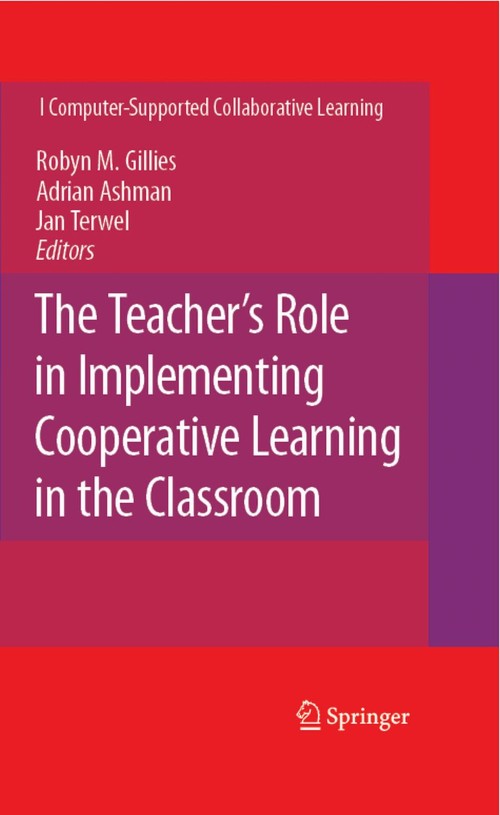
The Teacher's Role in Implementing Cooperative Learning in the Classroom [electronic resource] / edited by Robyn M. Gillies, Adrian Ashman, Jan Terwel.
Erişim Adresi
ISBN
9780387708928
Dil Kodu
İngilizce
Yer Numarası
DK/7730
Basım Bildirimi
1st ed. 2008.
Yayın Bilgisi
New York, NY : Springer US : Imprint: Springer, 2008.
Fiziksel Niteleme
X, 267 p. online resource.
Dizi
Computer-Supported Collaborative Learning Series, 2543-0157 ; 8
İçindekiler Notu
Social Interdependence Theory and Cooperative Learning: The Teacher's Role -- Beyond the Classroom and into the Community: The Role of the Teacher in Expanding the Pedagogy of Cooperation -- Pupil Grouping for Learning: Developing a Social Pedagogy of the Classroom -- Structuring Peer Interaction to Promote Higher-Order Thinking and Complex Learning in Cooperating Groups -- Cooperative Learning and Literacy Instruction in Middle Level Education -- Structuring Group Interaction to Promote Thinking and Learning During Small Group Learning in High School Settings -- Feedback and Reflection to Promote Student Participation in Computer Supported Collaborative Learning: A Multiple Case Study -- School and Inclusive Practices -- Developing Language and Mastering Content in Heterogeneous Classrooms -- Teacher Practices and Small-Group Dynamics in Cooperative Learning Classrooms -- Explanation Giving and Receiving in Cooperative Learning Groups -- Teachers’ and Students’ Verbal Behaviours During Cooperative Learning.
Özet, vb.
Cooperative learning is widely endorsed as a pedagogical practice that promotes student learning. Recently, the research focus has moved to the role of teachers’ discourse during cooperative learning and its effects on the quality of group discussions and the learning achieved. Although the benefits of cooperative learning are well documented, implementing this pedagogical practice in classrooms is a challenge that many teachers have difficulties accomplishing. The Teacher's Role in Implementing Cooperative Learning in the Classroom provides readers with a comprehensive overview of the challenges and issues with clear guidelines on how teachers can embed cooperative learning into their classroom curricula to obtain the benefits widely attributed to this pedagogical practice. It does so by using language that is appropriate for both novice and experienced educators. The volume provides: an overview of the major research and theoretical perspectives that underpin the development of cooperative learning pedagogy; outlines how specific small group experiences can promote thinking and learning; discusses the key role teachers play in promoting student discourse; and, demonstrates how interaction style among students and teachers is crucial in facilitating discussion and learning. The collection of chapters includes many practical illustrations, drawn from the contributors’ own research of how teachers can use cooperative learning pedagogy to facilitate thinking and learning among students across different educational settings.
Konu
Learning, Psychology of.
Educational technology.
Education __ Data processing.
Instructional Psychology.
Digital Education and Educational Technology.
Computers and Education.
Educational technology.
Education __ Data processing.
Instructional Psychology.
Digital Education and Educational Technology.
Computers and Education.
Diğer Yazarlar
Kurum Adı
Eseri Alıntıla
Referansları kullanmadan önce gözden geçirmeniz ve varsa gerekli düzeltmeleri yapmanız önerilir.
Dijital Kaynak
MARC Görünümü
LEADER 04684nam a22005415i 4500
001 806430
003 TR_AnAIT
005 20260127002106
007 cr nn 008mamaa
008 100301s2008 xxu| s |||| 0|eng d
020 |a9780387708928|9978-0-387-70892-8
024 7 |a10.1007/978-0-387-70892-8|2doi
041 |aeng
049 |aTürk Tarih Kurumu Kütüphanesi
050 4|aLB1060-1077
072 7|aJNC|2bicssc
072 7|aEDU009000|2bisacsh
072 7|aJNC|2thema
082 04|a370.15|223
090 |aDK/7730
245 14|aThe Teacher's Role in Implementing Cooperative Learning in the Classroom|h[electronic resource] /|cedited by Robyn M. Gillies, Adrian Ashman, Jan Terwel.
250 |a1st ed. 2008.
264 1|aNew York, NY :|bSpringer US :|bImprint: Springer,|c2008.
300 |aX, 267 p.|bonline resource.
336 |atext|btxt|2rdacontent
337 |acomputer|bc|2rdamedia
338 |aonline resource|bcr|2rdacarrier
347 |atext file|bPDF|2rda
490 1 |aComputer-Supported Collaborative Learning Series,|x2543-0157 ;|v8
505 0 |aSocial Interdependence Theory and Cooperative Learning: The Teacher's Role -- Beyond the Classroom and into the Community: The Role of the Teacher in Expanding the Pedagogy of Cooperation -- Pupil Grouping for Learning: Developing a Social Pedagogy of the Classroom -- Structuring Peer Interaction to Promote Higher-Order Thinking and Complex Learning in Cooperating Groups -- Cooperative Learning and Literacy Instruction in Middle Level Education -- Structuring Group Interaction to Promote Thinking and Learning During Small Group Learning in High School Settings -- Feedback and Reflection to Promote Student Participation in Computer Supported Collaborative Learning: A Multiple Case Study -- School and Inclusive Practices -- Developing Language and Mastering Content in Heterogeneous Classrooms -- Teacher Practices and Small-Group Dynamics in Cooperative Learning Classrooms -- Explanation Giving and Receiving in Cooperative Learning Groups -- Teachers’ and Students’ Verbal Behaviours During Cooperative Learning.
520 |aCooperative learning is widely endorsed as a pedagogical practice that promotes student learning. Recently, the research focus has moved to the role of teachers’ discourse during cooperative learning and its effects on the quality of group discussions and the learning achieved. Although the benefits of cooperative learning are well documented, implementing this pedagogical practice in classrooms is a challenge that many teachers have difficulties accomplishing. The Teacher's Role in Implementing Cooperative Learning in the Classroom provides readers with a comprehensive overview of the challenges and issues with clear guidelines on how teachers can embed cooperative learning into their classroom curricula to obtain the benefits widely attributed to this pedagogical practice. It does so by using language that is appropriate for both novice and experienced educators. The volume provides: an overview of the major research and theoretical perspectives that underpin the development of cooperative learning pedagogy; outlines how specific small group experiences can promote thinking and learning; discusses the key role teachers play in promoting student discourse; and, demonstrates how interaction style among students and teachers is crucial in facilitating discussion and learning. The collection of chapters includes many practical illustrations, drawn from the contributors’ own research of how teachers can use cooperative learning pedagogy to facilitate thinking and learning among students across different educational settings.
650 0|aLearning, Psychology of.
650 0|aEducational technology.
650 0|aEducation|xData processing.
650 14|aInstructional Psychology.
650 24|aDigital Education and Educational Technology.
650 24|aComputers and Education.
700 1 |aGillies, Robyn M.|eeditor.|4edt|4http://id.loc.gov/vocabulary/relators/edt
700 1 |aAshman, Adrian.|eeditor.|4edt|4http://id.loc.gov/vocabulary/relators/edt
700 1 |aTerwel, Jan.|eeditor.|4edt|4http://id.loc.gov/vocabulary/relators/edt
710 2 |aSpringerLink (Online service)
773 0 |tSpringer Nature eBook
776 08|iPrinted edition:|z9780387708911
776 08|iPrinted edition:|z9780387518077
776 08|iPrinted edition:|z9781441943644
830 0|aComputer-Supported Collaborative Learning Series,|x2543-0157 ;|v8
856 40|uhttps://doi.org/10.1007/978-0-387-70892-8
912 |aZDB-2-SHU
912 |aZDB-2-SXED
950 |aHumanities, Social Sciences and Law (SpringerNature-11648)
950 |aEducation (R0) (SpringerNature-43721)
001 806430
003 TR_AnAIT
005 20260127002106
007 cr nn 008mamaa
008 100301s2008 xxu| s |||| 0|eng d
020 |a9780387708928|9978-0-387-70892-8
024 7 |a10.1007/978-0-387-70892-8|2doi
041 |aeng
049 |aTürk Tarih Kurumu Kütüphanesi
050 4|aLB1060-1077
072 7|aJNC|2bicssc
072 7|aEDU009000|2bisacsh
072 7|aJNC|2thema
082 04|a370.15|223
090 |aDK/7730
245 14|aThe Teacher's Role in Implementing Cooperative Learning in the Classroom|h[electronic resource] /|cedited by Robyn M. Gillies, Adrian Ashman, Jan Terwel.
250 |a1st ed. 2008.
264 1|aNew York, NY :|bSpringer US :|bImprint: Springer,|c2008.
300 |aX, 267 p.|bonline resource.
336 |atext|btxt|2rdacontent
337 |acomputer|bc|2rdamedia
338 |aonline resource|bcr|2rdacarrier
347 |atext file|bPDF|2rda
490 1 |aComputer-Supported Collaborative Learning Series,|x2543-0157 ;|v8
505 0 |aSocial Interdependence Theory and Cooperative Learning: The Teacher's Role -- Beyond the Classroom and into the Community: The Role of the Teacher in Expanding the Pedagogy of Cooperation -- Pupil Grouping for Learning: Developing a Social Pedagogy of the Classroom -- Structuring Peer Interaction to Promote Higher-Order Thinking and Complex Learning in Cooperating Groups -- Cooperative Learning and Literacy Instruction in Middle Level Education -- Structuring Group Interaction to Promote Thinking and Learning During Small Group Learning in High School Settings -- Feedback and Reflection to Promote Student Participation in Computer Supported Collaborative Learning: A Multiple Case Study -- School and Inclusive Practices -- Developing Language and Mastering Content in Heterogeneous Classrooms -- Teacher Practices and Small-Group Dynamics in Cooperative Learning Classrooms -- Explanation Giving and Receiving in Cooperative Learning Groups -- Teachers’ and Students’ Verbal Behaviours During Cooperative Learning.
520 |aCooperative learning is widely endorsed as a pedagogical practice that promotes student learning. Recently, the research focus has moved to the role of teachers’ discourse during cooperative learning and its effects on the quality of group discussions and the learning achieved. Although the benefits of cooperative learning are well documented, implementing this pedagogical practice in classrooms is a challenge that many teachers have difficulties accomplishing. The Teacher's Role in Implementing Cooperative Learning in the Classroom provides readers with a comprehensive overview of the challenges and issues with clear guidelines on how teachers can embed cooperative learning into their classroom curricula to obtain the benefits widely attributed to this pedagogical practice. It does so by using language that is appropriate for both novice and experienced educators. The volume provides: an overview of the major research and theoretical perspectives that underpin the development of cooperative learning pedagogy; outlines how specific small group experiences can promote thinking and learning; discusses the key role teachers play in promoting student discourse; and, demonstrates how interaction style among students and teachers is crucial in facilitating discussion and learning. The collection of chapters includes many practical illustrations, drawn from the contributors’ own research of how teachers can use cooperative learning pedagogy to facilitate thinking and learning among students across different educational settings.
650 0|aLearning, Psychology of.
650 0|aEducational technology.
650 0|aEducation|xData processing.
650 14|aInstructional Psychology.
650 24|aDigital Education and Educational Technology.
650 24|aComputers and Education.
700 1 |aGillies, Robyn M.|eeditor.|4edt|4http://id.loc.gov/vocabulary/relators/edt
700 1 |aAshman, Adrian.|eeditor.|4edt|4http://id.loc.gov/vocabulary/relators/edt
700 1 |aTerwel, Jan.|eeditor.|4edt|4http://id.loc.gov/vocabulary/relators/edt
710 2 |aSpringerLink (Online service)
773 0 |tSpringer Nature eBook
776 08|iPrinted edition:|z9780387708911
776 08|iPrinted edition:|z9780387518077
776 08|iPrinted edition:|z9781441943644
830 0|aComputer-Supported Collaborative Learning Series,|x2543-0157 ;|v8
856 40|uhttps://doi.org/10.1007/978-0-387-70892-8
912 |aZDB-2-SHU
912 |aZDB-2-SXED
950 |aHumanities, Social Sciences and Law (SpringerNature-11648)
950 |aEducation (R0) (SpringerNature-43721)
Materyaller
Depodan talep edilen materyal sadece kütüphane içerisinde kullanılmaktadır.
Materyal dışarıya ödünç verilmemektedir.
Materyal dışarıya ödünç verilmemektedir.
