

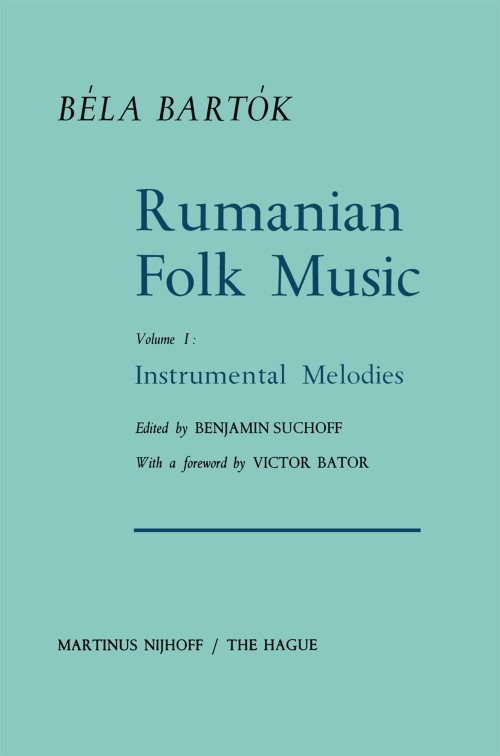
Rumanian Folk Music [electronic resource] : Instrumental Melodies / by Bela Bartok ; edited by B. Suchoff.
Erişim Adresi
ISBN
9789401034999
Dil Kodu
İngilizce
Yer Numarası
DK/7775
Yazar
Basım Bildirimi
1st ed. 1967.
Yayın Bilgisi
Dordrecht : Springer Netherlands : Imprint: Springer, 1967.
Fiziksel Niteleme
L, 704 p. online resource.
Dizi
Bartok Archives Studies in Musicology ; 1
İçindekiler Notu
Preface -- Choice of the Material -- Grouping of the material in general -- to Volume One -- Grouping of the Melodies -- Instruments -- List of the Various Dance Genres -- Order of Dances in Sunday Dancing -- Choreography to Some of the Dances -- Musical Characteristics -- List of Melodies of Possibly Foreign Origin -- Remarks on Some of the Performers -- Explanation of the Signs Used in the Music Notations -- Statistical Data Concerning the Output in Counties and Villages -- Errata in the Melodies -- Music Examples -- Notes to the Melodies.
Özet, vb.
n several of his writings on folk music Bela Bart6k recalls an incident I that happened to him in 1904 during a visit to a small village in Tran 1 syl vania. Quite by chance he heard there an eighteen-year-old Hun garian peasant girl singing Hungarian folk songs whose construction was 2 significantly different from the songs he had known until then. This experience appealed to his imagination far deeper than chance oc currences usually do. It sparked in him a creative fire that was there after to impart to his music certain characteristics that are recognizable today as indigenous to the Bart6kian style of composition. The inspirational value of the incident was rekindled by return trips to Transylvania. During these trips he was not merely listening. He began notating, melodies, building them into a coordinated collection. Soon Bart6k's itinerary took him into villages populated in checkered proximity by both Hungarians and Rumanians, thence into little communities where the population was exclusively Rumanian. There he discovered that their songs were much less, if at all, influenced by the urban civilization of Western Europe than those he had collected in Hungarian villages. In an interview he gave to a Transylvanian newspaper in 1922, Bart6k described the difference between the available Hungarian and Rumanian songs.
Konu
Music.
Performing arts.
Theater.
Arts.
Music.
Theatre and Performance Arts.
Fine Art.
Performing arts.
Theater.
Arts.
Music.
Theatre and Performance Arts.
Fine Art.
Diğer Yazarlar
Kurum Adı
Eseri Alıntıla
Referansları kullanmadan önce gözden geçirmeniz ve varsa gerekli düzeltmeleri yapmanız önerilir.
Dijital Kaynak
MARC Görünümü
LEADER 04559nam a22006015i 4500
001 806475
003 TR_AnAIT
005 20260127002158
007 cr nn 008mamaa
008 121227s1967 ne | s |||| 0|eng d
020 |a9789401034999|9978-94-010-3499-9
024 7 |a10.1007/978-94-010-3499-9|2doi
041 |aeng
049 |aTürk Tarih Kurumu Kütüphanesi
050 4|aM1-5000
072 7|aAV|2bicssc
072 7|aMUS000000|2bisacsh
072 7|aAV|2thema
082 04|a780|223
090 |aDK/7775
100 1 |aBartok, Bela.|eauthor.|4aut|4http://id.loc.gov/vocabulary/relators/aut
245 10|aRumanian Folk Music|h[electronic resource] :|bInstrumental Melodies /|cby Bela Bartok ; edited by B. Suchoff.
250 |a1st ed. 1967.
264 1|aDordrecht :|bSpringer Netherlands :|bImprint: Springer,|c1967.
300 |aL, 704 p.|bonline resource.
336 |atext|btxt|2rdacontent
337 |acomputer|bc|2rdamedia
338 |aonline resource|bcr|2rdacarrier
347 |atext file|bPDF|2rda
490 1 |aBartok Archives Studies in Musicology ;|v1
505 0 |aPreface -- Choice of the Material -- Grouping of the material in general -- to Volume One -- Grouping of the Melodies -- Instruments -- List of the Various Dance Genres -- Order of Dances in Sunday Dancing -- Choreography to Some of the Dances -- Musical Characteristics -- List of Melodies of Possibly Foreign Origin -- Remarks on Some of the Performers -- Explanation of the Signs Used in the Music Notations -- Statistical Data Concerning the Output in Counties and Villages -- Errata in the Melodies -- Music Examples -- Notes to the Melodies.
520 |an several of his writings on folk music Bela Bart6k recalls an incident I that happened to him in 1904 during a visit to a small village in Tran 1 syl vania. Quite by chance he heard there an eighteen-year-old Hun garian peasant girl singing Hungarian folk songs whose construction was 2 significantly different from the songs he had known until then. This experience appealed to his imagination far deeper than chance oc currences usually do. It sparked in him a creative fire that was there after to impart to his music certain characteristics that are recognizable today as indigenous to the Bart6kian style of composition. The inspirational value of the incident was rekindled by return trips to Transylvania. During these trips he was not merely listening. He began notating, melodies, building them into a coordinated collection. Soon Bart6k's itinerary took him into villages populated in checkered proximity by both Hungarians and Rumanians, thence into little communities where the population was exclusively Rumanian. There he discovered that their songs were much less, if at all, influenced by the urban civilization of Western Europe than those he had collected in Hungarian villages. In an interview he gave to a Transylvanian newspaper in 1922, Bart6k described the difference between the available Hungarian and Rumanian songs.
532 8 |aAccessibility summary: This PDF is not accessible. It is based on scanned pages and does not support features such as screen reader compatibility or described non-text content (images, graphs etc). However, it likely supports searchable and selectable text based on OCR (Optical Character Recognition). Users with accessibility needs may not be able to use this content effectively. Please contact us at accessibilitysupport@springernature.com if you require assistance or an alternative format.
532 8 |aInaccessible, or known limited accessibility
532 8 |aNo reading system accessibility options actively disabled
532 8 |aPublisher contact for further accessibility information: accessibilitysupport@springernature.com
650 0|aMusic.
650 0|aPerforming arts.
650 0|aTheater.
650 0|aArts.
650 14|aMusic.
650 24|aTheatre and Performance Arts.
650 24|aFine Art.
700 1 |aSuchoff, B.|eeditor.|4edt|4http://id.loc.gov/vocabulary/relators/edt
710 2 |aSpringerLink (Online service)
773 0 |tSpringer Nature eBook
776 08|iPrinted edition:|z9789024706235
776 08|iPrinted edition:|z9789401035002
776 08|iPrinted edition:|z9789401035019
830 0|aBartok Archives Studies in Musicology ;|v1
856 40|uhttps://doi.org/10.1007/978-94-010-3499-9
912 |aZDB-2-SHU
912 |aZDB-2-SXL
912 |aZDB-2-BAE
950 |aHumanities, Social Sciences and Law (SpringerNature-11648)
950 |aLiterature, Cultural and Media Studies (R0) (SpringerNature-43723)
001 806475
003 TR_AnAIT
005 20260127002158
007 cr nn 008mamaa
008 121227s1967 ne | s |||| 0|eng d
020 |a9789401034999|9978-94-010-3499-9
024 7 |a10.1007/978-94-010-3499-9|2doi
041 |aeng
049 |aTürk Tarih Kurumu Kütüphanesi
050 4|aM1-5000
072 7|aAV|2bicssc
072 7|aMUS000000|2bisacsh
072 7|aAV|2thema
082 04|a780|223
090 |aDK/7775
100 1 |aBartok, Bela.|eauthor.|4aut|4http://id.loc.gov/vocabulary/relators/aut
245 10|aRumanian Folk Music|h[electronic resource] :|bInstrumental Melodies /|cby Bela Bartok ; edited by B. Suchoff.
250 |a1st ed. 1967.
264 1|aDordrecht :|bSpringer Netherlands :|bImprint: Springer,|c1967.
300 |aL, 704 p.|bonline resource.
336 |atext|btxt|2rdacontent
337 |acomputer|bc|2rdamedia
338 |aonline resource|bcr|2rdacarrier
347 |atext file|bPDF|2rda
490 1 |aBartok Archives Studies in Musicology ;|v1
505 0 |aPreface -- Choice of the Material -- Grouping of the material in general -- to Volume One -- Grouping of the Melodies -- Instruments -- List of the Various Dance Genres -- Order of Dances in Sunday Dancing -- Choreography to Some of the Dances -- Musical Characteristics -- List of Melodies of Possibly Foreign Origin -- Remarks on Some of the Performers -- Explanation of the Signs Used in the Music Notations -- Statistical Data Concerning the Output in Counties and Villages -- Errata in the Melodies -- Music Examples -- Notes to the Melodies.
520 |an several of his writings on folk music Bela Bart6k recalls an incident I that happened to him in 1904 during a visit to a small village in Tran 1 syl vania. Quite by chance he heard there an eighteen-year-old Hun garian peasant girl singing Hungarian folk songs whose construction was 2 significantly different from the songs he had known until then. This experience appealed to his imagination far deeper than chance oc currences usually do. It sparked in him a creative fire that was there after to impart to his music certain characteristics that are recognizable today as indigenous to the Bart6kian style of composition. The inspirational value of the incident was rekindled by return trips to Transylvania. During these trips he was not merely listening. He began notating, melodies, building them into a coordinated collection. Soon Bart6k's itinerary took him into villages populated in checkered proximity by both Hungarians and Rumanians, thence into little communities where the population was exclusively Rumanian. There he discovered that their songs were much less, if at all, influenced by the urban civilization of Western Europe than those he had collected in Hungarian villages. In an interview he gave to a Transylvanian newspaper in 1922, Bart6k described the difference between the available Hungarian and Rumanian songs.
532 8 |aAccessibility summary: This PDF is not accessible. It is based on scanned pages and does not support features such as screen reader compatibility or described non-text content (images, graphs etc). However, it likely supports searchable and selectable text based on OCR (Optical Character Recognition). Users with accessibility needs may not be able to use this content effectively. Please contact us at accessibilitysupport@springernature.com if you require assistance or an alternative format.
532 8 |aInaccessible, or known limited accessibility
532 8 |aNo reading system accessibility options actively disabled
532 8 |aPublisher contact for further accessibility information: accessibilitysupport@springernature.com
650 0|aMusic.
650 0|aPerforming arts.
650 0|aTheater.
650 0|aArts.
650 14|aMusic.
650 24|aTheatre and Performance Arts.
650 24|aFine Art.
700 1 |aSuchoff, B.|eeditor.|4edt|4http://id.loc.gov/vocabulary/relators/edt
710 2 |aSpringerLink (Online service)
773 0 |tSpringer Nature eBook
776 08|iPrinted edition:|z9789024706235
776 08|iPrinted edition:|z9789401035002
776 08|iPrinted edition:|z9789401035019
830 0|aBartok Archives Studies in Musicology ;|v1
856 40|uhttps://doi.org/10.1007/978-94-010-3499-9
912 |aZDB-2-SHU
912 |aZDB-2-SXL
912 |aZDB-2-BAE
950 |aHumanities, Social Sciences and Law (SpringerNature-11648)
950 |aLiterature, Cultural and Media Studies (R0) (SpringerNature-43723)
Materyaller
Depodan talep edilen materyal sadece kütüphane içerisinde kullanılmaktadır.
Materyal dışarıya ödünç verilmemektedir.
Materyal dışarıya ödünç verilmemektedir.
