

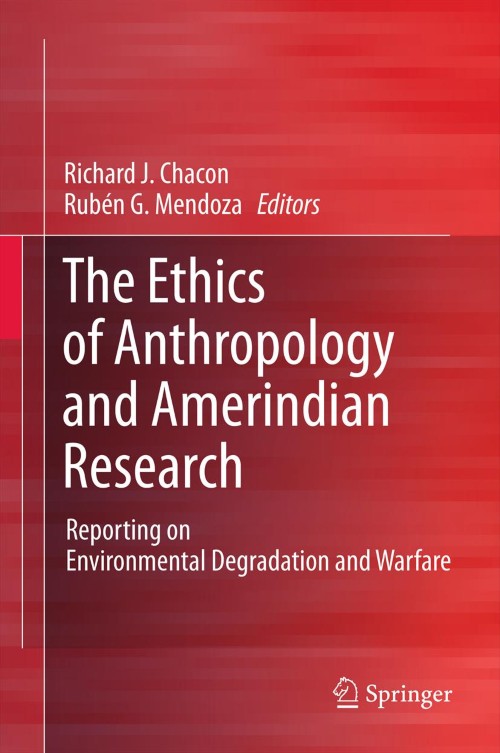
The Ethics of Anthropology and Amerindian Research [electronic resource] : Reporting on Environmental Degradation and Warfare / edited by Richard J. Chacon, Rubén G. Mendoza.
Erişim Adresi
ISBN
9781461410652
Dil Kodu
İngilizce
Yer Numarası
DK/7782
Basım Bildirimi
1st ed. 2012.
Yayın Bilgisi
New York, NY : Springer New York : Imprint: Springer, 2012.
Fiziksel Niteleme
XVI, 524 p. online resource.
İçindekiler Notu
Shepard Krech III (Brown University) “Foreword.” 1. Richard J. Chacon (Winthrop University) and Rubén G. Mendoza (California State U. Monterey Bay) “Introduction.”-.2. Christopher W. Schmidt (University of Indianapolis) and Rachel A. Lockhart Sharkey (University of Indianapolis) “Ethical and Political Ramifications of the Reporting/Non-reporting of Native American Ritualized Violence.” -- 3. Charles R. Cobb (South Carolina Institute of Archaeology and Anthropology) and Dawnie Wolfe Steadman (Binghamton University) “Pre-Columbian Warfare and Indecorous Images in Southeastern North America.”.-4. David H. Dye (University of Memphis) and M. Franklin Keel (Bureau of Indian Affairs) “The Portrayal of Native American Violence and Warfare: Who Speaks for the Past?” -- 5. Brooke Bauer (University of North Carolina, Chapel Hill) “Catawba Indians’ Adaptive Response to Colonialism.”.-6. Kitty F. Emery (Florida Museum of Natural History) and Linda Brown (George Washington University) “Maya Hunting Sustainability: Perspectives From Past and Present.”.-7. Arthur A. Demarest (Vanderbilt) and Brent Woodfill (U. of Louisiana, Lafayette) “Sympathetic Ethnocentrism, Repression, and Auto-repression of Q’eqchi’ Maya Blood Sacrifice.”.-8. Richard D. Hansen (Idaho State University) “Relativism, Revisionism, Aboriginalism, and Emic/Etic Truth: The Case Study of Apocalypto.”.-9. Rubén G. Mendoza (California State U. Monterey Bay) and Shari René Harder (California State U. Monterey Bay) “Mythologies of Conquest: Demystifying Amerindian Warfare and European Triumphalism in the Americas.”.-10. John W. Hoopes (University of Kansas) “Imagining Human Alteration of Ancient Landscapes in Central and South America.”.-11.Dennis E. Ogburn (UNC Charlotte) “Overstating, Downplaying and Denying Indigenous Conquest Warfare in Prehispanic Empires of the Andes.”.-12. Elizabeth Arkush (University of Pittsburg) “Violence, indigeneity, andarchaeological interpretation in the central Andes.”.-13. Richard J. Chacon (Winthrop University) “Conservation or Resource Maximization? Analyzing Subsistence Hunting Among the Achuar (Shiwiar) of Ecuador.” -- 14. Robert L. Carneiro (American Museum of Natural History). “The Studied Avoidance of War as an Instrument of Political Evolution.” -- 15. John Walden (Marshall University School of Medicine) “Medical Ramifications of Failing to Acknowledge Amerindian Warfare, Violence, Social Inequality and Cultural Enigmas.”.-16. Antonio Chavarria (Museum of Indian Arts and Culture) and Rubén G. Mendoza (California State U. Monterey Bay). “Ancestral Pueblos and Modern Diatribes: An Interview with Antonio Chavarria of Santa Clara Pueblo, Curator of Ethnology, Museum of Indian Arts and Culture, Santa Fe, New Mexico.” -- 17. Alberto Esquit-Choy (Kaqchikel Maya Foundation) “Indigenous Peoples and Environmental Degradation: An Indigenous Perspective.” -- 18. M. Gregory Oakes (Winthrop University) “The Logic of Indigenous Voice.”.-19. Richard J. Chacon (Winthrop University) and Rubén G. Mendoza (California State U. Monterey Bay) “Discussion and Conclusions.”.-.
Özet, vb.
The decision to publish scholarly findings bearing on the question of Amerindian environmental degradation, warfare, and/or violence is one that weighs heavily on anthropologists. This burden stems from the fact that documentation of this may render indigenous communities vulnerable to a host of predatory agendas and hostile modern forces. Consequently, some anthropologists and community advocates alike argue that such culturally and socially sensitive, and thereby, politically volatile information regarding Amerindian-induced environmental degradation and warfare should not be reported. This admonition presents a conundrum for anthropologists and other social scientists employed in the academy or who work at the behest of tribal entities. This work documents the various ethical dilemmas that confront anthropologists, and researchers in general, when investigating Amerindian communities. The contributions to this volume explore the ramifications of reporting--and, specfically,--of non-reporting instances of environmental degradation and warfare among Amerindians. Collectively, the contributions in this volume, which extend across the disciplines of archaeology, anthropology, ethnohistory, ethnic studies, philosophy, and medicine, argue that the non-reporting of environmental mismanagement and violence in Amerindian communities generally harms not only the field of anthropology but the Amerindian populations themselves.
Konu
Anthropology.
Ethics.
Ethnology.
Culture.
Archaeology.
Anthropology.
Moral Philosophy and Applied Ethics.
Regional Cultural Studies.
Archaeology.
Ethics.
Ethnology.
Culture.
Archaeology.
Anthropology.
Moral Philosophy and Applied Ethics.
Regional Cultural Studies.
Archaeology.
Diğer Yazarlar
Kurum Adı
Eseri Alıntıla
Referansları kullanmadan önce gözden geçirmeniz ve varsa gerekli düzeltmeleri yapmanız önerilir.
Dijital Kaynak
MARC Görünümü
LEADER 06533nam a22005415i 4500
001 806482
003 TR_AnAIT
005 20260127002207
007 cr nn 008mamaa
008 111214s2012 xxu| s |||| 0|eng d
020 |a9781461410652|9978-1-4614-1065-2
024 7 |a10.1007/978-1-4614-1065-2|2doi
041 |aeng
049 |aTürk Tarih Kurumu Kütüphanesi
050 4|aGN
072 7|aJHM|2bicssc
072 7|aSOC002000|2bisacsh
072 7|aJHM|2thema
082 04|a301|223
090 |aDK/7782
245 14|aThe Ethics of Anthropology and Amerindian Research|h[electronic resource] :|bReporting on Environmental Degradation and Warfare /|cedited by Richard J. Chacon, Rubén G. Mendoza.
250 |a1st ed. 2012.
264 1|aNew York, NY :|bSpringer New York :|bImprint: Springer,|c2012.
300 |aXVI, 524 p.|bonline resource.
336 |atext|btxt|2rdacontent
337 |acomputer|bc|2rdamedia
338 |aonline resource|bcr|2rdacarrier
347 |atext file|bPDF|2rda
505 0 |aShepard Krech III (Brown University) “Foreword.” 1. Richard J. Chacon (Winthrop University) and Rubén G. Mendoza (California State U. Monterey Bay) “Introduction.”-.2. Christopher W. Schmidt (University of Indianapolis) and Rachel A. Lockhart Sharkey (University of Indianapolis) “Ethical and Political Ramifications of the Reporting/Non-reporting of Native American Ritualized Violence.” -- 3. Charles R. Cobb (South Carolina Institute of Archaeology and Anthropology) and Dawnie Wolfe Steadman (Binghamton University) “Pre-Columbian Warfare and Indecorous Images in Southeastern North America.”.-4. David H. Dye (University of Memphis) and M. Franklin Keel (Bureau of Indian Affairs) “The Portrayal of Native American Violence and Warfare: Who Speaks for the Past?” -- 5. Brooke Bauer (University of North Carolina, Chapel Hill) “Catawba Indians’ Adaptive Response to Colonialism.”.-6. Kitty F. Emery (Florida Museum of Natural History) and Linda Brown (George Washington University) “Maya Hunting Sustainability: Perspectives From Past and Present.”.-7. Arthur A. Demarest (Vanderbilt) and Brent Woodfill (U. of Louisiana, Lafayette) “Sympathetic Ethnocentrism, Repression, and Auto-repression of Q’eqchi’ Maya Blood Sacrifice.”.-8. Richard D. Hansen (Idaho State University) “Relativism, Revisionism, Aboriginalism, and Emic/Etic Truth: The Case Study of Apocalypto.”.-9. Rubén G. Mendoza (California State U. Monterey Bay) and Shari René Harder (California State U. Monterey Bay) “Mythologies of Conquest: Demystifying Amerindian Warfare and European Triumphalism in the Americas.”.-10. John W. Hoopes (University of Kansas) “Imagining Human Alteration of Ancient Landscapes in Central and South America.”.-11.Dennis E. Ogburn (UNC Charlotte) “Overstating, Downplaying and Denying Indigenous Conquest Warfare in Prehispanic Empires of the Andes.”.-12. Elizabeth Arkush (University of Pittsburg) “Violence, indigeneity, andarchaeological interpretation in the central Andes.”.-13. Richard J. Chacon (Winthrop University) “Conservation or Resource Maximization? Analyzing Subsistence Hunting Among the Achuar (Shiwiar) of Ecuador.” -- 14. Robert L. Carneiro (American Museum of Natural History). “The Studied Avoidance of War as an Instrument of Political Evolution.” -- 15. John Walden (Marshall University School of Medicine) “Medical Ramifications of Failing to Acknowledge Amerindian Warfare, Violence, Social Inequality and Cultural Enigmas.”.-16. Antonio Chavarria (Museum of Indian Arts and Culture) and Rubén G. Mendoza (California State U. Monterey Bay). “Ancestral Pueblos and Modern Diatribes: An Interview with Antonio Chavarria of Santa Clara Pueblo, Curator of Ethnology, Museum of Indian Arts and Culture, Santa Fe, New Mexico.” -- 17. Alberto Esquit-Choy (Kaqchikel Maya Foundation) “Indigenous Peoples and Environmental Degradation: An Indigenous Perspective.” -- 18. M. Gregory Oakes (Winthrop University) “The Logic of Indigenous Voice.”.-19. Richard J. Chacon (Winthrop University) and Rubén G. Mendoza (California State U. Monterey Bay) “Discussion and Conclusions.”.-.
520 |aThe decision to publish scholarly findings bearing on the question of Amerindian environmental degradation, warfare, and/or violence is one that weighs heavily on anthropologists. This burden stems from the fact that documentation of this may render indigenous communities vulnerable to a host of predatory agendas and hostile modern forces. Consequently, some anthropologists and community advocates alike argue that such culturally and socially sensitive, and thereby, politically volatile information regarding Amerindian-induced environmental degradation and warfare should not be reported. This admonition presents a conundrum for anthropologists and other social scientists employed in the academy or who work at the behest of tribal entities. This work documents the various ethical dilemmas that confront anthropologists, and researchers in general, when investigating Amerindian communities. The contributions to this volume explore the ramifications of reporting--and, specfically,--of non-reporting instances of environmental degradation and warfare among Amerindians. Collectively, the contributions in this volume, which extend across the disciplines of archaeology, anthropology, ethnohistory, ethnic studies, philosophy, and medicine, argue that the non-reporting of environmental mismanagement and violence in Amerindian communities generally harms not only the field of anthropology but the Amerindian populations themselves.
650 0|aAnthropology.
650 0|aEthics.
650 0|aEthnology.
650 0|aCulture.
650 0|aArchaeology.
650 14|aAnthropology.
650 24|aMoral Philosophy and Applied Ethics.
650 24|aRegional Cultural Studies.
650 24|aArchaeology.
700 1 |aChacon, Richard J.|eeditor.|4edt|4http://id.loc.gov/vocabulary/relators/edt
700 1 |aMendoza, Rubén G.|eeditor.|4edt|4http://id.loc.gov/vocabulary/relators/edt
710 2 |aSpringerLink (Online service)
773 0 |tSpringer Nature eBook
776 08|iPrinted edition:|z9781461410645
776 08|iPrinted edition:|z9781461410669
776 08|iPrinted edition:|z9781489989628
856 40|uhttps://doi.org/10.1007/978-1-4614-1065-2
912 |aZDB-2-SHU
912 |aZDB-2-SXS
950 |aHumanities, Social Sciences and Law (SpringerNature-11648)
950 |aSocial Sciences (R0) (SpringerNature-43726)
001 806482
003 TR_AnAIT
005 20260127002207
007 cr nn 008mamaa
008 111214s2012 xxu| s |||| 0|eng d
020 |a9781461410652|9978-1-4614-1065-2
024 7 |a10.1007/978-1-4614-1065-2|2doi
041 |aeng
049 |aTürk Tarih Kurumu Kütüphanesi
050 4|aGN
072 7|aJHM|2bicssc
072 7|aSOC002000|2bisacsh
072 7|aJHM|2thema
082 04|a301|223
090 |aDK/7782
245 14|aThe Ethics of Anthropology and Amerindian Research|h[electronic resource] :|bReporting on Environmental Degradation and Warfare /|cedited by Richard J. Chacon, Rubén G. Mendoza.
250 |a1st ed. 2012.
264 1|aNew York, NY :|bSpringer New York :|bImprint: Springer,|c2012.
300 |aXVI, 524 p.|bonline resource.
336 |atext|btxt|2rdacontent
337 |acomputer|bc|2rdamedia
338 |aonline resource|bcr|2rdacarrier
347 |atext file|bPDF|2rda
505 0 |aShepard Krech III (Brown University) “Foreword.” 1. Richard J. Chacon (Winthrop University) and Rubén G. Mendoza (California State U. Monterey Bay) “Introduction.”-.2. Christopher W. Schmidt (University of Indianapolis) and Rachel A. Lockhart Sharkey (University of Indianapolis) “Ethical and Political Ramifications of the Reporting/Non-reporting of Native American Ritualized Violence.” -- 3. Charles R. Cobb (South Carolina Institute of Archaeology and Anthropology) and Dawnie Wolfe Steadman (Binghamton University) “Pre-Columbian Warfare and Indecorous Images in Southeastern North America.”.-4. David H. Dye (University of Memphis) and M. Franklin Keel (Bureau of Indian Affairs) “The Portrayal of Native American Violence and Warfare: Who Speaks for the Past?” -- 5. Brooke Bauer (University of North Carolina, Chapel Hill) “Catawba Indians’ Adaptive Response to Colonialism.”.-6. Kitty F. Emery (Florida Museum of Natural History) and Linda Brown (George Washington University) “Maya Hunting Sustainability: Perspectives From Past and Present.”.-7. Arthur A. Demarest (Vanderbilt) and Brent Woodfill (U. of Louisiana, Lafayette) “Sympathetic Ethnocentrism, Repression, and Auto-repression of Q’eqchi’ Maya Blood Sacrifice.”.-8. Richard D. Hansen (Idaho State University) “Relativism, Revisionism, Aboriginalism, and Emic/Etic Truth: The Case Study of Apocalypto.”.-9. Rubén G. Mendoza (California State U. Monterey Bay) and Shari René Harder (California State U. Monterey Bay) “Mythologies of Conquest: Demystifying Amerindian Warfare and European Triumphalism in the Americas.”.-10. John W. Hoopes (University of Kansas) “Imagining Human Alteration of Ancient Landscapes in Central and South America.”.-11.Dennis E. Ogburn (UNC Charlotte) “Overstating, Downplaying and Denying Indigenous Conquest Warfare in Prehispanic Empires of the Andes.”.-12. Elizabeth Arkush (University of Pittsburg) “Violence, indigeneity, andarchaeological interpretation in the central Andes.”.-13. Richard J. Chacon (Winthrop University) “Conservation or Resource Maximization? Analyzing Subsistence Hunting Among the Achuar (Shiwiar) of Ecuador.” -- 14. Robert L. Carneiro (American Museum of Natural History). “The Studied Avoidance of War as an Instrument of Political Evolution.” -- 15. John Walden (Marshall University School of Medicine) “Medical Ramifications of Failing to Acknowledge Amerindian Warfare, Violence, Social Inequality and Cultural Enigmas.”.-16. Antonio Chavarria (Museum of Indian Arts and Culture) and Rubén G. Mendoza (California State U. Monterey Bay). “Ancestral Pueblos and Modern Diatribes: An Interview with Antonio Chavarria of Santa Clara Pueblo, Curator of Ethnology, Museum of Indian Arts and Culture, Santa Fe, New Mexico.” -- 17. Alberto Esquit-Choy (Kaqchikel Maya Foundation) “Indigenous Peoples and Environmental Degradation: An Indigenous Perspective.” -- 18. M. Gregory Oakes (Winthrop University) “The Logic of Indigenous Voice.”.-19. Richard J. Chacon (Winthrop University) and Rubén G. Mendoza (California State U. Monterey Bay) “Discussion and Conclusions.”.-.
520 |aThe decision to publish scholarly findings bearing on the question of Amerindian environmental degradation, warfare, and/or violence is one that weighs heavily on anthropologists. This burden stems from the fact that documentation of this may render indigenous communities vulnerable to a host of predatory agendas and hostile modern forces. Consequently, some anthropologists and community advocates alike argue that such culturally and socially sensitive, and thereby, politically volatile information regarding Amerindian-induced environmental degradation and warfare should not be reported. This admonition presents a conundrum for anthropologists and other social scientists employed in the academy or who work at the behest of tribal entities. This work documents the various ethical dilemmas that confront anthropologists, and researchers in general, when investigating Amerindian communities. The contributions to this volume explore the ramifications of reporting--and, specfically,--of non-reporting instances of environmental degradation and warfare among Amerindians. Collectively, the contributions in this volume, which extend across the disciplines of archaeology, anthropology, ethnohistory, ethnic studies, philosophy, and medicine, argue that the non-reporting of environmental mismanagement and violence in Amerindian communities generally harms not only the field of anthropology but the Amerindian populations themselves.
650 0|aAnthropology.
650 0|aEthics.
650 0|aEthnology.
650 0|aCulture.
650 0|aArchaeology.
650 14|aAnthropology.
650 24|aMoral Philosophy and Applied Ethics.
650 24|aRegional Cultural Studies.
650 24|aArchaeology.
700 1 |aChacon, Richard J.|eeditor.|4edt|4http://id.loc.gov/vocabulary/relators/edt
700 1 |aMendoza, Rubén G.|eeditor.|4edt|4http://id.loc.gov/vocabulary/relators/edt
710 2 |aSpringerLink (Online service)
773 0 |tSpringer Nature eBook
776 08|iPrinted edition:|z9781461410645
776 08|iPrinted edition:|z9781461410669
776 08|iPrinted edition:|z9781489989628
856 40|uhttps://doi.org/10.1007/978-1-4614-1065-2
912 |aZDB-2-SHU
912 |aZDB-2-SXS
950 |aHumanities, Social Sciences and Law (SpringerNature-11648)
950 |aSocial Sciences (R0) (SpringerNature-43726)
Materyaller
Depodan talep edilen materyal sadece kütüphane içerisinde kullanılmaktadır.
Materyal dışarıya ödünç verilmemektedir.
Materyal dışarıya ödünç verilmemektedir.
