

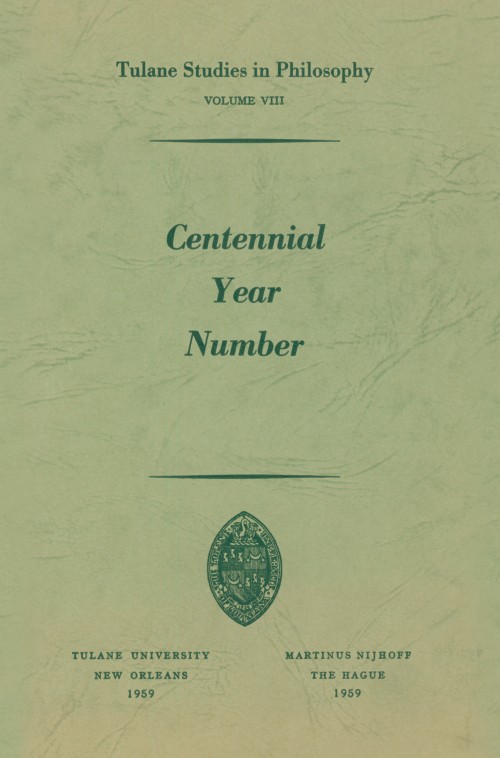
Centennial Year Number [electronic resource] / by James K. Feibleman, Paul G. Morrison, Andrew J. Reck, Harold N. Lee, Edward G. Ballard, Richard L. Barber, Carl H. Hamburg, Robert C. Whittemore.
Erişim Adresi
ISBN
9789401036955
Dil Kodu
İngilizce
Yer Numarası
DK/7805
Yazar
Basım Bildirimi
1st ed. 1959.
Yayın Bilgisi
Dordrecht : Springer Netherlands : Imprint: Springer, 1959.
Fiziksel Niteleme
132 p. online resource.
Dizi
Tulane Studies in Philosophy ; 8
İçindekiler Notu
Darwin and Scientific Method -- On Evolution -- Bergson’s Theory of Duration -- Bergson’s Two Ways of Knowing -- On the Nature of Romanticism -- Toward a Working Definition of Metaphysics -- Kant’s First Steps Toward an Ethical Formalism -- Metaphysical Foundations of Sartre’s Ontology.
Özet, vb.
The year 1959 has been called The Centennial Year in view of the anniversary of the publication of The Origin of SPecies and the centenary of the births of many who later contributed much to the philosophy of the recent past, such as Samuel Alexander, Henri Bergson, John Dewey and Edmund Husser!' The essays in the present volume which are on subjects germane to any of the anniversaries celebrated this year have been placed first in the present volume. CENTENNIAL YEAR NUMBER DARWIN AND SCIENTIFIC METHOD JAMES K. FEIBLEMAN The knowledge of methodology, which is acquired by means of formal education in the various disciplines, is usually com municated in abstract form. Harmony and counterpoint in musical composition, the axiomatic method of mathematics, the established laws in physics or in chemistry, the principles of mathematics - all these are taught abstractly. It is only when we come to the method of discovery in experimental science that we find abstract communication failing. The most recent as well as the greatest successes of the experimental sciences have been those scored in modern times, but we know as yet of no abstract way to teach the scientific method. The astonishing pedagogical fact is that this method has never been abstracted and set forth in a fashion which would permit of its easy acquisition. Here is an astonishing oversight indeed, for which the very difficulty of the topic may itself be responsible.
Konu
Ontology.
Science __ Philosophy.
Ontology.
Philosophy of Science.
Science __ Philosophy.
Ontology.
Philosophy of Science.
Diğer Yazarlar
Kurum Adı
