

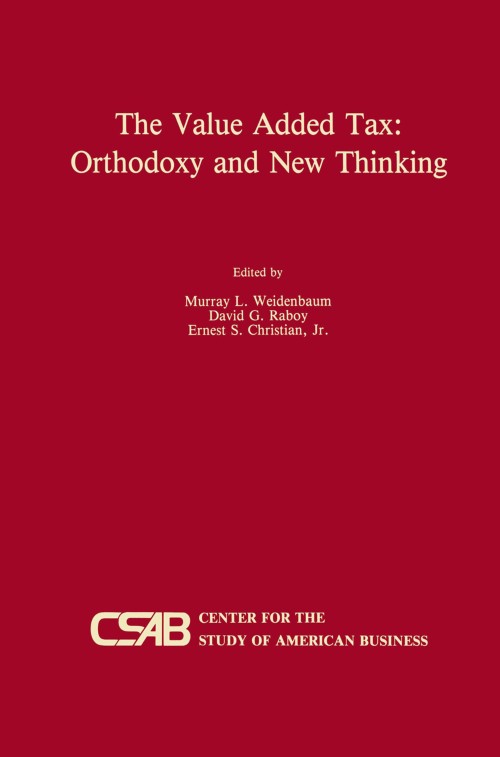
The Value-Added Tax: Orthodoxy and New Thinking [electronic resource] / edited by Murray L. Weidenbaum, David G. Raboy, Ernest S. Christian Jr.
Erişim Adresi
ISBN
9789400924963
Dil Kodu
İngilizce
Yer Numarası
DK/7811
Basım Bildirimi
1st ed. 1989.
Yayın Bilgisi
Dordrecht : Springer Netherlands : Imprint: Springer, 1989.
Fiziksel Niteleme
XX, 272 p. online resource.
İçindekiler Notu
1. Shifting to Consumption as a Federal Tax Base: An Overview -- 2. If, When You Say “Value-Added Tax,” You Mean... -- 3. Who Bears the Burden of Consumption Taxes? -- 4. Implications of the Form of VAT on Incidence and Other Factors -- 5. Preferential Treatment: The Implications for Horizontal Equity Among Companies -- 6. Problems of Transition to a Value-Added Tax -- 7. International Implications of Value-Added Taxes -- 8. Value-Added Taxation of Financial Services -- 9. The Sectoral Impacts of a Value-Added Tax -- 10. Macroeconomic Effects of a Consumption-Based Tax -- 11. Administration and Compliance -- About the Contributors.
Özet, vb.
IF, WHEN YOU SAY "CONSUMPTION TAX , " YOU MEAN . . . by Ernest S. Christian, Jr. and Cliff Massa III Much has been said and written about consumption taxes in the United States, but mostly in a theoretical context. Dozens of schol arly treatises have been published, along with innumerable papers and speeches most of which were more argumentative than illumi nating in nature. Audiences have sat through uncounted confer ences on the merits or evils of consumption taxes, depending on the speakers' perspectives. There have been only three comprehensive legislative proposals to which these theories and arguments could be 1 applied, no one of which was acted upon in the Congress. Purveyors of conventional wisdom have suggested that this theo retical context might be replaced within a year or two by actual con sideration of a federal-level consumption tax. Some see enactment of such a tax as a desirable -- or at least a necessary -- means for reducing the federal deficit. The National Economic Commission, which was created by legislation in 1987 to recommend deficit reduction measures, was perceived by many skeptics and proponents alike to be the Trojan Horse which would carry a consumption tax Lrhe proposals were H. R. 7015, ''The Tax Restructuring Act of 1980," introduced by Rep. Al Ullman; S. 1102, ''The Business Transfer Tax Act of 1985," introduced by Senator William Roth; and H. R. 4598, introduced by Rep.
Konu
Private international law.
Conflict of laws.
International law.
Comparative law.
Finance, Public.
Economic policy.
Finance.
Private International Law, International and Foreign Law, Comparative Law.
Public Economics.
Economic Policy.
Financial Economics.
Conflict of laws.
International law.
Comparative law.
Finance, Public.
Economic policy.
Finance.
Private International Law, International and Foreign Law, Comparative Law.
Public Economics.
Economic Policy.
Financial Economics.
Diğer Yazarlar
Kurum Adı
Eseri Alıntıla
Referansları kullanmadan önce gözden geçirmeniz ve varsa gerekli düzeltmeleri yapmanız önerilir.
Dijital Kaynak
MARC Görünümü
LEADER 05049nam a22006615i 4500
001 806513
003 TR_AnAIT
005 20260127002244
007 cr nn 008mamaa
008 121227s1989 ne | s |||| 0|eng d
020 |a9789400924963|9978-94-009-2496-3
024 7 |a10.1007/978-94-009-2496-3|2doi
041 |aeng
049 |aTürk Tarih Kurumu Kütüphanesi
050 4|aK7000-7720.22
072 7|aLB|2bicssc
072 7|aLAM|2bicssc
072 7|aLAW051000|2bisacsh
072 7|aLB|2thema
072 7|aLAM|2thema
082 04|a340.9|223
090 |aDK/7811
245 14|aThe Value-Added Tax: Orthodoxy and New Thinking|h[electronic resource] /|cedited by Murray L. Weidenbaum, David G. Raboy, Ernest S. Christian Jr.
250 |a1st ed. 1989.
264 1|aDordrecht :|bSpringer Netherlands :|bImprint: Springer,|c1989.
300 |aXX, 272 p.|bonline resource.
336 |atext|btxt|2rdacontent
337 |acomputer|bc|2rdamedia
338 |aonline resource|bcr|2rdacarrier
347 |atext file|bPDF|2rda
505 0 |a1. Shifting to Consumption as a Federal Tax Base: An Overview -- 2. If, When You Say “Value-Added Tax,” You Mean... -- 3. Who Bears the Burden of Consumption Taxes? -- 4. Implications of the Form of VAT on Incidence and Other Factors -- 5. Preferential Treatment: The Implications for Horizontal Equity Among Companies -- 6. Problems of Transition to a Value-Added Tax -- 7. International Implications of Value-Added Taxes -- 8. Value-Added Taxation of Financial Services -- 9. The Sectoral Impacts of a Value-Added Tax -- 10. Macroeconomic Effects of a Consumption-Based Tax -- 11. Administration and Compliance -- About the Contributors.
520 |aIF, WHEN YOU SAY "CONSUMPTION TAX , " YOU MEAN . . . by Ernest S. Christian, Jr. and Cliff Massa III Much has been said and written about consumption taxes in the United States, but mostly in a theoretical context. Dozens of schol arly treatises have been published, along with innumerable papers and speeches most of which were more argumentative than illumi nating in nature. Audiences have sat through uncounted confer ences on the merits or evils of consumption taxes, depending on the speakers' perspectives. There have been only three comprehensive legislative proposals to which these theories and arguments could be 1 applied, no one of which was acted upon in the Congress. Purveyors of conventional wisdom have suggested that this theo retical context might be replaced within a year or two by actual con sideration of a federal-level consumption tax. Some see enactment of such a tax as a desirable -- or at least a necessary -- means for reducing the federal deficit. The National Economic Commission, which was created by legislation in 1987 to recommend deficit reduction measures, was perceived by many skeptics and proponents alike to be the Trojan Horse which would carry a consumption tax Lrhe proposals were H. R. 7015, ''The Tax Restructuring Act of 1980," introduced by Rep. Al Ullman; S. 1102, ''The Business Transfer Tax Act of 1985," introduced by Senator William Roth; and H. R. 4598, introduced by Rep.
532 8 |aAccessibility summary: This PDF is not accessible. It is based on scanned pages and does not support features such as screen reader compatibility or described non-text content (images, graphs etc). However, it likely supports searchable and selectable text based on OCR (Optical Character Recognition). Users with accessibility needs may not be able to use this content effectively. Please contact us at accessibilitysupport@springernature.com if you require assistance or an alternative format.
532 8 |aInaccessible, or known limited accessibility
532 8 |aNo reading system accessibility options actively disabled
532 8 |aPublisher contact for further accessibility information: accessibilitysupport@springernature.com
650 0|aPrivate international law.
650 0|aConflict of laws.
650 0|aInternational law.
650 0|aComparative law.
650 0|aFinance, Public.
650 0|aEconomic policy.
650 0|aFinance.
650 14|aPrivate International Law, International and Foreign Law, Comparative Law.
650 24|aPublic Economics.
650 24|aEconomic Policy.
650 24|aFinancial Economics.
700 1 |aWeidenbaum, Murray L.|eeditor.|4edt|4http://id.loc.gov/vocabulary/relators/edt
700 1 |aRaboy, David G.|eeditor.|4edt|4http://id.loc.gov/vocabulary/relators/edt
700 1 |aChristian Jr., Ernest S.|eeditor.|4edt|4http://id.loc.gov/vocabulary/relators/edt
710 2 |aSpringerLink (Online service)
773 0 |tSpringer Nature eBook
776 08|iPrinted edition:|z9780792390022
776 08|iPrinted edition:|z9789400924970
776 08|iPrinted edition:|z9789401076265
856 40|uhttps://doi.org/10.1007/978-94-009-2496-3
912 |aZDB-2-SHU
912 |aZDB-2-SXLC
912 |aZDB-2-BAE
950 |aHumanities, Social Sciences and Law (SpringerNature-11648)
950 |aLaw and Criminology (R0) (SpringerNature-43727)
001 806513
003 TR_AnAIT
005 20260127002244
007 cr nn 008mamaa
008 121227s1989 ne | s |||| 0|eng d
020 |a9789400924963|9978-94-009-2496-3
024 7 |a10.1007/978-94-009-2496-3|2doi
041 |aeng
049 |aTürk Tarih Kurumu Kütüphanesi
050 4|aK7000-7720.22
072 7|aLB|2bicssc
072 7|aLAM|2bicssc
072 7|aLAW051000|2bisacsh
072 7|aLB|2thema
072 7|aLAM|2thema
082 04|a340.9|223
090 |aDK/7811
245 14|aThe Value-Added Tax: Orthodoxy and New Thinking|h[electronic resource] /|cedited by Murray L. Weidenbaum, David G. Raboy, Ernest S. Christian Jr.
250 |a1st ed. 1989.
264 1|aDordrecht :|bSpringer Netherlands :|bImprint: Springer,|c1989.
300 |aXX, 272 p.|bonline resource.
336 |atext|btxt|2rdacontent
337 |acomputer|bc|2rdamedia
338 |aonline resource|bcr|2rdacarrier
347 |atext file|bPDF|2rda
505 0 |a1. Shifting to Consumption as a Federal Tax Base: An Overview -- 2. If, When You Say “Value-Added Tax,” You Mean... -- 3. Who Bears the Burden of Consumption Taxes? -- 4. Implications of the Form of VAT on Incidence and Other Factors -- 5. Preferential Treatment: The Implications for Horizontal Equity Among Companies -- 6. Problems of Transition to a Value-Added Tax -- 7. International Implications of Value-Added Taxes -- 8. Value-Added Taxation of Financial Services -- 9. The Sectoral Impacts of a Value-Added Tax -- 10. Macroeconomic Effects of a Consumption-Based Tax -- 11. Administration and Compliance -- About the Contributors.
520 |aIF, WHEN YOU SAY "CONSUMPTION TAX , " YOU MEAN . . . by Ernest S. Christian, Jr. and Cliff Massa III Much has been said and written about consumption taxes in the United States, but mostly in a theoretical context. Dozens of schol arly treatises have been published, along with innumerable papers and speeches most of which were more argumentative than illumi nating in nature. Audiences have sat through uncounted confer ences on the merits or evils of consumption taxes, depending on the speakers' perspectives. There have been only three comprehensive legislative proposals to which these theories and arguments could be 1 applied, no one of which was acted upon in the Congress. Purveyors of conventional wisdom have suggested that this theo retical context might be replaced within a year or two by actual con sideration of a federal-level consumption tax. Some see enactment of such a tax as a desirable -- or at least a necessary -- means for reducing the federal deficit. The National Economic Commission, which was created by legislation in 1987 to recommend deficit reduction measures, was perceived by many skeptics and proponents alike to be the Trojan Horse which would carry a consumption tax Lrhe proposals were H. R. 7015, ''The Tax Restructuring Act of 1980," introduced by Rep. Al Ullman; S. 1102, ''The Business Transfer Tax Act of 1985," introduced by Senator William Roth; and H. R. 4598, introduced by Rep.
532 8 |aAccessibility summary: This PDF is not accessible. It is based on scanned pages and does not support features such as screen reader compatibility or described non-text content (images, graphs etc). However, it likely supports searchable and selectable text based on OCR (Optical Character Recognition). Users with accessibility needs may not be able to use this content effectively. Please contact us at accessibilitysupport@springernature.com if you require assistance or an alternative format.
532 8 |aInaccessible, or known limited accessibility
532 8 |aNo reading system accessibility options actively disabled
532 8 |aPublisher contact for further accessibility information: accessibilitysupport@springernature.com
650 0|aPrivate international law.
650 0|aConflict of laws.
650 0|aInternational law.
650 0|aComparative law.
650 0|aFinance, Public.
650 0|aEconomic policy.
650 0|aFinance.
650 14|aPrivate International Law, International and Foreign Law, Comparative Law.
650 24|aPublic Economics.
650 24|aEconomic Policy.
650 24|aFinancial Economics.
700 1 |aWeidenbaum, Murray L.|eeditor.|4edt|4http://id.loc.gov/vocabulary/relators/edt
700 1 |aRaboy, David G.|eeditor.|4edt|4http://id.loc.gov/vocabulary/relators/edt
700 1 |aChristian Jr., Ernest S.|eeditor.|4edt|4http://id.loc.gov/vocabulary/relators/edt
710 2 |aSpringerLink (Online service)
773 0 |tSpringer Nature eBook
776 08|iPrinted edition:|z9780792390022
776 08|iPrinted edition:|z9789400924970
776 08|iPrinted edition:|z9789401076265
856 40|uhttps://doi.org/10.1007/978-94-009-2496-3
912 |aZDB-2-SHU
912 |aZDB-2-SXLC
912 |aZDB-2-BAE
950 |aHumanities, Social Sciences and Law (SpringerNature-11648)
950 |aLaw and Criminology (R0) (SpringerNature-43727)
Materyaller
Depodan talep edilen materyal sadece kütüphane içerisinde kullanılmaktadır.
Materyal dışarıya ödünç verilmemektedir.
Materyal dışarıya ödünç verilmemektedir.
