LEADER 03815nam a22005055i 4500
001 806531
003 TR_AnAIT
005 20260127002306
007 cr nn 008mamaa
008 100301s2010 ne | s |||| 0|eng d
020 |a9781402057717|9978-1-4020-5771-7
024 7 |a10.1007/978-1-4020-5771-7|2doi
041 |aeng
049 |aTürk Tarih Kurumu Kütüphanesi
050 4|aB790-5802
072 7|aHP|2bicssc
072 7|aPHI031000|2bisacsh
072 7|aQDH|2thema
082 04|a140|223
090 |aDK/7829
100 1 |aSefa Dei, George J.|eauthor.|4aut|4http://id.loc.gov/vocabulary/relators/aut
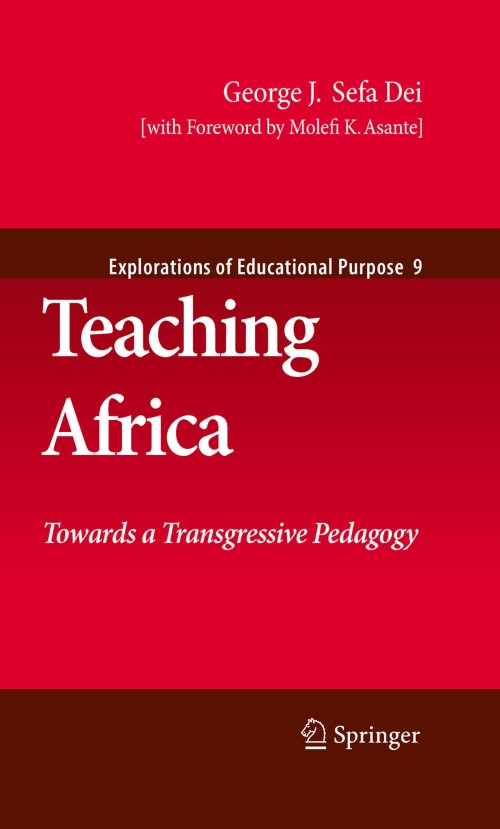
245 10|aTeaching Africa|h[electronic resource] :|bTowards a Transgressive Pedagogy /|cby George J. Sefa Dei.
250 |a1st ed. 2010.
264 1|aDordrecht :|bSpringer Netherlands :|bImprint: Springer,|c2010.
300 |aXXVII, 130 p.|bonline resource.
336 |atext|btxt|2rdacontent
337 |acomputer|bc|2rdamedia
338 |aonline resource|bcr|2rdacarrier
347 |atext file|bPDF|2rda
490 1 |aExplorations of Educational Purpose,|x1875-4457 ;|v9
505 0 |aHistory as Tool of Colonialism -- Teaching and Learning African History -- The Study of Africa and the African Experience: The Challenge and Possibilities of an Integrative Theory -- Theorizing Africa Beyond Its Boundaries -- Teaching Africa: “Development” and Decolonization -- Reclaiming “Development” Through Indigenity and Indigenous Knowledge -- Indigenous Knowledge! Any One? Pedagogical Possibilities for Anti-colonial Education -- Politicizing the Contemporary Learner: Implications for African Schooling and Education -- Looking to the Future – African-Centred Schooling in Action: Applying Development Discourse to Sustainability, Community Empowerment, and Health Awareness.
520 |aWritten from the perspective of a knowledge base and educational practice that are both African-centred, this volume uses a discursive pedagogy that is anti-colonial in origin. It theorizes colonial – and re-colonial – relations and the implications of imperial structures on knowledge production and use; the understanding of indigenousness; and the pursuit of agency, resistance and subjective politics. Using a refined definition of colonial, less as ‘foreign’ or ‘alien’ but more ‘imposed and dominating’, the author shows us how colonialism is domesticated and how those who have been oppressed by dominant/hegemonic discourses may find it difficult to step out of them, let alone challenge or resist them. The book is a call for a critical interrogation of dominant knowledge about Africa in order to help the contemporary learner come to grips with the challenges and possibilities of knowing about the African world and the African human condition. The author’s anti-colonial discursive platform addresses distorted Eurocentric views of Africa, raises ontological and epistemological questions about teaching methods and methodologies relating to Africa, and highlights knowledge indigenous to Africa. At the same time, it shows what the rest of the world can learn from this knowledge.
650 0|aPhilosophy, Modern.
650 0|aEducation|xPhilosophy.
650 14|aPhilosophical Traditions.
650 24|aPhilosophy of Education.
710 2 |aSpringerLink (Online service)
773 0 |tSpringer Nature eBook
776 08|iPrinted edition:|z9781402057700
776 08|iPrinted edition:|z9789048118458
776 08|iPrinted edition:|z9789400728615
776 08|iPrinted edition:|z9789400731295
830 0|aExplorations of Educational Purpose,|x1875-4457 ;|v9
856 40|uhttps://doi.org/10.1007/978-1-4020-5771-7
912 |aZDB-2-SHU
912 |aZDB-2-SXPR
950 |aHumanities, Social Sciences and Law (SpringerNature-11648)
950 |aPhilosophy and Religion (R0) (SpringerNature-43725)