

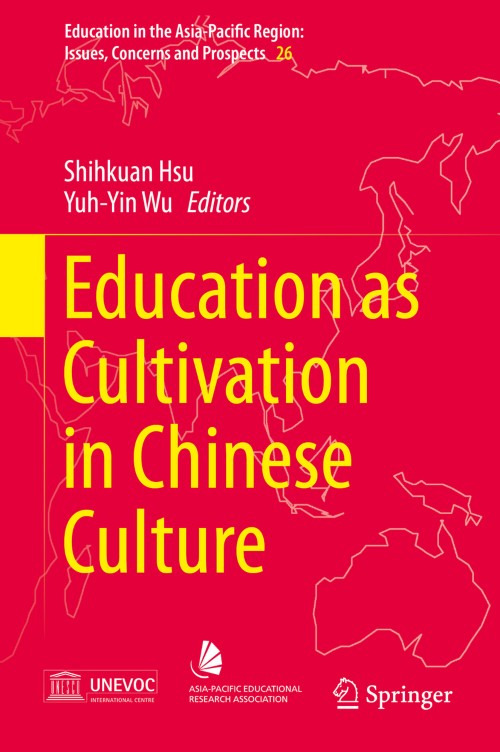
Education as Cultivation in Chinese Culture [electronic resource] / edited by Shihkuan Hsu, Yuh-Yin Wu.
Erişim Adresi
ISBN
9789812872241
Dil Kodu
İngilizce
Yer Numarası
DK/7858
Basım Bildirimi
1st ed. 2015.
Yayın Bilgisi
Singapore : Springer Nature Singapore : Imprint: Springer, 2015.
Fiziksel Niteleme
VIII, 288 p. 20 illus. online resource.
Dizi
Education in the Asia-Pacific Region: Issues, Concerns and Prospects, 2214-9791 ; 26
İçindekiler Notu
Chapter 1 Introduction -- Chapter 2 Human Nature and Learning in Ancient China -- Chapter 3 The Chinese Way of Goodness -- Chapter 4 Teaching at an Early Age -- Chapter 5 Conflicting Images of Taiwanese Young Children -- Chapter 6 Primary Schooling in Taiwan -- Chapter 7 The Studying and Striving of Secondary Students -- Chapter 8 Art Transforms Destiny: The Unified Examination and Fine Art Education -- Chapter 9 Education-Based Mobility and the Chinese Civilization -- Chapter 10 The conflict between social mobility and individual development -- Chapter 11 Teachers’ Dual Responsibilities for Academic Achievement and Character Development -- Chapter 12 Finding a New Identify for Teachers -- Chapter 13 Conclusion -- Appendix.
Özet, vb.
Given the increasing global interest in Chinese culture, this book uses case studies to describe and interpret Chinese cultivation in contemporary Taiwanese schools. Cultivation is a concept unique to Chinese culture and is characterized by different attitudes towards teaching and learning compared to Western models of education. The book starts with a discussion of human nature in Chinese schools of philosophy and levels of goodness. Following the philosophical background is a presentation of how cultivation is practiced in Chinese culture from prenatal through high school education. The case studies focus both on how students are cultivated as they become members of Chinese society, and on what role teachers play in cultivating the children in school. In addition, common practices of Chinese educational institutions, including public schools, families, and organizations such as private cram schools, are introduced and explained. In closing, the book presents a critique of the modern school reform movement and the conflicts between the reform proposals and traditional practices. Based on the collective work of Taiwanese researchers in the fields of education, history and anthropology, the book identifies the purpose of education as cultivating virtue, the process of creating an ideal person who serves society, and describes the way teachers have carried on this tradition despite its faltering status in contemporary educational discourse and in the face of reform movements.
Konu
Educational sociology.
Community psychology.
International education .
Comparative education.
Ethnology.
Culture.
Sociology of Education.
Community Psychology.
International and Comparative Education.
Regional Cultural Studies.
Community psychology.
International education .
Comparative education.
Ethnology.
Culture.
Sociology of Education.
Community Psychology.
International and Comparative Education.
Regional Cultural Studies.
Diğer Yazarlar
Kurum Adı
Eseri Alıntıla
Referansları kullanmadan önce gözden geçirmeniz ve varsa gerekli düzeltmeleri yapmanız önerilir.
Dijital Kaynak
MARC Görünümü
LEADER 04442nam a22006015i 4500
001 806560
003 TR_AnAIT
005 20260127002339
007 cr nn 008mamaa
008 141024s2015 si | s |||| 0|eng d
020 |a9789812872241|9978-981-287-224-1
024 7 |a10.1007/978-981-287-224-1|2doi
041 |aeng
049 |aTürk Tarih Kurumu Kütüphanesi
050 4|aLC189-214.53
072 7|aJN|2bicssc
072 7|aJHB|2bicssc
072 7|aEDU040000|2bisacsh
072 7|aJN|2thema
072 7|aJHB|2thema
082 04|a306.43|223
090 |aDK/7858
245 10|aEducation as Cultivation in Chinese Culture|h[electronic resource] /|cedited by Shihkuan Hsu, Yuh-Yin Wu.
250 |a1st ed. 2015.
264 1|aSingapore :|bSpringer Nature Singapore :|bImprint: Springer,|c2015.
300 |aVIII, 288 p. 20 illus.|bonline resource.
336 |atext|btxt|2rdacontent
337 |acomputer|bc|2rdamedia
338 |aonline resource|bcr|2rdacarrier
347 |atext file|bPDF|2rda
490 1 |aEducation in the Asia-Pacific Region: Issues, Concerns and Prospects,|x2214-9791 ;|v26
505 0 |aChapter 1 Introduction -- Chapter 2 Human Nature and Learning in Ancient China -- Chapter 3 The Chinese Way of Goodness -- Chapter 4 Teaching at an Early Age -- Chapter 5 Conflicting Images of Taiwanese Young Children -- Chapter 6 Primary Schooling in Taiwan -- Chapter 7 The Studying and Striving of Secondary Students -- Chapter 8 Art Transforms Destiny: The Unified Examination and Fine Art Education -- Chapter 9 Education-Based Mobility and the Chinese Civilization -- Chapter 10 The conflict between social mobility and individual development -- Chapter 11 Teachers’ Dual Responsibilities for Academic Achievement and Character Development -- Chapter 12 Finding a New Identify for Teachers -- Chapter 13 Conclusion -- Appendix.
520 |aGiven the increasing global interest in Chinese culture, this book uses case studies to describe and interpret Chinese cultivation in contemporary Taiwanese schools. Cultivation is a concept unique to Chinese culture and is characterized by different attitudes towards teaching and learning compared to Western models of education. The book starts with a discussion of human nature in Chinese schools of philosophy and levels of goodness. Following the philosophical background is a presentation of how cultivation is practiced in Chinese culture from prenatal through high school education. The case studies focus both on how students are cultivated as they become members of Chinese society, and on what role teachers play in cultivating the children in school. In addition, common practices of Chinese educational institutions, including public schools, families, and organizations such as private cram schools, are introduced and explained. In closing, the book presents a critique of the modern school reform movement and the conflicts between the reform proposals and traditional practices. Based on the collective work of Taiwanese researchers in the fields of education, history and anthropology, the book identifies the purpose of education as cultivating virtue, the process of creating an ideal person who serves society, and describes the way teachers have carried on this tradition despite its faltering status in contemporary educational discourse and in the face of reform movements.
650 0|aEducational sociology.
650 0|aCommunity psychology.
650 0|aInternational education .
650 0|aComparative education.
650 0|aEthnology.
650 0|aCulture.
650 14|aSociology of Education.
650 24|aCommunity Psychology.
650 24|aInternational and Comparative Education.
650 24|aRegional Cultural Studies.
700 1 |aHsu, Shihkuan.|eeditor.|4edt|4http://id.loc.gov/vocabulary/relators/edt
700 1 |aWu, Yuh-Yin.|eeditor.|4edt|4http://id.loc.gov/vocabulary/relators/edt
710 2 |aSpringerLink (Online service)
773 0 |tSpringer Nature eBook
776 08|iPrinted edition:|z9789812872234
776 08|iPrinted edition:|z9789812872258
776 08|iPrinted edition:|z9789811013300
830 0|aEducation in the Asia-Pacific Region: Issues, Concerns and Prospects,|x2214-9791 ;|v26
856 40|uhttps://doi.org/10.1007/978-981-287-224-1
912 |aZDB-2-SHU
912 |aZDB-2-SXED
950 |aHumanities, Social Sciences and Law (SpringerNature-11648)
950 |aEducation (R0) (SpringerNature-43721)
001 806560
003 TR_AnAIT
005 20260127002339
007 cr nn 008mamaa
008 141024s2015 si | s |||| 0|eng d
020 |a9789812872241|9978-981-287-224-1
024 7 |a10.1007/978-981-287-224-1|2doi
041 |aeng
049 |aTürk Tarih Kurumu Kütüphanesi
050 4|aLC189-214.53
072 7|aJN|2bicssc
072 7|aJHB|2bicssc
072 7|aEDU040000|2bisacsh
072 7|aJN|2thema
072 7|aJHB|2thema
082 04|a306.43|223
090 |aDK/7858
245 10|aEducation as Cultivation in Chinese Culture|h[electronic resource] /|cedited by Shihkuan Hsu, Yuh-Yin Wu.
250 |a1st ed. 2015.
264 1|aSingapore :|bSpringer Nature Singapore :|bImprint: Springer,|c2015.
300 |aVIII, 288 p. 20 illus.|bonline resource.
336 |atext|btxt|2rdacontent
337 |acomputer|bc|2rdamedia
338 |aonline resource|bcr|2rdacarrier
347 |atext file|bPDF|2rda
490 1 |aEducation in the Asia-Pacific Region: Issues, Concerns and Prospects,|x2214-9791 ;|v26
505 0 |aChapter 1 Introduction -- Chapter 2 Human Nature and Learning in Ancient China -- Chapter 3 The Chinese Way of Goodness -- Chapter 4 Teaching at an Early Age -- Chapter 5 Conflicting Images of Taiwanese Young Children -- Chapter 6 Primary Schooling in Taiwan -- Chapter 7 The Studying and Striving of Secondary Students -- Chapter 8 Art Transforms Destiny: The Unified Examination and Fine Art Education -- Chapter 9 Education-Based Mobility and the Chinese Civilization -- Chapter 10 The conflict between social mobility and individual development -- Chapter 11 Teachers’ Dual Responsibilities for Academic Achievement and Character Development -- Chapter 12 Finding a New Identify for Teachers -- Chapter 13 Conclusion -- Appendix.
520 |aGiven the increasing global interest in Chinese culture, this book uses case studies to describe and interpret Chinese cultivation in contemporary Taiwanese schools. Cultivation is a concept unique to Chinese culture and is characterized by different attitudes towards teaching and learning compared to Western models of education. The book starts with a discussion of human nature in Chinese schools of philosophy and levels of goodness. Following the philosophical background is a presentation of how cultivation is practiced in Chinese culture from prenatal through high school education. The case studies focus both on how students are cultivated as they become members of Chinese society, and on what role teachers play in cultivating the children in school. In addition, common practices of Chinese educational institutions, including public schools, families, and organizations such as private cram schools, are introduced and explained. In closing, the book presents a critique of the modern school reform movement and the conflicts between the reform proposals and traditional practices. Based on the collective work of Taiwanese researchers in the fields of education, history and anthropology, the book identifies the purpose of education as cultivating virtue, the process of creating an ideal person who serves society, and describes the way teachers have carried on this tradition despite its faltering status in contemporary educational discourse and in the face of reform movements.
650 0|aEducational sociology.
650 0|aCommunity psychology.
650 0|aInternational education .
650 0|aComparative education.
650 0|aEthnology.
650 0|aCulture.
650 14|aSociology of Education.
650 24|aCommunity Psychology.
650 24|aInternational and Comparative Education.
650 24|aRegional Cultural Studies.
700 1 |aHsu, Shihkuan.|eeditor.|4edt|4http://id.loc.gov/vocabulary/relators/edt
700 1 |aWu, Yuh-Yin.|eeditor.|4edt|4http://id.loc.gov/vocabulary/relators/edt
710 2 |aSpringerLink (Online service)
773 0 |tSpringer Nature eBook
776 08|iPrinted edition:|z9789812872234
776 08|iPrinted edition:|z9789812872258
776 08|iPrinted edition:|z9789811013300
830 0|aEducation in the Asia-Pacific Region: Issues, Concerns and Prospects,|x2214-9791 ;|v26
856 40|uhttps://doi.org/10.1007/978-981-287-224-1
912 |aZDB-2-SHU
912 |aZDB-2-SXED
950 |aHumanities, Social Sciences and Law (SpringerNature-11648)
950 |aEducation (R0) (SpringerNature-43721)
Materyaller
Depodan talep edilen materyal sadece kütüphane içerisinde kullanılmaktadır.
Materyal dışarıya ödünç verilmemektedir.
Materyal dışarıya ödünç verilmemektedir.
