

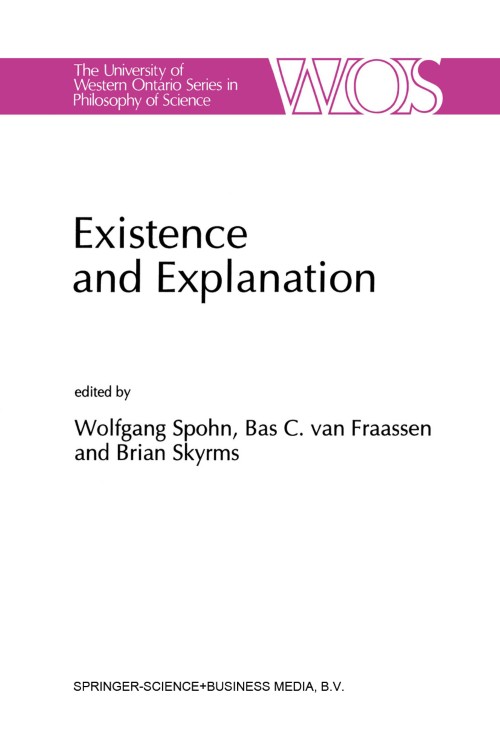
Existence and Explanation [electronic resource] : Essays presented in Honor of Karel Lambert / edited by W. Spohn, B.C. van Fraassen, B. Skyrms.
Erişim Adresi
ISBN
9789401132442
Dil Kodu
İngilizce
Yer Numarası
DK/7872
Basım Bildirimi
1st ed. 1991.
Yayın Bilgisi
Dordrecht : Springer Netherlands : Imprint: Springer, 1991.
Fiziksel Niteleme
XII, 247 p. online resource.
Dizi
The Western Ontario Series in Philosophy of Science, A Series of Books in Philosophy of Science, Methodology, Epistemology, Logic, History of Science, and Related Fields, 2215-1974 ; 49
İçindekiler Notu
On (the x) (x = Lambert) -- Five Easy Pieces -- The Cartesian Cogitos -- Undefined Definite Descriptions -- Maximum Entropy Updating and Conditionalization -- Leibniz on Ens and Existence -- Colours, Corners and Complexity: Meinong and Wittgenstein on Some Internal Relations -- Atomic Sentences as Singular Terms in Free Logic -- EPR-Situation and Bell’s Inequality -- On Being Spread Out in Time: Temporal Parts and the Problem of Change -- Stability and Chance -- A Reason for Explanation: Explanations Provide Stable Reasons -- The Systems of Plato and Aristotle Compared as to Their Contributions to Physics -- A Note on Aristotle’s Theory of Definition and Scientific Explanation -- Actualism, Free Logic and First-Order Supervaluations -- Bibliography Of Karel Lambert.
Özet, vb.
This collection of essays is dedicated to 'Joe' Karel Lambert. The contributors are all personally affected to Joe in some way or other, but they are definitely not the only ones. Whatever excuses there are - there are some -, the editors apologize to whomever they have neglected. But even so the collection displays how influential Karel Lambert has been, personally and through his teaching and his writings. The display is in alphabetical order - with one exception: Bas van Fraassen, being about the earliest student of Karel Lambert, opens the collection with some reminiscences. Naturally, one of the focal points of this volume is Lambert's logical thinking and (or: freed of) ontological thinking. Free logic is intimately connected with description theory. Bas van Fraassen gives a survey of the development of the area, and Charles Daniels points to difficulties with definite descriptions in modal contexts and stories. Peter Woodruff addresses the relation between free logic and supervaluation semantics, presenting a novel condition which recovers desirable metatheoretic properties for free logic under that semantics. Terence Parsons shows how free logic can be utilized in interpreting sentences as purporting to denote events (true ones succeed and false ones fail) and how this helps to understand natural language.
Konu
Logic.
Science __ Philosophy.
Language and languages __ Philosophy.
Logic.
Philosophy of Science.
Philosophy of Language.
Science __ Philosophy.
Language and languages __ Philosophy.
Logic.
Philosophy of Science.
Philosophy of Language.
Diğer Yazarlar
Kurum Adı
Eseri Alıntıla
Referansları kullanmadan önce gözden geçirmeniz ve varsa gerekli düzeltmeleri yapmanız önerilir.
Dijital Kaynak
MARC Görünümü
LEADER 05198nam a22006015i 4500
001 806574
003 TR_AnAIT
005 20260127002356
007 cr nn 008mamaa
008 121227s1991 ne | s |||| 0|eng d
020 |a9789401132442|9978-94-011-3244-2
024 7 |a10.1007/978-94-011-3244-2|2doi
041 |aeng
049 |aTürk Tarih Kurumu Kütüphanesi
050 4|aBC1-199
072 7|aHPL|2bicssc
072 7|aPHI011000|2bisacsh
072 7|aQDTL|2thema
082 04|a160|223
090 |aDK/7872
245 10|aExistence and Explanation|h[electronic resource] :|bEssays presented in Honor of Karel Lambert /|cedited by W. Spohn, B.C. van Fraassen, B. Skyrms.
250 |a1st ed. 1991.
264 1|aDordrecht :|bSpringer Netherlands :|bImprint: Springer,|c1991.
300 |aXII, 247 p.|bonline resource.
336 |atext|btxt|2rdacontent
337 |acomputer|bc|2rdamedia
338 |aonline resource|bcr|2rdacarrier
347 |atext file|bPDF|2rda
490 1 |aThe Western Ontario Series in Philosophy of Science, A Series of Books in Philosophy of Science, Methodology, Epistemology, Logic, History of Science, and Related Fields,|x2215-1974 ;|v49
505 0 |aOn (the x) (x = Lambert) -- Five Easy Pieces -- The Cartesian Cogitos -- Undefined Definite Descriptions -- Maximum Entropy Updating and Conditionalization -- Leibniz on Ens and Existence -- Colours, Corners and Complexity: Meinong and Wittgenstein on Some Internal Relations -- Atomic Sentences as Singular Terms in Free Logic -- EPR-Situation and Bell’s Inequality -- On Being Spread Out in Time: Temporal Parts and the Problem of Change -- Stability and Chance -- A Reason for Explanation: Explanations Provide Stable Reasons -- The Systems of Plato and Aristotle Compared as to Their Contributions to Physics -- A Note on Aristotle’s Theory of Definition and Scientific Explanation -- Actualism, Free Logic and First-Order Supervaluations -- Bibliography Of Karel Lambert.
520 |aThis collection of essays is dedicated to 'Joe' Karel Lambert. The contributors are all personally affected to Joe in some way or other, but they are definitely not the only ones. Whatever excuses there are - there are some -, the editors apologize to whomever they have neglected. But even so the collection displays how influential Karel Lambert has been, personally and through his teaching and his writings. The display is in alphabetical order - with one exception: Bas van Fraassen, being about the earliest student of Karel Lambert, opens the collection with some reminiscences. Naturally, one of the focal points of this volume is Lambert's logical thinking and (or: freed of) ontological thinking. Free logic is intimately connected with description theory. Bas van Fraassen gives a survey of the development of the area, and Charles Daniels points to difficulties with definite descriptions in modal contexts and stories. Peter Woodruff addresses the relation between free logic and supervaluation semantics, presenting a novel condition which recovers desirable metatheoretic properties for free logic under that semantics. Terence Parsons shows how free logic can be utilized in interpreting sentences as purporting to denote events (true ones succeed and false ones fail) and how this helps to understand natural language.
532 8 |aAccessibility summary: This PDF is not accessible. It is based on scanned pages and does not support features such as screen reader compatibility or described non-text content (images, graphs etc). However, it likely supports searchable and selectable text based on OCR (Optical Character Recognition). Users with accessibility needs may not be able to use this content effectively. Please contact us at accessibilitysupport@springernature.com if you require assistance or an alternative format.
532 8 |aInaccessible, or known limited accessibility
532 8 |aNo reading system accessibility options actively disabled
532 8 |aPublisher contact for further accessibility information: accessibilitysupport@springernature.com
650 0|aLogic.
650 0|aScience|xPhilosophy.
650 0|aLanguage and languages|xPhilosophy.
650 14|aLogic.
650 24|aPhilosophy of Science.
650 24|aPhilosophy of Language.
700 1 |aSpohn, W.|eeditor.|4edt|4http://id.loc.gov/vocabulary/relators/edt
700 1 |avan Fraassen, B.C.|eeditor.|4edt|4http://id.loc.gov/vocabulary/relators/edt
700 1 |aSkyrms, B.|eeditor.|4edt|4http://id.loc.gov/vocabulary/relators/edt
710 2 |aSpringerLink (Online service)
773 0 |tSpringer Nature eBook
776 08|iPrinted edition:|z9780792312529
776 08|iPrinted edition:|z9789401132459
776 08|iPrinted edition:|z9789401054300
830 0|aThe Western Ontario Series in Philosophy of Science, A Series of Books in Philosophy of Science, Methodology, Epistemology, Logic, History of Science, and Related Fields,|x2215-1974 ;|v49
856 40|uhttps://doi.org/10.1007/978-94-011-3244-2
912 |aZDB-2-SHU
912 |aZDB-2-SXPR
912 |aZDB-2-BAE
950 |aHumanities, Social Sciences and Law (SpringerNature-11648)
950 |aPhilosophy and Religion (R0) (SpringerNature-43725)
001 806574
003 TR_AnAIT
005 20260127002356
007 cr nn 008mamaa
008 121227s1991 ne | s |||| 0|eng d
020 |a9789401132442|9978-94-011-3244-2
024 7 |a10.1007/978-94-011-3244-2|2doi
041 |aeng
049 |aTürk Tarih Kurumu Kütüphanesi
050 4|aBC1-199
072 7|aHPL|2bicssc
072 7|aPHI011000|2bisacsh
072 7|aQDTL|2thema
082 04|a160|223
090 |aDK/7872
245 10|aExistence and Explanation|h[electronic resource] :|bEssays presented in Honor of Karel Lambert /|cedited by W. Spohn, B.C. van Fraassen, B. Skyrms.
250 |a1st ed. 1991.
264 1|aDordrecht :|bSpringer Netherlands :|bImprint: Springer,|c1991.
300 |aXII, 247 p.|bonline resource.
336 |atext|btxt|2rdacontent
337 |acomputer|bc|2rdamedia
338 |aonline resource|bcr|2rdacarrier
347 |atext file|bPDF|2rda
490 1 |aThe Western Ontario Series in Philosophy of Science, A Series of Books in Philosophy of Science, Methodology, Epistemology, Logic, History of Science, and Related Fields,|x2215-1974 ;|v49
505 0 |aOn (the x) (x = Lambert) -- Five Easy Pieces -- The Cartesian Cogitos -- Undefined Definite Descriptions -- Maximum Entropy Updating and Conditionalization -- Leibniz on Ens and Existence -- Colours, Corners and Complexity: Meinong and Wittgenstein on Some Internal Relations -- Atomic Sentences as Singular Terms in Free Logic -- EPR-Situation and Bell’s Inequality -- On Being Spread Out in Time: Temporal Parts and the Problem of Change -- Stability and Chance -- A Reason for Explanation: Explanations Provide Stable Reasons -- The Systems of Plato and Aristotle Compared as to Their Contributions to Physics -- A Note on Aristotle’s Theory of Definition and Scientific Explanation -- Actualism, Free Logic and First-Order Supervaluations -- Bibliography Of Karel Lambert.
520 |aThis collection of essays is dedicated to 'Joe' Karel Lambert. The contributors are all personally affected to Joe in some way or other, but they are definitely not the only ones. Whatever excuses there are - there are some -, the editors apologize to whomever they have neglected. But even so the collection displays how influential Karel Lambert has been, personally and through his teaching and his writings. The display is in alphabetical order - with one exception: Bas van Fraassen, being about the earliest student of Karel Lambert, opens the collection with some reminiscences. Naturally, one of the focal points of this volume is Lambert's logical thinking and (or: freed of) ontological thinking. Free logic is intimately connected with description theory. Bas van Fraassen gives a survey of the development of the area, and Charles Daniels points to difficulties with definite descriptions in modal contexts and stories. Peter Woodruff addresses the relation between free logic and supervaluation semantics, presenting a novel condition which recovers desirable metatheoretic properties for free logic under that semantics. Terence Parsons shows how free logic can be utilized in interpreting sentences as purporting to denote events (true ones succeed and false ones fail) and how this helps to understand natural language.
532 8 |aAccessibility summary: This PDF is not accessible. It is based on scanned pages and does not support features such as screen reader compatibility or described non-text content (images, graphs etc). However, it likely supports searchable and selectable text based on OCR (Optical Character Recognition). Users with accessibility needs may not be able to use this content effectively. Please contact us at accessibilitysupport@springernature.com if you require assistance or an alternative format.
532 8 |aInaccessible, or known limited accessibility
532 8 |aNo reading system accessibility options actively disabled
532 8 |aPublisher contact for further accessibility information: accessibilitysupport@springernature.com
650 0|aLogic.
650 0|aScience|xPhilosophy.
650 0|aLanguage and languages|xPhilosophy.
650 14|aLogic.
650 24|aPhilosophy of Science.
650 24|aPhilosophy of Language.
700 1 |aSpohn, W.|eeditor.|4edt|4http://id.loc.gov/vocabulary/relators/edt
700 1 |avan Fraassen, B.C.|eeditor.|4edt|4http://id.loc.gov/vocabulary/relators/edt
700 1 |aSkyrms, B.|eeditor.|4edt|4http://id.loc.gov/vocabulary/relators/edt
710 2 |aSpringerLink (Online service)
773 0 |tSpringer Nature eBook
776 08|iPrinted edition:|z9780792312529
776 08|iPrinted edition:|z9789401132459
776 08|iPrinted edition:|z9789401054300
830 0|aThe Western Ontario Series in Philosophy of Science, A Series of Books in Philosophy of Science, Methodology, Epistemology, Logic, History of Science, and Related Fields,|x2215-1974 ;|v49
856 40|uhttps://doi.org/10.1007/978-94-011-3244-2
912 |aZDB-2-SHU
912 |aZDB-2-SXPR
912 |aZDB-2-BAE
950 |aHumanities, Social Sciences and Law (SpringerNature-11648)
950 |aPhilosophy and Religion (R0) (SpringerNature-43725)
Materyaller
Depodan talep edilen materyal sadece kütüphane içerisinde kullanılmaktadır.
Materyal dışarıya ödünç verilmemektedir.
Materyal dışarıya ödünç verilmemektedir.
