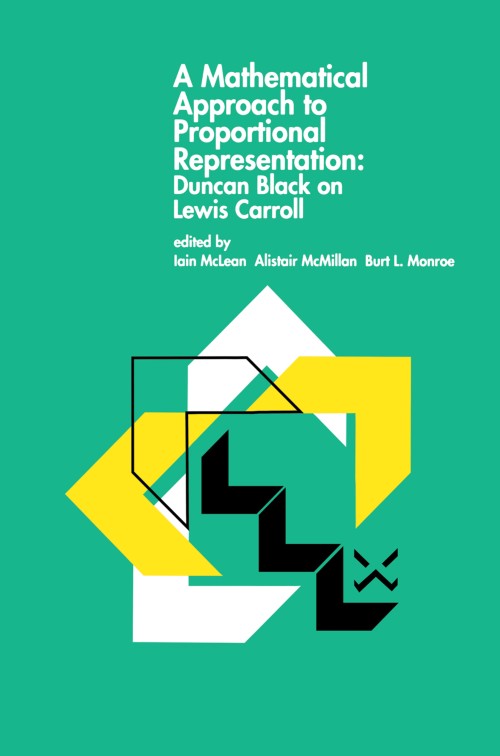
A Mathematical Approach to Proportional Representation: Duncan Black on Lewis Carroll [electronic resource] / edited by Iain S. McLean, Alistair McMillan, Burt L. Monroe.
Erişim Adresi
ISBN
9789400708242
Dil Kodu
İngilizce
Yer Numarası
DK/7906
Basım Bildirimi
1st ed. 1996.
Yayın Bilgisi
Dordrecht : Springer Netherlands : Imprint: Springer, 1996.
Fiziksel Niteleme
XXXVIII, 189 p. online resource.
İçindekiler Notu
1. The Life and Logic of Lewis Carroll -- 1.1 Government by Logic -- 2. The Principles of Parliamentary Representation -- 2.1. An Outline of Carroll’s Argument. -- 2.2. The Central Argument in The Principles of Parliamentary Representation -- 2.3. Carroll and the Cambridge Mathematical School of PR: Arthur Cohen and Edith Denman -- 3. An Analysis of Carroll’s Argument -- 3.1. Carroll’s Scheme of Proportional Representation -- 3.2. The Desiderata: In at the Deep End -- 3.3. The Droop Quota in a Two-Party System -- 3.4. The Representation of the Droop Quota -- 3.5. Walter Baily and the Number of Voters Unrepresented -- 3.6. J G Marshall and the Two-Person Zero-Sum Game -- 3.7. Demand Curves, Maximin, and the d’Hondt Scheme of PR -- 3.8. The Fourfold Table and Carroll’s Quota, Q(s) -- 3.9. Carroll’s Practical Scheme and the Single Transferable Vote -- 3.10. Allocating Members to Districts -- 4. Reprints of Original Material -- 4.1. Lewis Carroll: The Principles of Parliamentary Representation, with Supplement and Postscript to Supplement -- 4.2. James Garth Marshall: Minorities and Majorities; Their Relative Rights -- 4.3. Walter Baily: Proportional Representation in Large Constituencies.
Özet, vb.
`This is a book about a well-known writer, Lewis Carroll, and about a little-known subject, the theory of voting' (from the Editors' Introduction). This book has been edited from the manuscripts of the late Scottish economist Duncan Black. Shortly after the publication of The Theory of Committees and Elections Black started to collect material for papers and a book on Lewis Carroll's theory of proportional representation. Black's chapter plans made it clear that the book was to be in three parts, written by himself, followed by a reprint of Carroll's Principles of Parliamentary Representation and its main sources. Part I is biographical, introducing Lewis Carroll and giving relevant details of his life. Part II is Black's already published work on Lewis Carroll. Part III comprises the more detailed arguments about Carroll's reasoning, and Part IV contains reprints of rare original material on proportional representation by Carroll, James Garth Marshall, and Walter Baily. Taken together, the editors have provided a complete reference source for the theory of voting and proportional representation.
Konu
Political science.
Mathematical models.
Microeconomics.
Political Science.
Mathematical Modeling and Industrial Mathematics.
Microeconomics.
Mathematical models.
Microeconomics.
Political Science.
Mathematical Modeling and Industrial Mathematics.
Microeconomics.
Diğer Yazarlar
Kurum Adı

Eseri Alıntıla
Referansları kullanmadan önce gözden geçirmeniz ve varsa gerekli düzeltmeleri yapmanız önerilir.
Dijital Kaynak
MARC Görünümü
LEADER 05086nam a22005775i 4500
001 806612
003 TR_AnAIT
005 20260127002438
007 cr nn 008mamaa
008 121227s1996 ne | s |||| 0|eng d
020 |a9789400708242|9978-94-007-0824-2
024 7 |a10.1007/978-94-007-0824-2|2doi
041 |aeng
049 |aTürk Tarih Kurumu Kütüphanesi
050 4|aJA1-92
072 7|aJPA|2bicssc
072 7|aPOL000000|2bisacsh
072 7|aJPA|2thema
082 04|a320|223
090 |aDK/7906
245 12|aA Mathematical Approach to Proportional Representation: Duncan Black on Lewis Carroll|h[electronic resource] /|cedited by Iain S. McLean, Alistair McMillan, Burt L. Monroe.
250 |a1st ed. 1996.
264 1|aDordrecht :|bSpringer Netherlands :|bImprint: Springer,|c1996.
300 |aXXXVIII, 189 p.|bonline resource.
336 |atext|btxt|2rdacontent
337 |acomputer|bc|2rdamedia
338 |aonline resource|bcr|2rdacarrier
347 |atext file|bPDF|2rda
505 0 |a1. The Life and Logic of Lewis Carroll -- 1.1 Government by Logic -- 2. The Principles of Parliamentary Representation -- 2.1. An Outline of Carroll’s Argument. -- 2.2. The Central Argument in The Principles of Parliamentary Representation -- 2.3. Carroll and the Cambridge Mathematical School of PR: Arthur Cohen and Edith Denman -- 3. An Analysis of Carroll’s Argument -- 3.1. Carroll’s Scheme of Proportional Representation -- 3.2. The Desiderata: In at the Deep End -- 3.3. The Droop Quota in a Two-Party System -- 3.4. The Representation of the Droop Quota -- 3.5. Walter Baily and the Number of Voters Unrepresented -- 3.6. J G Marshall and the Two-Person Zero-Sum Game -- 3.7. Demand Curves, Maximin, and the d’Hondt Scheme of PR -- 3.8. The Fourfold Table and Carroll’s Quota, Q(s) -- 3.9. Carroll’s Practical Scheme and the Single Transferable Vote -- 3.10. Allocating Members to Districts -- 4. Reprints of Original Material -- 4.1. Lewis Carroll: The Principles of Parliamentary Representation, with Supplement and Postscript to Supplement -- 4.2. James Garth Marshall: Minorities and Majorities; Their Relative Rights -- 4.3. Walter Baily: Proportional Representation in Large Constituencies.
520 |a`This is a book about a well-known writer, Lewis Carroll, and about a little-known subject, the theory of voting' (from the Editors' Introduction). This book has been edited from the manuscripts of the late Scottish economist Duncan Black. Shortly after the publication of The Theory of Committees and Elections Black started to collect material for papers and a book on Lewis Carroll's theory of proportional representation. Black's chapter plans made it clear that the book was to be in three parts, written by himself, followed by a reprint of Carroll's Principles of Parliamentary Representation and its main sources. Part I is biographical, introducing Lewis Carroll and giving relevant details of his life. Part II is Black's already published work on Lewis Carroll. Part III comprises the more detailed arguments about Carroll's reasoning, and Part IV contains reprints of rare original material on proportional representation by Carroll, James Garth Marshall, and Walter Baily. Taken together, the editors have provided a complete reference source for the theory of voting and proportional representation.
532 8 |aAccessibility summary: This PDF is not accessible. It is based on scanned pages and does not support features such as screen reader compatibility or described non-text content (images, graphs etc). However, it likely supports searchable and selectable text based on OCR (Optical Character Recognition). Users with accessibility needs may not be able to use this content effectively. Please contact us at accessibilitysupport@springernature.com if you require assistance or an alternative format.
532 8 |aInaccessible, or known limited accessibility
532 8 |aNo reading system accessibility options actively disabled
532 8 |aPublisher contact for further accessibility information: accessibilitysupport@springernature.com
650 0|aPolitical science.
650 0|aMathematical models.
650 0|aMicroeconomics.
650 14|aPolitical Science.
650 24|aMathematical Modeling and Industrial Mathematics.
650 24|aMicroeconomics.
700 1 |aMcLean, Iain S.|eeditor.|4edt|4http://id.loc.gov/vocabulary/relators/edt
700 1 |aMcMillan, Alistair.|eeditor.|4edt|4http://id.loc.gov/vocabulary/relators/edt
700 1 |aMonroe, Burt L.|eeditor.|4edt|4http://id.loc.gov/vocabulary/relators/edt
710 2 |aSpringerLink (Online service)
773 0 |tSpringer Nature eBook
776 08|iPrinted edition:|z9780792396208
776 08|iPrinted edition:|z9789400708259
776 08|iPrinted edition:|z9789401037358
856 40|uhttps://doi.org/10.1007/978-94-007-0824-2
912 |aZDB-2-SHU
912 |aZDB-2-SXPI
912 |aZDB-2-BAE
950 |aHumanities, Social Sciences and Law (SpringerNature-11648)
950 |aPolitical Science and International Studies (R0) (SpringerNature-43724)
001 806612
003 TR_AnAIT
005 20260127002438
007 cr nn 008mamaa
008 121227s1996 ne | s |||| 0|eng d
020 |a9789400708242|9978-94-007-0824-2
024 7 |a10.1007/978-94-007-0824-2|2doi
041 |aeng
049 |aTürk Tarih Kurumu Kütüphanesi
050 4|aJA1-92
072 7|aJPA|2bicssc
072 7|aPOL000000|2bisacsh
072 7|aJPA|2thema
082 04|a320|223
090 |aDK/7906
245 12|aA Mathematical Approach to Proportional Representation: Duncan Black on Lewis Carroll|h[electronic resource] /|cedited by Iain S. McLean, Alistair McMillan, Burt L. Monroe.
250 |a1st ed. 1996.
264 1|aDordrecht :|bSpringer Netherlands :|bImprint: Springer,|c1996.
300 |aXXXVIII, 189 p.|bonline resource.
336 |atext|btxt|2rdacontent
337 |acomputer|bc|2rdamedia
338 |aonline resource|bcr|2rdacarrier
347 |atext file|bPDF|2rda
505 0 |a1. The Life and Logic of Lewis Carroll -- 1.1 Government by Logic -- 2. The Principles of Parliamentary Representation -- 2.1. An Outline of Carroll’s Argument. -- 2.2. The Central Argument in The Principles of Parliamentary Representation -- 2.3. Carroll and the Cambridge Mathematical School of PR: Arthur Cohen and Edith Denman -- 3. An Analysis of Carroll’s Argument -- 3.1. Carroll’s Scheme of Proportional Representation -- 3.2. The Desiderata: In at the Deep End -- 3.3. The Droop Quota in a Two-Party System -- 3.4. The Representation of the Droop Quota -- 3.5. Walter Baily and the Number of Voters Unrepresented -- 3.6. J G Marshall and the Two-Person Zero-Sum Game -- 3.7. Demand Curves, Maximin, and the d’Hondt Scheme of PR -- 3.8. The Fourfold Table and Carroll’s Quota, Q(s) -- 3.9. Carroll’s Practical Scheme and the Single Transferable Vote -- 3.10. Allocating Members to Districts -- 4. Reprints of Original Material -- 4.1. Lewis Carroll: The Principles of Parliamentary Representation, with Supplement and Postscript to Supplement -- 4.2. James Garth Marshall: Minorities and Majorities; Their Relative Rights -- 4.3. Walter Baily: Proportional Representation in Large Constituencies.
520 |a`This is a book about a well-known writer, Lewis Carroll, and about a little-known subject, the theory of voting' (from the Editors' Introduction). This book has been edited from the manuscripts of the late Scottish economist Duncan Black. Shortly after the publication of The Theory of Committees and Elections Black started to collect material for papers and a book on Lewis Carroll's theory of proportional representation. Black's chapter plans made it clear that the book was to be in three parts, written by himself, followed by a reprint of Carroll's Principles of Parliamentary Representation and its main sources. Part I is biographical, introducing Lewis Carroll and giving relevant details of his life. Part II is Black's already published work on Lewis Carroll. Part III comprises the more detailed arguments about Carroll's reasoning, and Part IV contains reprints of rare original material on proportional representation by Carroll, James Garth Marshall, and Walter Baily. Taken together, the editors have provided a complete reference source for the theory of voting and proportional representation.
532 8 |aAccessibility summary: This PDF is not accessible. It is based on scanned pages and does not support features such as screen reader compatibility or described non-text content (images, graphs etc). However, it likely supports searchable and selectable text based on OCR (Optical Character Recognition). Users with accessibility needs may not be able to use this content effectively. Please contact us at accessibilitysupport@springernature.com if you require assistance or an alternative format.
532 8 |aInaccessible, or known limited accessibility
532 8 |aNo reading system accessibility options actively disabled
532 8 |aPublisher contact for further accessibility information: accessibilitysupport@springernature.com
650 0|aPolitical science.
650 0|aMathematical models.
650 0|aMicroeconomics.
650 14|aPolitical Science.
650 24|aMathematical Modeling and Industrial Mathematics.
650 24|aMicroeconomics.
700 1 |aMcLean, Iain S.|eeditor.|4edt|4http://id.loc.gov/vocabulary/relators/edt
700 1 |aMcMillan, Alistair.|eeditor.|4edt|4http://id.loc.gov/vocabulary/relators/edt
700 1 |aMonroe, Burt L.|eeditor.|4edt|4http://id.loc.gov/vocabulary/relators/edt
710 2 |aSpringerLink (Online service)
773 0 |tSpringer Nature eBook
776 08|iPrinted edition:|z9780792396208
776 08|iPrinted edition:|z9789400708259
776 08|iPrinted edition:|z9789401037358
856 40|uhttps://doi.org/10.1007/978-94-007-0824-2
912 |aZDB-2-SHU
912 |aZDB-2-SXPI
912 |aZDB-2-BAE
950 |aHumanities, Social Sciences and Law (SpringerNature-11648)
950 |aPolitical Science and International Studies (R0) (SpringerNature-43724)
Materyaller
Depodan talep edilen materyal sadece kütüphane içerisinde kullanılmaktadır.
Materyal dışarıya ödünç verilmemektedir.
