LEADER 03918nam a22005655i 4500
001 806632
003 TR_AnAIT
005 20260127002507
007 cr nn 008mamaa
008 100301s1994 ne | s |||| 0|eng d
020 |a9780306472046|9978-0-306-47204-6
024 7 |a10.1007/0-306-47204-X|2doi
041 |aeng
049 |aTürk Tarih Kurumu Kütüphanesi
050 4|aQA10.92-20
072 7|aJNU|2bicssc
072 7|aPB|2bicssc
072 7|aEDU029010|2bisacsh
072 7|aJNU|2thema
072 7|aPB|2thema
082 04|a510.71|223
090 |aDK/7926
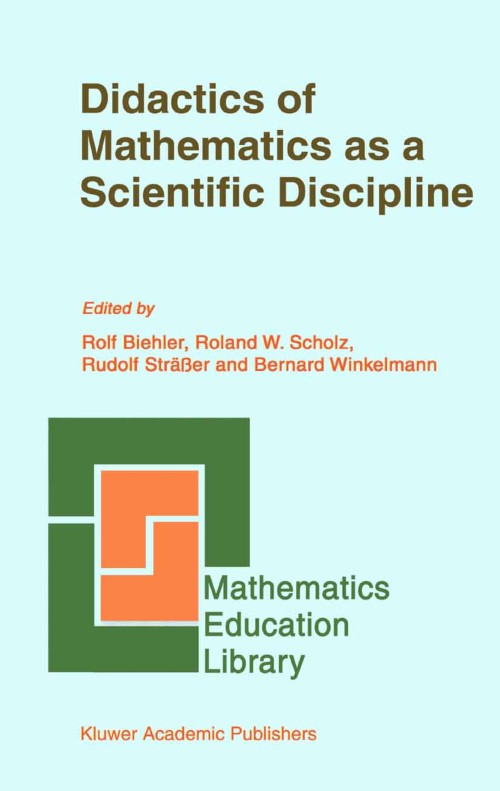
245 10|aDidactics of Mathematics as a Scientific Discipline|h[electronic resource] /|cedited by Rolf Biehler, Roland W. Scholz, Rudolf Sträßer, Bernard Winkelmann.
250 |a1st ed. 1994.
264 1|aDordrecht :|bSpringer Netherlands :|bImprint: Springer,|c1994.
300 |aIX, 467 p.|bonline resource.
336 |atext|btxt|2rdacontent
337 |acomputer|bc|2rdamedia
338 |aonline resource|bcr|2rdacarrier
347 |atext file|bPDF|2rda
490 1 |aMathematics Education Library,|x2214-983X ;|v13
505 0 |aPreface -- Preparing Mathematics for Students -- Teacher Education and Research on Teaching -- Interaction in the Classroom -- Technology and Mathematics Teaching -- Psychology of Mathematical Thinking -- Differential Didactics -- History and Epistemology of Mathematics and Mathematics Education -- Cultural Framing of Teaching and Learning Mathematics.
520 |aDidactics of Mathematics as a Scientific Discipline describes the state of the art in a new branch of science. Starting from a general perspective on the didactics of mathematics, the 30 original contributions to the book, drawn from 10 different countries, go on to identify certain subdisciplines and suggest an overall structure or `topology' of the field. The book is divided into eight sections: (1) Preparing Mathematics for Students; (2) Teacher Education and Research on Teaching; (3) Interaction in the Classroom; (4) Technology and Mathematics Education; (5) Psychology of Mathematical Thinking; (6) Differential Didactics; (7) History and Epistemology of Mathematics and Mathematics Education; (8) Cultural Framing of Teaching and Learning Mathematics. Didactics of Mathematics as a Scientific Discipline is required reading for all researchers into the didactics of mathematics, and contains surveys and a variety of stimulating reflections which make it extremely useful for mathematics educators and teacher trainers interested in the theory of their practice. Future and practising teachers of mathematics will find much to interest them in relation to their daily work, especially as it relates to the teaching of different age groups and ability ranges. The book is also recommended to researchers in neighbouring disciplines, such as mathematics itself, general education, educational psychology and cognitive science.
650 0|aMathematics|xStudy and teaching .
650 0|aMathematics.
650 14|aMathematics Education.
650 24|aMathematics.
700 1 |aBiehler, Rolf.|eeditor.|4edt|4http://id.loc.gov/vocabulary/relators/edt
700 1 |aScholz, Roland W.|eeditor.|4edt|4http://id.loc.gov/vocabulary/relators/edt
700 1 |aSträßer, Rudolf.|eeditor.|4edt|4http://id.loc.gov/vocabulary/relators/edt
700 1 |aWinkelmann, Bernard.|eeditor.|4edt|4http://id.loc.gov/vocabulary/relators/edt
710 2 |aSpringerLink (Online service)
773 0 |tSpringer Nature eBook
776 08|iPrinted edition:|z9780792326137
776 08|iPrinted edition:|z9789401737654
776 08|iPrinted edition:|z9789401737661
830 0|aMathematics Education Library,|x2214-983X ;|v13
856 40|uhttps://doi.org/10.1007/0-306-47204-X
912 |aZDB-2-SHU
912 |aZDB-2-SXED
912 |aZDB-2-BAE
950 |aHumanities, Social Sciences and Law (SpringerNature-11648)
950 |aEducation (R0) (SpringerNature-43721)