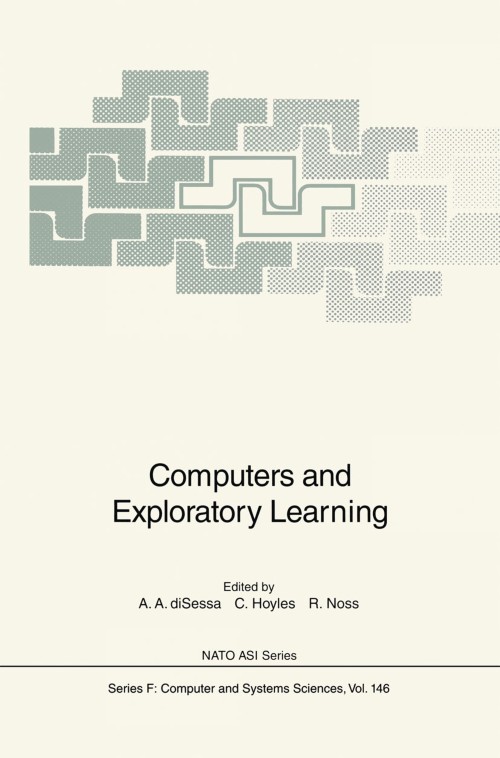
Computers and Exploratory Learning [electronic resource] / edited by Andrea A. DiSessa, Celia Hoyles, Richard Noss.
Erişim Adresi
ISBN
9783642577994
Dil Kodu
İngilizce
Yer Numarası
DK/7950
Basım Bildirimi
1st ed. 1995.
Yayın Bilgisi
Berlin, Heidelberg : Springer Berlin Heidelberg : Imprint: Springer, 1995.
Fiziksel Niteleme
VIII, 482 p. online resource.
Dizi
NATO ASI Subseries F:, Computer and Systems Sciences ; 146
İçindekiler Notu
1. Computers and Exploratory Learning: Setting the Scene -- Section I: Computers and Knowledge -- 2. Thematic Chapter: Epistemology and Systems Design -- 3. New Paradigms for Computing, New Paradigms for Thinking -- 4. From Local to Global: Programming and the Unfolding of Local Models in the Exploratory Learning of Mathematics and Science -- 5. East or West—GEOMLAND is Best, or Does the Answer Depend on the Angle? -- 6. Computational Media to Support the Learning and Use of Functions -- 7. Knowledge Representation in a Learning Environment for Euclidean Geometry -- 8. Microworlds as Representations -- 9. Visualizing Formal and Structural Relationships with Spreadsheets -- 10. Creating Software Applications for Children: Some Thoughts About Design -- Section II: Computers and Learning -- 11. Thematic Chapter: Exploratory Software, Exploratory Cultures? -- 12. The Medium and the Curriculum: Reflections on Transparent Tools and Tacit Mathematics -- 13. What About a Learning Environment Where Euclidean Concepts are Manipulated with a Mouse? -- 14. Four Steps to the Right -- 15. Learning Dynamic Geometry: Implementing Rotations -- 16. Sketching a Multidisciplinary Microworld: A Collaborative Exploration in Boxer -- 17. Design of Computer-Based Cognitive Tools -- 18. The Spreadsheet as a Tool for Mathematical Modeling: A Case Study -- 19. The Many Faces of a Computational Medium: Teaching the Mathematics of Motion -- Section III: Computers and Cultures -- 20. Thematic Chapter: Computers as Commodities -- 21. Exploring the Sketch Metaphor for Presenting Mathematics Using Boxer -- 22. Programming as a Means of Expressing and Exploring Ideas: Three Case Studies Situated in a Directive Educational System -- 23. Do Users Inhabit Or Build Their Boxer Environment? -- 24. Designing, Exploring andInteracting: Novice Activities in the Boxer Computational Medium -- 25. Learning Opportunities Provided by Domain-Oriented Design Environments.
Özet, vb.
Computers are playing a fundamental role in enhancing exploratory learning techniques in education. This volume in the NATO Special Programme on Advanced Educational Technology covers the state of the art in the design and use of computer systems for exploratory learning. Contributed chapters treat principles, theory, practice, and examples of some of the best contemporary computer-based learning environments: Logo, Boxer, Microworlds, Cabri-Géomètre, Star Logo, Table Top, Geomland, spreadsheets, Function Machines, and others. Emphasis is on mathematics and science education. Synthetic chapters provide an overview of the current scene in computers and exploratory learning, and analyses from the perspectives of epistemology, learning, and socio-cultural studies.
Konu
Educational psychology.
Artificial intelligence.
Computer science.
Educational Psychology.
Artificial Intelligence.
Theory of Computation.
Artificial intelligence.
Computer science.
Educational Psychology.
Artificial Intelligence.
Theory of Computation.
Diğer Yazarlar
Kurum Adı

Eseri Alıntıla
Referansları kullanmadan önce gözden geçirmeniz ve varsa gerekli düzeltmeleri yapmanız önerilir.
Dijital Kaynak
MARC Görünümü
LEADER 05569nam a22006015i 4500
001 806656
003 TR_AnAIT
005 20260127002536
007 cr nn 008mamaa
008 121227s1995 gw | s |||| 0|eng d
020 |a9783642577994|9978-3-642-57799-4
024 7 |a10.1007/978-3-642-57799-4|2doi
041 |aeng
049 |aTürk Tarih Kurumu Kütüphanesi
050 4|aLB1050.9-1091
072 7|aJNC|2bicssc
072 7|aEDU009000|2bisacsh
072 7|aJNC|2thema
082 04|a370.15|223
090 |aDK/7950
245 10|aComputers and Exploratory Learning|h[electronic resource] /|cedited by Andrea A. DiSessa, Celia Hoyles, Richard Noss.
250 |a1st ed. 1995.
264 1|aBerlin, Heidelberg :|bSpringer Berlin Heidelberg :|bImprint: Springer,|c1995.
300 |aVIII, 482 p.|bonline resource.
336 |atext|btxt|2rdacontent
337 |acomputer|bc|2rdamedia
338 |aonline resource|bcr|2rdacarrier
347 |atext file|bPDF|2rda
490 1 |aNATO ASI Subseries F:, Computer and Systems Sciences ;|v146
505 0 |a1. Computers and Exploratory Learning: Setting the Scene -- Section I: Computers and Knowledge -- 2. Thematic Chapter: Epistemology and Systems Design -- 3. New Paradigms for Computing, New Paradigms for Thinking -- 4. From Local to Global: Programming and the Unfolding of Local Models in the Exploratory Learning of Mathematics and Science -- 5. East or West—GEOMLAND is Best, or Does the Answer Depend on the Angle? -- 6. Computational Media to Support the Learning and Use of Functions -- 7. Knowledge Representation in a Learning Environment for Euclidean Geometry -- 8. Microworlds as Representations -- 9. Visualizing Formal and Structural Relationships with Spreadsheets -- 10. Creating Software Applications for Children: Some Thoughts About Design -- Section II: Computers and Learning -- 11. Thematic Chapter: Exploratory Software, Exploratory Cultures? -- 12. The Medium and the Curriculum: Reflections on Transparent Tools and Tacit Mathematics -- 13. What About a Learning Environment Where Euclidean Concepts are Manipulated with a Mouse? -- 14. Four Steps to the Right -- 15. Learning Dynamic Geometry: Implementing Rotations -- 16. Sketching a Multidisciplinary Microworld: A Collaborative Exploration in Boxer -- 17. Design of Computer-Based Cognitive Tools -- 18. The Spreadsheet as a Tool for Mathematical Modeling: A Case Study -- 19. The Many Faces of a Computational Medium: Teaching the Mathematics of Motion -- Section III: Computers and Cultures -- 20. Thematic Chapter: Computers as Commodities -- 21. Exploring the Sketch Metaphor for Presenting Mathematics Using Boxer -- 22. Programming as a Means of Expressing and Exploring Ideas: Three Case Studies Situated in a Directive Educational System -- 23. Do Users Inhabit Or Build Their Boxer Environment? -- 24. Designing, Exploring andInteracting: Novice Activities in the Boxer Computational Medium -- 25. Learning Opportunities Provided by Domain-Oriented Design Environments.
520 |aComputers are playing a fundamental role in enhancing exploratory learning techniques in education. This volume in the NATO Special Programme on Advanced Educational Technology covers the state of the art in the design and use of computer systems for exploratory learning. Contributed chapters treat principles, theory, practice, and examples of some of the best contemporary computer-based learning environments: Logo, Boxer, Microworlds, Cabri-Géomètre, Star Logo, Table Top, Geomland, spreadsheets, Function Machines, and others. Emphasis is on mathematics and science education. Synthetic chapters provide an overview of the current scene in computers and exploratory learning, and analyses from the perspectives of epistemology, learning, and socio-cultural studies.
532 8 |aAccessibility summary: This PDF is not accessible. It is based on scanned pages and does not support features such as screen reader compatibility or described non-text content (images, graphs etc). However, it likely supports searchable and selectable text based on OCR (Optical Character Recognition). Users with accessibility needs may not be able to use this content effectively. Please contact us at accessibilitysupport@springernature.com if you require assistance or an alternative format.
532 8 |aInaccessible, or known limited accessibility
532 8 |aNo reading system accessibility options actively disabled
532 8 |aPublisher contact for further accessibility information: accessibilitysupport@springernature.com
650 0|aEducational psychology.
650 0|aArtificial intelligence.
650 0|aComputer science.
650 14|aEducational Psychology.
650 24|aArtificial Intelligence.
650 24|aTheory of Computation.
700 1 |aDiSessa, Andrea A.|eeditor.|4edt|4http://id.loc.gov/vocabulary/relators/edt
700 1 |aHoyles, Celia.|eeditor.|4edt|4http://id.loc.gov/vocabulary/relators/edt
700 1 |aNoss, Richard.|eeditor.|4edt|4http://id.loc.gov/vocabulary/relators/edt
710 2 |aSpringerLink (Online service)
773 0 |tSpringer Nature eBook
776 08|iPrinted edition:|z9783540592020
776 08|iPrinted edition:|z9783642578007
776 08|iPrinted edition:|z9783642633591
830 0|aNATO ASI Subseries F:, Computer and Systems Sciences ;|v146
856 40|uhttps://doi.org/10.1007/978-3-642-57799-4
912 |aZDB-2-SHU
912 |aZDB-2-SXED
912 |aZDB-2-BAE
950 |aHumanities, Social Sciences and Law (SpringerNature-11648)
950 |aEducation (R0) (SpringerNature-43721)
001 806656
003 TR_AnAIT
005 20260127002536
007 cr nn 008mamaa
008 121227s1995 gw | s |||| 0|eng d
020 |a9783642577994|9978-3-642-57799-4
024 7 |a10.1007/978-3-642-57799-4|2doi
041 |aeng
049 |aTürk Tarih Kurumu Kütüphanesi
050 4|aLB1050.9-1091
072 7|aJNC|2bicssc
072 7|aEDU009000|2bisacsh
072 7|aJNC|2thema
082 04|a370.15|223
090 |aDK/7950
245 10|aComputers and Exploratory Learning|h[electronic resource] /|cedited by Andrea A. DiSessa, Celia Hoyles, Richard Noss.
250 |a1st ed. 1995.
264 1|aBerlin, Heidelberg :|bSpringer Berlin Heidelberg :|bImprint: Springer,|c1995.
300 |aVIII, 482 p.|bonline resource.
336 |atext|btxt|2rdacontent
337 |acomputer|bc|2rdamedia
338 |aonline resource|bcr|2rdacarrier
347 |atext file|bPDF|2rda
490 1 |aNATO ASI Subseries F:, Computer and Systems Sciences ;|v146
505 0 |a1. Computers and Exploratory Learning: Setting the Scene -- Section I: Computers and Knowledge -- 2. Thematic Chapter: Epistemology and Systems Design -- 3. New Paradigms for Computing, New Paradigms for Thinking -- 4. From Local to Global: Programming and the Unfolding of Local Models in the Exploratory Learning of Mathematics and Science -- 5. East or West—GEOMLAND is Best, or Does the Answer Depend on the Angle? -- 6. Computational Media to Support the Learning and Use of Functions -- 7. Knowledge Representation in a Learning Environment for Euclidean Geometry -- 8. Microworlds as Representations -- 9. Visualizing Formal and Structural Relationships with Spreadsheets -- 10. Creating Software Applications for Children: Some Thoughts About Design -- Section II: Computers and Learning -- 11. Thematic Chapter: Exploratory Software, Exploratory Cultures? -- 12. The Medium and the Curriculum: Reflections on Transparent Tools and Tacit Mathematics -- 13. What About a Learning Environment Where Euclidean Concepts are Manipulated with a Mouse? -- 14. Four Steps to the Right -- 15. Learning Dynamic Geometry: Implementing Rotations -- 16. Sketching a Multidisciplinary Microworld: A Collaborative Exploration in Boxer -- 17. Design of Computer-Based Cognitive Tools -- 18. The Spreadsheet as a Tool for Mathematical Modeling: A Case Study -- 19. The Many Faces of a Computational Medium: Teaching the Mathematics of Motion -- Section III: Computers and Cultures -- 20. Thematic Chapter: Computers as Commodities -- 21. Exploring the Sketch Metaphor for Presenting Mathematics Using Boxer -- 22. Programming as a Means of Expressing and Exploring Ideas: Three Case Studies Situated in a Directive Educational System -- 23. Do Users Inhabit Or Build Their Boxer Environment? -- 24. Designing, Exploring andInteracting: Novice Activities in the Boxer Computational Medium -- 25. Learning Opportunities Provided by Domain-Oriented Design Environments.
520 |aComputers are playing a fundamental role in enhancing exploratory learning techniques in education. This volume in the NATO Special Programme on Advanced Educational Technology covers the state of the art in the design and use of computer systems for exploratory learning. Contributed chapters treat principles, theory, practice, and examples of some of the best contemporary computer-based learning environments: Logo, Boxer, Microworlds, Cabri-Géomètre, Star Logo, Table Top, Geomland, spreadsheets, Function Machines, and others. Emphasis is on mathematics and science education. Synthetic chapters provide an overview of the current scene in computers and exploratory learning, and analyses from the perspectives of epistemology, learning, and socio-cultural studies.
532 8 |aAccessibility summary: This PDF is not accessible. It is based on scanned pages and does not support features such as screen reader compatibility or described non-text content (images, graphs etc). However, it likely supports searchable and selectable text based on OCR (Optical Character Recognition). Users with accessibility needs may not be able to use this content effectively. Please contact us at accessibilitysupport@springernature.com if you require assistance or an alternative format.
532 8 |aInaccessible, or known limited accessibility
532 8 |aNo reading system accessibility options actively disabled
532 8 |aPublisher contact for further accessibility information: accessibilitysupport@springernature.com
650 0|aEducational psychology.
650 0|aArtificial intelligence.
650 0|aComputer science.
650 14|aEducational Psychology.
650 24|aArtificial Intelligence.
650 24|aTheory of Computation.
700 1 |aDiSessa, Andrea A.|eeditor.|4edt|4http://id.loc.gov/vocabulary/relators/edt
700 1 |aHoyles, Celia.|eeditor.|4edt|4http://id.loc.gov/vocabulary/relators/edt
700 1 |aNoss, Richard.|eeditor.|4edt|4http://id.loc.gov/vocabulary/relators/edt
710 2 |aSpringerLink (Online service)
773 0 |tSpringer Nature eBook
776 08|iPrinted edition:|z9783540592020
776 08|iPrinted edition:|z9783642578007
776 08|iPrinted edition:|z9783642633591
830 0|aNATO ASI Subseries F:, Computer and Systems Sciences ;|v146
856 40|uhttps://doi.org/10.1007/978-3-642-57799-4
912 |aZDB-2-SHU
912 |aZDB-2-SXED
912 |aZDB-2-BAE
950 |aHumanities, Social Sciences and Law (SpringerNature-11648)
950 |aEducation (R0) (SpringerNature-43721)
Materyaller
Depodan talep edilen materyal sadece kütüphane içerisinde kullanılmaktadır.
Materyal dışarıya ödünç verilmemektedir.
